
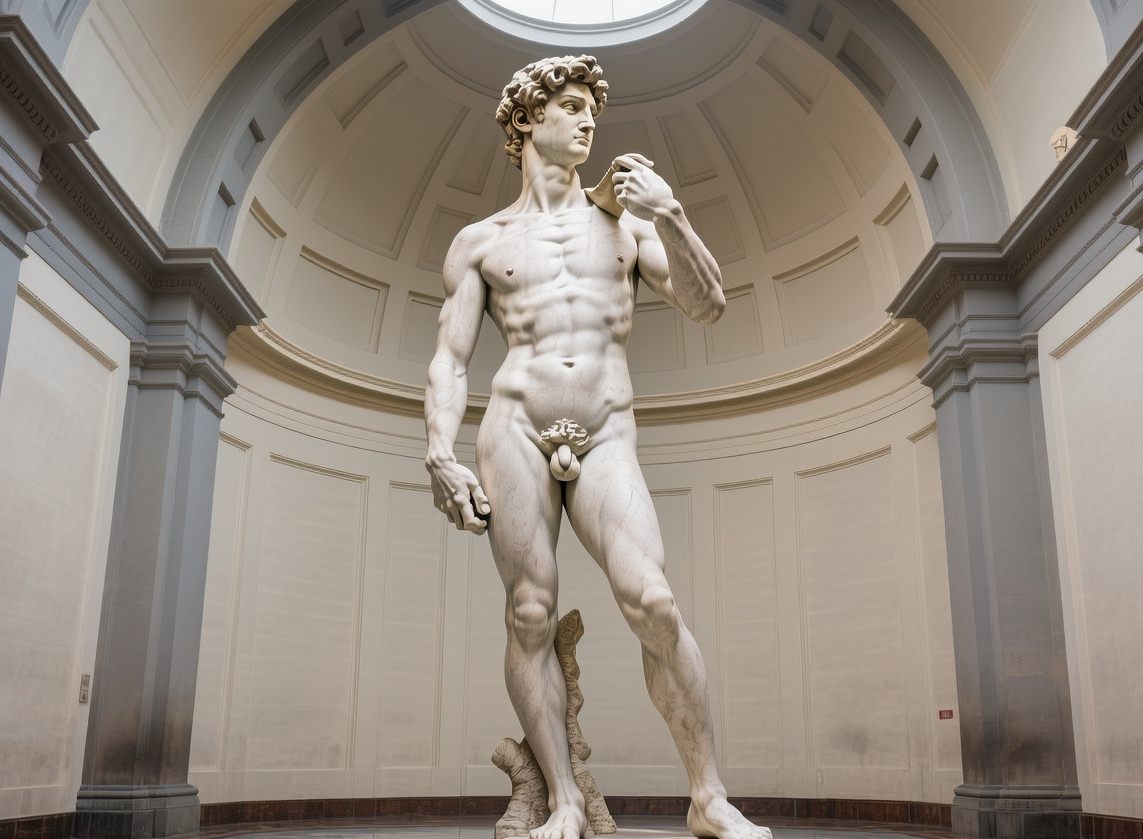
David Statue Marble Meets Human Resolve
Morning light filters through the high clerestory windows of Florence’s Accademia Gallery—casting a soft, golden halo around the most famous sculpture in the world. You stand before Michelangelo’s David, and time seems to still. Carved from a single block of Carrara marble deemed “unworkable” by other sculptors, this 5.17-meter (17-foot) colossus captures the moment before battle—not in victory, but in quiet, coiled tension. His veins bulge, his brow furrows, his sling rests almost casually over his shoulder; every muscle is taut with anticipation. Created between 1501 and 1504 when Michelangelo was just 26, the statue was originally intended for the roofline of Florence Cathedral but was instead placed in front of the Palazzo Vecchio as a symbol of the Republic’s defiance against tyranny. Today, housed in climate-controlled silence since 1873, David remains more than art—he is an enduring emblem of human potential. In 2026, as we navigate our own uncertain battles, his gaze offers not just beauty, but a mirror to our own resilience.
Why David Embodies the Spirit of Florentine Humanism
Michelangelo’s David is not merely a masterpiece of Renaissance sculpture—it is a political manifesto carved in stone. Commissioned by the Opera del Duomo in 1501, the statue was meant to adorn the buttresses of Florence Cathedral. But upon its completion in 1504, a committee including Leonardo da Vinci and Botticelli unanimously agreed it was too powerful for such a remote perch. Instead, it was installed in the Piazza della Signoria—the heart of Florentine civic life—as a symbol of the Republic’s strength against larger, more powerful rivals like the Medici (then in exile) and the Papal States. Standing 5.17 meters tall and weighing over 6 tons, David was revolutionary in its psychological depth: unlike earlier depictions showing Goliath’s severed head at David’s feet, Michelangelo chose the tense moment *before* the fight, emphasizing intellect and moral courage over brute force. The statue’s contrapposto stance, anatomical precision, and idealized yet intensely human expression epitomize Renaissance humanism—the belief that man, through reason and virtue, could shape his destiny. Today, the original resides in the Accademia Gallery, protected from pollution and vibration, while a replica stands in the Piazza della Signoria, continuing its centuries-old role as Florence’s silent guardian.
The Best Time to Experience David Statue
To encounter Michelangelo’s David with space for contemplation and optimal lighting, plan your visit for the precise window of September 18–October 2, 2026. During these weeks, Florence enjoys mild temperatures of 17–23°C (63–73°F)—ideal for walking and for the gallery’s controlled interior climate [[22], [25]]. The absolute best time to enter the Accademia is during the first admission slot at 8:15 AM, which grants near-private access to the Tribune where David stands illuminated under a skylight designed specifically for him. Tuesdays and Wednesdays are consistently less crowded than weekends. Avoid visiting during peak periods: all of May, July, and August, when queues can exceed 90 minutes even with reservations, and major holidays like Easter week or Christmas markets [[27]]. For the most dramatic visual experience, position yourself slightly to the left of the statue—this angle aligns with Michelangelo’s intentional perspective correction, making the proportions appear perfectly balanced. Always verify current opening days via the official website (galleriaaccademiafirenze.it), as restoration work occasionally adjusts viewing access.
Approximate Budget for a 7-Day Trip (2026)
This budget reflects mid-range 2025 pricing adjusted for Italy’s projected 2026 inflation rate of 1.5% [[37]], offering a realistic estimate for a solo traveler based within walking distance of the Accademia Gallery.
- Accommodation: €870–€1,155 total (€145–€190 per night) for a 3-star hotel or private apartment in the San Marco or Santa Croce neighborhoods—quiet, central, and rich in local character.
- Food: €455 total (€65 per day). Breakfast at a neighborhood bar (€3 for cappuccino and cornetto); lunch near Mercato Centrale (€15 for schiacciata with prosciutto); dinner at a family-run trattoria (€42 for pappa al pomodoro, bistecca alla fiorentina, and house Chianti).
- Transportation: €25 total. Florence is eminently walkable; this covers a few ATAF bus rides (€1.70 per ticket) or a taxi from Santa Maria Novella station.
- Attractions: €105 total. Accademia Gallery (€22); Uffizi Gallery (€28); Bargello Museum (€15); Boboli Gardens (€12); and a guided Renaissance sculpture walking tour (€28).
- Miscellaneous: €110 total. A museum-quality print from the Accademia’s official bookstore (€30); gelato from Gelateria dei Neri (€4); a hand-tooled leather wallet from Scuola del Cuoio (€40); and a Chianti wine tasting in Oltrarno (€35).
Total Estimated Budget: €1,565–€1,950
5 Essential David Statue Experiences
- Enter at 8:15 AM for Solitary Contemplation: Book the earliest timed entry to experience David alone in the Tribune. The soft morning light from the overhead skylight enhances the marble’s luminosity, making his veins and muscles seem almost alive.
- Study the Unfinished “Prisoners”: In the hallway leading to David, four of Michelangelo’s “Slaves” or “Prisoners” emerge from raw marble blocks. These unfinished works reveal his belief that sculpture was the act of “freeing the figure imprisoned in the stone.”
- Compare with the Piazza della Signoria Replica: After your visit, walk to the Palazzo Vecchio to see the 1910 bronze replica in its original civic context. Notice how the outdoor setting changes your perception of scale and symbolism.
- Visit the Museo dell’Opera del Duomo: See the original plaster cast used to create the Piazza della Signoria replica, along with Michelangelo’s haunting final Pietà—a deeply personal work he attempted to destroy.
- Attend a Sculpture Demonstration in Oltrarno: Book a short workshop with a local marble carver in the artisan district south of the Arno to understand the physicality and patience required to shape stone—a humbling complement to viewing David.
3 Hidden Gems Most Travelers Miss
- Casa Buonarroti Courtyard: Just a five-minute walk from the Accademia at Via Ghibellina, 70, this museum in Michelangelo’s family home features two early sculptures by the master and a serene internal courtyard rarely visited by tourists.
- Giardino delle Rose (Rose Garden): Located below Piazzale Michelangelo, this fragrant garden offers a panoramic view of Florence with the Accademia’s roofline visible in the distance—a perfect reflective spot after your visit.
- Officina Profumo-Farmaceutica di Santa Maria Novella: A ten-minute stroll north at Via della Scala, 16, this 1221-founded apothecary immerses you in Florence’s medieval mercantile world—offering a sensory counterpoint to the visual intensity of Renaissance art.
Cultural & Practical Tips
- Book timed tickets online—at least 3 weeks ahead: Walk-up entry is virtually impossible in 2026. Reserve via the official site (galleriaaccademiafirenze.it) and select the 8:15 AM slot for the best experience.
- Dress respectfully: Shoulders and knees must be covered. This is a cultural institution housing one of Western civilization’s most revered artworks.
- Photography is allowed without flash: But avoid tripods or selfie sticks. Never block the central aisle—step to the side if stopping to admire.
- Learn key phrases: “Dov’è la statua del David?” (doh-VEH lah STAH-too-ah del Dah-VEED?) for “Where is the David statue?”; “Grazie mille” (GRAHT-see-eh MEE-leh) for sincere thanks.
- Allow 1.5–2 hours minimum: Rushing defeats the purpose. Focus on David and the “Prisoners”—they alone offer a profound meditation on creation and struggle. The gallery is closed on Mondays.
Conclusion: Travel with Reverence, Not Just Recognition
Seeing Michelangelo’s David in 2026 is not about ticking off a bucket list—it’s about standing before a vision of human possibility that has inspired poets, rebels, and dreamers for over 500 years. Your €22 ticket directly funds the climate-controlled environment that preserves this irreplaceable marble from humidity, pollution, and vibration. To travel mindfully means choosing presence over performance: silencing your phone, resisting the urge to pose for a selfie, and instead absorbing the quiet intensity in David’s eyes. Support the official museum bookstore’s scholarly reproductions rather than cheap plastic trinkets; dine at a family trattoria in San Lorenzo rather than a tourist trap. In doing so, you honor not just Michelangelo’s genius, but the living city that continues to protect his legacy. Let your visit be an act of witness—not consumption—and David will reveal far more than marble.