
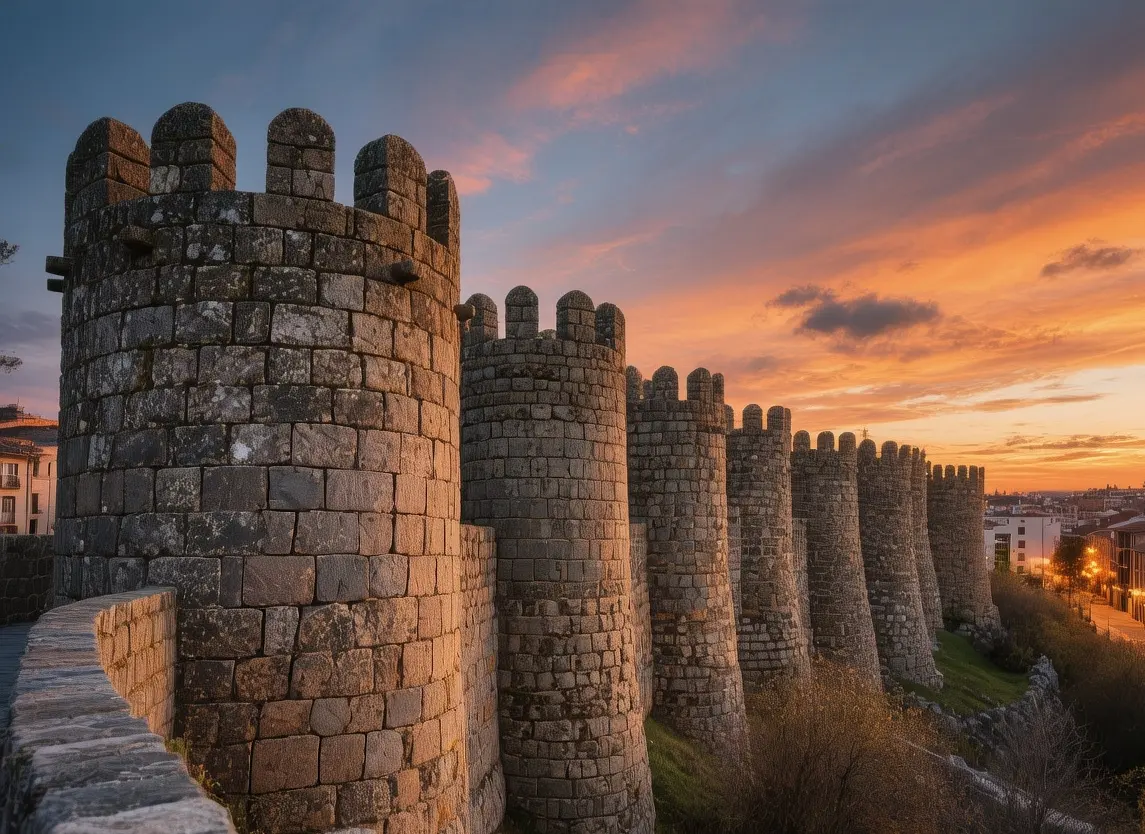
Lugo Roman Walls Ancient Stone Meets Galician Heritage
The evening mist clings to the granite battlements as dusk settles over the old town—your footsteps echo on the stone walkway 10 meters above the street, tracing a path worn smooth by nearly 1,800 years of passage. Encircling the entire historic center, the Lugo Roman walls stand as the only fully intact Roman fortification in the world, a UNESCO World Heritage Site since 2000 that defies the erosion of time. You lean against the cold slate and granite masonry, built between 263 and 276 AD to defend the Roman settlement of Lucus Augusti, while the distant sound of church bells drifts up from the cathedral below. The air smells of damp stone and eucalyptus from the nearby hills; the light is soft and diffuse, filtering through the characteristic Galician brétema that sustains the region's intense verdancy. In 2026, as historic sites face the dual threats of commercialization and climate degradation, this place matters now more than ever: it preserves a rare moment where military engineering meets civic life, demanding that you witness a monument that is not merely a relic but a living promenade used daily by the community it once protected.
Why Lugo Roman Walls Embodies Military Engineering
The Lugo Roman walls represent far more than a defensive barrier—they stand as a critical pivot point in the history of Roman military architecture and the urban identity of Galicia. When the Roman Empire faced increasing instability in the 3rd century AD, the province of Gallaecia required a fortified capital to protect against Suebi and Germanic incursions. The solution was audacious: constructing a continuous wall measuring 2,266 meters in length that completely encircled the city, utilizing local slate and granite to create a structure up to 12 meters high and 4.2 meters thick. This infrastructure solved the immediate need for security while creating an urban boundary that defines the city to this day. The wall originally featured 85 towers; today, 71 remain standing, including cylindrical and square structures that showcase the evolution of defensive design during the late Empire.
The engineering specifics reveal the complexity of the construction: the walls are founded on bedrock in some sections and filled with earth and rubble in others, utilizing a double-skin technique with a core of opus caementicium (Roman concrete). The five original gates have been expanded to ten over the centuries, with the Porta Miñá and Porta Falsa retaining their original Roman arches. The walkway along the top, accessible via ramps and stairs, allows visitors to traverse the entire perimeter, a feature unique among Roman fortifications. Today, the site fulfills a dual need: functioning as a protected cultural asset managed by the Lugo City Council while serving as a public park for the 30,000 residents of the old town. With continuous conservation efforts funded by the Spanish Ministry of Culture and the Xunta de Galicia, the Lugo Roman walls remain structurally sound, preserving a dialogue between ancient military strategy and modern urban life that defines the identity of northern Spain.
The Best Time to Experience Lugo Roman Walls
While the walkway of the Lugo Roman walls remains accessible year-round, your experience depends heavily on the oceanic climate of Galicia and the local festival calendar. For optimal visiting conditions, target May 15–June 20 or September 10–October 15, when daytime temperatures average 16–24°C (61–75°F) and rainfall is moderate. During these windows, you'll explore the battlements comfortably without the heavy rains of winter or the humidity of summer. The light during these months also enhances the grey granite, creating ideal photography conditions for the stone towers against the sky.
For the most atmospheric experience, arrive between 8:00–9:30 AM when the morning mist lifts off the stones and the city is quiet, or during golden hour (8:30–10:00 PM in summer, 6:30–8:00 PM in winter) when the sun sets behind the cathedral. Early morning visits offer the clearest air for viewing the architectural details without crowd reflections. Winter months (December–February) bring colder temperatures of 6–12°C (43–54°F) and frequent rain, which dramatically reduces crowds but requires warm clothing for outdoor viewing. The walls look dramatic under grey skies, though the stone can be slippery.
Avoid July 25–August 25 and the Arde Lucus festival (third week of June) when daily visitor numbers spike and accommodation prices double. Midday visits during peak season create bottlenecks at the access ramps. For real-time weather and event schedules,.
Approximate Budget for a 7-Day Trip (2026)
Lugo offers exceptional value compared to major Spanish cities, though prices have risen 22% since 2020 due to tourism growth and inflation. This budget assumes moderate comfort—clean, well-located accommodation; authentic meals at traditional Galician restaurants; and selective paid attractions. Prices reflect 2026 rates with approximately 4% annual inflation factored into estimates. This budget covers a relaxed 7-day stay based in Lugo with day trips to the nearby coast.
Accommodation: €65–€120 per night for a double room in a historic hotel in the Old Town; budget hostels from €40/night
Food: €35–€60 per day
-
• Breakfast: €4–€7 (café con leche €2.50, toast with tomato €3.50)
• Lunch: €15–€25 (menú del día includes soup, main course like pulpo a feira, dessert, wine/water)
• Dinner: €20–€35 (grilled beef €18, local lacón €20, glass of Ribeira Sacra wine €4)
Transportation:
-
• Train from Madrid to Lugo: €45–€65 one-way (Renfe, 5 hours 30 minutes)
• Local buses within Lugo: €1.20 per ride
• Taxi from station to Old Town: €8–€12
• Day trip to Praia de las Catedrales: €15 bus round-trip
Attractions:
-
• Lugo Roman Walls access: Free
• Lugo Cathedral: €5
• Roman Mosaic Museum: €3
• Provincial Museum: €4
• Guided historic tour: €15
Miscellaneous:
-
• Local wine bottle (Ribeira Sacra): €12–€20
• Handcrafted ceramics: €25–€60
• Travel insurance: €50 for week
• Souvenir tinned fish: €10–€20
Total for 7 days (per person, double occupancy): €950–€1,450
7 Essential Lugo Roman Walls Experiences
- Walk the Battlements: Traverse the full 2,266 meters between 8:00–9:00 AM to avoid crowds. The stone path is uneven in sections. The view of the city rooftops is stunning. The wind is often strong here—secure loose items. This is the core experience of the site and should not be rushed. Allow 90 minutes to complete the circuit.
- Visit the Porta Miñá: Located on the north side, this gate retains its original Roman arch. Access: Street level, open 24 hours, free entry. Insider tip: Look for the inscription stones embedded in the wall. It provides context for the Roman history you're experiencing. The preservation is remarkable for its age.
- Explore the Cathedral: Located in the center of the walled city, this Romanesque-Gothic building houses the Blessed Sacrament. Access: Plaza de Pío XII, open 10 AM–8 PM, €5 entry. Insider tip: Visit the cloister for quiet reflection. It provides context for the religious history you're experiencing. The acoustics during quiet moments are remarkable.
- View the Towers from Below: Walk the perimeter at street level to see the scale of the fortification. The 1-kilometer walk is flat and shaded, making it suitable for families. You will see 71 towers up close. Allow 1 hour for the walk. Bring water as there are limited services along the trail. The connection between height and defense is striking here.
- Dine on Galician Specialties: Reserve a table at a restaurant near the Plaza Mayor. Order the local specialty lacón con grelos (pork shoulder with greens) while watching the light change on the stone facades. Evening dining (9:30 PM) allows you to see the walls illuminated against the night sky. The hearty stew is perfect for the cool climate.
- Visit the Roman Mosaic Museum: Located near the walls, this museum showcases artifacts found during excavations. The 500-meter walk from the Cathedral is flat, making it suitable for all visitors. You will see 4th-century floor mosaics. Allow 1 hour for the visit. Bring water as there are limited services along the trail. The history dates back to the late Empire.
- Attend the Arde Lucus Festival (If Visiting in June): If visiting during the third week of June, witness the traditional festivities honoring the Roman past. The city fills with actors, soldiers, and markets. Book accommodation 6 months in advance as hotels fill completely. The night parade is spectacular. This event showcases the community spirit that keeps the tradition alive.
3 Hidden Gems Most Travelers Miss
- Porta Falsa: While most visitors focus on the main gates, this smaller entrance retains significant original Roman masonry. Access: Rúa da Porta Falsa, open 24 hours, free entry. Insider tip: Visit early morning when the light hits the stone arch. The isolation is unmatched. It provides context for the defensive layout you're experiencing. It is often overlooked by those rushing to the Cathedral.
- Church of Santiago: Located near the walls, this 12th-century church is often overshadowed by the Cathedral. Access: Plaza de Santiago, open 10 AM–7 PM, free entry. Insider tip: The Romanesque facade is intricately carved. It provides context for the medieval history you're experiencing. The interior is peaceful. It is often overlooked by those focused solely on the walls.
- Paseo das Murallas: A specific promenade located at the base of the walls, accessible via a path often overlooked by tour groups. This green space offers a secluded spot for reflection away from tourist crowds. Access: Follow the signs from the Old Town, look for the marked trail. Insider tip: Bring binoculars. Storks frequently nest on the towers here. Best visited late afternoon when the light hits the stone. The views of the fortification from below are breathtaking.
Cultural & Practical Tips
- Photography etiquette: Tripods require permission from city security—fines up to €500 for violations. Street photography of locals requires verbal consent; a simple "¿Puedo?" (PWEH-doh) shows respect. Flash photography is prohibited inside the Cathedral to protect the artwork.
- Dress code for churches: Shoulders and knees must be covered to enter the Lugo Cathedral. Carry a lightweight scarf even in summer. Remove hats when entering religious spaces.
- Respect the monument: Do not climb on the outer walls. Keep noise levels moderate near residential areas. Quiet hours are enforced after 11 PM. Do not remove stones or graffiti.
- Essential phrases: "Bos días" (bos DEE-as) = "Good morning" in Galician; "¿Onde está o baño?" (ON-deh es-TA o BA-nyo) = "Where is the bathroom?"; "A conta, por favor" (a KON-ta por fa-BOR) = "The bill, please."
- Weather preparedness: The region experiences frequent rain year-round. Nights can be 10°C cooler than days. Bring layers and a waterproof jacket. Winter visits require sturdy shoes for potentially slick stone paths on the battlements.
- Tipping customs: Round up restaurant bills or leave 5–10% for exceptional service. Not tipping is acceptable but leaving small change shows appreciation. Taxi drivers appreciate small change rounded up to the nearest euro.
- Accessibility information: The street level path is wheelchair accessible. The battlements have stairs and are not accessible. Contact the tourism office for adapted route maps along the base of the walls.
Conclusion: Travel with Reverence, Not Just Checklist Tourism
The Lugo Roman walls have witnessed nearly 1,800 years of human history—Roman soldiers patrolling the walkway, medieval pilgrims passing through the gates, modern citizens reclaiming the stones. When you walk these battlements in 2026, you're not just capturing images for your gallery; you're stepping into a living narrative of resilience and continuity. The granite blocks holding this structure never imagined they would support tourists from every corner of the globe; the engineers who laid the foundations never conceived their work would become a UNESCO treasure.
But here's what separates meaningful travel from tourism: these walls don't need your footprint—they need your reverence, your willingness to understand the complexity of heritage preservation, to recognize that each visitor adds wear to structures that cannot be easily replaced. In an age of overtourism, Lugo offers a masterclass in balance—showing us that some wonders demand we subordinate our desire for access to the greater need for protection. Walk the circuit, yes, but emerge with something deeper than souvenirs: carry forward a commitment to protect not just these walls, but all the fragile, irreplaceable treasures that connect us to our shared human history.