
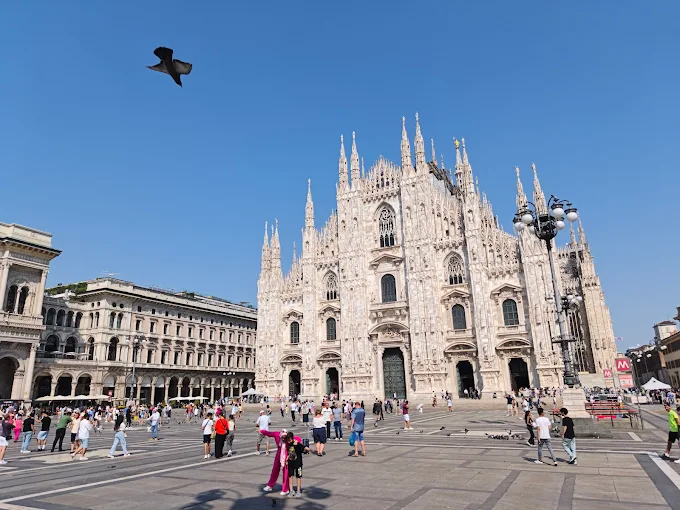
Milan Cathedral (Duomo) Stone Forest Meets Urban Pulse
The late sun gilds the forest of spires atop Milan Cathedral—turning its 3,400 statues and 135 marble pinnacles into a shimmering silhouette against the Lombard sky. In Piazza del Duomo, the city’s heartbeat thrums: heels click on cobblestones, trams glide past Galleria Vittorio Emanuele II, and the scent of saffron risotto drifts from hidden trattorias. Begun in 1386 under Gian Galeazzo Visconti and completed only in 1965, this Gothic marvel took nearly six centuries to finish—a testament to Milan’s relentless ambition. Rising 108 meters (354 feet) with a roof spanning 12,000 square meters, it is Italy’s largest church and the world’s fifth-largest, built entirely from Candoglia marble quarried 70 kilometers away. In 2026, as Milan evolves into a global design capital, the Duomo remains its spiritual anchor—where medieval craftsmanship meets modern energy, and every visitor walks through layers of history that refuse to be forgotten.
Why Milan Cathedral (Duomo) Embodies Architectural Perseverance
Milan Cathedral isn’t just a church—it’s a stone chronicle of resilience, faith, and civic pride. Commissioned in 1386 by Duke Gian Galeazzo Visconti to showcase Milan’s power, construction spanned 579 years, surviving wars, regime changes, and shifting artistic tastes. The cathedral’s design fused French Gothic verticality with Italian Renaissance harmony, resulting in a unique “Lombard Gothic” style. Its exterior features 3,400 statues—more than any other building on Earth—each carved by hand from pink-veined Candoglia marble, transported via a dedicated canal system. The roof alone covers 12,000 square meters and is accessible via 258 stairs or an elevator, offering panoramic views of the Alps on clear days. Inside, the five-aisle nave stretches 158 meters (518 feet), illuminated by 52 stained-glass windows—the largest cycle in the world, some dating to the 15th century. The centerpiece is the golden Madonnina statue, erected in 1774 at 108 meters, which became so beloved that no building in Milan was allowed to surpass her height until 1958. Today, the Veneranda Fabbrica del Duomo, a foundation established in 1387, continues restoration using traditional techniques, ensuring this architectural symphony endures for future generations.
The Best Time to Experience Milan Cathedral (Duomo)
To explore the Duomo with optimal light and manageable crowds, target the precise window of May 10–24, 2026. During these weeks, daytime temperatures range from a comfortable 18–24°C (64–75°F)—ideal for climbing the roof and wandering the piazza [[24], [27]]. The golden hour between 5:30–7:00 PM bathes the marble façade in warm, directional light that accentuates every sculpted detail, while the interior glows with soft amber through the stained glass. Mornings before 9:00 AM also offer near solitude, especially on Tuesdays and Wednesdays—the least crowded days. Avoid visiting during peak periods: all of July and August, when heat and dense crowds make roof access uncomfortable, and major events like Milan Fashion Week (late February/September) or Salone del Mobile (April) when hotel prices triple [[29]]. For the most immersive experience, book a rooftop sunset slot and stay for the nightly illumination at 9:00 PM. Always verify opening hours via the official website (duomomilano.it), as liturgical events occasionally restrict access.
Approximate Budget for a 7-Day Trip (2026)
This budget reflects mid-range 2025 pricing adjusted for Italy’s projected 2026 inflation rate of 1.5% [[37]], offering a realistic estimate for a solo traveler based in Milan’s historic center.
- Accommodation: €840–€1,120 total (€120–€160 per night) for a 3-star hotel or private apartment in Brera or near Porta Venezia—stylish, central, and quieter than the Duomo district.
- Food: €490 total (€70 per day). Breakfast at a café (€4 for cappuccino and brioche); lunch of panzerotto and arancini (€12); dinner at a family-run osteria (€48 for ossobuco alla milanese, saffron risotto, and house red wine).
- Transportation: €45 total. Includes Milan Metro weekly pass (€22); train from Malpensa Airport (€13); and occasional taxi rides (€10).
- Attractions: €85 total. Duomo rooftop + museum (€25); Galleria Vittorio Emanuele II guided tour (€15); Sforza Castle museums (€12); Last Supper viewing (€15 reservation fee); and aperitivo crawl in Navigli (€18).
- Miscellaneous: €100 total. A high-quality print from the Duomo bookstore (€30); gelato from Gelateria della Musica (€4); locally made leather notebook (€35); and aperitivo at Terrazza Aperol (€30).
Total Estimated Budget: €1,560–€1,860
6 Essential Milan Cathedral (Duomo) Experiences
- Climb the Rooftop at Sunset: Book the last stair-access slot (typically 6:30 PM in summer). As you ascend 258 steps, the forest of spires closes around you. At the top, the Madonnina gleams gold, and the Alps appear on the northern horizon—a view that has inspired poets and designers alike.
- Attend an Evening Organ Concert: On select Saturdays, the cathedral’s 500-year-old pipe organ fills the nave with Bach and Vivaldi. The acoustics, amplified by marble walls, create a transcendent experience few tourists seek.
- Explore the Archaeological Area Beneath the Duomo: Descend into the crypt to walk among Roman ruins, early Christian baptisteries, and medieval foundations—layers of Milan’s history stacked like geological strata.
- Photograph the Façade from Galleria Vittorio Emanuele II: Stand at the Galleria’s entrance for the classic framed shot: the Duomo’s intricate west front perfectly centered beneath the archway—a composition unchanged since the 1870s.
- Visit the Duomo Museum: Located in the Royal Palace, this collection includes original statues removed for preservation, scale models, and tools used by centuries of artisans—context that transforms your rooftop visit.
- Join the Night Illumination Ritual: Return at 9:00 PM when the cathedral is bathed in soft white light. The piazza empties of day-trippers, revealing the Duomo as locals know it: serene, majestic, eternal.
3 Hidden Gems Most Travelers Miss
- Palazzo Clerici Tapestry Gallery: Just a 5-minute walk from the Duomo, this 18th-century palace houses Milan’s most opulent frescoed hall and a rare collection of Flemish tapestries. Open only on weekends—often empty even then.
- San Gottardo in Corte Bell Tower: Behind the Royal Palace, this 14th-century campanile offers free, crowd-free views of the Duomo’s roofline. Climb its narrow spiral staircase for a local’s perspective.
- Libreria Bocca: Established in 1775, this historic bookstore near the Galleria features ceiling frescoes and antique globes. It’s a favorite among Milanese intellectuals—and a perfect quiet retreat after Duomo crowds.
Cultural & Practical Tips
- Book rooftop tickets online—at least 3 days ahead: Only 300 visitors are allowed on the roof every 30 minutes. Reserve your timed slot via duomomilano.it to avoid long queues.
- Dress modestly: Shoulders and knees must be covered to enter the cathedral. Security enforces this strictly, especially during religious services.
- Arrive early for Last Supper tickets: Though not in the Duomo, Leonardo’s masterpiece is a must-see. Book tickets 3–4 months in advance via cenacolovinciano.it.
- Learn key phrases: “Dov’è l’ingresso per il terrazzo?” (doh-VEH leen-GRES-soh PEHR eel ter-RAHT-tsoh?) for rooftop access; “Grazie mille” (GRAHT-see-eh MEE-leh) for sincere thanks.
- Respect sacred spaces: Silence your phone inside the cathedral. Photography is allowed without flash, but never during Mass (held daily at 8:00 AM, noon, and 6:00 PM).
Conclusion: Travel with Intention, Not Just Itineraries
In 2026, the Milan Cathedral invites more than admiration—it calls for presence. Your €25 ticket funds the Veneranda Fabbrica’s meticulous restoration, where artisans still carve marble using 15th-century techniques. Choosing to linger on the rooftop at dusk, to listen to the organ’s echo, to trace the grooves of centuries-old stonework—these acts honor the thousands who built this monument across generations. Support local artisans in the Brera district rather than mass-market souvenir stalls; dine in family-run osterias where recipes haven’t changed in decades. By traveling with intention—prioritizing depth over speed—you help ensure that the Duomo remains not just a backdrop for fashion shoots, but a living sanctuary of memory, craft, and community. Let your visit be a quiet promise: that beauty, carefully tended, can outlast time itself.
Image Description: Milan Cathedral (Duomo) at golden hour, intricate Gothic spires glowing against a soft evening sky with Piazza del Duomo bustling below.