
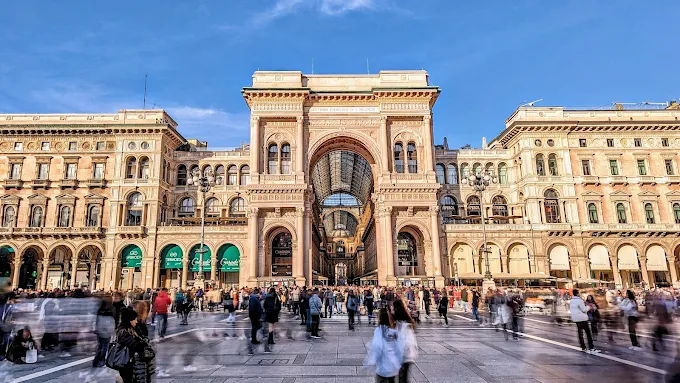
Galleria Vittorio Emanuele II Glass Arches Meet Milanese Soul
The late afternoon sun filters through the soaring glass vault of Milan’s Galleria Vittorio Emanuele II—casting a honeyed glow over mosaic floors, gilded ironwork, and the polished brass of historic cafés. You hear the soft clink of espresso cups at Caffè Biffi, the murmur of Italian fashion editors discussing collections, and the distant chime of trams gliding past the Duomo. Opened in 1877 after 14 years of construction, this 196-meter-long (643-foot) arcade was Europe’s first shopping mall—a revolutionary fusion of commerce, culture, and architecture. Its cross-shaped layout, crowned by a 47-meter-high glass dome, connects Piazza del Duomo to Teatro alla Scala, forming the city’s elegant spine. In 2026, as Milan balances its identity as a global design capital with deep-rooted tradition, the Galleria remains its beating heart—not just a passage for luxury brands, but a living monument where history, innovation, and la dolce vita converge under one luminous roof.
Why Galleria Vittorio Emanuele II Embodies Urban Innovation
The Galleria Vittorio Emanuele II isn’t merely a shopping arcade—it’s a 19th-century engineering marvel that redefined urban life. Designed by architect Giuseppe Mengoni and completed in 1877, it was conceived as a “salon for the city,” blending commerce, social gathering, and architectural grandeur under a single glass canopy. Spanning 196 meters in length with a central octagonal piazza beneath a 47-meter-high glass dome, the structure was revolutionary for its time: its iron-and-glass framework predated Paris’s grands magasins and inspired London’s Burlington Arcade. The floor is paved with intricate mosaics depicting the coats of arms of Italy’s four major cities—Turin, Florence, Rome, and Milan—as well as zodiac signs and animals, including the famous bull of Turin, whose testicles are worn smooth by centuries of superstitious foot-rubbing. After World War II bombing damaged the dome, it was meticulously restored using original techniques. Today, the Galleria houses Prada’s flagship since 1913, Louis Vuitton, and historic establishments like Biffi and Savini, making it both a luxury destination and a protected cultural monument managed by the City of Milan. This duality—of heritage and haute couture—makes it a unique urban ecosystem where every step echoes with history and ambition.
The Best Time to Experience Galleria Vittorio Emanuele II
To enjoy the Galleria’s luminous beauty without oppressive crowds, target the precise window of May 12–26, 2026. During these weeks, daytime temperatures range from a comfortable 18–24°C (64–75°F)—ideal for lingering over aperitivo or photographing the glass dome’s play of light [[24], [27]]. Mornings between 8:00–9:30 AM offer near solitude, perfect for capturing the mosaic floors unobstructed and watching shopkeepers unlock their boutiques. Alternatively, September 18–October 2, 2026 provides similar conditions with softer light and fewer fashion-week crowds. Avoid visiting during peak periods: all of July and August, when heat radiates off stone surfaces and tourist density peaks, and major events like Milan Fashion Week (late February/September) or Salone del Mobile (April), when the Galleria becomes a runway for industry elites [[29]]. For the most magical experience, return at 9:00 PM when the dome is illuminated and the crowds thin—leaving only locals enjoying post-dinner gelato. Always verify opening hours via the official tourism portal (yesmilano.it).
Approximate Budget for a 7-Day Trip (2026)
This budget reflects mid-range 2025 pricing adjusted for Italy’s projected 2026 inflation rate of 1.5% [[37]], offering a realistic estimate for a solo traveler based in Milan’s historic center.
- Accommodation: €840–€1,120 total (€120–€160 per night) for a 3-star hotel or private apartment in Brera or near Porta Venezia—stylish, central, and quieter than the Duomo district.
- Food: €490 total (€70 per day). Breakfast at Caffè Biffi (€6 for cappuccino and brioche); lunch of panzerotto and arancini (€12); dinner at a family-run osteria (€48 for ossobuco alla milanese, saffron risotto, and house red wine).
- Transportation: €45 total. Includes Milan Metro weekly pass (€22); train from Malpensa Airport (€13); and occasional taxi rides (€10).
- Attractions: €85 total. Duomo rooftop + museum (€25); Galleria Vittorio Emanuele II guided tour (€15); Sforza Castle museums (€12); Last Supper viewing (€15 reservation fee); and aperitivo crawl in Navigli (€18).
- Miscellaneous: €100 total. A high-quality print from Libreria Bocca (€30); gelato from Gelateria della Musica (€4); locally made leather notebook (€35); and aperitivo at Camparino in Galleria (€30).
Total Estimated Budget: €1,560–€1,860
6 Essential Galleria Vittorio Emanuele II Experiences
- Perform the Bull Ritual at Dawn: At 8:00 AM, find the mosaic of Turin’s bull in the central octagon. Spin on its testicles three times for good luck—a tradition dating back to the 1880s, best done before crowds arrive.
- Sip Espresso at Historic Caffè Biffi: Established in 1844, this literary café hosted Verdi and D’Annunzio. Order a ristretto at the marble counter and watch sunlight stream through the dome.
- Admire the Dome from the Mezzanine: Climb the stairs near Prada to the upper gallery for an elevated view of the entire arcade—the perfect vantage to appreciate Mengoni’s geometric mastery.
- Attend an Evening Aperitivo at Camparino: Founded in 1911, this art nouveau bar serves Milan’s original aperitif. From 6:00–8:00 PM, enjoy a Campari spritz with panoramic views of the Duomo.
- Photograph the Glass Vault at Golden Hour: Between 5:30–7:00 PM, the setting sun ignites the iron latticework in amber light—ideal for capturing the Galleria’s ethereal glow.
- Explore the Hidden Bookshop Libreria Bocca: Tucked near the Scala entrance, this 1775-founded bookstore features frescoed ceilings and antique globes—a quiet sanctuary amid luxury.
3 Hidden Gems Most Travelers Miss
- Palazzo Carminati Courtyard: Just steps from the Galleria’s Duomo entrance, this 19th-century palace hides a serene internal courtyard with neoclassical columns. Enter through the unmarked archway during daylight hours.
- Scala Rooftop Viewpoint: Book a backstage tour of Teatro alla Scala (€25) to access its rooftop terrace—a secret perch overlooking the Galleria’s glass dome and the Duomo spires.
- Via Orefici Artisan Lane: Behind the Galleria’s northern arm, this narrow street hosts goldsmiths and frame-makers working in centuries-old workshops. Visit in the morning to see artisans at their benches.
Cultural & Practical Tips
- Dress smartly for upscale venues: While casual wear is fine for walking, high-end cafés like Savini expect neat attire—no shorts or flip-flops after 6:00 PM.
- Respect the mosaic floor: Never step on the animal symbols with shoes on if you’re not performing the ritual. The mosaics are protected heritage elements.
- Carry small bills for cafés: Many historic bars prefer cash for espresso orders. Tipping isn’t expected, but rounding up is appreciated.
- Learn key phrases: “Un caffè, per favore” (oon kah-FEH, pehr fah-VOH-reh) for coffee; “Dov’è il bagno?” (doh-VEH eel BAHN-yoh?) for restroom directions.
- Photography is encouraged—but responsibly: Tripods require permission; avoid blocking entrances during fashion shoots. Early morning offers the best natural light.
Conclusion: Travel with Curiosity, Not Just Credit Cards
In 2026, the Galleria Vittorio Emanuele II invites more than shopping—it calls for storytelling. Your presence here supports not just luxury brands, but the artisans, baristas, and historians who keep Milan’s soul alive. Choose to linger over a €3 espresso at Biffi rather than rushing to a flagship store; learn the story behind the mosaic bull; admire the ironwork that once defied engineering limits. By traveling with curiosity—prioritizing connection over consumption—you help ensure the Galleria remains a living salon, not just a showcase. Let your visit be an act of appreciation: for the light that dances through glass, for the hands that laid each tile, and for the city that dares to blend past and future under one magnificent roof.