
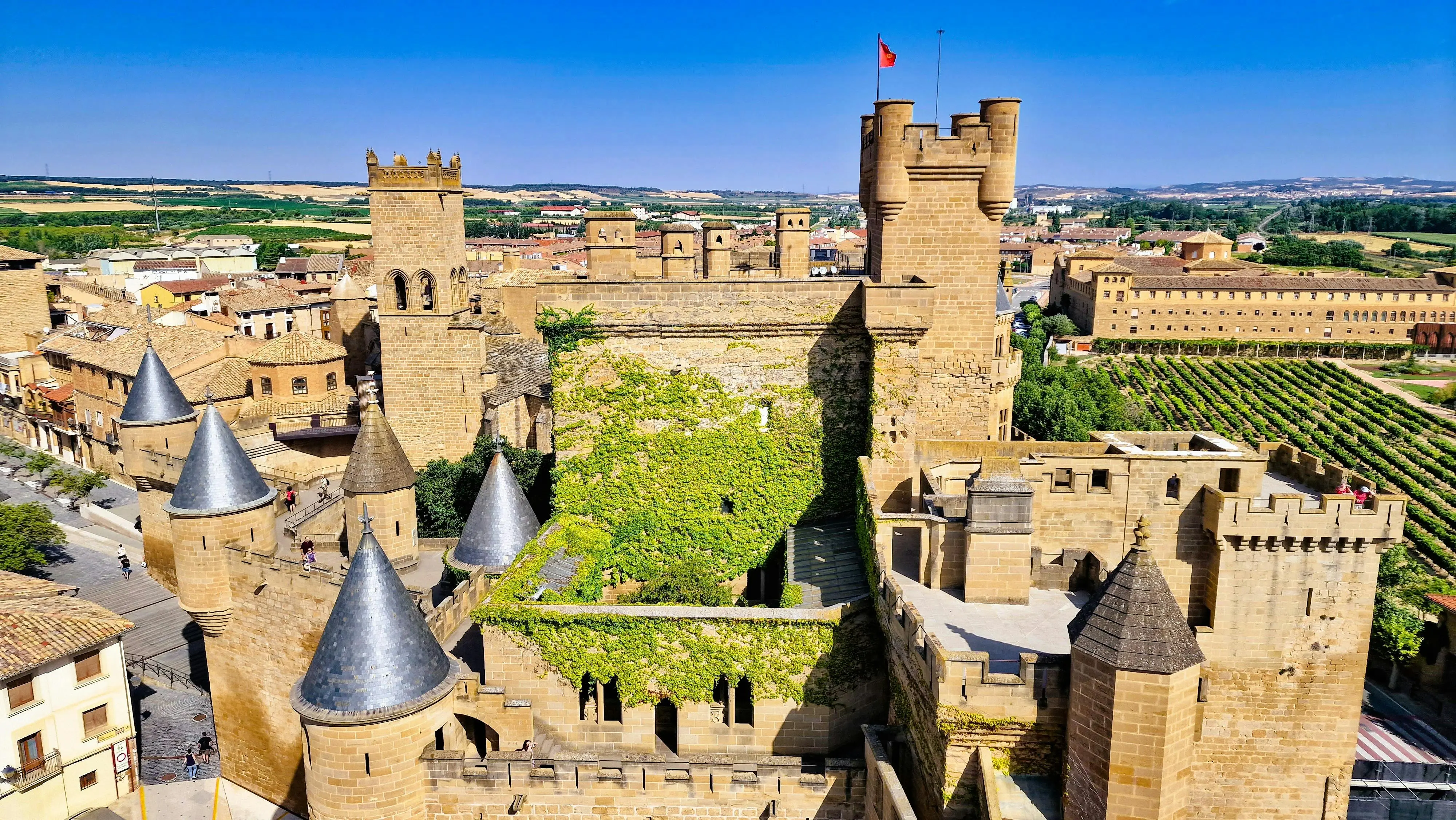
Olite Castle Medieval Fairy Tales Meet Navarrese Wine Country
First light breaks over the Cidacos valley as mist clings to limestone towers—seven centuries of royal history rising from the vineyards of Navarra like a storybook illustration come to life. You stand before the Palacio Real de Olite, its asymmetrical silhouette punctuated by 20 cylindrical towers, irregular battlements, and labyrinthine courtyards that defy the rigid symmetry of typical medieval fortifications. This is no ordinary castle: built primarily between 1260 and 1420 under the reign of Charles III "the Noble," the palace sprawls across 3,500 square meters with over 100 rooms, 22 towers reaching heights of 40 meters, and gardens that once housed exotic animals including lions and camels. The morning air carries the scent of Rioja wine from surrounding vineyards mixed with the earthy perfume of ancient stone—limestone quarried from nearby hills, sandstone for decorative elements, and timber from the Irati Forest. In 2026, as mass tourism threatens to homogenize Europe's medieval heritage, Olite Castle matters because it preserves something increasingly rare: an authentic, unvarnished monument to royal ambition that never sacrificed character for convention, standing as a testament to the Kingdom of Navarre's independent spirit.
Why Olite Castle Embodies Medieval Architectural Whimsy
The Castillo de Olite solves a fundamental medieval problem: how to project royal power while creating a livable residence that balances defense with comfort. Unlike the austere fortresses of Castile or the geometric precision of French châteaux, Olite embraces asymmetry and organic growth—each king added wings, towers, and courtyards according to personal whim rather than master plan, creating what architectural historian José María Azcárate calls "the most irregular and charming royal palace in Spain." The castle's evolution began in 1260 when Theobald I of Navarre established Olite as a royal residence, but the structure you see today primarily reflects the vision of Charles III (reigned 1387–1425), who transformed a military fortress into a Gothic pleasure palace worthy of Europe's most sophisticated courts.
Technical specifications reveal the scale of medieval ambition: the Old Palace (Palacio Viejo), completed around 1300, features thick defensive walls measuring 2.5 meters and a rectangular keep rising 30 meters; the New Palace (Palacio Nuevo), constructed 1380–1420, showcases delicate Gothic tracery, vaulted ceilings reaching 12 meters, and the famous Galería de los Reyes (Gallery of Kings) with its star-vaulted ceiling. The castle incorporates 22 towers of varying heights—some cylindrical, others square—including the 40-meter Torre del Homenaje (Homage Tower) and the Torre de la Atalaya (Watchtower) with its distinctive conical roof. Interior spaces feature Mudejar-influenced plasterwork, polychrome tiles imported from Valencia, and stained glass from French workshops. The palace once contained Spain's first zoo, with menagerie quarters for lions, bears, and camels gifted by Mediterranean traders, plus extensive gardens irrigated by a sophisticated system of channels drawing from the Cidacos River.
Tragically, the castle suffered devastating damage in 1813 during the Peninsular War when Spanish general Espoz y Mina ordered its partial destruction to prevent French occupation—300 kilograms of gunpowder reduced sections to rubble. Reconstruction began in 1937 under architect José Yárnoz, continuing through 2005 with €12 million in funding from the Government of Navarre. Today, the castle functions as a parador (luxury state-run hotel) in restored sections while remaining open for tours, preserving both its royal heritage and practical utility for modern travelers seeking authentic medieval immersion.
The Best Time to Experience Olite Castle
For optimal conditions—when Navarre's vineyards display their full seasonal splendor and temperatures permit comfortable exploration of exposed ramparts—target May 12–June 28 or September 8–October 22. During these windows, daytime temperatures range 18–26°C (64–79°F), while mornings dip to 8–14°C (46–57°F)—perfect for photographing the castle's towers in soft light without summer's intense heat or winter's potential closures.
For photography and atmospheric exploration, arrive at the castle gates between 9:00–10:00 AM when opening begins, allowing you to experience the Gothic courtyards before tour groups arrive from Pamplona. The golden hour before sunset—approximately 8:45–9:50 PM in June, 7:15–8:15 PM in September—casts dramatic shadows across the irregular towers, creating ideal conditions for capturing the castle's fairy-tale silhouette against the Sierra de Izko mountains. Visit Tuesday through Thursday to avoid weekend crowds; Saturday afternoons see visitor numbers reach 500+ people, creating bottlenecks in narrow spiral staircases.
Avoid July 15–August 20 unless you tolerate temperatures exceeding 32°C (90°F) with minimal shade on exposed walkways; the castle's stone surfaces absorb heat, making interior tours uncomfortable without air conditioning. December through February brings frequent rain (averaging 10–14 rainy days per month) and temperatures dropping to 2–8°C (36–46°F); while the castle takes on a moody, atmospheric quality, some exterior sections close for safety during icy conditions. For wine harvest atmosphere, target September 20–October 5 when surrounding vineyards bustle with activity, but book accommodations four months ahead.
Verify current opening hours and restoration schedules at the official Parador de Olite website: https://palaciorealolite.com/ or call +34 948 740 000.
Approximate Budget for a 7-Day Trip (2026)
This budget reflects mid-range travel with comfortable accommodations, quality dining, and comprehensive cultural experiences—based on 2025 pricing adjusted for Spain's projected 3.2% inflation rate for 2026. Olite sits in rural Navarre where costs run 20–30% lower than major cities, though the parador commands premium pricing for its unique historic setting.
Accommodation: €75–€195 per night
- Budget pensión in Olite town center: €75–€95 (Pensión Eder, 5-minute walk to castle)
- Parador de Olite (inside castle): €165–€195 (includes breakfast, castle access)
- Boutique hotel in nearby Tafalla (12 km): €95–€130 (Hotel Yoldi)
Food: €40–€70 per day
- Breakfast: €6–€10 (coffee, tostada, fresh orange juice at Café Castilla)
- Lunch: €14–€22 (menú del día: Navarrese asparagus, grilled lamb, or migas with wine included)
- Dinner: €22–€38 (traditional asador: suckling lamb, Rioja wine, dessert)
Transportation:
- Round-trip bus Pamplona to Olite (Line 230): €11.40
- Rental car (7 days, compact): €260–€330 (essential for winery visits)
- Fuel for regional exploration (380 km): €52–€62
- Train Madrid to Pamplona (RENFE Alvia): €45–€72 one-way
Attractions & Experiences:
- Castle guided tour (exterior + selected interiors): €7
- Castle + Santa María la Real church combined ticket: €10
- Wine tour (Bodegas Ochoa or Señorío de Arínzano): €16–€32
- Navarre Museum (Pamplona day trip): €4
- Medieval Olite walking tour: €12
Miscellaneous:
- Bottle of Navarra DO wine (to ship home): €15–€42
- Local artisan cheese (Idiazábal or Roncal): €13–€19
- Travel insurance (7 days): €25–€40
- Souvenirs and incidentals: €45–€75
Total for 7 days (mid-range): €1,050–€1,380 per person (excluding international flights)
6 Essential Olite Castle Experiences
- Tour the New Palace Gothic Chambers: Enter through the main gate at 9:00 AM when the castle opens, proceeding to the Palacio Nuevo where Charles III's 15th-century renovations created Spain's most sophisticated royal apartments. The Salón de los Reyes (Kings' Hall) features a star-vaulted ceiling with 120 carved wooden bosses depicting heraldic symbols; notice the original 15th-century polychrome traces on the walls. The Cámara de la Reina (Queen's Chamber) preserves Gothic windows with alabaster mullions and a fireplace carved with scenes of courtly life. Allow 45 minutes; audio guide included in €7 entry fee (available in Spanish, English, French, Basque).
- Climb the Torre del Homenaje: Ascend the 158 stone steps of the 40-meter Homage Tower for panoramic views of Navarre's vineyards stretching to the Pyrenees. The climb takes 15 minutes; the tower's cylindrical design (internal diameter: 6 meters) creates a slightly disorienting spiral that medieval architects intended to confuse attackers. At the top, a 360-degree viewing platform reveals the castle's full complexity: 22 towers, 5 courtyards, and the geometric precision of surrounding medieval streets. Best climbed at 10:00 AM when morning light illuminates the Sierra de Izko; avoid midday when stone surfaces radiate heat in summer.
- Explore the Medieval Menagerie Ruins: In the castle's eastern quarter, examine the foundations of Spain's first royal zoo, where Charles III housed lions, bears, camels, and exotic birds received as diplomatic gifts. Information panels (in Spanish and English) explain the 15th-century irrigation system that maintained tropical plants and the elaborate cages designed by French architects. The site remains partially excavated; look for the stone feeding troughs and drainage channels that sustained large carnivores. Access included in general admission; best visited at 11:00 AM when interpretive signage is most legible in natural light.
- Dine in the Parador Restaurant: Even if not staying overnight, reserve a table at the parador's restaurant (open to non-guests for lunch, 1:30–3:30 PM) to dine within the castle walls. The menú histórico (€38) features medieval-inspired dishes: lamb stew with saffron, pomegranate-glazed quail, and almond tart with honey from the castle's original recipes. Request a table in the vaulted dining room where 12-meter ceilings create dramatic acoustics; the wine list emphasizes Navarra DO labels at €18–€45 per bottle. Book 2 weeks ahead via +34 948 740 000.
- Photograph the Irregular Towers at Sunset: Position yourself in Plaza de Carlos III el Noble (the main square facing the castle) at 7:30 PM in September or 9:00 PM in June to capture the castle's distinctive silhouette. The asymmetrical towers—some conical, others flat-topped, varying from 15 to 40 meters—create a jagged skyline unique in European castle architecture. Use a telephoto lens (70–200mm) to compress the perspective; the warm stone glows amber in evening light. Stay through blue hour (20 minutes after sunset) when interior lights illuminate Gothic windows.
- Visit Santa María la Real Church: Adjacent to the castle, this 13th-century Gothic church served as the royal pantheon where Charles III and his wife Eleanor of Castile lie in alabaster tombs carved by Jehan Lome de Tournai in 1416. The retablo (altarpiece) features 16th-century paintings by Pedro de Aponte; the cloister contains 14th-century capitals depicting biblical scenes. Entry €4 or €10 combined with castle; open 10:00 AM–1:30 PM and 4:00–7:00 PM. Allow 30 minutes; photography prohibited inside.
3 Hidden Gems Most Travelers Miss
- Judería de Olite (Medieval Jewish Quarter): While thousands photograph the castle, few explore the labyrinthine streets behind it where Olite's medieval Jewish community lived from the 11th to 15th centuries. The judería preserves narrow alleys, stone archways, and the remains of a 13th-century synagogue (now a private residence at Calle Judería 14). Join the free guided tour Saturday mornings at 11:00 AM (meeting point: Tourist Office, Plaza de Carlos III; call +34 948 740 502 to reserve). The 45-minute walk reveals mikveh (ritual bath) foundations and explains how 200 Jewish families contributed to Olite's prosperity as merchants and scholars before the 1492 expulsion.
- Bodega Ochoa Wine Cellar: Located 800 meters from the castle at Camino de la Ermita s/n, this family winery operates from a 19th-century cave carved into limestone, maintaining constant 14°C (57°F) temperatures ideal for aging. While most visitors tour flashier modern wineries, Ochoa offers intimate tastings (€16 for 5 wines) in the original vaulted cellar where owner Adrián Ochoa explains traditional Navarra winemaking. Open Monday–Saturday, 10:00 AM–2:00 PM and 4:00–7:00 PM; reservation required (+34 948 740 066). The Garnacha and Tempranillo rosés pair perfectly with castle views; purchase limited-edition bottles unavailable elsewhere.
- Palacio de los Teobaldos Ruins: Behind the main castle, accessible through an unmarked gate on the north side (ask at tourist office for key), lie the excavated foundations of the original 11th-century palace where Theobald I established his court. Most visitors never discover these ruins, which reveal Romanesque wall foundations, a 12th-century cistern, and the original chapel's apse. The site opens Tuesday and Thursday, 10:00 AM–12:00 PM by appointment only (email turismo@olite.es 48 hours ahead). Free entry; bring a flashlight to examine the 900-year-old stonework. The ruins provide crucial context for understanding how the castle evolved from fortress to palace.
Cultural & Practical Tips
- Language considerations: While Spanish dominates, Basque (Euskera) holds co-official status in Navarre. Key phrases: Eskerrik asko (es-keh-reek ash-koh = thank you in Basque), Gracias (GRAH-see-ahs = thank you in Spanish), ¿Dónde está el castillo? (DON-deh es-TAH el kahs-TEE-yoh = where is the castle?), Una copa de vino tinto (OO-nah KOH-pah deh BEE-noh TEEN-toh = a glass of red wine).
- Castle accessibility: The medieval structure presents significant challenges: spiral staircases with 158+ steps, uneven stone floors, and narrow passages (some only 1.2 meters wide). Wheelchair access is limited to ground-floor areas and courtyards; the towers and upper chambers remain inaccessible. Visitors with mobility issues should request the adapted route at the ticket office; staff can arrange a virtual reality tour of inaccessible areas. Service animals permitted with advance notice (+34 948 740 000).
- Photography guidelines: Tripods require written permission from the parador management (email olite@parador.es 7 days ahead). Flash photography prohibited in Gothic chambers to preserve 15th-century polychrome; use high ISO (1600–3200) and natural light. The best interior shots occur 10:00 AM–12:00 PM when sunlight penetrates Gothic windows. Drone use strictly prohibited within 500 meters of the castle (protected monument status).
- Weather preparation: Olite sits at 435 meters (1,427 feet) elevation in Navarra's ribera (river valley), creating hot summers and cool winters. Even in summer, bring a light jacket for early morning tours—stone surfaces remain cool until 11:00 AM. Autumn and spring bring sudden rain; pack waterproof layers. The castle's exposed ramparts offer no shade; wear sun protection June–September.
- Dining schedules: Navarre follows traditional Spanish meal times: lunch 2:00–4:00 PM, dinner 9:00–11:00 PM. Many restaurants close between 4:00–8:00 PM; plan accordingly. For authentic Navarra cuisine, try espárragos de Navarra (white asparagus with vinaigrette), cordero asado (roast lamb), and pimientos del piquillo (stuffed roasted peppers). Order Navarra DO rosé (€12–€18 per bottle)—the region produces Spain's finest rosados.
- Medieval festival timing: If visiting in July, target the Fiesta de la Reconquista (third week of July) when Olite recreates its 12th-century history with medieval markets, jousting tournaments, and period costumes. The festival draws 15,000 visitors; book accommodations 6 months ahead. Alternatively, visit September 29 for San Miguel patron saint celebrations featuring traditional jota dancing and bull-running through medieval streets.
- Combined ticket strategy: Purchase the €10 combined ticket (castle + Santa María la Real church + Medieval Olite Museum) rather than individual entries (€7 + €4 + €3 = €14). The museum, housed in a 16th-century palace, displays archaeological finds from excavations and explains the castle's 1813 destruction. Open Tuesday–Sunday, 10:00 AM–2:00 PM and 5:00–8:00 PM (summer); closed Monday except holidays.
Conclusion: Travel with Wonder, Not Just Checklists
Olite Castle doesn't require your admiration to endure—it has stood sentinel over Navarrese vineyards for 750 years, surviving war, neglect, and the passage of kingdoms without validation from guidebooks or social media. What it deserves is your wonder: the willingness to climb 158 stone steps and imagine Charles III gazing at the same Pyrenean peaks; the patience to trace Mudejar plasterwork and understand how Christian, Islamic, and Jewish artisans collaborated to create beauty; the humility to recognize that this irregular, whimsical monument rejects the rigid conventions that define so much of medieval architecture. In 2026, as heritage sites worldwide face pressure to sanitize history for mass consumption, Olite offers something increasingly precious: authenticity without apology. Its asymmetrical towers, labyrinthine passages, and partially ruined menagerie tell honest stories of ambition, destruction, and renewal. Walk these courtyards slowly. Touch the limestone warmed by centuries of Navarrese sun. Let the irregularity teach you that perfection isn't the goal—character is. Travel to Olite not to check a box, but to remember that some of humanity's greatest achievements emerged not from rigid planning, but from the beautiful chaos of individual vision.