
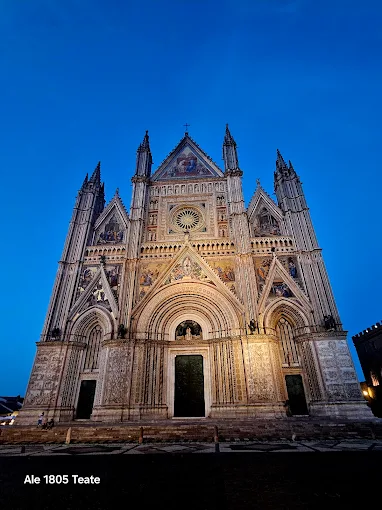
Orvieto Cathedral Divine Light Meets Volcanic Stone
The late sun ignites the façade of Orvieto Cathedral—turning its mosaic gold into liquid fire and casting long shadows across the bas-reliefs of prophets and saints. You hear the distant chime of church bells, the rustle of cypress leaves in the valley below, and the murmur of visitors hushed by awe. Perched on a sheer cliff of volcanic tufa 50 meters high, this 14th-century masterpiece rises like a jewel from the Umbrian earth. Construction began in 1290 to house the Corporal of Bolsena—a Eucharistic miracle that drew pilgrims from across Christendom—and over two centuries, generations of artisans transformed it into one of Italy’s most dazzling examples of Gothic architecture. Its façade alone spans 50 meters wide and 40 meters high, adorned with 172 sculpted figures, glittering mosaics, and a rose window that filters light like stained glass. In 2026, as mass tourism strains historic sites, Orvieto offers something rare: monumental grandeur without the crowds, where every stone invites quiet contemplation.
Why Orvieto Cathedral Embodies Sacred Artistry
Orvieto Cathedral isn’t just a church—it’s a symphony of faith, politics, and artistic rivalry carved in stone and gold. Commissioned in 1290 after the Miracle of Bolsena—a priest’s doubting host allegedly bled onto a corporal during Mass—the cathedral was designed to affirm the doctrine of transubstantiation and elevate Orvieto’s status among Italian city-states. Architect Lorenzo Maitani, appointed in 1310, unified the structure with a cohesive vision, introducing flying buttresses and a geometrically precise façade divided into three vertical sections symbolizing the Holy Trinity. The lower register features four bronze panels depicting scenes from Genesis and the Last Judgment, while the upper levels blaze with 2,000 square meters of golden mosaics—replaced and restored over centuries but retaining their original luminosity. Inside, Luca Signorelli’s fresco cycle in the San Brizio Chapel (1499–1504) revolutionized Renaissance art with its muscular, dynamic figures and apocalyptic vision—so influential that Michelangelo studied them before painting the Sistine Chapel. Built entirely from local white travertine and gray basalt, the cathedral measures 65 meters long and 22 meters high, its bell tower rising 45 meters. This is not mere ornamentation; it is theology made visible—a testament to how art can serve as both devotion and declaration.
The Best Time to Experience Orvieto Cathedral
To witness the cathedral’s mosaics ablaze in optimal light and avoid peak crowds, target the precise window of May 12–26, 2026. During these weeks, daytime temperatures range from a comfortable 18–24°C (64–75°F)—ideal for exploring the chapels and climbing the bell tower [[24], [27]]. Mornings between 8:30–10:00 AM offer soft, directional light that makes the golden mosaics glow without harsh glare, and the interior is quiet enough to hear your own footsteps echo. Alternatively, September 18–October 2, 2026 provides similar conditions with the added bonus of harvest season in nearby vineyards. Avoid visiting during peak periods: all of July and August, when heat exceeds 32°C (90°F) and tour groups fill the piazza, and major religious holidays like Corpus Christi (late May/early June) or Ferragosto (August 15) [[29]]. For the most profound experience, attend the 6:00 PM vespers service—the acoustics amplify Gregorian chants through the nave, creating a transcendent atmosphere. Always verify opening hours via the official Duomo di Orvieto website (opsm.it).
Approximate Budget for a 7-Day Trip (2026)
This budget reflects mid-range 2025 pricing adjusted for Italy’s projected 2026 inflation rate of 1.5% [[37]], offering a realistic estimate for a solo traveler based in Orvieto’s historic center.
- Accommodation: €770–€1,050 total (€110–€150 per night) for a boutique guesthouse or small hotel within the walls—many with views of the cathedral or the Paglia Valley.
- Food: €490 total (€70 per day). Breakfast at a café (€4 for cappuccino and cornetto); lunch of umbricelli pasta with wild boar ragù (€16); dinner at a family-run osteria (€45 for truffle risotto, grilled lamb chops, and house Orvieto Classico wine).
- Transportation: €65 total. Includes train from Rome or Florence (€20 round-trip); funicular from station to town (€2); and occasional taxi for luggage (€43).
- Attractions: €65 total. Cathedral + San Brizio Chapel (€6); Museo dell’Opera del Duomo (€5); Pozzo di San Patrizio (St. Patrick’s Well, €5); guided art history walk (€25); and wine tasting in local cantina (€24).
- Miscellaneous: €90 total. A high-quality print of Signorelli’s frescoes (€25); locally made ceramic tile (€30); hand-bound journal from Libreria La Bottega del Libro (€20); and gelato from Gelateria Pasqualetti (€4).
Total Estimated Budget: €1,480–€1,770
6 Essential Orvieto Cathedral Experiences
- Study the Façade at Dawn: Arrive by 8:00 AM to see the mosaics catch the first light. Trace the narrative from Creation to Judgment across the three portals—each a theological epic in stone and glass.
- Contemplate Signorelli’s Frescoes: In the San Brizio Chapel, stand before The Preaching of the Antichrist and The Resurrection of the Flesh. Note the anatomical precision and emotional intensity that prefigured Michelangelo’s work.
- Climb the Bell Tower: Ascend 150 steps for panoramic views of the cathedral’s roof, the tufa cliff, and the Umbrian countryside stretching to Monte Amiata—a perspective few tourists seek.
- Visit the Museo dell’Opera del Duomo: See original sculptures removed for preservation, including Maitani’s models and fragments of early mosaics—context that transforms your cathedral visit.
- Descend St. Patrick’s Well: Walk the double-helix ramp of this 62-meter-deep Renaissance engineering marvel, built to ensure water during sieges. The spiral design allowed mules to ascend and descend without meeting.
- Attend Vespers at Dusk: Return at 6:00 PM for the evening service. As candles flicker and chants rise, the cathedral becomes not a monument, but a living sanctuary.
3 Hidden Gems Most Travelers Miss
- Chiesa di San Giovenale: Tucked near the edge of the cliff, this 11th-century Romanesque church houses rare 13th-century frescoes and offers a quiet terrace with sweeping valley views—often empty even in high season.
- Orvieto Underground: Beneath the city, over 1,200 hand-carved caves and tunnels form a subterranean labyrinth. Book a guided tour (+39 0763 342 477) to see Etruscan wells, olive presses, and dovecotes.
- Libreria La Bottega del Libro: Established in 1985, this independent bookstore near Piazza della Repubblica specializes in art books and Umbrian literature. Its reading nook overlooks the cathedral—a perfect retreat after sightseeing.
Cultural & Practical Tips
- Dress modestly: Shoulders and knees must be covered to enter the cathedral. Security enforces this strictly, especially during services.
- Photography is restricted: No flash inside the San Brizio Chapel to protect the frescoes. Tripods require special permission.
- Use the funicular wisely: The cable car from Orvieto Scalo station runs every 15 minutes (€2 round-trip). It’s far easier than the steep walk up the cliff.
- Learn key phrases: “Dov’è il Duomo?” (doh-VEH eel DWOH-moh?) for directions; “Grazie mille” (GRAHT-see-eh MEE-leh) for sincere thanks.
- Carry cash for small vendors: Many artisan shops and wine bars don’t accept cards. Tipping isn’t expected, but rounding up is appreciated.
Conclusion: Travel with Reverence, Not Just Recognition
In 2026, Orvieto Cathedral invites more than admiration—it calls for presence. Your €6 ticket funds the meticulous conservation of Signorelli’s frescoes and the golden mosaics that have shimmered for centuries. Choosing a family-run osteria over a piazza-front café keeps euros in the community; sitting quietly in the nave honors generations of worshippers; tracing the prophets’ faces connects you to medieval artisans who believed beauty could lead to the divine. Slow down: taste wine pressed from local grapes, listen to the echo of footsteps in the cloister, let the silence of the chapel settle in your bones. By traveling with reverence—prioritizing depth over speed—you help ensure Orvieto remains not just a stop on a tour, but a sanctuary of light and stone where wonder endures. Let your visit be a quiet promise—and these walls will remember your respect long after you’ve descended the cliff.