
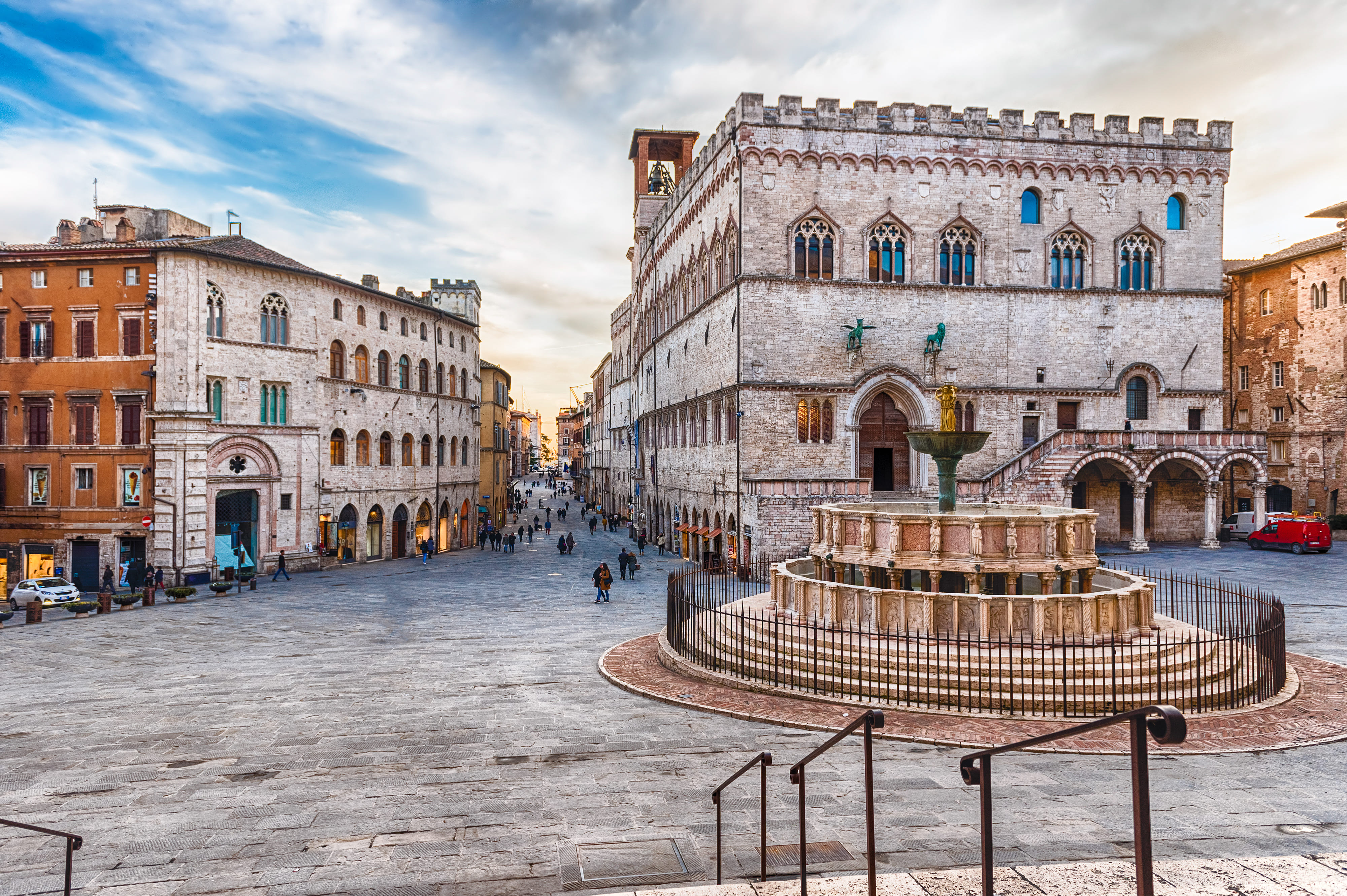
Perugia Old Town Etruscan Stone Meets Umbrian Soul
The late sun gilds the honey-colored travertine of Perugia—casting long shadows across Corso Vannucci, where students sip espresso at historic cafés and the scent of roasting chestnuts drifts from hidden alleys. You hear the distant chime of the Palazzo dei Priori’s bell, the rustle of cypress leaves in the valley below, and the murmur of Italian families gathering in Piazza IV Novembre. Perched on a high ridge between the Tiber and Chiascio rivers, this ancient city has been a crossroads of civilizations since the 9th century BCE—first as an Etruscan stronghold, then a Roman colony, and later a powerful medieval commune. Its old town, enclosed by 3-kilometer-long walls punctuated by massive gates like Porta Eburnea, rises 493 meters above sea level, offering panoramic views of the Umbrian countryside. In 2026, as mass tourism bypasses lesser-known gems for crowded hotspots, Perugia offers something rare: monumental history without the queues, where every cobblestone whispers of empires, artists, and chocolate.
Why Perugia Old Town Embodies Layered Legacy
Perugia’s old town isn’t just picturesque—it’s a living archive of Mediterranean civilization. Founded by the Etruscans in the 9th century BCE, it became one of their twelve most powerful cities, evidenced by the still-standing Arco Etrusco (Etruscan Arch) from the 3rd century BCE—a massive gate built from local limestone blocks weighing up to 5 tons each. The Romans later fortified it, leaving behind the well-preserved underground Pozzo Etrusco (Etruscan Well), a 36-meter-deep engineering marvel that supplied water during sieges. In the Middle Ages, Perugia flourished as a free commune, rivaling Florence and Siena, and its civic pride is embodied in the Palazzo dei Priori—Umbria’s largest medieval palace, completed in 1443, with a façade adorned with griffins, the city’s symbol. The city’s artistic legacy includes Pietro Perugino, Raphael’s teacher, whose frescoes grace the Collegio del Cambio. Today, Perugia balances its scholarly identity—as home to Italy’s oldest university for foreigners—with deep-rooted traditions like the Eurochocolate Festival and the Umbria Jazz Festival. This layered history—Etruscan, Roman, medieval, and modern—makes Perugia not a relic, but a resilient, evolving community.
The Best Time to Experience Perugia Old Town
To explore the old town in comfortable weather and manageable crowds, target the precise window of May 10–24, 2026. During these weeks, daytime temperatures range from a pleasant 17–23°C (63–73°F)—ideal for walking the steep streets and visiting underground sites [[24], [27]]. Mornings between 8:00–9:30 AM offer near solitude in Piazza IV Novembre and clear views from the Rocca Paolina fortress. Alternatively, September 15–29, 2026 provides similar conditions with softer light and post-summer calm. Avoid visiting during peak periods: all of July and August, when heat exceeds 30°C (86°F) and narrow streets become congested, and major events like Eurochocolate (mid-October) or Umbria Jazz (July), when hotels fill months ahead [[29]]. For the most authentic experience, attend a non-festival weekday—locals reclaim the piazzas after 6:00 PM, revealing the city’s quiet, residential soul. Always verify opening hours via the official tourism portal (perugiaonline.com).
Approximate Budget for a 7-Day Trip (2026)
This budget reflects mid-range 2025 pricing adjusted for Italy’s projected 2026 inflation rate of 1.5% [[37]], offering a realistic estimate for a solo traveler based in Perugia’s historic center.
- Accommodation: €770–€1,050 total (€110–€150 per night) for a boutique guesthouse or small hotel within the walls—many with views of the valley or access to the Rocca Paolina.
- Food: €490 total (€70 per day). Breakfast at Caffè Sandri (€5 for cappuccino and brioche); lunch of torta al testo with grilled vegetables (€12); dinner at a family-run osteria (€45 for umbricelli pasta with truffle, grilled lamb chops, and house Sagrantino wine).
- Transportation: €65 total. Includes train from Rome or Florence (€20 round-trip); Minimetrò automated people mover from station to center (€2); and occasional taxi for luggage (€43).
- Attractions: €65 total. National Gallery of Umbria (€8); Rocca Paolina underground fortress (€5); Etruscan Well (€4); guided historical walk (€25); and chocolate tasting at Perugina Museum (€23).
- Miscellaneous: €90 total. A handcrafted chocolate gift box from Sandri (€25); locally made ceramic tile (€30); leather journal from Bottega del Libro (€20); and gelato from Gelateria Crispini (€4).
Total Estimated Budget: €1,480–€1,770
6 Essential Perugia Old Town Experiences
- Walk Through the Etruscan Arch at Dawn: Arrive by 7:30 AM to see the 3rd-century BCE gateway unobstructed. Touch the massive limestone blocks—some weighing over 5 tons—and imagine Etruscan chariots passing through.
- Explore the Rocca Paolina Underground: Descend into this 16th-century fortress, deliberately buried by locals after papal rule ended. Its labyrinthine tunnels now connect the train station to the old town—a unique urban artery.
- Admire Perugino’s Frescoes in Collegio del Cambio: In Piazza IV Novembre, study the master’s work in this 15th-century bankers’ guild hall. His serene figures and balanced compositions directly influenced Raphael.
- Sip Espresso at Historic Caffè Sandri: Established in 1860, this literary café served Gabriele D’Annunzio. Order a ristretto at the marble counter and watch sunlight filter through stained-glass windows.
- Visit the National Gallery of Umbria: Housed in the Palazzo dei Priori, this collection spans from the 13th to 19th centuries, featuring works by Perugino, Pinturicchio, and Fra Angelico—context for the city’s artistic soul.
- Watch Sunset from the Carducci Gardens: Climb the stairs behind the cathedral to this panoramic park. As the sun dips behind Monte Subasio, the entire old town glows in amber light—a perfect farewell view.
3 Hidden Gems Most Travelers Miss
- Oratorio di San Bernardino: Just off Corso Vannucci, this 15th-century chapel features a dazzling pink-and-white marble façade by Agostino di Duccio. Often empty, its interior glows with Renaissance harmony.
- Fontana Maggiore Early Morning: While crowds gather by noon, visit this 13th-century fountain at 8:00 AM. Study the 50 bas-reliefs depicting zodiac signs, biblical scenes, and daily medieval life in crisp morning light.
- Bottega del Libro: Tucked near Piazza Italia, this independent bookstore specializes in Umbrian history and art. Its reading nook overlooks the valley—a quiet sanctuary after sightseeing.
Cultural & Practical Tips
- Use the Minimetrò wisely: This driverless cable car connects Perugia Fontivegge station to Piazza Italia in 6 minutes (€2 round-trip). It’s far easier than the steep walk uphill.
- Wear sturdy shoes: Streets are steep and paved with uneven cobblestones. Sandals or flip-flops are impractical for daily exploration.
- Respect religious sites: Shoulders and knees must be covered in churches like San Domenico or the Cathedral.
- Learn key phrases: “Dov’è l’Arco Etrusco?” (doh-VEH lar-KOH eh-TRUHS-koh?) for directions; “Grazie mille” (GRAHT-see-eh MEE-leh) for sincere thanks.
- Carry cash for small vendors: Many artisan shops and cafés don’t accept cards. Tipping isn’t expected, but rounding up is appreciated.
Conclusion: Travel with Curiosity, Not Just Checklists
In 2026, Perugia invites more than sightseeing—it calls for engagement. Your presence supports local chocolatiers who craft Baci Perugina by hand, artisans who restore Etruscan stonework, and scholars who keep Umbrian dialects alive. Choosing a family osteria over a tourist trap keeps euros in the community; tracing the grooves of the Etruscan Arch connects you to engineers who shaped Italy before Rome; sipping espresso where D’Annunzio once wrote ties you to centuries of intellectual life. Slow down: taste wine pressed from local grapes, listen to the echo of footsteps in the Rocca Paolina tunnels, let the silence of the National Gallery settle your mind. By traveling with curiosity—prioritizing depth over speed—you help ensure Perugia remains not just a stop on a map, but a living testament to resilience and beauty. Let your visit be a thread in its enduring story—and these stones will remember your respect long after you’ve left the hilltop.