
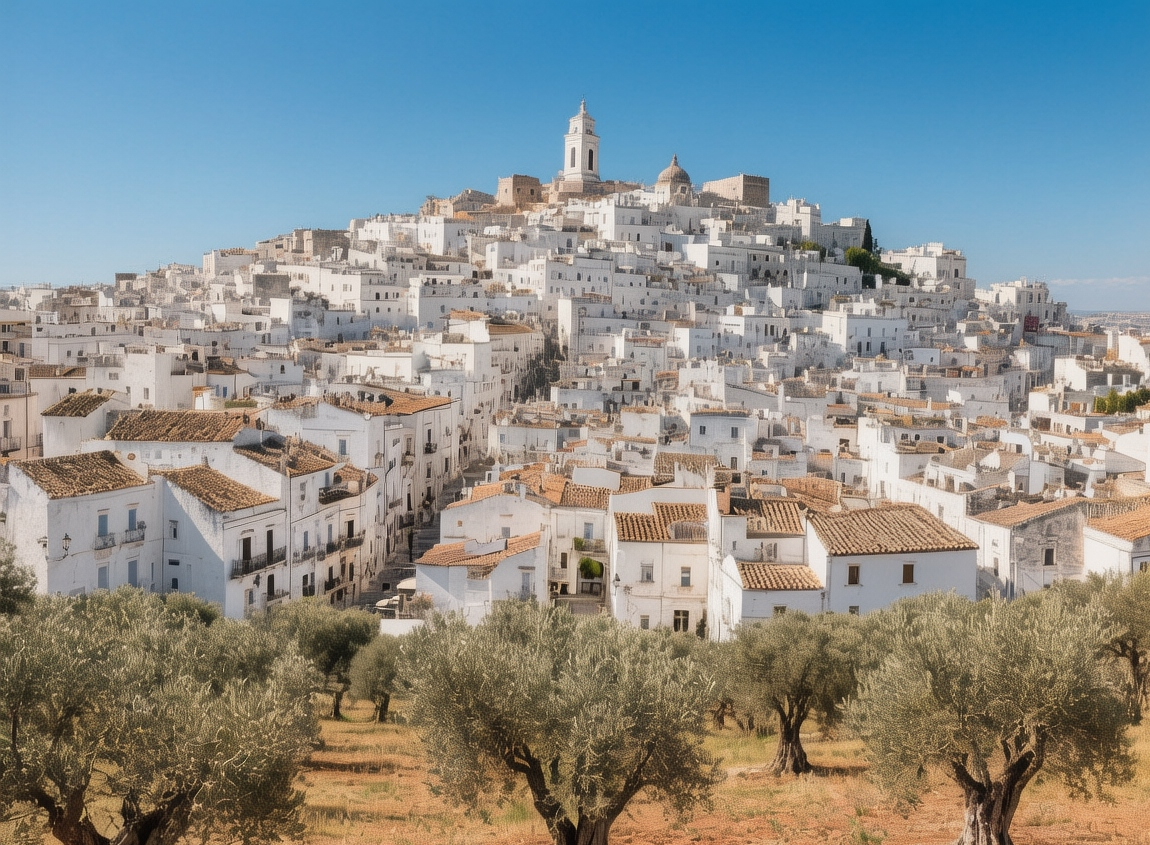
Ostuni White City Sunlit Walls Meet Olive-Green Horizons
The morning sun in Puglia strikes the blindingly white walls of Ostuni, transforming the entire hilltop town into a beacon that glows against a backdrop of endless olive groves. You hear the soft echo of footsteps on ancient cobbled lanes, the distant clang of a church bell from the 15th-century cathedral, and the gentle rustle of centuries-old olive trees in the warm breeze. This is the “White City” (Città Bianca), a labyrinth of whitewashed houses stacked like sugar cubes, their surfaces refreshed annually with slaked lime—a tradition dating back to the 14th century when it was used to sanitize the town during plague outbreaks [[16]]. Perched 230 meters (755 feet) above sea level, Ostuni’s historic center commands panoramic views over a sea of silver-green olive trees that stretches all the way to the Adriatic coast, just 8 kilometers (5 miles) away. In an age of homogenized travel experiences, Ostuni matters now more than ever—it is a living canvas of light, history, and resilience, where every alleyway tells a story of survival and beauty.
Why Ostuni White City Embodies Luminous Resilience
Ostuni’s dazzling whiteness is far more than an aesthetic choice; it is a profound symbol of historical necessity and cultural identity. The tradition of painting the town’s buildings with calce viva (slaked lime) began in the Middle Ages as a public health measure—the alkaline properties of lime were known to disinfect surfaces and ward off disease, a critical defense during repeated plague epidemics [[16]]. Over time, this practical solution evolved into a defining cultural signature, creating a unified, luminous aesthetic that reflects the intense Puglian sun and keeps interiors cool during the scorching summer months. The town’s layout itself is a masterpiece of defensive urban planning. Its concentric rings of narrow, winding streets—designed to confuse invaders—climb steeply to the summit, crowned by the Gothic-Romanesque Ostuni Cathedral, built in 1483. This architecture solved a fundamental problem: how to create a safe, healthy, and socially cohesive community on a vulnerable hilltop. Today, this legacy fulfills a modern need—for a place that feels both timeless and authentic, where beauty is born not of luxury, but of resilience and a deep connection to the land. The annual re-whitewashing is not just maintenance; it is a ritual of renewal, a collective act that binds the community to its past and its future.
The Best Time to Experience Ostuni White City
To experience Ostuni in its full, luminous glory while enjoying comfortable weather, plan your visit for the specific windows of April 25–May 30 or September 10–October 10, 2026. During these periods, Puglia basks in ideal conditions, with daytime temperatures ranging from a pleasant 22–27°C (72–81°F) and clear skies that make the white walls positively glow against the green landscape [[11]]. The best time of day to explore is in the early morning, between 8:00 AM and 10:30 AM, when the soft light creates dramatic shadows in the narrow alleys and the streets are quiet, allowing you to absorb the town’s serene atmosphere before the tour groups arrive. It is essential to avoid the peak summer months of July and August, when temperatures can soar above 35°C (95°F) and the intense midday sun makes walking the steep, exposed streets uncomfortable [[34]]. For the most current information on local events, opening hours, and guided tours, always consult the official tourism portal: viaggiareinpuglia.it.
Approximate Budget for a 7-Day Trip (2026)
This budget is calculated for a solo traveler seeking a comfortable, culturally immersive experience in Ostuni in 2026, based on current inflation trends and average regional costs for southern Italy.
- Accommodation: €90–€160 per night. Staying in a restored trullo or a boutique hotel within the historic white city offers an unforgettable experience. Options in the newer part of town are more affordable.
- Food: €45 per day. Breakfast (€5): a cappuccino and cornetto at a local bar. Lunch (€16): a plate of orecchiette pasta with tomato and ricotta forte. Dinner (€24): a main course like grilled lamb chops with a glass of local Primitivo wine.
- Transportation: €150 total. A regional train ticket from Bari to Ostuni (€7). A rental car for exploring the surrounding countryside and coastal towns like Monopoli (€40/day). Local transport within Ostuni is primarily on foot.
- Attractions: Entry to the Diocesan Museum and Cathedral Treasury (€4). Guided walking tour of the white city (€20). Visit to a local olive oil mill for a tasting (€10).
- Miscellaneous: €95. This covers a bottle of extra-virgin olive oil (€20), several gelato stops (€3 each), a hands-on cooking class featuring local recipes (€40), and souvenirs like handmade ceramics.
Total Estimated Cost: €940–€1,060
6 Essential Ostuni White City Experiences
- Get Lost in the White Labyrinth: Wander the narrow, sloping streets of the historic center without a map. Discover hidden courtyards draped in bougainvillea, ancient doorways, and unexpected vistas over the olive groves. The best time is early morning for solitude.
- Visit the Ostuni Cathedral at Sunrise: Arrive by 8:30 AM to see the rose window of this 15th-century Gothic masterpiece illuminated by the morning sun. The interior’s cool, quiet space is a perfect contrast to the bright streets outside.
- Dine on a Rooftop Terrace: Reserve a table at a restaurant like L’Aratro, which offers panoramic views over the white city and the surrounding countryside. Savor local specialties as the sun sets and the town begins to glow with evening lights.
- Explore the Museo di Civiltà Preclassiche: This museum houses the famous “Delia,” a 25,000-year-old pregnant woman figurine found in a nearby cave. It provides essential context for the region’s deep human history.
- Tour a Local Olive Oil Mill: Visit a masseria (fortified farmhouse) like Masseria Moroseta to learn about Puglia’s liquid gold. Taste fresh, peppery olive oil and understand why these ancient trees are the soul of the landscape.
- Watch the Sunset from the Belvedere: Head to the public viewpoint near Porta Nova for the most iconic panorama. As the sun dips below the horizon, the white city turns a soft pink, and the sea of olive trees shimmers in the twilight.
3 Hidden Gems Most Travelers Miss
- The Church of San Vito Martire: Tucked away in a quiet corner of the old town, this small 18th-century church has a stunning Baroque interior that is often overlooked. Look for the intricate gilded altar and the peaceful cloister garden.
- The Path to Lama Cardillo: Just outside the city walls, a short hiking trail leads down to this hidden ravine (lama). It’s a cool, green oasis of wildflowers and ancient stone walls, perfect for a quiet afternoon escape.
- The Artisan Workshops on Via Cattedrale: Away from the main tourist drags, small studios here keep traditional crafts alive. Visit a ceramist who paints local motifs or a weaver using ancient looms. A polite “Buongiorno” at the door is always appreciated.
Cultural & Practical Tips
- Wear sturdy, non-slip shoes: The streets are steep, cobbled, and can be slippery, especially after a rare rain shower. Sandals or smooth-soled shoes are not recommended.
- Book your historic-center accommodation early: The most atmospheric stays fill up months in advance, especially for the shoulder seasons. Booking by January 2026 is highly recommended.
- Learn a few key phrases: “Dov’è il belvedere?” (DOH-veh eel bel-veh-DEH-reh?) for “Where is the viewpoint?”, and “Un bicchiere di Primitivo, per favore” (oon bee-KYEH-reh dee pri-MEE-tee-voh).
- Respect the siesta: Many small shops and restaurants close between 1:00 PM and 4:00 PM. Plan your hikes or visits to museums during these hours.
- Beware of the midday sun in summer: The white walls reflect intense heat and light. Wear a hat, sunglasses, and high-SPF sunscreen, and seek shade during the hottest part of the day.
- Tipping is appreciated but not expected: A small tip of €1–€2 for exceptional service at a restaurant is a kind gesture.
Conclusion: Travel with Presence, Not Just a Lens
Ostuni’s white city is not a static postcard, but a living, breathing entity that reveals its secrets only to those who slow down and pay attention. In 2026, as we seek travel that is both beautiful and meaningful, Ostuni offers a powerful lesson in mindful presence. Your journey here should be one of immersion—not just capturing the perfect photo, but feeling the coolness of a shaded alley, tasting the peppery bite of fresh olive oil, and listening to the silence that hangs between the bells of the cathedral. By traveling with this deep attention, you honor the resilience of a community that has turned necessity into breathtaking beauty. Slow down. Sit on a step and watch the light change on the white walls. In that quiet moment of connection, you don’t just visit Ostuni—you become part of its enduring, luminous story.