
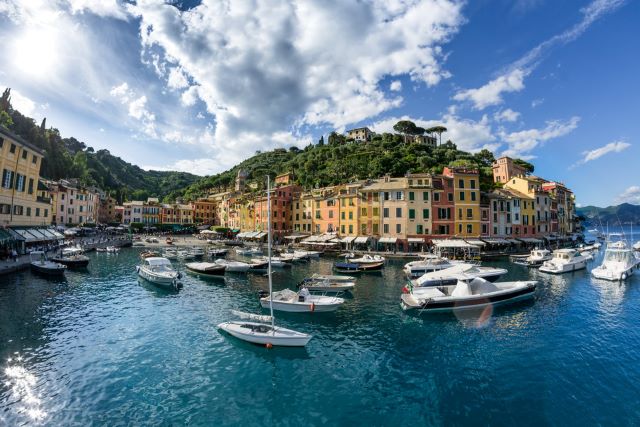
Portofino Harbor Mediterranean Light Meets Timeless Elegance
The late sun gilds the Ligurian Sea—turning Portofino’s harbor into a liquid mirror that reflects the village’s iconic arc of pastel houses in shimmering hues of coral, ochre, and sky blue. You hear the gentle lap of waves against polished yachts, the distant chime of church bells from San Giorgio, and the murmur of Italian families gathering for aperitivo on the piazzetta. Nestled in a natural amphitheater on the Italian Riviera, this fishing village turned jet-set sanctuary has charmed visitors since Roman times—when it was known as Portus Delphini (Port of the Dolphin) for its dolphin-rich waters. Though only 400 residents call it home, Portofino’s compact harbor—just 150 meters wide—has hosted everyone from Elizabeth Taylor to Picasso, drawn by its perfect blend of natural beauty and understated luxury. In 2026, as overtourism strains coastal gems across Europe, Portofino balances its allure with strict environmental protections, proving that elegance and sustainability can coexist—if approached with care.
Why Portofino Harbor Embodies Coastal Harmony
Portofino’s harbor isn’t just picturesque—it’s a masterclass in harmonious urban design shaped by geography and history. The village occupies a narrow crescent of land where steep, forested slopes meet the sea, forcing architecture to conform to nature rather than dominate it. Its iconic pastel buildings—many dating to the 17th century—are constructed from local stone and lime plaster, their colors chosen not for aesthetics alone but to reflect sunlight and keep interiors cool. The harbor itself is a natural deep-water cove, historically sheltering fishing boats and now accommodating superyachts up to 60 meters. In the 19th century, Portofino became a favorite of British aristocrats, who preserved its charm by opposing industrial development. Today, it lies within the Portofino Marine Protected Area (established in 1998), which restricts boat traffic, bans anchoring on seagrass beds, and enforces sustainable fishing. This delicate balance—between tourism, tradition, and ecology—makes Portofino not a playground for the wealthy, but a model of conscious coastal living where every villa, café, and cobblestone path respects the landscape that sustains it.
The Best Time to Experience Portofino Harbor
To enjoy the harbor’s luminous beauty without oppressive crowds, target the precise window of May 15–29, 2026. During these weeks, daytime temperatures range from a comfortable 19–25°C (66–77°F)—ideal for coastal walks and harbor swims [[24], [27]]. Mornings between 8:00–9:30 AM offer empty piazzas, calm water for photography, and the chance to watch fishermen unload their catch at the dock. Alternatively, September 12–26, 2026 provides similar conditions with golden light and fewer day-trippers. Avoid visiting during peak periods: all of July and August, when heat exceeds 30°C (86°F), ferry queues stretch for hours, and hotel rates triple, and major holidays like Italian Ferragosto (August 15) [[29]]. For the most authentic experience, stay overnight—day visitors vanish by 6:00 PM, revealing the village’s quiet, residential soul. Always verify ferry schedules via the official Navigazione Libera del Golfo website (nlg.it).
Approximate Budget for a 7-Day Trip (2026)
This budget reflects mid-range 2025 pricing adjusted for Italy’s projected 2026 inflation rate of 1.5% [[37]], offering a realistic estimate for a solo traveler based in nearby Santa Margherita Ligure—with day trips to Portofino.
- Accommodation: €840–€1,120 total (€120–€160 per night) for a boutique guesthouse or private apartment in Santa Margherita Ligure—charming, more affordable, and just a 15-minute ferry ride from Portofino.
- Food: €560 total (€80 per day). Breakfast at a café (€5 for cappuccino and cornetto); lunch of focaccia with pesto and farinata (€15); dinner at a family-run trattoria (€55 for trofie al pesto, grilled sea bass, and house Vermentino wine).
- Transportation: €75 total. Includes train from Milan or Genoa (€20 round-trip); ferry pass to Portofino (€25 for 7 days); and occasional taxi for luggage (€30).
- Attractions: €65 total. Brown Castle entry (€7); guided coastal hike (€25); wine tasting at a local cantina (€20); and gelato from Gelateria Sottovento (€4).
- Miscellaneous: €100 total. A high-quality print from a local artisan shop (€30); locally made pesto kit (€25); leather sandals from Mercatino (€30); and aperitivo at Bar Centrale (€4).
Total Estimated Budget: €1,640–€1,920
6 Essential Portofino Harbor Experiences
- Arrive by Ferry at Dawn: Take the first ferry from Santa Margherita Ligure (7:30 AM) to see the harbor in soft morning light—yachts bobbing gently, fishermen mending nets, and the pastel façades glowing without crowds.
- Climb to Brown Castle (Castello Brown): Ascend the 15-minute path to this 16th-century fortress for panoramic views of the harbor, the Ligurian coastline, and the emerald waters of Paraggi Bay—a perspective few tourists seek.
- Dine on the Piazzetta at Sunset: At Ristorante Puny, enjoy a plate of spaghetti ai ricci (sea urchin pasta) while seated on the harbor’s edge—the same spot where Hemingway once sipped Campari.
- Swim in Paraggi Bay: Just a 20-minute walk east of the harbor, this sheltered cove offers crystal-clear water and smooth rocks perfect for sunbathing—far quieter than the main village.
- Stroll the Church of San Giorgio: Visit this 12th-century Romanesque church to see its simple stone interior and peaceful cloister. Legend says St. George slew the dragon on this very hillside.
- Attend an Evening Aperitivo Ritual: From 6:00–8:00 PM, join locals at Bar Centrale for a spritz with olives and focaccia—the Italian art of la passeggiata meets coastal elegance.
3 Hidden Gems Most Travelers Miss
- Oratory of Santa Maria Assunta: Tucked behind the main church, this 15th-century chapel features frescoes by local masters and is often empty even in high season—perfect for quiet reflection.
- Punta Chiappa Trail: Hike the 3-kilometer coastal path from Camogli to this dramatic headland. The trail offers cliffside views of Portofino and ends at a tiny beach where locals swim at dawn.
- Gelateria Sottovento: Hidden down a side alley near the marina, this artisanal gelato shop uses local honey, basil, and lemon—flavors inspired by the Ligurian landscape.
Cultural & Practical Tips
- Use ferries, not cars: Portofino bans private vehicles. Park in Santa Margherita Ligure and take the frequent ferry (every 30 minutes in summer).
- Respect residential life: These are working homes, not photo backdrops. Keep noise down after 10:00 PM, and never block doorways for selfies.
- Carry cash for small vendors: Many cafés and boutiques don’t accept cards. Tipping isn’t expected, but rounding up is appreciated.
- Learn key phrases: “Dov’è il porto?” (doh-VEH eel POR-toh?) for directions; “Grazie mille” (GRAHT-see-eh MEE-leh) for sincere thanks.
- Photograph responsibly: Drones require permits in the marine protected area. Early morning offers the best natural light without harsh midday glare.
Conclusion: Travel with Presence, Not Just Postcards
In 2026, Portofino invites more than admiration—it calls for mindful presence. Your choice to stay in Santa Margherita Ligure eases pressure on the village’s fragile infrastructure; dining at a family trattoria supports generational artisans; swimming in Paraggi Bay honors the marine ecosystem protected since 1998. Slow down: taste wine pressed from local grapes, listen to the rhythm of waves against ancient stone, watch the light shift on pastel walls as it has for centuries. By traveling with presence—prioritizing connection over content—you help ensure Portofino remains not just a backdrop for luxury, but a living community where elegance and ecology thrive together. Let your visit be a quiet promise: that beauty, carefully tended, can endure along this luminous shore.