
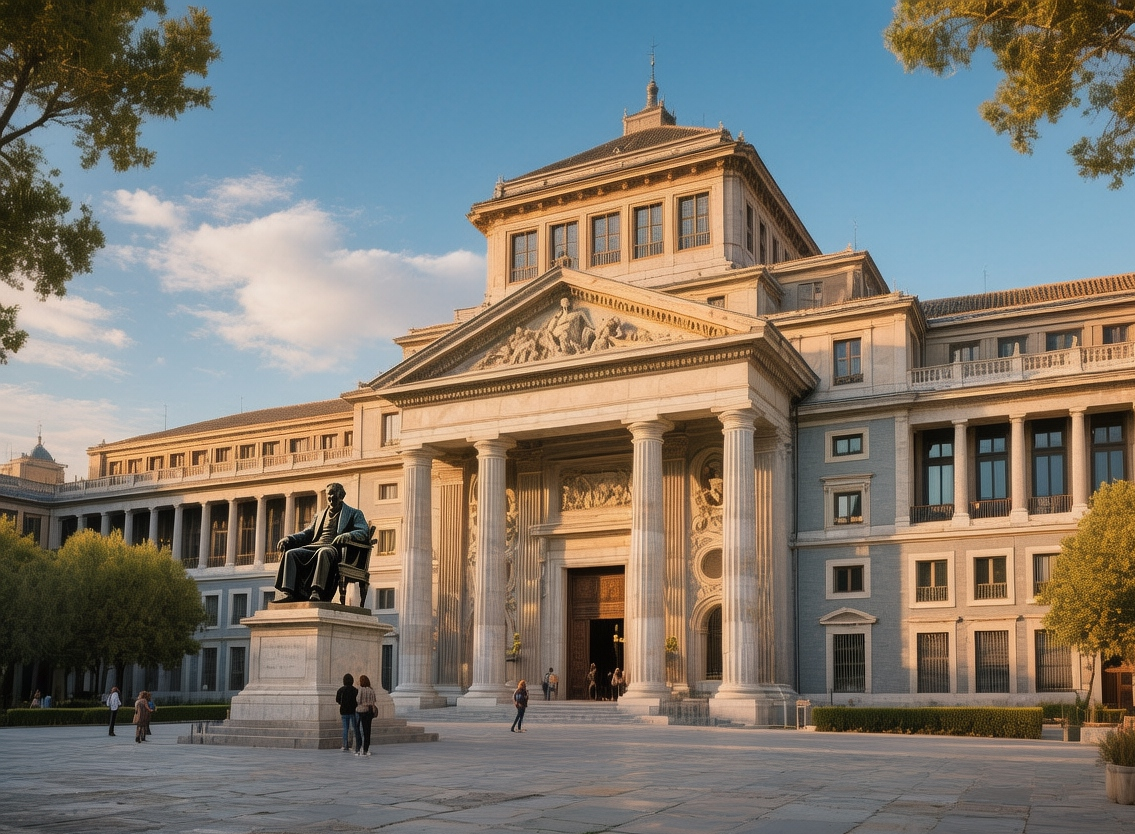
Prado Museum, Madrid Masterpiece Canvases Meet Castilian Light
The silence inside the Prado Museum, Madrid is not empty—it is heavy with the weight of centuries, broken only by the soft shuffle of footsteps on polished stone. You stand before Velázquez's Las Meninas, a canvas measuring 318 by 276 centimeters, where the light painted in 1656 seems to shift as you move. The air smells of floor wax and old oil paint; the temperature is a constant 20°C, preserved to protect the pigments from the harsh Castilian sun outside. This is the Prado Museum, Madrid, a neoclassical temple of art designed by Juan de Villanueva in 1785, housing over 8,000 paintings and 1,000 sculptures. You walk through galleries where Goya's dark visions hang beside Titian's golden mythologies, a dialogue of color and shadow spanning five hundred years. In 2026, as digital reproductions flood our screens, the Prado Museum, Madrid remains a sanctuary of the original—a place where the brushstroke is tangible, and the presence of the artist feels immediate, demanding a slowness that the modern world rarely affords.
Why Prado Museum, Madrid Embodies Artistic Sovereignty
The Prado Museum, Madrid represents one of the world's most concentrated collections of European art, solving the critical need to preserve the Spanish Royal Collection after the monarchy's decline. Opened to the public in 1819 under King Ferdinand VII, the museum was originally intended as a Natural History Cabinet but transformed into a painting gallery due to the sheer volume of royal acquisitions. The building itself, constructed between 1785 and 1808, utilizes granite and Colmenar limestone, designed to withstand Madrid's seismic activity while providing fireproof vaulted ceilings.
The collection's depth is unparalleled in Spanish art: it holds 100% of Velázquez's known works, 90% of Goya's paintings, and masterpieces by El Greco and Ribera. The engineering of the gallery spaces—specifically the Villanueva Building's central rotunda—allows for natural light to illuminate the canvases without UV damage, a feat of 18th-century architectural foresight. With over 3,100 square meters of exhibition space, the Prado Museum, Madrid functions not merely as a repository but as a narrative of power, faith, and human emotion. This concentration of genius makes it a pilgrimage site for art historians, where the evolution of Western painting is traced through the very brushstrokes that defined the medium.
The Best Time to Experience Prado Museum, Madrid
For the optimal Prado Museum, Madrid visit, target April 10–June 5 or September 20–November 15, when temperatures range between 15–25°C (59–77°F) and the light in the galleries is clearest. The museum opens at 10:00 AM Monday through Saturday; arrive 15 minutes before opening to enter with the first group, as school tours converge by 11:00 AM. Free entry hours—Monday to Saturday 6:00–8:00 PM and Sundays 5:00–7:00 PM—draw significant crowds; purchase tickets in advance to bypass queues. Sunset light through the western windows—specifically 5:00–6:30 PM in winter—creates dramatic shadows across the sculpture hall.
Avoid July 15–August 25 unless you tolerate heat and crowds; temperatures regularly exceed 35°C (95°F), making the queue outdoors uncomfortable despite air-conditioned interiors. The museum is busiest during Art Week (ARCO) in February; accommodation prices surge 40–60% during this period. Winter months (December–February) bring fewer tourists but shorter daylight hours for traveling to the site. Verify current exhibition schedules at www.museodelprado.es or contact the information desk at ayuda@museodelprado.es (+34 913 302 800). Tuesday mornings typically see the lowest visitor density, allowing for contemplative viewing of the masterpieces.
Approximate Budget for a 7-Day Trip
Madrid offers excellent value for cultural travelers, though costs fluctuate during major events like ARCO or San Isidro Festival. The following budget assumes mid-range comfort with a focus on local experiences, based on 2026 pricing with approximately 3.5% inflation from 2025 figures. Estimates include stays near the historic center for easy access to the Prado Museum, Madrid.
- Accommodation: €80–€150 per night for a double room in a boutique hotel or renovated apartment in Centro, Sol, or Jerónimos neighborhoods; luxury options near the museum command €200–€400 per night
- Food: €45–€65 per day—breakfast €5–€9 (café con leche and churros con chocolate), lunch €15–€25 (menú del día including cocido madrileño, salad, and wine), dinner €25–€35 (tapas selection including calamari and jamón ibérico)
- Transportation: Train from Barcelona Sants to Madrid Atocha: €50–€80 high-speed AVE (2.5 hours); Metro single ticket: €1.50 or €18.50 10-trip pass; taxi from airport: €35 fixed rate; bike rental: €15 per day
- Attractions: Prado Museum, Madrid entry: €16; Reina Sofía: €10; Royal Palace: €13; Retiro Park boat rental: €6; Thyssen-Bornemisza: €13
- Miscellaneous: Art books from €20; local wine €8–€20 per bottle; horchata drink €3; artisan leather goods €30–€70; guided museum tour €25
Total estimated cost for 7 days: €1,050–€1,450 per person (based on double occupancy; solo travelers should add 35–45% for single supplements)
7 Essential Prado Museum, Madrid Experiences
- Stand Before Las Meninas: Enter Room 012 in the Villanueva Building to face Velázquez's 1656 masterpiece. The painting measures 318 by 276 centimeters; stand 3 meters back to see the brushwork dissolve into light. Visit at 10:00 AM opening time to experience the space before crowds obscure the view. Notice the reflection of the king and queen in the mirror; the perspective is a puzzle that shifts as you move. Allow 20 minutes to observe the details of the Infanta's dress. This is the anchor of the Prado Museum, Madrid; do not rush past it.
- Explore Goya's Black Paintings: Descend to the ground floor to view the 14 murals painted directly onto the walls of Goya's house between 1819 and 1823. Saturn Devouring His Son and The Dog convey raw psychological terror. Visit between 2:00–4:00 PM when lighting accentuates the dark tones. The transfer from wall to canvas in 1874 preserved them for posterity. Audio guides explain the context of Goya's deafness and isolation. This collection defines the birth of modern expressionism.
- Examine Bosch's Garden of Earthly Delights: Locate the triptych in Room 056A, painted between 1490 and 1510. The intricate details of hell, paradise, and earth require close inspection. Use the provided magnifying glass stations if available. Visit at 11:30 AM when the guide explains the symbolism. The oak panels measure 220 by 389 centimeters when open. It is one of the most complex works in the Prado Museum, Madrid; allow 30 minutes to decode the imagery.
- Walk the Sculpture Gallery: Stroll through the central rotunda where Roman and Greek statues stand beneath a vaulted ceiling. The natural light from the skylights illuminates the marble textures. Visit in late afternoon when the sun angles through the windows. The collection includes pieces from the Royal Collection of Philip IV. Entry is free in this section. This provides a peaceful retreat from the crowded painting halls.
- View Titian's Emperor Charles V: Find the equestrian portrait in Room 049, painted in 1548. The armor gleams with gold leaf; the horse's muscles are rendered with anatomical precision. Visit when sunlight streams through the windows to illuminate the glaze. The painting defined royal portraiture for centuries. It demonstrates the Habsburg power that built the museum's original collection. Do not touch the protective glass; oils damage the surface.
- Attend Evening Openings: During summer months, special night openings occur with reduced crowds. The galleries are illuminated artificially, creating a mystical atmosphere distinct from daytime. Tickets cost €16 and must be booked in advance. Events run at 7:00 PM and 8:30 PM. The temperature drops significantly after sunset; bring a light jacket. This experience emphasizes the art over the tourism, appealing to serious viewers.
- Trace the Jerónimos Extension: Walk through the 2007 Rafael Moneo extension connecting the museum to the Church of San Jerónimo. The modern brick contrasts with the neoclassical original. Visit at 1:00 PM when the light wells illuminate the staircases. The space houses temporary exhibitions and 19th-century paintings. The architecture itself is worth studying. It reveals the museum's ongoing evolution beyond the 18th-century core.
3 Hidden Gems Most Travelers Miss
- Church of San Jerónimo el Real: Located directly adjacent to the Prado Museum, Madrid extension, this 16th-century church was restored in 2007. Entry is free; open 10:00 AM–6:00 PM. It is often overlooked as visitors focus on the museum entrance. The cloister features serene gardens and Renaissance arches. Contact: +34 914 202 873. Visit early morning for private guided tours that access rooms closed to general public. The connection tunnel allows seamless access from the museum.
- Villa de París Room: Tucked in the Jerónimos Building, this room displays 19th-century Spanish painting often skipped by tourists rushing to Velázquez. Features works by Sorolla and Fortuny. Entry included with ticket; open 10:00 AM–6:00 PM. It is quieter than the main halls. The light quality here is exceptional for photography. Look for the coastal scenes that capture Mediterranean light. It provides context for the transition to modernism.
- Café Velázquez: Located inside the museum under the Rotunda, this café features a ceiling painted by José María Sert. Entry requires museum ticket; open 10:00 AM–6:00 PM. It is often overlooked by tourists rushing to eat outside. The menu features traditional Spanish dishes at museum prices. Look for the mythological frescoes above the counter. It provides a restful pause without exiting the security perimeter. The coffee is superior to typical museum fare.
Cultural & Practical Tips
- Security checks: Expect airport-style security screening at the entrance. Large backpacks and suitcases are not permitted; use the left luggage facility at Atocha station or your hotel. Allow an extra 15 minutes for security processing during peak hours.
- Master these phrases: "Buenos días" (BWEH-nos DEE-as) for good morning; "Por favor" (por fah-BOR) for please; "Una entrada, por favor" (OO-nah en-TRAH-dah) to buy a ticket; "¿Dónde está el baño?" (DON-deh es-TAH el BA-nyo) to find the restroom.
- Photography guidelines: Flash photography is prohibited inside the museum to protect artwork. Tripods require special permission from the administration (+34 913 302 800). Mobile phones must be silenced. Respect "no fotos" signs in temporary exhibition areas.
- Free entry times: Monday to Saturday 6:00–8:00 PM and Sundays 5:00–7:00 PM offer free admission but draw large crowds. Arrive 45 minutes early to queue. Students under 25 and children under 18 enter free with ID all day. Seniors over 65 receive discounted rates (€8).
- Hydration strategy: Madrid's inland location means dry heat; carry a refillable water bottle. Public fountains (fuentes) are available in the Retiro Park nearby. The water is potable and sourced from local springs. You'll save €2–€3 daily and reduce plastic waste.
- Ticket strategy: Purchase tickets online at least 48 hours in advance during peak season (April–June, September–October). On-site queues can exceed 60 minutes. Combined passes with Thyssen-Bornemisza offer savings. Verify times on the official website before arriving.
- Weather considerations: The museum offers climate control but queues are outdoors; wear a hat and sunscreen during summer months. Winter evenings can be chilly; bring a light jacket even if the day is warm. Rain is rare but possible in November; the stone surfaces become slick when wet.
Conclusion: Travel with Reverence, Not Just Reverie
The Prado Museum, Madrid demands more than casual observation—it asks for contemplation of the layers of history embedded in every brushstroke, every frame, every gallery wall carved by hands long turned to dust. When you walk these halls in 2026, you're not merely touring a monument; you're walking through a fragile ecosystem of memory where Spanish sovereignty, artistic genius, and modern tourism intersect in delicate balance.
Choose to engage deeply: hire a local guide from the Jerónimos neighborhood rather than a large tour company; purchase tickets directly to support preservation efforts; respect the silence of the halls that house national treasures. The Prado Museum, Madrid survives not as a museum exhibit but as a living archive—and its preservation depends on visitors who recognize the difference between appreciation and consumption.
Slow down. Sit in the Rotunda after the tour buses depart. Listen to the silence that holds the weight of centuries. Taste the sweetness of a churro from a nearby café. The museum rewards those who approach it not as a checklist item but as a conversation across time—a dialogue between past and present that continues, like the light on the canvases, in perpetual motion.