
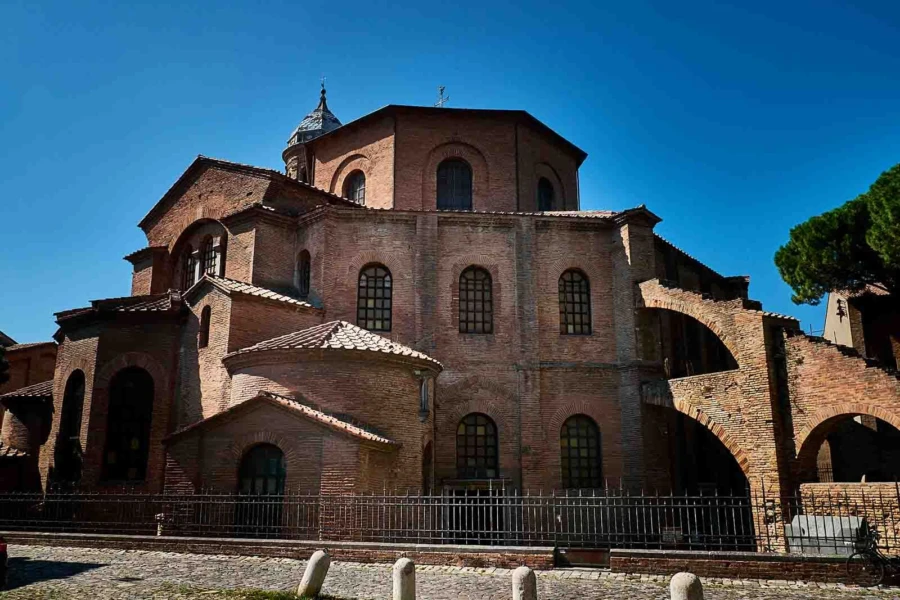
Ravenna Mosaics Golden Light Meets Sacred Geometry
The late sun slants through high clerestory windows—igniting the golden tesserae of Ravenna’s mosaics into a celestial fire that seems to hover just above the stone walls. You hear the soft shuffle of footsteps on ancient marble, the distant chime of a church bell, and the whisper of centuries echoing through vaulted naves. In this unassuming Adriatic city, eight UNESCO World Heritage sites preserve the most complete collection of early Christian and Byzantine mosaics in the world—dating from the 5th and 6th centuries, when Ravenna was the capital of the Western Roman Empire and later the seat of Byzantine power in Italy. These aren’t mere decorations; they are theological manifestos in glass and stone, where every tile—over 10 million in the Basilica of San Vitale alone—was placed with divine precision. In 2026, as digital screens dominate our visual landscape, Ravenna offers something rare: art that demands stillness, silence, and sustained attention—a sanctuary where light itself becomes sacred.
Why Ravenna Mosaics Embodies Divine Craftsmanship
Ravenna’s mosaics aren’t just beautiful—they’re a revolutionary fusion of imperial power, theological doctrine, and artistic innovation. After Emperor Honorius moved the Western Roman capital to Ravenna in 402 CE, the city became a canvas for political and spiritual messaging. The mosaics of the Mausoleum of Galla Placidia (c. 430 CE) use deep blue backgrounds and star-filled vaults to evoke the heavens, while the Basilica of San Vitale (consecrated in 547 CE) features life-sized portraits of Emperor Justinian and Empress Theodora—rare depictions of rulers in religious contexts, asserting their divine right to rule. Crafted from millions of tiny glass and stone cubes (tesserae), often backed with gold leaf, these works employed advanced techniques like opus vermiculatum (worm-like lines) to create fluid drapery and lifelike expressions. The materials were imported from across the empire: lapis lazuli from Afghanistan, porphyry from Egypt, and gold leaf from Syria. Unlike frescoes, mosaics resist humidity and time—critical in Ravenna’s marshy terrain. Today, these eight UNESCO sites—including the Neonian Baptistery and the Arian Baptistery—form a cohesive narrative of faith, power, and artistry that influenced everything from medieval iconography to modern design.
The Best Time to Experience Ravenna Mosaics
To view the mosaics in optimal light and manageable crowds, target the precise window of May 12–26, 2026. During these weeks, daytime temperatures range from a comfortable 18–24°C (64–75°F)—ideal for walking between sites and avoiding summer heat [[24], [27]]. Mornings between 8:30–10:00 AM offer soft, directional light that makes gold tesserae glow without harsh glare, and interiors are quiet enough to hear your own breath. Alternatively, September 15–29, 2026 provides similar conditions with softer light and fewer tourists. Avoid visiting during peak periods: all of July and August, when heat exceeds 32°C (90°F) and humidity dulls the mosaics’ brilliance, and major holidays like Ferragosto (August 15) [[29]]. For the most profound experience, visit San Vitale on a Tuesday or Thursday morning—when guided tours are less frequent, allowing for uninterrupted contemplation. Always verify opening hours via the official tourism portal (turismo.ra.it).
Approximate Budget for a 7-Day Trip (2026)
This budget reflects mid-range 2025 pricing adjusted for Italy’s projected 2026 inflation rate of 1.5% [[37]], offering a realistic estimate for a solo traveler based in Ravenna’s historic center.
- Accommodation: €700–€945 total (€100–€135 per night) for a boutique guesthouse or small hotel near Piazza del Popolo—central and steps from the main mosaic sites.
- Food: €490 total (€70 per day). Breakfast at a café (€4 for cappuccino and cornetto); lunch of piadina with squacquerone cheese (€12); dinner at a family-run osteria (€45 for passatelli in broth, grilled seafood, and house Sangiovese wine).
- Transportation: €65 total. Includes train from Bologna or Venice (€20 round-trip); local bus pass (€15 for 7 days); and occasional taxi for luggage (€30).
- Attractions: €55 total. Combined mosaic ticket (€13.50 for 5 sites); Dante’s Tomb visit (€2); guided mosaic history walk (€25); and workshop at a local mosaic studio (€15).
- Miscellaneous: €90 total. A handcrafted mosaic coaster from Koko Mosaico (€25); locally made ceramic tile (€30); leather journal from Libreria Feltrinelli (€20); and gelato from Gelateria Ciacco (€4).
Total Estimated Budget: €1,400–€1,645
6 Essential Ravenna Mosaics Experiences
- Witness the Justinian Panel at Dawn: Arrive at San Vitale by 8:30 AM to see the emperor’s retinue in soft morning light. Note how the gold background dissolves earthly space, placing the figures in eternal presence.
- Contemplate the Good Shepherd in Galla Placidia’s Mausoleum: In this intimate chapel, the youthful Christ cradles a lamb amid a starry blue vault—a rare blend of Roman naturalism and Christian symbolism.
- Compare the Orthodox and Arian Baptisteries: Visit both domes to see how nearly identical compositions (Christ’s baptism) convey different theological messages through subtle shifts in gesture and color.
- Attend a Mosaic Workshop: At Koko Mosaico or Studio Tintori, learn to cut and place tesserae using traditional methods—a hands-on way to appreciate the craft’s precision.
- Visit Dante’s Tomb at Dusk: Though not a mosaic site, the poet’s final resting place is steps from San Francesco. The adjacent Quadrarco di Braccioforte features simple but poignant 15th-century mosaics.
- See the Archiepiscopal Chapel’s Hidden Gems: This private chapel, part of the Archbishop’s Museum, contains the only surviving mosaic of Christ as a warrior—sword in hand, trampling beasts.
3 Hidden Gems Most Travelers Miss
- Chapel of Sant’Andrea: Behind the Duomo, this 8th-century chapel houses rare Lombard-era mosaics with geometric patterns and floral motifs—often empty even in high season.
- Museo TAMO (Tutti i Mosaici del Mondo): This innovative museum traces mosaic history from Mesopotamia to modern art. Its interactive displays reveal how Ravenna’s techniques influenced Picasso and Klimt.
- Libreria Feltrinelli Ravenna: Tucked near Piazza del Popolo, this bookstore hosts readings on Byzantine art and sells high-quality reproductions of mosaic details—perfect for quiet reflection after sightseeing.
Cultural & Practical Tips
- Dress modestly: Shoulders and knees must be covered in all religious sites. Security enforces this strictly, especially in San Vitale and the Baptistery.
- Photography is restricted: No flash or tripods inside mosaic sites to protect the ancient surfaces. In San Vitale, photography is often prohibited—always check signage.
- Buy the combined ticket: The “Mosaici di Ravenna” pass (€13.50) covers five key sites and is valid for 7 days—essential for efficient exploration.
- Learn key phrases: “Dov’è la Basilica di San Vitale?” (doh-VEH lah bah-ZEE-lee-kah dee San VEE-tah-leh?) for directions; “Grazie mille” (GRAHT-see-eh MEE-leh) for sincere thanks.
- Carry cash for small vendors: Many artisan shops and cafés don’t accept cards. Tipping isn’t expected, but rounding up is appreciated.
Conclusion: Travel with Contemplation, Not Just Cameras
In 2026, Ravenna’s mosaics invite more than admiration—they call for presence. Your €13.50 ticket funds the meticulous conservation of gold leaf that has shimmered for 1,500 years. Choosing a family-run osteria over a tourist trap keeps euros in the community; sitting quietly before Theodora’s procession honors the artisans who believed beauty could lead to the divine; tracing the curve of a saint’s robe connects you to hands that shaped history one tile at a time. Slow down: let the blue vaults dissolve your sense of time, listen to the silence between footsteps, allow the gold to warm your spirit. By traveling with contemplation—prioritizing depth over speed—you help ensure Ravenna remains not just a stop on a tour, but a living sanctuary of light and stone where wonder endures. Let your visit be a quiet promise—and these walls will remember your respect long after you’ve left their glow.