
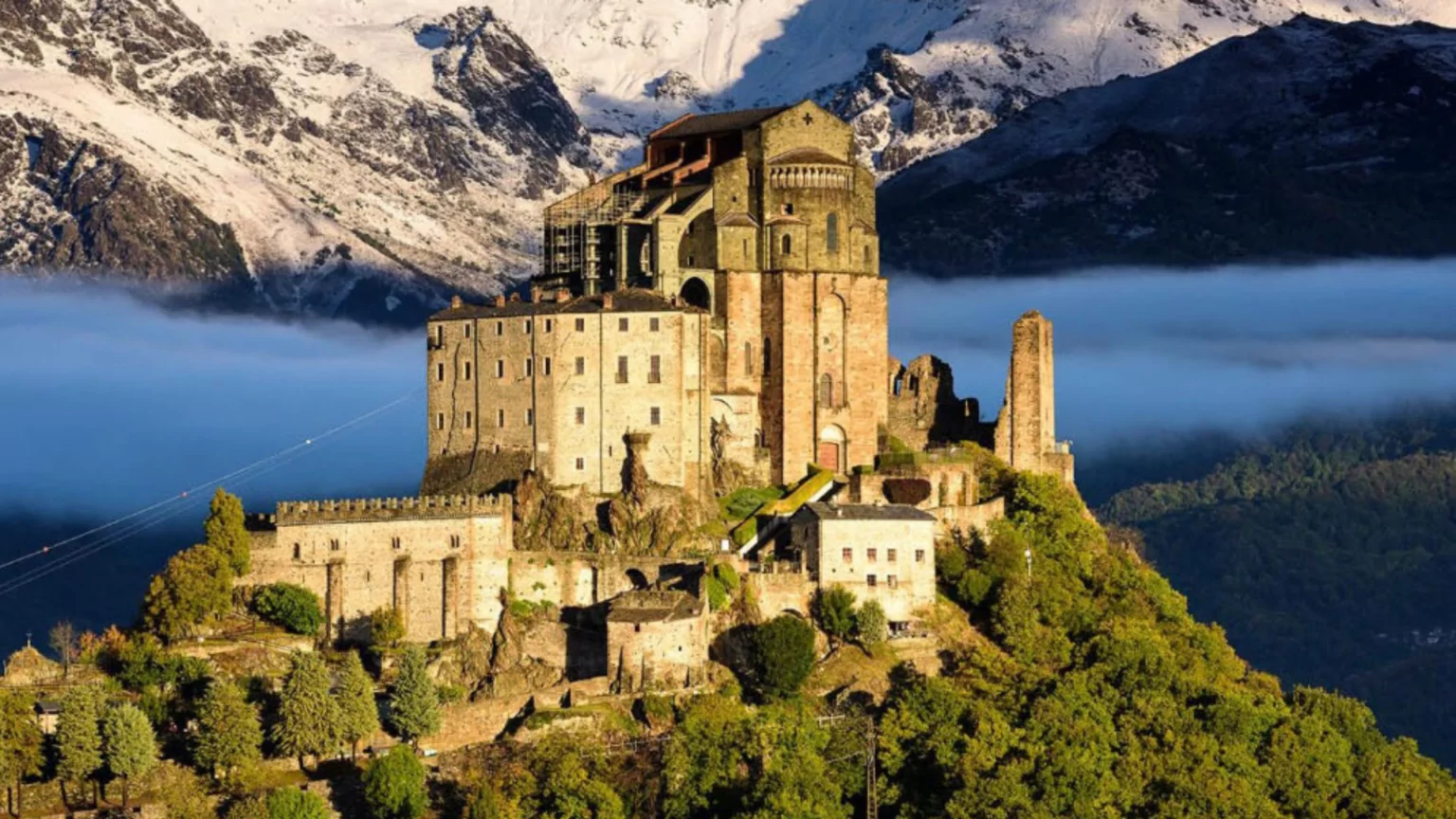
Sacra di San Michele Mountain Stone Meets Celestial Silence
The first light of dawn spills over the Susa Valley—turning the Sacra di San Michele into a silhouette of stone and faith against a soft lavender sky. You hear the distant chime of monastery bells, the rustle of alpine wind through ancient cypresses, and the crunch of gravel underfoot as you ascend the final steps to this mountaintop abbey. Perched at 962 meters (3,156 feet) on Mount Pirchiriano, this Benedictine monastery has stood since the 10th century as a spiritual sentinel between Turin and the French Alps. Its dramatic location—accessible only by foot or winding road—was chosen for its symbolic power: a bridge between earth and heaven, man and the divine. Built along the ancient Via Francigena pilgrimage route, the Sacra’s soaring arches, crypts carved into rock, and the famed “Stairway of the Dead” have inspired poets, pilgrims, and Umberto Eco, who set his novel The Name of the Rose here. In 2026, as digital noise drowns quiet reflection, the Sacra offers something rare: a sanctuary where silence speaks louder than spectacle.
Why Sacra di San Michele Embodies Sacred Architecture
The Sacra di San Michele isn’t just a monastery—it’s a masterwork of medieval engineering and spiritual symbolism. Founded around 983 CE by Benedictine monks, it was built atop a pre-Christian sacred site, its location chosen for its commanding view of the Susa Valley—a strategic and mystical crossroads. The complex stretches over 100 meters along the mountain ridge, constructed from local gray stone and featuring Romanesque and Gothic elements fused across centuries. Its most iconic feature is the **Stairway of the Dead**—a steep, vaulted corridor lined with tombs of noble pilgrims who died en route to Rome. Above it rises the **Tower of the Bell**, standing 47 meters tall, and the **Church of the Old Sacristy**, with its apse hewn directly from the mountain rock. The abbey solved a profound need: to provide spiritual refuge and physical safety for pilgrims traveling the Via Francigena. At its peak in the 12th century, it housed over 100 monks and controlled vast lands. Abandoned in 1622 and nearly lost to ruin, it was saved by King Carlo Alberto of Savoy in the 19th century and restored as a national monument. Today, it remains an active place of worship and a UNESCO World Heritage candidate—a testament to how faith and stone can endure time itself.
The Best Time to Experience Sacra di San Michele
To experience the Sacra in serene beauty and optimal light, target the precise window of May 18–June 12, 2026. During these weeks, daytime temperatures range from a comfortable 14–21°C (57–70°F)—ideal for the 1.5-kilometer uphill walk and exploring the exposed terraces [[24], [27]]. Mornings between 8:00–9:30 AM offer mist-shrouded valleys, empty pathways, and soft light that highlights the texture of ancient stone. Alternatively, September 10–24, 2026 provides similar conditions with golden autumn hues and fewer visitors. Avoid visiting during peak periods: all of July and August, when afternoon thunderstorms are common and heat makes the climb strenuous, and major religious holidays like All Saints’ Day (November 1), when pilgrim numbers surge [[29]]. For the most profound experience, attend the 7:00 AM Mass in the crypt—locals and pilgrims gather in hushed unity, their voices echoing through the mountain. Always verify opening hours via the official Fondazione S. Michele website (sanmichelemonte.it).
Approximate Budget for a 7-Day Trip (2026)
This budget reflects mid-range 2025 pricing adjusted for Italy’s projected 2026 inflation rate of 1.5% [[37]], offering a realistic estimate for a solo traveler based in Turin with a day trip to the Sacra.
- Accommodation: €770–€1,050 total (€110–€150 per night) for a boutique hotel or private apartment in Turin’s historic center—well-connected by train to Sant’Ambrogio di Torino, the base village.
- Food: €490 total (€70 per day). Breakfast at a café (€4 for cappuccino and brioche); lunch of tajarin pasta with butter and sage (€14); dinner at a family-run osteria (€45 for brasato al Barolo, roasted vegetables, and house Nebbiolo wine).
- Transportation: €65 total. Includes train from Turin to Sant’Ambrogio (€5 round-trip); shuttle bus or taxi to the trailhead (€10); and local bus pass in Turin (€15 for 7 days).
- Attractions: €55 total. Sacra di San Michele entry (€10); guided spiritual walk (€20 donation); Turin Royal Palace (€15); and bicerin tasting at Caffè Al Bicerin (€4).
- Miscellaneous: €90 total. A high-quality print of the abbey (€25); locally made gianduja chocolate (€20); leather journal from Libreria Internazionale (€30); and gelato from Gelateria Pepino (€4).
Total Estimated Budget: €1,470–€1,760
6 Essential Sacra di San Michele Experiences
- Climb the “Scalone dei Morti” at Dawn: Ascend the Stairway of the Dead in early morning light. The vaulted corridor, lined with medieval tombs, feels like walking through time—each step echoing with centuries of prayer.
- Attend Morning Mass in the Crypt: Join the 7:00 AM service in the rock-hewn crypt. The candlelit space, filled with whispered Latin chants, offers a deeply moving start to your day.
- Hike the Pilgrim’s Path from Sant’Ambrogio: Take the 1.5-kilometer “Via Crucis” trail—stone steps winding through chestnut forests. The path replicates the medieval journey, ending at the abbey’s grand portal.
- View the Susa Valley from the Bell Tower Terrace: Climb the 47-meter tower for panoramic views of the Alps and valley—a perspective unchanged since the 11th century.
- Explore the Ruined Cloister: Wander the skeletal remains of the monks’ cloister, where ivy climbs broken arches and wildflowers bloom in spring—a haunting reminder of time’s passage.
- Visit the Onlus Bookshop: Support restoration efforts by purchasing a book on Benedictine history or a hand-printed postcard—the proceeds fund ongoing conservation.
3 Hidden Gems Most Travelers Miss
- Eremo di San Giovanni Vincenzo: A 30-minute hike beyond the Sacra leads to this secluded hermitage, still inhabited by a single monk. Visitors may leave a note in the prayer box—responses sometimes appear weeks later.
- Chiesa di San Pietro in Vincoli: In Sant’Ambrogio village, this 11th-century church features rare frescoes and a peaceful courtyard. Often empty, it’s a perfect reflective pause before the ascent.
- Rifugio San Michele Café: Just below the abbey, this simple café serves espresso and walnut cake with a terrace overlooking the valley—ideal for post-climb contemplation.
Cultural & Practical Tips
- Dress modestly: Shoulders and knees must be covered to enter the church and crypt. Security enforces this strictly, especially during services.
- Wear sturdy hiking shoes: The pilgrim’s path includes uneven stone steps and forest trails. Sandals or flip-flops are impractical and unsafe.
- Carry water and layers: Weather changes rapidly at 962 meters. Even in summer, mornings are cool and afternoons can bring sudden rain.
- Learn key phrases: “Dov’è la Sacra di San Michele?” (doh-VEH lah SAH-krah dee San MEE-keh-leh?) for directions; “Grazie mille” (GRAHT-see-eh MEE-leh) for sincere thanks.
- Photography is restricted: No flash inside the crypt or church. Tripods require special permission—always ask at the entrance.
Conclusion: Travel with Reverence, Not Just Recognition
In 2026, the Sacra di San Michele invites more than admiration—it calls for presence. Your €10 ticket funds the preservation of frescoes and stonework that have weathered a millennium of storms. Choosing to hike the pilgrim’s path connects you to seekers who’ve walked these steps since the Middle Ages; sitting quietly in the crypt honors centuries of prayer; listening to the wind through the cloister arches reminds you that some truths are found only in silence. Slow down: taste wine pressed from local grapes, trace the grooves of centuries-old doorways, let the mountain air clear your mind. By traveling with reverence—prioritizing depth over speed—you help ensure the Sacra remains not just a landmark, but a living sanctuary of spirit and stone. Let your visit be a vow: that wonder, carefully tended, can endure for generations on this sacred mountaintop.