
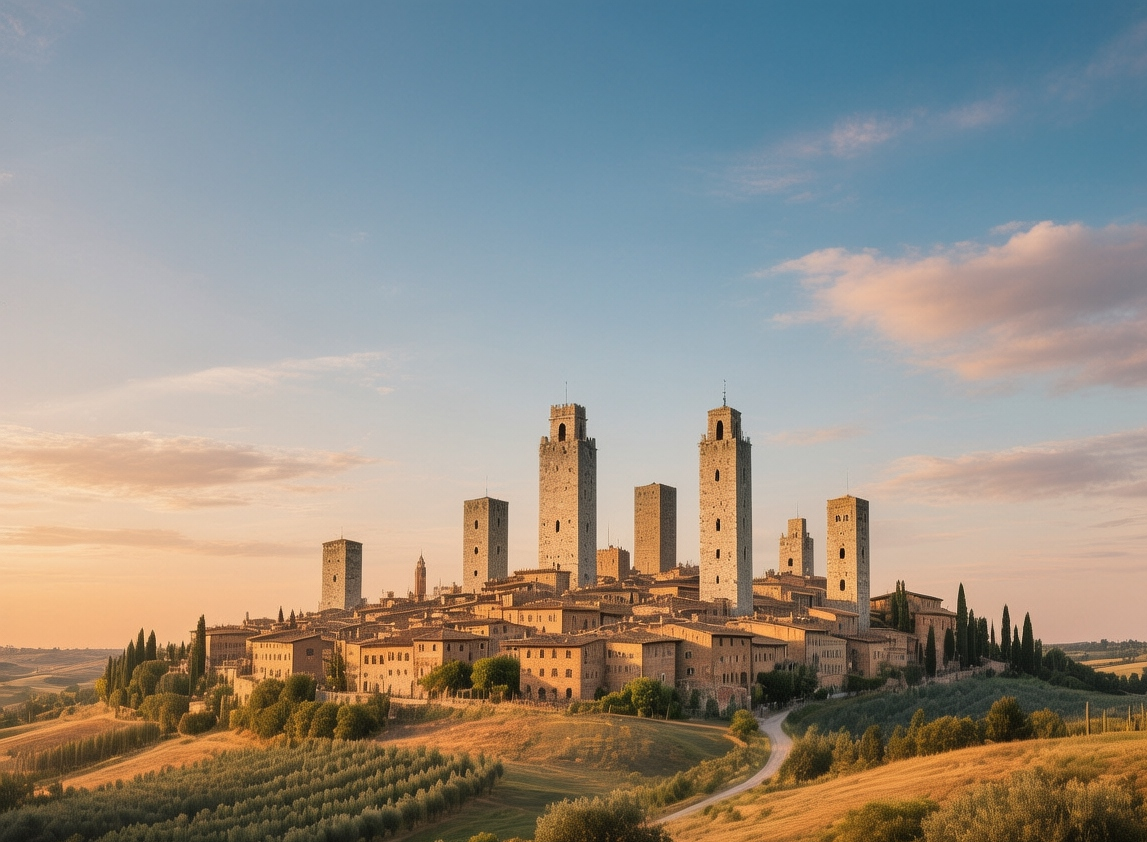
San Gimignano Towers Medieval Ambition Meets Tuscan Sky
The late sun gilds the hilltop of San Gimignano—turning its forest of stone towers into golden sentinels against a soft lavender sky. You hear the distant chime of church bells, the rustle of cypress leaves in the breeze, and the murmur of Italian families gathering in Piazza della Cisterna. Once home to 72 rival towers built by feuding noble families in the 12th and 13th centuries, this walled town now stands with 14 remaining spires—some soaring over 50 meters (164 feet)—a testament to medieval one-upmanship frozen in time. Encircled by 2.5 kilometers of intact walls and perched on a ridge between Florence and Siena, San Gimignano was a crucial stop on the Via Francigena pilgrimage route. In 2026, as overtourism strains historic centers across Tuscany, this UNESCO World Heritage site offers a rare balance: monumental grandeur and intimate authenticity, where every cobblestone whispers of power, pride, and preservation.
Why San Gimignano Towers Embodies Vertical Rivalry
San Gimignano’s towers aren’t just architectural relics—they’re stone declarations of wealth and status from a turbulent era. Between the 11th and 14th centuries, rival Guelph and Ghibelline families competed to build the tallest tower, symbolizing political dominance and economic power. At its peak, the town boasted 72 towers, some exceeding 70 meters (230 feet)—higher than many modern apartment blocks. The tallest, Torre Grossa, rises 54 meters (177 feet) and was completed in 1311 by the Ardinghelli family. Construction halted after the Black Death devastated the population in 1348, freezing the skyline in its dramatic state. Built from local limestone and travertine without scaffolding, these towers feature minimal windows and thick walls (up to 2.5 meters thick at the base) for defense and structural stability. In 1255, the town council passed a law limiting new towers to the height of the Palazzo del Podestà (51 meters), but enforcement was inconsistent. Today, the 14 surviving towers—along with the town’s intact walls, churches, and piazzas—form a remarkably preserved medieval urban fabric, earning UNESCO designation in 1990 as “an outstanding example of a medieval urban ensemble.”
The Best Time to Experience San Gimignano Towers
To explore the towers and piazzas in comfortable weather and manageable crowds, target the precise window of May 15–29, 2026. During these weeks, daytime temperatures range from a pleasant 19–25°C (66–77°F)—ideal for climbing Torre Grossa and walking the city walls [[24], [27]]. Mornings between 8:00–9:30 AM offer near solitude in Piazza del Duomo and clear views from tower tops before tour buses arrive. Alternatively, September 12–26, 2026 provides similar conditions with softer light and fewer visitors. Avoid visiting during peak periods: all of July and August, when temperatures exceed 32°C (90°F) and narrow streets become congested, and major holidays like Italian Ferragosto (August 15) [[29]]. For the most magical experience, stay overnight—day-trippers vanish by 6:00 PM, revealing the town’s quiet, residential soul. Always verify opening hours via the official tourism portal (sangimignano.com).
Approximate Budget for a 7-Day Trip (2026)
This budget reflects mid-range 2025 pricing adjusted for Italy’s projected 2026 inflation rate of 1.5% [[37]], offering a realistic estimate for a solo traveler based in San Gimignano or nearby Castellina in Chianti.
- Accommodation: €840–€1,120 total (€120–€160 per night) for a boutique guesthouse or private apartment within the walls or in the surrounding countryside—offering views and tranquility.
- Food: €490 total (€70 per day). Breakfast at a café (€4 for cappuccino and cornetto); lunch of pici pasta with wild boar ragù (€16); dinner at a family-run osteria (€45 for grilled lamb chops, saffron risotto, and house Vernaccia wine).
- Transportation: €75 total. Includes train from Florence (€10 round-trip); local bus to San Gimignano (€4); and rental car for flexibility (€61 for 3 days to explore nearby vineyards).
- Attractions: €65 total. Torre Grossa climb (€6); Civic Museum & Art Gallery (€10); San Gimignano 1300 museum (€12); guided walking tour (€20); and wine tasting at a local cantina (€17).
- Miscellaneous: €95 total. A bottle of Vernaccia di San Gimignano DOCG wine (€25); handcrafted saffron (€20); locally made leather journal (€30); and gelato from Gelateria Dondoli (€4).
Total Estimated Budget: €1,565–€1,850
6 Essential San Gimignano Towers Experiences
- Climb Torre Grossa at Sunrise: Book the 8:00 AM slot to ascend 218 steps for panoramic views of the Tuscan countryside—rolling hills, vineyards, and the iconic towers below bathed in golden light.
- Stroll Piazza della Cisterna at Dawn: Arrive by 7:30 AM to experience this triangular square in silence. The wellhead at its center, dating to 1346, once served as the town’s main water source.
- Walk the Intact City Walls: Follow the 2.5-kilometer perimeter path for elevated views of the towers and surrounding countryside—a perspective few tourists seek.
- Taste Vernaccia di San Gimignano: At Cantina San Giusto, sample Italy’s first white wine to receive DOCG status (1993), known for its crisp minerality and citrus notes.
- Visit San Gimignano 1300 Museum: This immersive exhibit features a 1:100 scale model of the town as it appeared in 1300—with all 72 towers—bringing medieval rivalry to life.
- Watch Sunset from Rocca di Montestaffoli: This ruined fortress on the town’s western edge offers unobstructed views of the towers silhouetted against the setting sun—a perfect end to your day.
3 Hidden Gems Most Travelers Miss
- Oratorio di Sant’Agostino: Tucked off Via San Matteo, this 13th-century chapel features frescoes by Benozzo Gozzoli. Often empty, it’s a serene counterpoint to the crowded Duomo.
- Fattoria San Donato Farm: Just outside the walls, this organic farm offers saffron harvesting workshops in October. Call ahead (+39 0577 940 123) for a private tour and tasting.
- Via delle Fonti Secret Path: Behind Piazza della Cisterna, this narrow lane leads to ancient public fountains and hidden courtyards—ideal for photography away from crowds.
Cultural & Practical Tips
- Book tower tickets early: Only 25 people are allowed in Torre Grossa every 30 minutes. Reserve online via museisenesi.org.
- Wear sturdy shoes: Streets are steep and paved with uneven cobblestones. Sandals or flip-flops are impractical for daily exploration.
- Respect residential spaces: Many towers are private homes. Never enter courtyards without permission, and keep noise down in narrow alleys after 10:00 PM.
- Learn key phrases: “Dov’è la Torre Grossa?” (doh-VEH lah TOR-reh GROS-sah?) for directions; “Grazie mille” (GRAHT-see-eh MEE-leh) for sincere thanks.
- Carry cash for small vendors: Many artisan shops and wine bars don’t accept cards. Tipping isn’t expected, but rounding up is appreciated.
Conclusion: Travel with Reverence, Not Just Recognition
In 2026, San Gimignano invites more than photo ops—it calls for historical presence. Your €6 tower ticket funds conservation of medieval stonework; choosing a family-run osteria supports generational artisans; carrying out your trash preserves the same landscape that inspired Dante Alighieri, who visited in 1300. Slow down: sip Vernaccia where the grapes were grown, trace the grooves of centuries-old doorways, listen to the echo of footsteps in Piazza del Duomo. By traveling with reverence—prioritizing depth over speed—you help ensure San Gimignano remains not just a skyline of towers, but a living community where history breathes through every alley. Let your visit be a promise: that ambition, tempered by care, can endure for centuries more.