
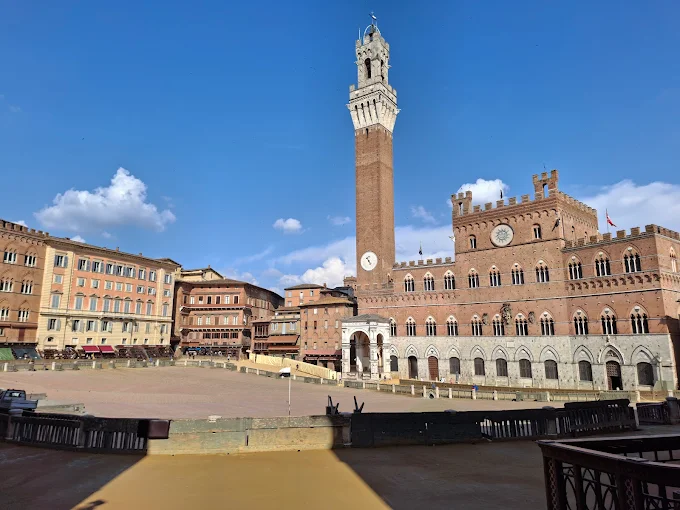
Siena – Piazza del Campo Medieval Harmony Meets Living Tradition
The late sun gilds the terracotta rooftops of Siena—casting long shadows across the Piazza del Campo, a vast, shell-shaped square paved with red brick and travertine. You hear the murmur of Italian families gathering on the sloping benches, the distant chime of the Torre del Mangia’s bell, and the rustle of silk banners from the city’s 17 contrade (districts) fluttering in the breeze. Built in the 14th century as a civic heart for a proud republic, this UNESCO World Heritage site is one of Europe’s greatest medieval squares—measuring 13,000 square meters and designed to host public life, markets, and celebrations. Its unique fishbone-patterned pavement slopes gently toward the Palazzo Pubblico, symbolizing the convergence of citizens under communal rule. In 2026, as mass tourism threatens historic centers across Italy, Siena remains fiercely protective of its identity—where the Palio horse race still ignites centuries-old rivalries, and every stone whispers of a time when art, governance, and community were inseparable.
Why Siena – Piazza del Campo Embodies Civic Renaissance
The Piazza del Campo isn’t just a square—it’s a revolutionary urban manifesto carved in brick and stone. Constructed between 1287 and 1349 by the Republic of Siena, it was designed as a democratic counterpoint to ecclesiastical power, centered around the secular Palazzo Pubblico (Town Hall). Its distinctive fan shape—divided into nine segments representing the Council of Nine that ruled Siena during its golden age—creates a natural amphitheater that slopes gently toward the Palazzo, symbolizing unity and civic equality. The pavement, laid in 1349, uses a herringbone pattern of red brick and white travertine that radiates from the central drain, guiding rainwater and crowds alike toward the seat of government. Towering above it all is the 102-meter (335-foot) Torre del Mangia, completed in 1348 and named after its first bell-ringer, Giovanni di Balduccio, nicknamed “Mangiaguadagni” (Eat-Profit) for his spendthrift ways. At the time, it was the tallest secular tower in Italy—deliberately built to match the height of Siena Cathedral’s bell tower, asserting civic parity with the Church. Today, the piazza remains a living stage for the Palio di Siena, held twice each summer—a bareback horse race that has united and divided the city’s contrade since 1656.
The Best Time to Experience Siena – Piazza del Campo
To experience the piazza in serene beauty and avoid Palio chaos, target the precise window of May 12–26, 2026. During these weeks, daytime temperatures range from a comfortable 18–24°C (64–75°F)—ideal for exploring the Torre del Mangia and wandering the contrade alleys [[24], [27]]. Mornings between 8:00–9:30 AM offer near solitude on the brick benches, perfect for photography and quiet reflection. Alternatively, September 18–October 2, 2026 provides similar conditions with softer light and post-Palio calm. Avoid visiting during peak periods: July 2 and August 16, when the Palio transforms the piazza into a packed, high-stakes arena (bookings fill a year ahead), and all of August, when heat and crowds peak [[29]]. For the most authentic experience, attend a non-Palio contrada festival—many hold private dinners and flag-throwing displays in May or September. Always verify event calendars via the official Comune di Siena portal (comune.siena.it).
Approximate Budget for a 7-Day Trip (2026)
This budget reflects mid-range 2025 pricing adjusted for Italy’s projected 2026 inflation rate of 1.5% [[37]], offering a realistic estimate for a solo traveler based in Siena’s historic center.
- Accommodation: €770–€1,050 total (€110–€150 per night) for a 3-star hotel or private apartment in the Terzo di Città district—central yet quieter than the immediate piazza area.
- Food: €490 total (€70 per day). Breakfast at a café (€4 for cappuccino and cornetto); lunch of pici pasta with wild boar ragù (€16); dinner at a family-run osteria (€45 for ribollita, grilled lamb chops, and house Chianti).
- Transportation: €55 total. Includes train from Florence (€15 round-trip); local bus from station to center (€2); and occasional taxi for luggage (€38).
- Attractions: €85 total. Torre del Mangia climb (€12); Palazzo Pubblico & Civic Museum (€10); Siena Cathedral complex (€15); guided contrada tour (€25); and wine tasting in nearby Chianti (€23).
- Miscellaneous: €90 total. A high-quality print from Libreria Piccolomini (€25); gelato from Gelateria Kopakabana (€4); locally made leather journal (€30); and a contrada silk scarf (€25).
Total Estimated Budget: €1,490–€1,780
6 Essential Siena – Piazza del Campo Experiences
- Climb the Torre del Mangia at Sunrise: Book the 8:00 AM slot to ascend 400 steps for panoramic views of Siena’s terracotta sea and the Tuscan hills beyond—before crowds arrive and the sun beats down.
- Attend a Contrada Museum Visit: Explore the Oca (Goose) or Chiocciola (Snail) contrada museum to see historic Palio banners, costumes, and trophies—a glimpse into Siena’s deep-rooted neighborhood pride.
- Dine on the Piazza’s Slope: At Osteria Le Logge, enjoy a glass of Vernaccia di San Gimignano while seated on the brick incline—the same spot where citizens gathered for centuries.
- Witness the Fonte Gaia at Dawn: The piazza’s northern edge features Jacopo della Quercia’s 1419 fountain. Visit early to see its marble figures unobstructed by crowds, bathed in soft morning light.
- Walk the Contrade Alleys: Wander narrow lanes like Via di Città to discover hidden courtyards, artisan workshops, and contrada fountains—each district has its own emblem and colors.
- Attend a Flag-Throwing Demonstration: In May or September, many contrade host free exhibitions of sbandieratori—athletes who twirl and toss heavy silk flags in choreographed displays of skill and tradition.
3 Hidden Gems Most Travelers Miss
- Orto Botanico dell’Università: Tucked behind the cathedral, this 18th-century botanical garden features medicinal herbs and rare Tuscan plants. Entry is €3, and you’ll likely have it to yourself.
- San Domenico Basilica Rooftop: Climb the stairs beside the church for a free, crowd-free view of the piazza and Torre del Mangia—locals’ secret for sunset photos.
- Libreria Piccolomini: Established in 1928, this historic bookstore near the Duomo specializes in maps, prints, and Sienese literature. Its frescoed ceiling and antique globes make it a quiet sanctuary.
Cultural & Practical Tips
- Book Torre del Mangia tickets online: Only 150 visitors are allowed per hour. Reserve via comune.siena.it to avoid long queues.
- Respect contrada boundaries: Each district is a tight-knit community. Ask before photographing private courtyards or contrada shrines.
- Dress modestly for churches: Shoulders and knees must be covered in the Duomo and San Domenico.
- Learn key phrases: “Dov’è la Torre del Mangia?” (doh-VEH lah TOR-reh del MAN-jah?) for directions; “Grazie mille” (GRAHT-see-eh MEE-leh) for sincere thanks.
- Carry cash for small eateries: Many family-run osterias don’t accept cards. Tipping isn’t expected, but rounding up is appreciated.
Conclusion: Travel with Community, Not Just Cameras
In 2026, Siena invites more than sightseeing—it calls for belonging. Your presence here supports not just tourism, but the living fabric of the contrade—where neighbors share meals, preserve crafts, and pass down Palio lore through generations. Choosing a family osteria over a piazza-front café keeps euros in local hands; learning the story behind a contrada’s emblem honors centuries of identity; sitting quietly on the brick slope connects you to citizens who’ve done the same since the 1300s. Slow down: listen to the bell’s echo, taste wine pressed from local grapes, watch artisans carve wood in shadowed alleys. By traveling with community—prioritizing connection over content—you help ensure Siena remains not just a monument, but a home. Let your visit be a thread in its enduring tapestry—and these stones will remember your respect long after you’ve left the piazza.