
Tuileries Garden, Paris : Power, Art, and Public Life Converge
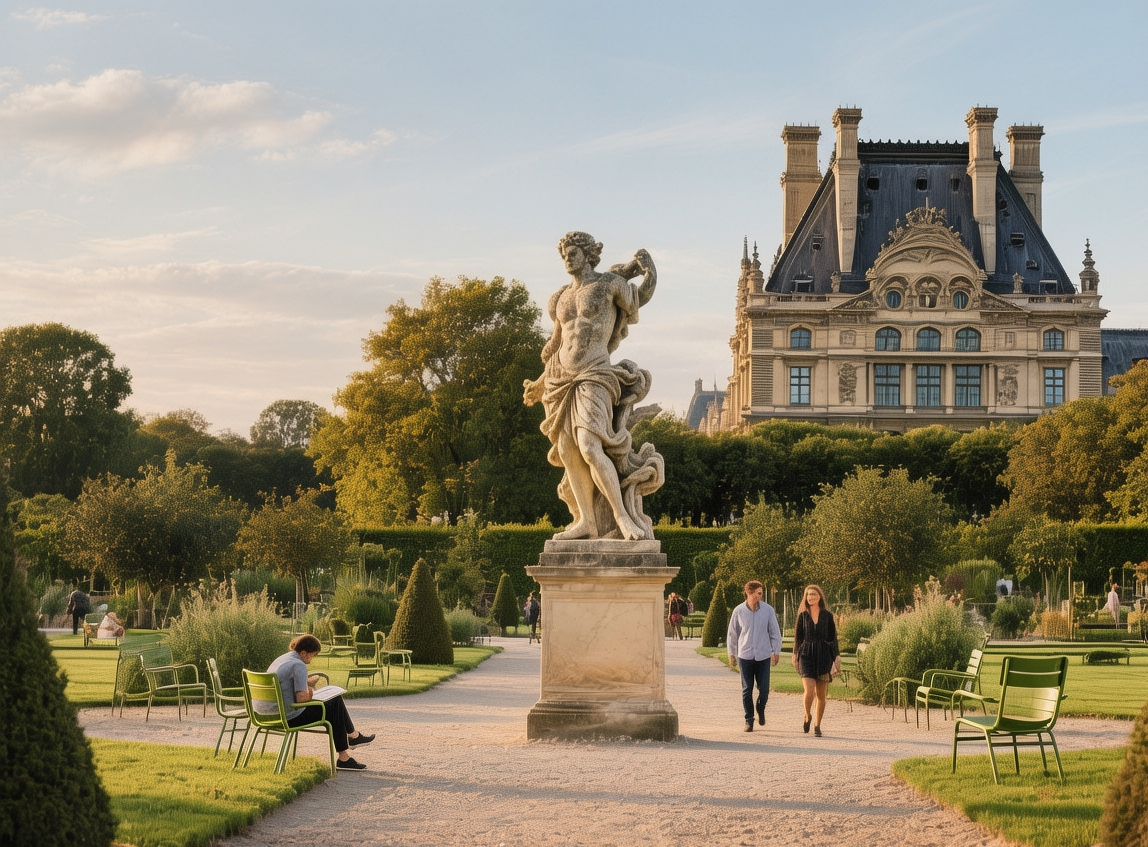
The Tuileries Garden doesn't announce itself with fanfare—it reveals itself through rhythm. As morning light filters through the chestnut allée, the gravel crunches underfoot in precise cadence while green chairs stand in military rows awaiting their occupants. To the east, I.M. Pei's glass pyramid catches the sun with quiet audacity; to the west, the Arc de Triomphe anchors the horizon along the world's grandest axial vista. This 28-hectare rectangle of formal French landscaping has witnessed history not as spectator but participant: Catherine de' Medici built her Tuileries Palace here in 1564 to escape the Louvre's gloom; revolutionaries stormed its gates in 1789; Napoleon reviewed troops on its central esplanade; and Monet painted its chestnut blossoms while the city modernized around him. Today, the Tuileries Garden remains Paris's most politically charged public space—not for protests, but for its daily demonstration that beauty belongs to everyone who claims a chair beneath the trees.
Why Tuileries Garden, Paris Endures as Essential Urban Sanctuary
The Tuileries Garden represents more than landscape design—it embodies the French Enlightenment ideal of accessible beauty. Unlike private royal gardens that preceded it, André Le Nôtre's 1667 redesign intentionally created sightlines connecting royal power (Louvre) with public space (the garden) and civic ambition (Place de la Concorde). This axial philosophy—extending 5.5 kilometers from the Louvre to La Défense—remains Europe's most ambitious urban planning achievement. The garden's power lies in democratic functionality: its geometric parterres satisfy formal aesthetics while gravel paths invite lingering, its ponds reflect sky without demanding reverence, and its chairs (introduced in 1923) democratize rest for all who arrive early enough to claim one. Surviving the Tuileries Palace's 1871 destruction during the Paris Commune, the garden transformed from royal appendage to civic institution—today hosting contemporary sculpture installations beside 17th-century statuary, proving that public space thrives not through preservation, but through continuous reinvention.
The Best Time to Experience Tuileries Garden, Paris
For optimal conditions—soft light on gravel pathways, manageable crowds, and authentic Parisian atmosphere—visit on a weekday between 8:00 and 9:30 AM from May 5 to June 15. Daytime temperatures average 14–21°C (57–70°F), the horse-chestnut trees provide dappled shade without summer's intensity, and the rose gardens begin their first bloom cycle. This window offers the garden in its most authentic state: gardeners in blue aprons arranging the 2,000 iconic green chairs in precise rows while elderly Parisians claim their regular spots with newspapers and thermoses. Morning light between 8:30–10:00 AM creates ideal photography conditions—long shadows accentuate Le Nôtre's geometric precision without harsh midday glare. September 10–25 provides a second excellent opportunity: warm days, departing tourists, and golden hour light that gilds the octagonal ponds. Avoid July–August weekends when heat drives crowds toward water features, creating congestion along central pathways. Note that the garden closes 30 minutes before sunset year-round—exact times shift seasonally (7:00 PM winter, 9:30 PM summer).
Approximate Budget for a 7-Day Trip (2026)
Based on 2025 benchmarks adjusted for 4% inflation (per INSEE and Paris Île-de-France Tourism Office projections), here's a realistic mid-range budget for a Paris itinerary centered on cultural immersion:
- Accommodation: €115–€165 per night for a boutique hotel in the 1st arrondissement (Les Halles) or Saint-Germain-l'Auxerrois—within 10-minute walk of the garden's eastern entrance.
- Food: €95–€110 per day—breakfast at bakery (€7), picnic supplies from Marché des Enfants Rouges (€20–€25), dinner at neighborhood bistro with natural wine (€50–€65).
- Transportation: €36 for a weekly Navigo Découverte pass (covers all Metro lines; Tuileries accessible via Palais Royal–Musée du Louvre or Tuileries stations).
- Attractions: Tuileries Garden: free. Louvre entry (advance booking essential): €17. Orangerie Museum (Monet's Water Lilies): €12.50. Pompidou Centre: €15. Allocate €100 total.
- Miscellaneous: €50 for artisanal chocolates from Angelina, fresh flowers from Rue de Rivoli market, or contributions to garden conservation via Les Amis des Tuileries association.
Total Estimated Cost: €1,250–€1,750 for seven days, excluding international flights.
5 Essential Tuileries Garden Experiences
- The Green Chair Ritual: Arrive before 9:00 AM to claim one of 2,000 signature green chairs arranged in precise rows—locals favor spots near the Grand Bassin for people-watching or the western terrace for sunset views toward Place de la Concorde.
- Grand Bassin Octagonal Ponds: The garden's central water feature where children sail vintage wooden boats (€4 rental) while chestnut blossoms drift across the surface—a tradition unchanged since 1920.
- Contemporary Sculpture Dialogue: Walk the central allée where Aristide Maillol's classical nudes converse with modern installations—currently featuring rotating works from the Musée d'Orsay's collection through 2026.
- Orangerie Connection: Exit the western gate directly into the Musée de l'Orangerie to experience Monet's Water Lilies in oval rooms designed specifically for these paintings—a seamless transition from living garden to painted homage.
- Axial Vista Walk: Stand at the garden's eastern entrance and gaze westward along the 5.5-kilometer historical axis: Louvre → Tuileries → Place de la Concorde → Champs-Élysées → Arc de Triomphe—a masterclass in urban perspective.
3 Hidden Gems Most Travelers Miss
- Jeu de Paume Courtyard: Behind the contemporary art museum's main entrance, a secluded courtyard with lemon trees and a working 19th-century fountain—accessible during museum opening hours (free entry to courtyard).
- Rue de Castiglione Secret Gate: The discreet northern entrance (near Place du Palais Royal) opens at 7:30 AM—20 minutes before main gates—allowing early access to empty pathways and perfect morning light on the central allée.
- Carousel des Missions Étrangères: A hidden vintage carousel operating since 1900 on Rue de Montpensier (northern edge)—not the tourist carousel near Place de la Concorde—featuring hand-painted horses and €3 rides beloved by local families.
Cultural & Practical Tips
- Chair Etiquette: Never move green chairs far from original placement—they're strategically positioned for sightlines and maintenance. Leaving one displaced disrupts the garden's careful choreography.
- Picnic Protocol: Alcohol permitted but consumed discreetly. Always remove all waste—even biodegradable items—using the garden's discreet bins to protect the historic gravel surfaces.
- Photography Respect: Never photograph people reading or relaxing without permission. Early morning (7:30–8:30 AM) offers empty vistas ideal for architectural shots without intruding on private moments.
- Learn Key Phrases: "Bonjour Madame/Monsieur," "Merci," and "Où sont les roses anciennes?" (Where are the heirloom roses?) demonstrate respect for gardeners who take pride in sharing knowledge.
- Security Awareness: The garden's openness makes it vulnerable to petty theft. Never leave bags unattended on chairs—carry valuables while exploring pathways.
Conclusion: Travel with Civic Consciousness, Not Just a Camera
The Tuileries Garden endures not as attraction to be consumed, but as daily demonstration that beauty thrives when shared. As a conscious traveler, your presence should honor this democratic spirit: claim a chair not for the perfect Instagram shot, but for the simple act of sitting quietly while Paris moves around you. Support the garden's conservation through official channels rather than trampling flowerbeds for photographs. Purchase coffee from nearby cafés rather than chain vendors to sustain neighborhood economy. Understand that your footsteps follow those of revolutionaries, artists, and ordinary Parisians who found solace here—not as tourists, but as temporary citizens of this shared space. By approaching the Tuileries not as backdrop but as living room, you participate in its enduring purpose: to remind us that cities achieve greatness not through monuments alone, but through spaces where power yields to poetry, and everyone—regardless of passport—earns the right to rest beneath the trees.