
Paleokastritsa Monastery: Where Byzantine Devotion Meets Ionian Grandeur
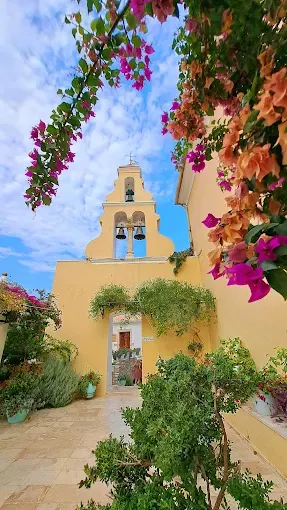
Late afternoon light spills over the dense, silvery canopy of olive groves, painting the rugged western cliffs of Corfu in shades of deep amber and crushed violet. The air smells sharply of wild thyme, sea spray, and the faint, earthy sweetness of burning beeswax. You climb the narrow, winding road—rising precisely 115 meters (377 feet) above the crashing surf—until the dense tree line abruptly parts to reveal a fortified complex of blinding white stone. The Paleokastritsa monastery stands sentinel on the rocky promontory, its austere rectangular form contrasting sharply with the chaotic, cerulean expanse of the Ionian Sea below. Founded in the early thirteenth century, this Orthodox sanctuary has withstood pirate raids, relentless seismic tremors, and the slow, inevitable erosion of time. The faint, rhythmic chanting of monks drifts over the inner courtyard, mingling with the relentless crashing of waves against the hidden sea caves. It matters because it is not merely a religious relic; it is a spiritual anchor that binds the wild, untamed beauty of the Corfiot landscape to centuries of unbroken monastic tradition.
Why the Paleokastritsa Monastery Embodies Byzantine Resilience
To understand the Paleokastritsa monastery is to recognize the existential threat it was built to counter. In the early medieval period, coastal settlements along the Ionian Sea were relentlessly terrorized by Barbary corsairs and rival naval powers. The monastery solved this by functioning as both a spiritual refuge and a militarized watchtower, fulfilling the desperate need for a defensible sanctuary on an otherwise exposed coastline. The current structures date primarily to a rigorous reconstruction completed during the eighteenth century, utilizing a highly deliberate architectural vocabulary. The complex is arranged around a central, sun-drenched courtyard measuring roughly 30 by 30 meters (98 by 98 feet), enclosed by thick, windowless walls of local porous limestone that measure up to 2 meters (6.5 feet) thick. This specific material choice was an engineering necessity; the soft, pale stone absorbs the kinetic energy of the fierce western winds and effectively blunts the impact of any artillery fire. The architectural resilience extends to the beautifully carved exonarthex—the outer narthex of the main church—featuring a heavy timber-framed roof designed to flex and survive violent seismic activity. By elevating the monastic community physically above the pirate-infested waters and spiritually through continuous prayer, the monastery fulfilled the critical need for survival in a lawless maritime frontier.
The Best Time to Experience the Paleokastritsa Monastery
To experience the monastery without the suffocating crush of peak-season tourism, you must time your arrival with absolute precision. Plan your visit between May 18 and June 12, or from September 22 to October 8. During these precise windows, the ambient temperature hovers between 22°C and 25°C (72°F–77°F), allowing you to comfortably climb the steep access road and explore the sun-drenched courtyard without physical distress. Arrive precisely at 8:30–9:30 AM, immediately after the heavy wooden gates open. At this early hour, the morning mist still clings to the olive groves, and the acoustic silence is broken only by the distant, melodic chanting of morning prayers. A secondary window occurs at 5:00–6:00 PM, when the lowering sun casts a dramatic, golden glow against the whitewashed exterior, perfectly contrasting with the turquoise sea below. Avoid July 15 through August 25 at all costs. During this brutal period, temperatures frequently exceed 33°C (91°F), and fleets of tour buses disgorge thousands of visitors into the tiny complex, entirely overwhelming the intimate cloisters. For accurate visiting hours and seasonal closure updates, consult the official regional tourism portal: www.corfu.gr.
Approximate Budget for a 7-Day Trip
Calculating the cost of a cultural immersion in Paleokastritsa requires balancing the premium pricing of coastal lodging with the accessible, daily rhythms of traditional Greek village life. Staying within walking distance of the monastery maximizes your time on the promontory and completely eliminates transit stress.
- • Accommodation: €90–€150 per night (boutique stone villa in the Lakones neighborhood, featuring panoramic views of the Ionian Sea)
- • Food: €50 per day (breakfast €6 for thick Greek yogurt and local thyme honey, lunch €14 for a grilled octopus salad with fresh lemon, dinner €30 for sofrito—tender braised veal in white wine sauce—and a carafe of local Kakotrygis wine)
- • Transportation: €28 total (€16 for the Green Line public bus from Corfu Town to the Paleokastritsa village center; €12 for local water taxis to access the remote beaches below)
- • Attractions: €12 individual prices listed (Paleokastritsa Monastery: €3; Angelokastro Fortress: free; Corfu Aquarium: €6; Museum of Asian Art in Corfu Town: €3)
- • Miscellaneous: €35 (bottle of cold-pressed local olive oil from a village press: €15; handwoven linen tablecloth from a coastal artisan: €14; natural sea sponge from a diver at the harbor: €6)
Total: €705–€1,195
6 Essential Paleokastritsa Monastery Experiences
- Ascending the Ancient Olive Grove Path: Skip the paved parking lot and take the historic stone footpath beginning at the main beach. The 10-minute walk weaves through a dense, fragrant canopy of ancient olive trees, offering a gradual, cinematic reveal of the monastery perched precariously on the cliff edge above.
- Standing Before the Iconostasis: Enter the dimly lit main church and immediately face the towering, intricately carved wooden screen. Observe the delicate gold-leaf detailing depicting biblical scenes; the heavy, intoxicating scent of beeswax and frankincense is almost overpowering in the enclosed space.
- Studying the Post-Byzantine Museum: Walk into the atmospheric former refectory, now a museum, to examine the rare icons. Look closely at the exquisite egg-tempera brushstrokes on the ornate depictions of Saint George and the Virgin Mary, noting the vivid crimson and azure pigments that have survived centuries of coastal humidity.
- Exploring the Subterranean Cellar: Descend into the cool, damp underground cellar where the resident monks traditionally processed their agricultural yield. The thick stone walls drop the ambient temperature dramatically, offering a visceral, tactile escape from the blazing Mediterranean sun overhead.
- Photographing the Kerkyra Viewpoint: Walk to the far western edge of the monastery’s exterior terrace. Frame the whitewashed bell tower against the jagged, limestone rock formations plunging into the sea, ensuring you capture the stark, geometric color contrast between the white architecture and the deep blue water.
- Listening to the Evening Bells: Remain quietly in the courtyard as the sun dips below the horizon. When the heavy iron bells toll, the deep, resonant sound rolls down the cliffside, echoing over the water in a profound, reverberating wave that vibrates through your chest.
3 Hidden Gems Most Travelers Miss
- The Cave of the Virgin Mary: Located a challenging 15-minute scramble down the rocky shoreline directly below the monastery. It is entirely overlooked because there is no directional signage, and access requires navigating sharp, slippery limestone ledges. Local tradition dictates the monastery was originally founded after a shepherd discovered a miraculous icon of the Virgin Mary in this exact cavern. Insider tip: wear thick-soled water shoes and check local tide charts; the low cave entrance is completely submerged during high swells.
- The Village of Lakones: Perched 200 meters (656 feet) above the Paleokastritsa bay. Most tourists never leave the coastal beach strip. Walk the steep, winding cobblestone path from the monastery gates to find a quiet, untouched cluster of Venetian-era stone houses. It is special because it offers an elevated, completely uncrowded panoramic view of the entire coastline, best enjoyed with a coffee at the local Bella Vista cafe.
- The Monastery’s Historic Olive Press Ruins: Situated in a slightly overgrown, fenced-off enclosure just behind the main upper parking area. It is ignored because visitors assume it is private residential property. Peer through the wrought-iron gate to see massive, centuries-old stone grinding mills and ancient terracotta storage vessels slowly being reclaimed by wild caper vines.
Cultural & Practical Tips
- • Dress modestly when entering the church and inner courtyard; women must cover their shoulders and knees, and although wraps are provided at the entrance, bringing your own lightweight scarf is considered far more respectful by the resident monks.
- • Learn a polite, culturally appropriate Greek phrase: say "Evlogia" (eff-vloh-EE-ah), meaning "blessing," when greeting the monks or purchasing items from the monastery store—a simple gesture that will be met with a warm, appreciative nod.
- • Photography is strictly forbidden inside the main church; respect the sacred space by keeping your smartphone securely in your pocket while in the presence of the holy icons and the burning altar candles.
- • Be acutely aware of the steep, completely unprotected cliff edges on the monastery's exterior terraces; keep a firm grip on young children at all times, as the ancient limestone pathways lack safety railings in several precarious sections.
- • Pack a reusable water bottle for your ascent; there are no vendors inside the complex, and the steep climb back up from the sea caves is physically demanding in the midday heat.
- • Watch for the sudden, fierce meltemi winds that can whip across the Ionian Sea in the late afternoon; these powerful gusts are strong enough to blow loose hats and sunglasses directly off the cliffside.
- • Do not feed the semi-feral cats that inhabit the courtyards; the monks carefully manage their diet to prevent them from hunting the local songbird population that nests in the surrounding olive groves.
Conclusion: Travel with Reverence, Not Just Sightseeing
The Paleokastritsa monastery is not merely a picturesque photographic backdrop to be captured and endlessly scrolled past on a digital feed. It is a living, breathing sanctuary where the ancient echoes of Byzantine chants still mingle with the wild, untamed Ionian wind. When you choose to travel with reverence rather than simply rushing to the next scenic viewpoint, you begin to honor the profound physical and spiritual endurance required to build a fortress of faith on a jagged cliff. Slow down. Resist the urge to hurry through the museum and instead sit quietly on the sun-warmed courtyard stones, letting the distant crash of the waves anchor you to the landscape. Mindful tourism recognizes that our physical presence in sacred spaces leaves a distinct footprint; by moving slowly and speaking softly, we actively help preserve the contemplative atmosphere the monks have cultivated for centuries. By engaging deeply with the rough texture of the limestone and the heavy silence of the cloisters, you transform from a fleeting tourist into a respectful witness to history. Let the profound isolation of this promontory humble you; that is where the true magic of Corfu resides.
.