Little Mermaid: Where Bronze Poetry Meets Copenhagen Harbor
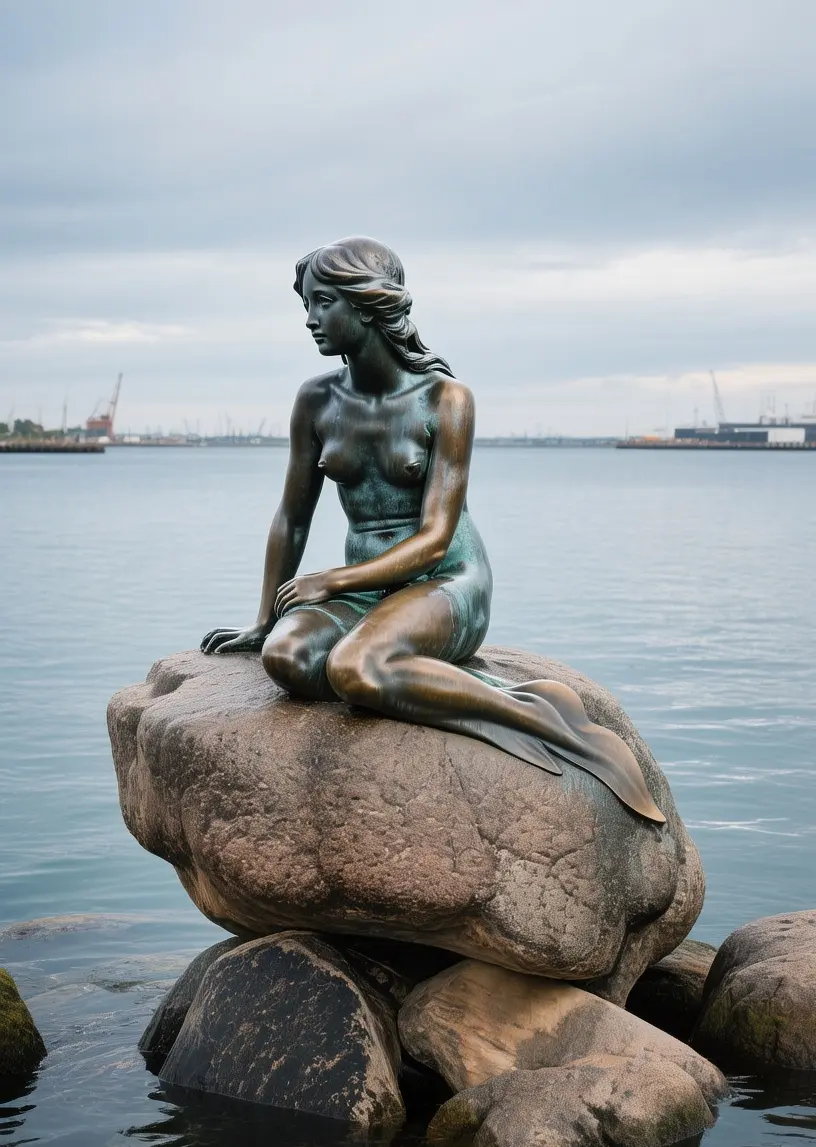
The Little Mermaid: Where Bronze Meets Sea and Story
I walk along the shore path just before ten in the morning. The sea breeze carries salt and cold. A small bronze figure sits hunched on a granite boulder. Her gaze stays fixed on the water. I paid nothing to stand and watch. The train ride from central Copenhagen took fifteen minutes. It cost 36 DKK one way. I bought a warm coffee from a cart nearby. It cost 30 DKK and warmed my hands. She is smaller than most expect. Shoulders curved, head tilted, she looks as if she might slip into the waves at any moment. This is one of the most visited statues on Earth — yet she sits quiet, alone with the sea.
Why The Little Mermaid Matters
Commissioned in 1909 by brewer Carl Jacobsen and unveiled in 1913, the statue was created by sculptor Edvard Eriksen. It draws from Hans Christian Andersen's fairy tale of a mermaid who trades her underwater life for a human soul. The story explores longing, sacrifice, and belonging — themes that speak across every generation. Over more than a century, the figure has become Copenhagen's most recognizable symbol. She has been defaced, restored, and debated — vandalism that itself became part of her story. Yet she remains, facing the horizon, unchanged in her stillness. She is not just a tourist draw. She is a mirror — each person sees their own longing in her posture.
She is not grand or imposing. Many visitors arrive expecting a larger monument and feel underwhelmed. The statue sits beside an industrial waterfront road — not a scenic park. Crowds gather constantly; at midday you may wait ten minutes for a clear view. Photography is unrestricted but everyone takes the same shot. The site offers no shelter, seating, or facilities. Wind and rain hit hard and unbuffered. Some find the experience brief and underdeveloped.
The Best Time to Experience The Little Mermaid
Late May through early September offers the longest days and mildest weather. Daytime temperatures sit between 14°C and 21°C (57°F–70°F). The shore path stays pleasant until late. Arrive before 9:30 AM to stand alone. July and August see thousands daily — come early or accept the crowds.
April, early May, and September balance mild conditions and fewer visitors. Temperatures hover around 9°C–15°C (48°F–59°F). Spring brings longer daylight but still brisk breeze. Autumn turns the water deep blue and gold. October through April brings shorter days and cooler conditions — 2°C–7°C (36°F–45°F). Winter visits feel most powerful — cold air, empty shore, grey waves. She stands as she always does, unshared and quiet. Weekdays stay noticeably quieter than weekends year-round.
Approximate Budget for a 7-Day Trip
- Accommodation: 4,200 DKK – 7,350 DKK. Hotel or B&B in central Copenhagen sits convenient. Staying in Østerbro district places you closest — ten minutes by foot.
- Food & Drink: 1,750 DKK – 2,940 DKK. Café meal nearby costs 115–195 DKK. Bringing a picnic costs far less — bread, cheese, and fruit from the market.
- Transport: 630 DKK – 1,190 DKK. Bus or train from city center 36 DKK one way. Harbor bus 25 DKK one way. Bicycle rental works perfectly at 100–140 DKK per day — dedicated lanes lead directly to the shore.
- Attractions & Entry: 0 DKK. Public shoreline — no ticket, no gate, no fee.
- Miscellaneous: 490 DKK – 840 DKK. Covers coffee, snacks, and small souvenirs.
Total estimated budget: 7,070 DKK – 12,320 DKK per person for 7 days.
One thing to watch: souvenir stalls right beside the statue charge premium rates. A postcard or small replica can cost double what it does in the city center. Walk five minutes inland — prices drop immediately.
Essential The Little Mermaid Experiences
- Stand quietly at the water's edge. Do not rush the photo. Look at her face, her hands, the curve of her back. She leans forward, tense, as if listening. The longer you stay, the more you see. Go early — the shore fills fast. Skip if you only want a quick snapshot — midday lines feel long.
- Walk the full harbor circuit. Approach from the west, not the nearest bus stop. The statue appears gradually — across water, then closer, then fully in view. This reveals how she belongs to the shoreline, not just a photo spot.
- See her in changing light. Morning sun hits her face warm. Midday she stands bright and hard. Evening she turns soft bronze. Return twice if you can — she changes with every hour.
- Read the story before you go. Hans Christian Andersen's original tale is darker than most remember. It gives weight to her posture — she waits, not just for a prince, but for an immortal soul. The statue feels deeper once you know the full story.
- Walk onward to Kastellet. The star-shaped fortress sits five minutes away along the ramparts. Green, quiet, and largely overlooked. It offers a peaceful counterpoint to the crowds at the statue.
- Watch the water beside her. Ships pass slowly toward the harbor. Gulls circle low. The waves lap constantly at the rocks. She has watched this same scene for more than a century. Stand still and watch with her for a moment.
Hidden Gems Most Travelers Miss
- The view from the pier across the water. Most people crowd the shore directly in front. Walk fifty yards along the breakwater. You see her in profile, framed by sea and sky, with no one in your frame.
- Overrated spot: the immediate shoreline viewpoint. Every group lines up here. Step ten yards to the left. The same figure appears with open water behind — far cleaner and quieter.
- The small memorial stone nearby. Tucked behind the path, almost hidden. It honors the sculptor and the donor. Few visitors pause to read it. It tells the human story behind the bronze.
- The quiet path back through Churchill Park. Trees and green lawns replace the road and crowds. It connects the statue area to the city. Most people retrace their steps — this way feels entirely different.
- First light on her shoulders. Arrive at dawn. Sun hits the bronze and turns it gold. The shore is empty. She looks as she did in 1913 — seen only by the sea.
Cultural & Practical Tips
- Do not expect grand scale. She stands about life-size. Many visitors are surprised. She is meant to be intimate, not monumental. That quiet presence is part of her power.
- Visit early or late. Between 10:00 AM and 3:00 PM the shore stays packed. Before 9:30 AM or after 4:00 PM you will likely have space. Weekdays feel calmest.
- Bring layers and a windproof jacket. The shore is fully exposed. Wind off the water feels colder than inland. Even sunny days turn breezy.
- Do not linger unnecessarily if crowds wait. Be mindful — others have traveled far too. Take your moment then step aside. Kindness matters here.
- Combine with nearby sites. The statue sits within walking distance of Amalienborg Palace, Kastellet, and the harbor promenade. Plan a route — do not make a separate trip just for the photo.
- Travel by bicycle. It is the most enjoyable way. Lanes run directly to the spot. You can stop, look, and continue easily. Parking nearby is limited and expensive.
Essential Visitor Information
Location & Access: The Little Mermaid, Langelinie Promenade, 2100 København Ø. Three ways to arrive: bus 26 from city center to Østerbrogade then 5-minute walk; harbor bus to Langelinie then 3-minute walk; bicycle or foot via waterfront path from Amalienborg — 15 minutes.
Tickets & Booking: Free. No ticket required. No booking. Open to all, always accessible.
Operating Hours: Public shoreline — accessible 24 hours daily. Best light early morning or late afternoon.
Visit Duration: 15–30 minutes for the statue itself. 1–2 hours including nearby paths and Kastellet.
Family Suitability: Good. Flat paved path. Stroller access excellent. No facilities right at the site — nearest restrooms 5 minutes away. Water's edge has no barrier — supervise children closely.
Timing: Best season: May or September. Best time: before 9:30 AM or after 4:00 PM. Weekdays stay noticeably quieter than weekends.
Highlights: The statue in morning light, profile view from breakwater, waterfront walk to Kastellet, quiet shoreline at dawn.
Nearby & Day Trip: Amalienborg Palace 15 minutes on foot. Nyhavn 20 minutes. Kastellet 5 minutes. Rosenborg Castle 20 minutes.
Conclusion: Travel with Depth, Not Just Sight
She is small, she is still, and she faces the sea. Millions travel here every year. Most snap a photo and leave. But if you pause, you see more than bronze. You see longing, patience, and the quiet courage of choosing. What will you carry away from this figure watching the waves?
Post a Comment