
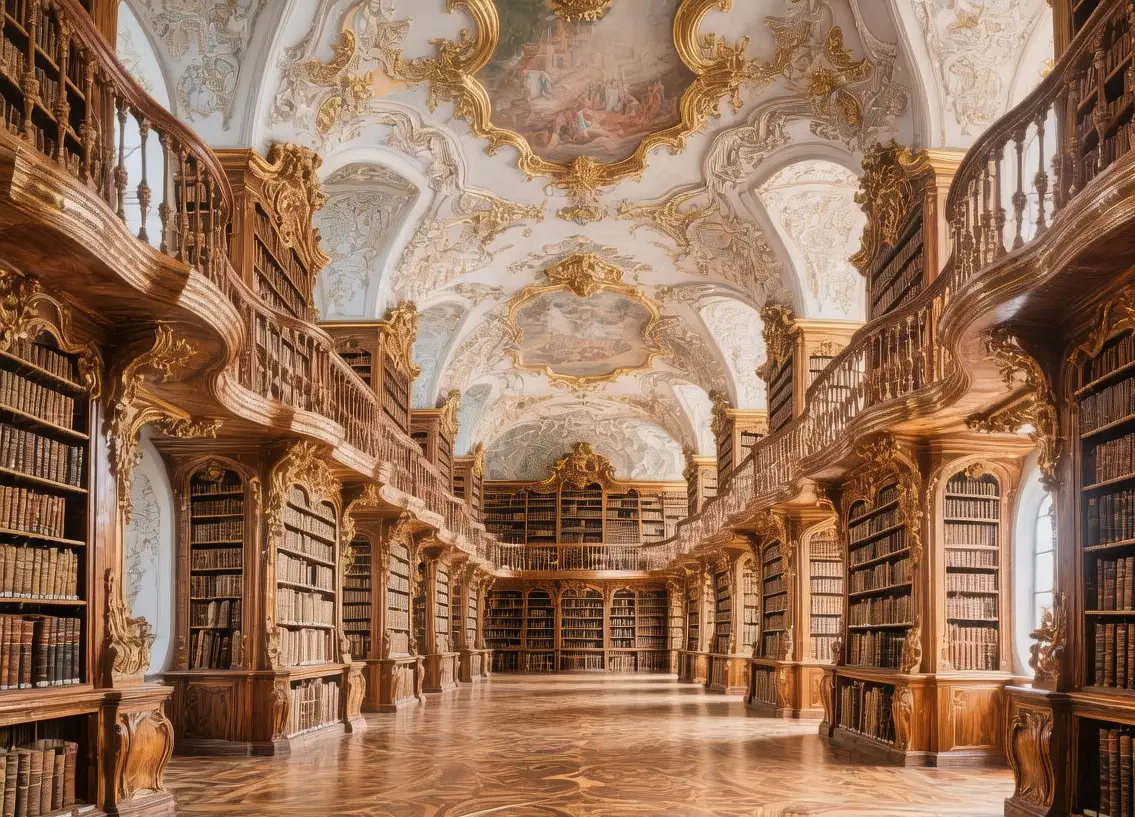
St. Gallen Abbey Library Rococo Splendor Meets Medieval Wisdom
The air inside the hall smells of vanilla, beeswax, and centuries of preserved paper—a scent that hits you the moment the heavy wooden doors swing open. You stand on the checkered marble floor of the St. Gallen Abbey Library, surrounded by 170,000 volumes that line the carved wooden galleries rising toward a ceiling painted with theological frescoes. The silence here is absolute, broken only by the soft shuffle of felt-slipped feet and the distant chime of the cathedral bell marking the hour. Built between 1758 and 1767 by architect Peter Thumb, this rococo masterpiece houses manuscripts dating back to the 8th century, including the famous Plan of St. Gallen from 820 AD. Dust motes dance in the shafts of light filtering through the tall windows, illuminating gold leaf that has not tarnished in 250 years. In 2026, as digital information overwhelms modern consciousness, the St. Gallen Abbey Library stands as a sanctuary of tangible knowledge—a place where the physical weight of history demands patience, reverence, and a willingness to slow down enough to read the fine print of human civilization.
Why St. Gallen Abbey Library Embodies Monastic Scholarship
The St. Gallen Abbey Library represents the pinnacle of Benedictine intellectual preservation, solving the historical problem of knowledge loss during the turbulent Middle Ages. Founded in 719 AD by Saint Otmar, the abbey became a beacon of learning when much of Europe fell into darkness. The current library hall, constructed between 1758 and 1767, utilizes a sophisticated wooden framework designed by Gebhard Moosbrugger, featuring galleries supported by ornate columns that distribute weight evenly across the sandstone foundation. The ceiling frescoes, painted by Giuseppe Artari and Giovanni Battista Innocenzo Colomba, depict the four ecumenical councils and the history of the church, serving as a visual catechism for scholars.
Beyond architecture, the library fulfills a cultural need for continuity in an age of ephemeral data. It holds 2,100 manuscripts from the 8th through 15th centuries, including 400 that are over 1,000 years old. The famous Plan of St. Gallen, drawn around 820 AD, is the oldest surviving architectural plan of a medieval monastery, offering invaluable insight into Benedictine life. The building was designated a UNESCO World Heritage site in 1983, recognizing its universal value. Today, the infrastructure balances preservation with access: climate control systems maintain 18°C (64°F) and 50% humidity to protect the parchment, while digital archives allow global researchers to view fragile texts without physical handling. This living heritage proves that ancient wisdom can coexist with modern conservation technology while maintaining the soul of the institution.
The Best Time to Experience St. Gallen Abbey Library
For optimal conditions combining manageable crowds, comfortable walking weather, and full access to the cathedral and library, visit between May 15–June 10 or September 5–September 20. During these windows, daytime temperatures range from 15–22°C (59–72°F), while evenings cool to 8–12°C (46–54°F). The ideal time to enter the library hall is 9:00–10:00 AM, when the morning light illuminates the frescoes without the glare of midday sun and tour groups haven't yet arrived.
Winter visits (December–February) offer a quiet atmosphere, but temperatures drop to -2–5°C (28–41°F), and daylight shrinks to 8.5 hours. The Christmas market in December brings crowds to the abbey square, while summer peak season (July 15–August 15) brings temperatures up to 25°C (77°F) but also queues exceeding 30 minutes for ticket collection. The indoor climate is controlled year-round, but outdoor walking between sites can be chilly in winter.
Avoid these periods: August 1 (Swiss National Day creates congestion and noise in the square), December 23–26 (holiday closures limit access to the library), and Easter Sunday (religious services restrict tourist movement). For real-time opening hours and exhibition schedules, verify conditions at stiftsbibliothek.ch or check the St. Gallen Tourism Office at stgallen.com for seasonal event calendars.
Approximate Budget for a 7-Day Trip (2026)
This budget estimate reflects mid-range travel preferences for a solo traveler or couple, based on 2026 pricing adjusted for Switzerland's 2.5% annual inflation rate (Swiss Federal Statistical Office data). St. Gallen is moderately priced compared to Zurich, but accommodation near the abbey commands a premium.
Accommodation:
• Budget hostel (dorm bed): CHF 50–CHF 70 per night (Youth Hostel St. Gallen, 15-minute walk from abbey)
• Mid-range hotel (3-star, Old Town): CHF 180–CHF 260 per night (Hotel Walhalla or Hotel Einstein)
• Upscale boutique (4-star, abbey view): CHF 320–CHF 480 per night (Schlosshotel St. Gallen or Parkhotel St. Gallen)
Food: CHF 70–CHF 100 per day
• Breakfast: CHF 18–CHF 28 (hotel buffet with Swiss muesli and local bread)
• Lunch: CHF 25–CHF 38 (Old Town café schnitzel or sausage salad)
• Dinner: CHF 45–CHF 65 (traditional fondue at Old Swiss House or Zollerhof)
• Coffee/pastry: CHF 7–CHF 12
Transportation:
• Swiss Travel Pass (8 days, 2nd class): CHF 432 (covers trains, buses, museums)
• St. Gallen Guest Card (free with hotel): includes local buses and discounts
• Airport transfer (Zürich to St. Gallen): covered by Swiss Travel Pass or CHF 38 one-way train
• Local bus (Line 1, 2): CHF 3.80 per ride (free with Guest Card)
Attractions:
• Abbey Library Entry: CHF 15
• Cathedral Treasury: CHF 8
• Abbey Cathedral: Free (donations encouraged)
• Textile Museum: CHF 12 (free with Swiss Travel Pass)
• Guided Abbey Tour: CHF 25
Miscellaneous:
• Souvenirs (Embroidery, chocolate, books): CHF 60–CHF 150
• Travel insurance (7 days): CHF 50–CHF 80
• SIM card/data (Swisscom 10GB): CHF 45
• Emergency fund: CHF 150
Total estimated cost (mid-range): CHF 2,300–CHF 3,000 for 7 days
Budget traveler option: CHF 1,200–CHF 1,500
Luxury experience: CHF 5,000–CHF 7,500+
7 Essential St. Gallen Abbey Library Experiences
1. Library Hall Exploration: Enter the main hall at 9:30 AM. The floor is checkered marble; wear the provided felt slippers to protect it. Look up at the frescoes depicting the Council of Nicaea. The wooden galleries contain 170,000 volumes. Allow 60 minutes. Cost: CHF 15. Photography without flash is permitted. The scent of old wood is distinct.
2. Cathedral Treasury Visit: Descend to the treasury at 11:00 AM. View the 9th-century ivory carvings and the golden reliquary of Saint Gall. The room is dimly lit to preserve artifacts. Audio guides explain the history of the relics. Entry: CHF 8. Allow 30 minutes. The craftsmanship is exquisite.
3. Abbey Cathedral Service: Attend the morning prayer at 7:00 AM (Monday–Saturday). The baroque interior fills with chant. Sit in the rear nave to observe the monks. Photography is prohibited during services. Free entry. Dress code: Shoulders and knees covered. The acoustics are remarkable.
4. Plan of St. Gallen Viewing: View the digital reproduction in the exhibition room at 2:00 PM. The original 820 AD parchment is too fragile for permanent display. The plan shows the ideal monastery layout. Interpretive panels explain the symbolism. Included in library ticket. Allow 20 minutes. Best for architecture enthusiasts.
5. Abbey Cemetery Walk: Walk the cemetery behind the cathedral at 4:00 PM. The iron crosses date to the 17th century. It offers a quiet perspective on the community's history. Open dawn to dusk. Free access. Best visited: Late afternoon for soft light. Respect the graves.
6. Textile Museum Visit: Take bus line 1 to the museum at 10:00 AM. St. Gallen is famous for embroidery. The collection spans 500 years. Interactive displays show the weaving process. Entry: CHF 12 (free with Swiss Travel Pass). Allow 90 minutes. The lacework is intricate.
7. Old Town Coffee Break: Stop at Café Halden at 3:00 PM. Order a Wiener Melange and a slice of apple strudel. The terrace overlooks the abbey square. Watch the pedestrians and trams. Prices: CHF 8–CHF 15. Best visited: Sunny afternoons. The people-watching is excellent.
3 Hidden Gems Most Travelers Miss
• Cathedral Crypt: Located beneath the main altar, this Romanesque crypt dates to the 10th century. Most visitors stay in the baroque upper church. Access: Ask at the sacristy for key access. Open Tuesday–Friday 2:00 PM–4:00 PM. Free entry. Insider tip: The acoustic resonance in the crypt is remarkable; speak softly to hear the echo.
• Abbey Archive Reading Room: Serious researchers can request access to the archive containing documents from 719 AD onwards. This is not a tourist attraction but a working scholarly space. Access: Requires written appointment via archive@stiftsbibliothek.ch at least 2 weeks in advance. Open Monday–Friday 9:00 AM–4:00 PM. Free for academic purposes. Gloves required for handling manuscripts.
• Kornhausmarkt Courtyard: Behind the market hall lies a secluded courtyard with a fountain and views of the abbey towers. Most tourists walk the street but miss the arched passageway. Access: Walk from Marktplatz towards the river. Open daily 8:00 AM–6:00 PM. Quiet photography only. Best visited: Early morning for soft light.
Cultural & Practical Tips
• Footwear protocol: You must wear felt slippers over your shoes in the library hall. This protects the 18th-century wooden floor. Socks are recommended. The slippers are provided at the entrance. Do not walk on the marble in street shoes.
• Photography restrictions: Flash photography is prohibited to protect the frescoes and manuscripts. Tripods require written permission from the abbey office. During services, all photography is banned. Respect the monks' privacy; do not photograph them without consent.
• Silence etiquette: Maintain a low voice in the library and cathedral. Mobile phones must be switched off completely, not just silenced. The librarians value silence as part of the scholarly atmosphere. Disruptive noise may result in being asked to leave.
• Language basics: The region speaks Swiss German. Learn these phrases: "Grüezi" (GRÜE-tsi) for hello, "Stift" (SHTIFT) for abbey, "Danke vilmal" (DAHN-keh feel-mahl) for thank you very much. English is spoken at the ticket counter.
• Donation protocol: Entry to the cathedral is free, but candles cost CHF 2 each. Place coins in the designated boxes near the side altars. Do not leave cash on the pews. Larger donations can be made via the website or at the parish office.
• Weather considerations: St. Gallen weather changes rapidly. Even in summer, evenings cool to 10°C (50°F). Carry a light jacket for evening walks. Winter visits require sturdy boots for icy cobblestones in the abbey square.
Conclusion: Travel with Reverence, Not Just Checklists
The St. Gallen Abbey Library stands not merely as a repository of books, but as a living testament to thirteen centuries of uninterrupted scholarship—a rhythm that persisted through wars, plagues, and the industrial age. As you walk the checkered marble floor in 2026, listening to the silence mingle with the distant city sounds, remember that this space belongs first to the knowledge it protects. Responsible travel means respecting the footwear rules, adhering to the silence without complaint, and understanding that the preservation of these manuscripts is a privilege granted by the librarians' diligence. Slow down. Look at the frescoes without rushing. Listen to the silence that has sustained this community for nearly a millennium. Leave behind the urge to capture every moment on film and instead absorb the stillness that has preserved wisdom for generations. True exploration isn't about counting sights; it's about allowing a sacred space to quiet your mind, leaving you with a sense of peace that outlasts the journey home.