
Achilleion Palace: Where Neoclassical Grandeur Meets Ionian Majesty
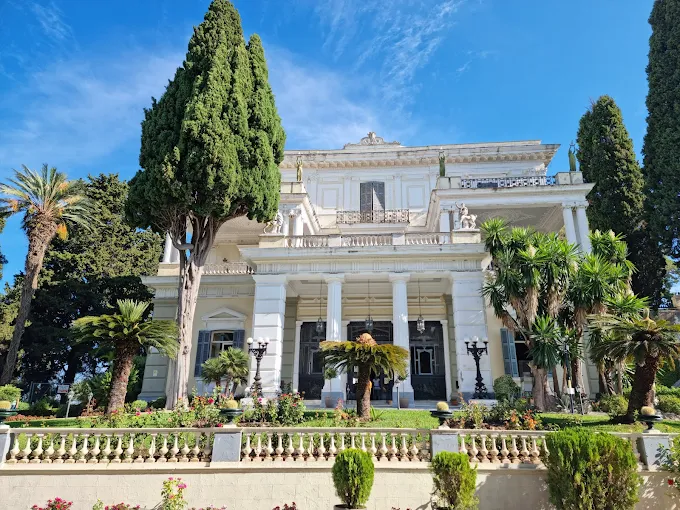
Midmorning light spills across the immense peristyle, gilding the muscular contours of bronze statues and warming the pale Pentelic marble columns. The air carries the sharp scent of wild jasmine and salt spray, drifting up from the densely forested ravines below. You stand on the panoramic terrace of the Achilleion Palace, positioned exactly 145 meters (475 feet) above the Ionian Sea, where the horizon fractures into a mosaic of cerulean and emerald. The crunch of gravel underfoot echoes softly against the austere facade—a sound that once accompanied the whispered intrigues of European royalty. Empress Elisabeth of Austria commissioned this sprawling retreat as a solitary sanctuary, filling its halls and gardens with the tragic, immortal mythos of Achilles. It matters because this estate is not merely an architectural relic; it is a physical manifestation of romantic melancholy, freezing a specific moment of imperial aesthetic obsession into stone and bronze against the untamed Corfiot landscape.
Why the Achilleion Palace Embodies Neoclassical Romanticism
To understand the Achilleion Palace is to recognize the profound emotional void it was built to fill. Following the tragic, unexpected death of her only son, Empress Elisabeth of Austria—known universally as Sisi—required a refuge far from the rigid, oppressive protocols of the Habsburg court. The estate solved this by creating an isolated theater of mourning disguised as a celebration of classical heroism. Designed by Italian architect Raffaele Caritto, the structure is a masterclass in Pompeian Neoclassicism, built atop the ruins of an earlier agricultural villa. The central reception hall stretches 32 meters (105 feet), featuring a dramatic elliptical dome decorated with vivid frescoes depicting the four seasons. The engineering is quietly brilliant; the palace utilizes a raised, ventilated subfloor system that mitigates the intense Mediterranean humidity, actively protecting the delicate interior plasterwork. Surrounding the structure, the gardens ascend the steep hillside via stepped terraces retaining over 10,000 cubic meters of imported fertile earth. Sisi populated these terraces with sculptures by German artist Ernst Herter, most notably the towering, agonizing centerpiece of the Dying Achilles. This specific artistic choice fulfills a deep psychological need; by worshiping the physical beauty and tragic mortality of a mythical hero, the Empress externalized her own profound grief into the very bedrock of the landscape.
The Best Time to Experience the Achilleion Palace
To appreciate the sweeping terraces and interior frescoes without the suffocating intrusion of peak-season crowds, precise timing is essential. Plan your visit between May 18 and June 12, or from September 22 to October 10. During these specific windows, the ambient temperature settles comfortably between 21°C and 24°C (70°F–75°F), allowing you to explore the exposed, sun-drenched gardens without physical fatigue. Arrive precisely at 8:30–9:30 AM, the exact moment the ticket kiosk opens. At this hour, the low-angle light casts deep, dramatic shadows across the muscular contours of the statues, and the acoustic silence is profound. You should actively avoid July 15 through August 25. During this brutal period, temperatures frequently exceed 34°C (93°F), and the lack of shade on the upper terraces makes the ascent physically dangerous. Additionally, massive tour buses disgorge thousands of cruise ship passengers into the narrow entrance hall, entirely destroying the contemplative atmosphere Sisi demanded. For official ticketing updates and conservation schedules, consult the primary heritage portal: https://achillion-corfu.gr/.
Approximate Budget for a 7-Day Trip
Calculating the cost of a cultural immersion near the Achilleion Palace requires prioritizing the upscale village of Gastouri, which balances aristocratic charm with accessible local pricing. Staying here eliminates transit friction, placing you at the gates of the estate every morning.
- • Accommodation: €110–€180 per night (neoclassical boutique guesthouse in Gastouri, featuring antique furnishings and sea-view balconies)
- • Food: €60 per day (breakfast €8 for pastries and Greek coffee at a village bakery, lunch €16 for a Greek salad and grilled sardines, dinner €36 for sofrito—braised veal in white wine sauce—and a carafe of Robola wine at a hillside taverna)
- • Transportation: €32 total (€15 for the Blue Line public bus from Corfu Town directly to the village square; €17 for a private taxi to access the village at night)
- • Attractions: €18 individual prices listed (Achilleion Palace upper floors and gardens: €10; Mon Repos estate: €4; Archaeological Museum of Corfu: €4)
- • Miscellaneous: €45 (hardbound book on Ionian architecture from the palace gift shop: €18; locally distilled kumquat liqueur: €15; silk scarf featuring the palace's repeating trefoil motif: €12)
Total: €905–€1,455
6 Essential Achilleion Palace Experiences
- Ascending the Imperial Staircase: Enter the main foyer and immediately look up. The sweeping, double-flighted marble staircase features intricate iron railings depicting intertwined ivy and laurel. Place your hand on the cool banister and walk slowly, feeling the immense weight of a space designed to intimidate and awe visiting dignitaries.
- Studying the Peristyle Frescoes: Walk into the central chapel-like hall surrounded by columns. Tilt your head back to examine the circular dome, where the Four Seasons are painted in vibrant, fading tempera. Notice the tactile, cracked texture of the plaster—a direct result of the coastal salt air interacting with the lime wash.
- Viewing the Dying Achilles: Stand directly before Ernst Herter’s colossal bronze in the lower garden. Trace the agonizing realism of the arrow lodged in the hero’s heel. The sculpture is specifically positioned so that the Ionian Sea serves as a dramatic, moving backdrop to the statue's mortality.
- Walking the Kaiser’s Spiral Staircase: Descend the narrow, spiraling stone staircase commissioned by Kaiser Wilhelm II. The steps are worn smooth in the center; hold the iron railing and descend to the dense, shaded undergrowth to feel a sudden, chilling drop in temperature.
- Exploring the Maidens of Muses Terrace: Locate the elevated stone terrace featuring a series of smaller, classical female statues. Sit on the low marble balustrade. From this exact vantage point, the geometric symmetry of the gardens perfectly frames the coastline, mimicking a painted canvas.
- Tasting the View at the Upper Cafe: Pause at the open-air cafe situated on the highest terrace. Order a thyme-infused honey pastry and listen to the distant, muffled sound of church bells drifting up from the village of Gastouri below.
3 Hidden Gems Most Travelers Miss
- The Sisi Private Chapel: Located in the far left wing of the upper floor, accessed through a narrow, unmarked wooden door. It is overlooked because the heavy velvet curtain over the entrance makes it appear closed to the public. It features original, deeply religious iconography commissioned by the deeply spiritual Empress, contrasting sharply with the pagan mythology dominating the rest of the estate.
- The Gastouri Village Spring: A 10-minute walk downhill from the palace gates, located behind the village's main church. Most tourists never leave the immediate palace perimeter. This stone-bounded, mossy spring features an ancient Venetian lion crest and provides a deeply atmospheric glimpse into the daily water-gathering routines that existed long before the imperial estate was constructed.
- The Kaiser’s Bridge Viewpoint: A derelict stone footbridge stretching across a dense ravine, located a 5-minute walk down the main road from the palace entrance. Wilhelm II built it to access a private tea pavilion. It is ignored because the access path is overgrown. Insider tip: push past the initial thorny brush to find a perfectly intact stone arch offering an entirely unobstructed, vertical photograph of the palace facades above.
Cultural & Practical Tips
- • Respect the interior photography rules; while exterior garden photography is encouraged, flash photography is strictly prohibited inside the frescoed rooms to prevent further degradation of the fragile tempera pigments.
- • Learn a polite Greek greeting: say "Kalimera" (kah-lee-MEH-rah) to the ticket attendants and cafe staff; acknowledging the local language softens interactions and often results in more insightful conversation about the estate's history.
- • Wear sturdy, rubber-soled shoes; the garden paths are constructed from polished river stones set in cement, which become treacherously slick when morning dew or occasional rain settles on the steep terraces.
- • Be acutely aware of the meltemi winds; during late summer, these strong northerly gusts whip across the exposed upper terraces with surprising force, requiring you to firmly secure hats, sunglasses, and loose maps.
- • Arrive with exact change; while the main ticket kiosk accepts cards, the exterior garden cafe and the small souvenir kiosk near the Kaiser's staircase are strictly cash-only operations.
- • Do not touch the bronze statues; the salts transferred from human hands actively corrode the patina of Ernst Herter's originals, and security monitors are positioned discretely throughout the lower gardens to enforce this rule.
- • Manage your expectations regarding interior furnishings; much of the original Habsburg furniture was removed during subsequent historical occupations, so appreciate the space for its architectural volume and fresco art rather than expecting a fully intact historic interior.
Conclusion: Travel with Reverence, Not Just Superficiality
The Achilleion Palace is not simply a decorative stage set designed for rapid digital consumption. It is a deeply psychological landscape—a physical manifestation of imperial grief, vanity, and the desperate human desire to freeze beauty in time. When you choose to travel with reverence rather than rushing through the gardens to capture a quick photograph, you begin to honor the complex emotional history embedded in the marble. Slow down. Resist the urge to quickly ascend to the Dying Achilles and instead sit quietly on the shaded peristyle, letting the silence of the Ionian horizon wash over you. Mindful tourism recognizes that ancient stonework and fragile frescoes have a finite tolerance for the friction of millions of passing footsteps. By engaging deeply—studying the specific brushstrokes of the dome, understanding the architectural engineering that tamed this rugged hillside—you shift from being a passive spectator to an active guardian of Sisi's legacy. Let the romantic melancholy of the space settle into your bones; that is where the true essence of the Achilleion Palace resides.