
Zakynthos Navagio Beach: Where Maritime Tragedy Meets Limestone Majesty
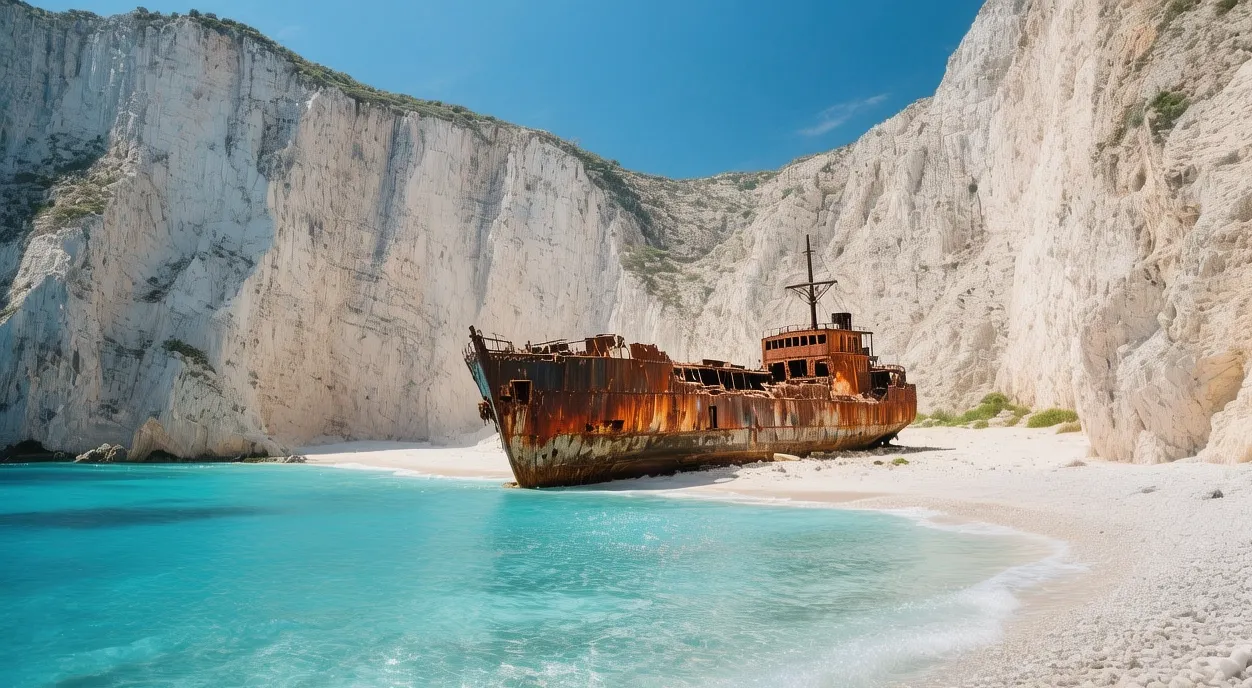
Midday light spills over the rim of a sheer, 250-meter (820-foot) limestone cliff, plunging into the enclosed cove with blinding intensity. The rhythmic crashing of Ionian swells against the curved white shoreline reverberates off the vertical rock faces, creating a deafening, echoing roar. Salt spray hangs heavy in the air. Below, resting awkwardly on the coarse sand, the rusted skeletal remains of the Panagiotis jut into the sky—a fractured steel spine contrasting violently with the electric blue water. The rusted hull, stripped of its paint by decades of saltwater corrosion, radiates a deep, burnt-orange glow. The coarse, white limestone pebbles shift with a distinct, grinding crunch beneath your boots as you step off the boat. You approach by sea, the vessel cutting through the impossibly translucent waves. It matters because Navagio Beach is not merely a picturesque cove; it is an accidental monument to the volatile intersection of human navigational error and the relentless, indifferent sculpting power of the Ionian Sea.
Why Zakynthos Navagio Beach Embodies Geological Isolation
To understand Navagio Beach is to confront the violent tectonic forces that created an inescapable trap. The cove fulfills a specific geomorphological function: acting as a natural sediment catchment. The towering cliffs, composed primarily of Eocene limestone shaped by millions of years of tectonic uplift, rise at a near-vertical 70-degree angle. This unique topography solved the problem of coastal erosion by entirely shielding the 200-meter (656-foot) stretch of shore from prevailing winds, allowing fine white pebbles to accumulate without being washed away. However, this same geological fortress became a navigational nightmare. On October 2, 1980, the coaster Panagiotis—a 163-ton vessel suspected of smuggling contraband cigarettes between Albania and Greece—lost its engine in rough seas. Strong currents drove the ship directly into this concealed cove, where its steel hull, measuring 45 meters (147 feet) in length, grounded violently on the shallow shelf. Over four decades, the saltwater catalyzed a rapid oxidation process, flaking away the original hull paint to reveal the raw, carbon-rich steel beneath. Today, the rusting vessel fulfills a new, unexpected role: serving as an artificial reef. The decaying metal provides a substrate for marine algae, fundamentally altering the localized micro-ecology while simultaneously anchoring the mythos of Zakynthos to a single, rusted object.
The Best Time to Experience Zakynthos Navagio Beach
To witness the cove without the chaotic intrusion of mass tourism requires precise, almost tactical planning. Plan your visit between May 18 and June 12, or from September 22 to October 5. During these specific windows, the water temperature sits at a comfortable 20°C to 22°C (68°F–72°F), and the ambient air reaches a pleasant 24°C to 26°C (75°F–79°F). Book the first departing boat from Porto Vromi, typically leaving at 8:00–8:30 AM, arriving at the cove by 8:45 AM. At this hour, the sun clears the eastern cliff top, striking the rusted hull with a dramatic, lateral light, and the beach remains mercifully empty for roughly 30 minutes. You must strictly avoid July 15 through August 25. During this peak window, temperatures exceed 32°C (90°F), and upwards of 30 boats anchor simultaneously in the tiny cove, turning the water into a churning, noisy mess of engines and crowds. Furthermore, avoid days when the meltemi wind blows from the northwest, as the port authority prohibits boats from entering the cove due to dangerous swell surges against the cliffs. For real-time sea condition updates and official safety alerts, consult the primary regional portal: https://www.navagiobeach.gr/.
Approximate Budget for a 7-Day Trip
Calculating the cost of an adventure-focused trip to Zakynthos requires balancing the premium pricing of specialized boat excursions with the budget-friendly reality of southern village life. By basing yourself near the departure docks, you minimize transit friction while maximizing your time on the water.
- • Accommodation: €60–€90 per night (family-run studio apartment in Laganas or Porto Vromi, featuring a small kitchenette and easy access to the southern bus routes)
- • Food: €45 per day (breakfast €5 for a spinach pie and Greek coffee, lunch €12 for a gyros pita and local beer, dinner €28 for grilled swordfish steak, tzatziki, and a carafe of local Verdea wine at a harbor taverna)
- • Transportation: €50 total (€15 for a 7-day local KTEL bus pass; €35 for the dedicated round-trip Navagio boat excursion departing from Porto Vromi, which includes the mandatory Blue Caves stop)
- • Attractions: €10 individual prices listed (Navagio Beach boat landing fee: included in excursion; Blue Caves boat entry: included in excursion; Zakynthos Town Byzantine Museum: €4; Marathonisi turtle island viewing: €6)
- • Miscellaneous: €35 (locally sourced Zakynthian olive oil from a village press: €12; branded Navagio Beach sarong from a seaside kiosk: €10; reef-safe biodegradable sunscreen to protect the cove's water quality: €13)
Total: €700–€980
6 Essential Zakynthos Navagio Beach Experiences
- Approaching by Sea from Porto Vromi: Sit on the starboard side of the vessel as it navigates the narrow cliff gaps. Feel the sudden drop in temperature as you enter the deep shadow of the limestone overhangs. The boat engine echoes deafeningly against the rock walls until you round the final corner, and the cove suddenly opens up in a burst of blinding, electric-blue light.
- Touching the Rusted Hull of the Panagiotis: Wade through the shallow, crystalline surf to reach the stern. Run your fingers over the pitted, oxidized steel plates—notice the texture feels like coarse, flaking rust rather than solid metal, shedding tiny orange fragments into the water with every passing wave.
- Swimming to the Eastern Sea Cave: At the far left edge of the beach, swim approximately 40 meters (130 feet) to a low, dark opening in the cliff face. The water inside drops to a chilly 18°C (64°F). Float on your back inside the cavern and look up to see the tangled roots of cliff-top vegetation hanging down through the cracks in the limestone ceiling.
- Viewing from the Navagio Cliffside Viewpoint: Drive to the remote Anafonitria region and walk to the fenced cliff edge, positioned 250 meters (820 feet) above the cove. Look straight down to see the beach as a tiny white strip, with the shipwreck resembling a discarded toy. The sheer vertical drop induces a visceral, dizzying sensation of exposure.
- Diving Beneath the Keel: Put on a snorkel and swim 5 meters (16 feet) out from the ship's starboard side. Look down through the perfectly transparent water to see the hull’s dark shadow stretching across the white pebble seabed, completely unobscured by algae or silt.
- Listening to the Acoustic Echo: Sit cross-legged near the center of the beach away from the boat engines. Close your eyes and isolate the sound of a single wave crashing and retreating over the smooth pebbles—the curved amphitheater of cliffs amplifies the water's hiss into a deep, resonant roar that vibrates in your chest.
3 Overlooked Wonders Most Travelers Miss
- The Blue Caves Archway: Located 3 kilometers (1.8 miles) north of Navagio, accessed only by small boat from Porto Vromi. Most tourists merely peer into the main cave entrance, but if you ask the captain to navigate to the southernmost arch, you can swim through a massive, naturally carved hole in the rock face. It is overlooked because the main cave is brightly lit, while this arch requires swimming in deep shadow. Insider tip: the water inside the arch flashes an intense, neon cobalt due to the specific angle of refracted sunlight hitting the cave floor.
- Porto Vromi’s Mushroom Rock: A distinctive, severely eroded limestone stack located just 100 meters from the main departure dock. It is entirely ignored by tourists rushing to board the shipwreck boats. It features a natural, arch-like erosion at its base that you can paddle through on a rented kayak. Insider tip: visit at 7:30 AM before the boat engines start churning the sediment, as the water clarity here is exceptional.
- The Village of Anafonitria: A 15-minute drive inland from the cliffside viewpoint. This is a true hidden gem, featuring a fortified, 15th-century monastery surrounded by ancient, gnarled olive groves. It is overlooked because it lacks coastal views and requires a detour off the main tourist road. Insider tip: knock on the heavy wooden monastery door between 9:00 and 11:00 AM; a local caretaker often provides an impromptu, deeply personal tour of the intact Byzantine frescoes.
Cultural & Practical Tips
- • Do not attempt to swim to the beach from the cliffside viewpoint; the sheer cliff face, unpredictable undertows, and lack of safe exit points make this a fatal mistake that has claimed multiple lives.
- • Learn a respectful Greek greeting: say "Yia sou" (YAH-soo) when addressing your boat captain, and "Signomi" (SEEG-noh-mee) when pushing past other passengers on the crowded departure docks.
- • Protect your camera gear aggressively; the salt spray generated by the high-speed boat ride and the echoing waves inside the cove will corrode unprotected lenses within hours. Use a waterproof housing or keep the camera sealed in a dry bag until you disembark.
- • Beware of sea urchins from June through August; the pebble bottom drops off abruptly into deeper water, so wear thick-soled water shoes when wading out from the beach to avoid painful spikes.
- • Pack strictly what you need in a small waterproof backpack; there are zero facilities, no shade, and no trash cans on Navagio Beach, meaning you must pack out every single piece of plastic or wrapper you bring into the cove.
- • Respect the strict no-drone policy; the airspace over the cove is heavily restricted by the Greek Civil Aviation Authority to protect the nesting sites of the endangered Eleonora’s falcon on the surrounding cliff faces.
- • Monitor the wind direction relentlessly; if the meltemi blows from the northwest for more than two consecutive days, the sea state at Navagio becomes dangerously unpredictable, and boat operators will abruptly cancel departures without significant advance notice.
Conclusion: Travel with Stewardship, Not Just Spectacle
Zakynthos Navagio Beach is not a curated theme park fabricated for social media validation; it is a wild, geologically volatile amphitheater that accidentally swallowed a ship. When you choose to travel with stewardship rather than simply chasing a viral photograph, you actively participate in the survival of this fragile coastal ecosystem. Slow down. Resist the urge to scramble aggressively over the rusted hull for the perfect angle; instead, sit on the white pebbles and listen to the deafening, solitary echo of the waves. Mindful tourism here requires acknowledging that every boat engine disrupts the marine life, and every human footprint shifts the delicate coastal geography. By refusing to leave trash behind, respecting the boundaries of the rusting steel, and embracing the immense scale of the cliffs, you shift from being a passive consumer of scenery to an active protector of an Ionian marvel. Let the immense geological timeline of the limestone walls humble you; that is where the true, enduring value of this legendary cove resides.
.