
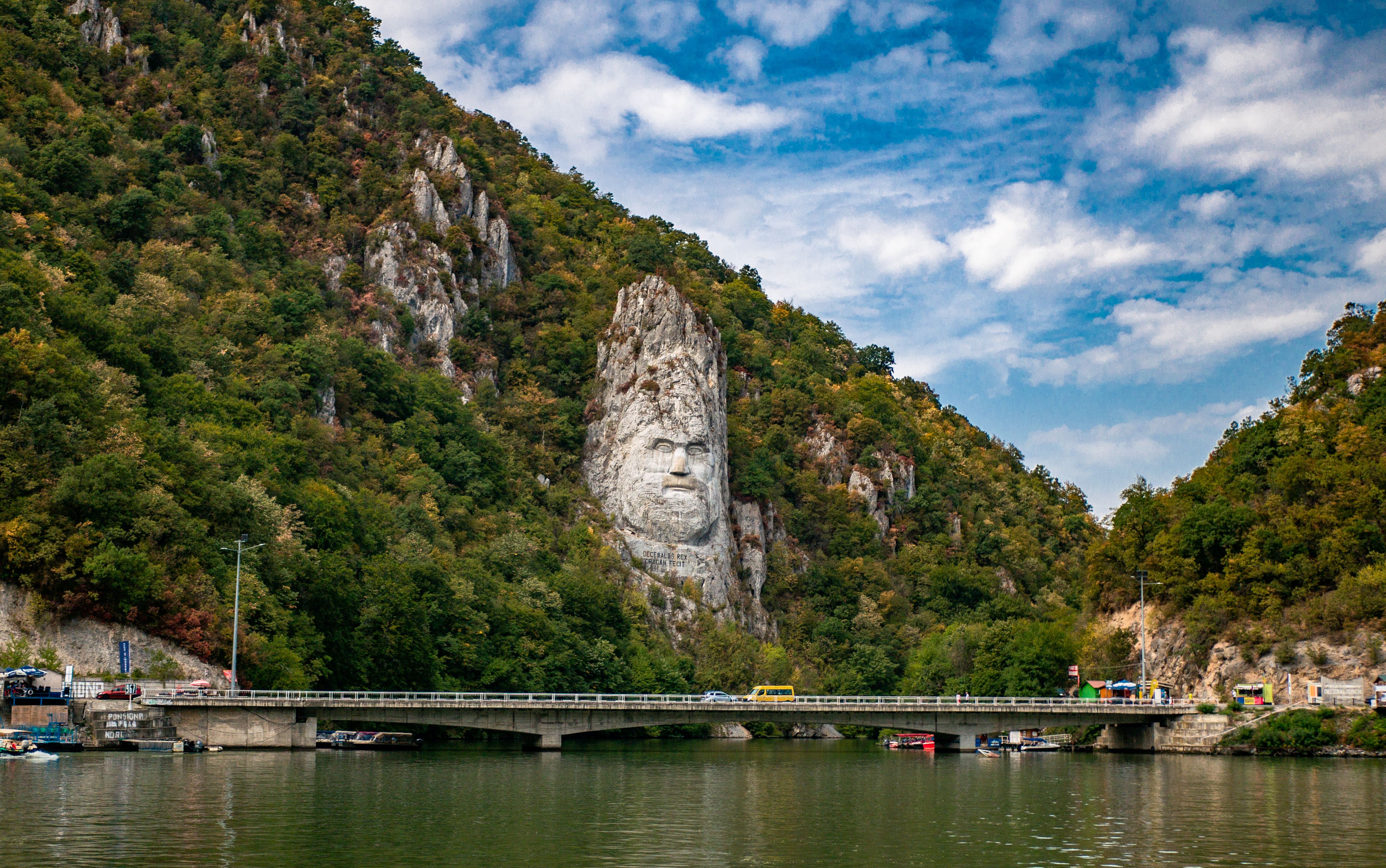
Decebalus Rock Face: Where Dacian Defiance Meets the Danube's Iron Gates
The Danube narrows to 150 meters (500 feet) at the Kazan Gorge—and suddenly, a 55-meter (180-foot) face emerges from the limestone cliff, glaring across the water for all eternity [citation:2][citation:4]. You stand on the Romanian shore, the current sliding past with deceptive speed, while above you, the bearded features of King Decebalus, the last ruler of Dacia, stare in defiance at the Tabula Traiana on the opposite Serbian cliff—the Roman plaque that commemorates his empire's destruction [citation:1][citation:7]. The sound of the river against the rock is a low, constant thunder, punctuated by the distant horn of a cargo ship navigating the Iron Gates dams. This is not an ancient monument carved by Roman hands. It is a modern masterpiece, completed in 2004 after a decade of labor, funded by a millionaire nationalist, and carved by twelve sculptors who worked with dynamite and chisels in conditions so treacherous that vipers shared the cliffs [citation:4][citation:7]. It is the tallest rock sculpture in Europe—and it is only 22 years old [citation:1].
Why Decebalus Embodies the 2,000-Year Defiance of Dacia
The story of the Decebalus rock face is not ancient history; it is modern ambition carved into ancient stone. Between AD 87 and 106, Decebalus ruled Dacia (modern Romania), reuniting fragmented tribes and fighting three wars against two Roman emperors—Domitian and Trajan—before finally succumbing to the power of Rome in AD 106 [citation:2][citation:7]. The Roman victory was commemorated on the Serbian side of the Danube with the Tabula Traiana, a marble plaque carved into the rock that recorded the completion of Trajan's military road and, by implication, the defeat of the Dacian kingdom [citation:1]. For nearly 2,000 years, that plaque stood unchallenged. Then came Iosif Constantin Drăgan, a Romanian businessman, historian, and leading figure in the protochronism movement—a nationalist ideology that portrays Romania as the cradle of European civilization [citation:2][citation:10]. In 1992, Drăgan purchased the rocky outcrop on the Romanian side of the gorge. He commissioned Italian sculptor Mario Galeotti to design a colossal face of Decebalus, intended to stare directly across the river at Tabula Traiana—a 2,000-year-old rebuttal [citation:2]. For ten years (1994–2004), twelve sculptors worked in dangerous conditions. The first six years involved dynamiting the rock into shape; the remaining four were devoted to finishing the detail [citation:9]. The lead artist was Florin Cotarcea from Orșova [citation:2]. Drăgan wanted the Serbs to carve a giant Roman emperor on their side to face Decebalus. The Serbs refused [citation:1].
The Best Time to Witness Decebalus's Stone Gaze
The optimal windows for visiting the Decebalus rock face are May 1st through June 15th and September 1st through October 15th [citation:9]. During these periods, daytime temperatures in the Iron Gates region range from a pleasant 19°C to 26°C (66°F–79°F) . In spring, the surrounding forests burst into fresh green, framing the limestone cliff; in autumn, gold and orange leaves contrast dramatically with the gray stone. For photographers, the late morning (10:00 AM – 12:00 PM) is ideal, when the sun is high enough to illuminate the face without casting harsh shadows across its features [citation:9]. The worst times are July and August, when the heat can reach 33°C (91°F) and boat tours are packed with summer travelers. Winter (December–February) offers a dramatic snow-dusted version of the sculpture, but access can be tricky—the winding roads along the Danube can become icy, and some boat operators suspend services. If you visit in winter, check road conditions and book boat tours well in advance . For current weather and tour availability, consult local operators in Orșova.
Approximate Budget for a 7-Day Iron Gates & Decebalus Trip
This budget assumes a mid-range trip based in Orșova or Dubova, including a boat tour to see the Decebalus statue and nearby caves, plus hiking in the Iron Gates Natural Park.
- Accommodation: 200–500 RON (€40–€100) per night. Budget: Pensiune in Orșova or Dubova, 180–250 RON (€36–€50) for a double room . Mid-range: Apartments with Danube views in Orșova, 400–500 RON (€80–€100).
- Food: 100–200 RON (€20–€40) per day. Breakfast 25–35 RON (€5–€7): often included in guesthouses—local cheeses, bread, and eggs. Lunch 40–70 RON (€8–€14): fresh grilled fish (carp or catfish) at a riverside restaurant. Dinner 50–80 RON (€10–€16): traditional ciorbă de burtă (tripe soup) or mici (grilled sausages) with mămăligă (polenta).
- Transportation: Car rental from Bucharest or Timișoara airports: 150–200 RON (€30–€40) per day. The drive from Bucharest to Orșova takes 5-6 hours on the A1/E70 highway . Local bus from Drobeta to Orșova: 10–15 RON (€2–€3).
- Attractions: Private boat tour to Decebalus statue (1.5 hours, up to 6 people): approximately 900 RON ($224) total . 20-person boat tour: approximately 170–200 RON (€35–€40) per person. Ponicova Cave and Veterani Cave entries: free or small fee (1.50€) [citation:3].
- Miscellaneous: Binoculars or zoom lens (to see the inscription detail): 100–300 RON (€20–€60). Rakija (Romanian plum brandy) tasting: 20–40 RON (€4–€8) per glass. Hand-painted ceramics from nearby Horezu region: 30–150 RON (€6–€30).
Total estimated 7-day budget (including accommodation, meals, car rental, and boat tour): 2,300–4,000 RON (€460–€800) per person. (Excluding international flights.)
7 Essential Decebalus Rock Face Experiences
- View Decebalus from the Water—The Only Way to See His Full Face: The 55-meter (180-foot) sculpture is impossible to appreciate from the roadside; the angle is wrong, and the face becomes a distorted profile. A 1.5-hour boat tour from Orșova or Dubova brings you directly beneath the statue, where you can tilt your head back and see the king's stern gaze in full relief [citation:6]. Tours cost approximately 900 RON ($224) for a private boat (up to 6 people) or 170–200 RON (€35–€40) per person on a larger vessel [citation:6][citation:8].
- Decode the Latin Inscription at the Base: Just below the massive face, carved into the rock, is a Latin inscription: "DECEBALUS REX—DRAGAN FECIT" ("King Decebalus—Made by Drăgan") [citation:2][citation:7]. The irony is thick: the inscription uses the language of the Roman conquerors to praise the Dacian king. Bring binoculars or a zoom lens—the text is difficult to read from the boat with the naked eye [citation:9].
- Gaze Across at the Tabula Traiana—The Roman Answer to Decebalus: On the Serbian side of the river, directly opposite the statue, the Tabula Traiana is a Roman memorial plaque carved into the cliff [citation:1]. Completed in AD 101, it commemorates Trajan's victory over Decebalus and the completion of a military road through the Iron Gates gorge [citation:2]. Drăgan placed his Decebalus to face this plaque—a 2,000-year-old argument made visible in stone. The Serbs declined his request to carve a matching Roman emperor [citation:7].
- Learn the Dangerous Conditions of the Sculptors: The twelve sculptors who worked on Decebalus between 1994 and 2004 faced extraordinary hazards. Access to the base of the rock was possible only by water [citation:4]. Heavy equipment could not be used; all materials were transported manually [citation:4]. The cliffs are inhabited by vipers, a venomous snake genus [citation:4]. The work could only take place from March to October, when temperatures were above freezing [citation:4]. The first six years involved dynamiting the rock into rough shape; the final four years were for detail work [citation:1]. This was not a construction project; it was an act of obsessive devotion.
- Combine Decebalus with Ponicova and Veterani Caves: Most boat tours of the Decebalus statue also include stops at two caves in the Iron Gates Natural Park: Ponicova Cave (a "through cave" accessible from both the water and a hiking trail) and Veterani Cave [citation:3]. Entrance fees are minimal (approximately 1.50€ per person) [citation:3]. Ponicova is particularly dramatic: you step directly from the boat into the limestone darkness, where stalactites and stalagmites, some 10,000 years old, line the main chamber. Bring a headlamp.
- Visit Mraconia Monastery—The "Floating" Nunnery Nearby: Most Decebalus boat tours also pass Mraconia Monastery, a small, picturesque nunnery that seems to float on the water [citation:6]. Built in 2000 on the site of a 15th-century monastic settlement submerged by the Iron Gates dam, the monastery is accessible only by boat . The nuns sell hand-painted icons and local honey. The boat will not dock unless you request it; tell your captain.
- Photograph Decebalus at Golden Hour from the Romanian Shore: While the boat offers the best angle for seeing the face, the late afternoon (4:00–5:00 PM in autumn, 5:00–6:00 PM in spring) from the Romanian roadside pull-offs offers a different kind of magic. The setting sun angles across the Danube, catching the side of the cliff and turning the limestone warm gold while the face remains in shadow and mystery. The best roadside viewpoint is approximately 2 kilometers east of the statue on DN57.
3 Hidden Gems Most Travelers Miss
- The Refused Roman Emperor—The Serbian Side That Never Was: Drăgan did not stop at carving Decebalus. He reportedly approached Serbian authorities with a proposal: carve a giant Roman emperor on the Serbian cliff facing Decebalus, creating a monumental dialogue across the Danube [citation:1]. The Serbs refused [citation:1]. Today, the opposite cliff remains bare—save for the small, ancient Tabula Traiana plaque, dwarfed by Drăgan's 55-meter rebuttal. This refusal is rarely mentioned on tours, but it is the statue's secret footnote. Ask your boat captain.
- The Inscription Error—Was It Ever Corrected? Early reports and photographs of the statue, including descriptions from the early 2000s, show the inscription as "DECEBALUS REX—DRAGAN DONE" or "DECEBALUS REX—DRAGAN FECIT" [citation:4]. Some sources note that the original inscription contained an error that had to be corrected. Ask locals in Orșova about the "inscription scandal." You may get a story; you may get a shrug. Either way, look carefully at the text. It is not as straightforward as it seems.
- The Abandoned Quarry Trail to Decebalus's Back: Most visitors see only the face. But a 2-kilometer hiking trail from the village of Dubova leads to the top of the cliff—to the rock face's un-carved back. The trail is unmarked, overgrown, and requires a local guide (ask at any guesthouse in Dubova). From the summit, you look down on the top of Decebalus's head—carved hair, defined crown, and all—and across the Danube to the Tabula Traiana. The view is disorienting, even surreal. You are standing on a 20th-century monument disguised as ancient history.
Cultural & Practical Tips
- Book Boat Tours in Advance—Especially for Private Boats: Private boat tours (up to 6 people) cost approximately 900 RON ($224) and can be reserved online or through Orșova tourist offices [citation:6]. Larger group tours (14-20 people) cost 170–200 RON (€35–€40) per person but run less frequently [citation:8]. In summer, tours fill by midday; book at least one day ahead. In shoulder seasons (May, September), tours may run only once per day or by request.
- Binoculars Are Not Optional: The inscription "DECEBALUS REX—DRAGAN FECIT" is legible from the boat but only with binoculars or a zoom lens [citation:9]. Without them, it is a dark smudge beneath the king's beard. Bring a pair—they also help spot the Tabula Traiana across the river.
- Passports Are Recommended for Boat Tours: The Iron Gates form the border between Romania and Serbia. While most boat tours remain in Romanian waters, some itineraries approach the Serbian shore closely enough that border police may request documents . Carry your passport on any boat tour—a photocopy is not sufficient.
- Cash Is Required for Smaller Boat Operators: In the villages of Dubova and Ilovița, some independent boat operators accept only Romanian Lei cash . The nearest ATMs are in Orșova. Arrive with small bills (10–100 RON notes). Larger tour companies and online bookings accept cards.
- Learn Two Romanian Phrases for the Statue: "Mulțumesc" (Mool-tzu-mesk) means thank you—essential after every boat tour. "Decebal" is pronounced "Deh-che-bahl" in Romanian, not "Deh-see-bahl-us." A friendly "Noroc" (No-roke) to your boat captain means "Cheers"—appropriate for the rakija tasting that often follows the tour.
- Respect the Sculpture—Do Not Attempt to Climb: The rock face is part of a protected natural area (Iron Gates Natural Park). Climbing the sculpture is strictly prohibited, and the fines are significant. The rock is unstable in places, and the area is still home to vipers [citation:4]. Enjoy Decebalus from the boat or roadside; that is how Drăgan intended it to be seen.
Conclusion: Travel With Curiosity, Not Just a Camera
There is a temptation to treat the Decebalus rock face as a photo opportunity—to cruise past, snap the giant face, and tick "European monument" off your list. But to travel this way is to miss the statue's secret: it is not ancient. It is barely old enough to drink. Decebalus was carved not by Dacian hands but by Romanian nationalists, using dynamite and chisels, in a decade-long act of ideological defiance. It stands not as a remnant of antiquity but as a rebuke to antiquity—a 55-meter middle finger aimed at the Roman Empire that conquered Dacia 2,000 years ago. The statue is not history; it is a commentary on history. And that makes it stranger, sadder, and more fascinating than any genuine Roman ruin. The Serbs refused to carve a matching emperor. The vipers still nest in the cliffs. The Danube still flows past, indifferent to both Romans and nationalists. Decebalus stares across the water at the Tabula Traiana, and the Tabula Traiana stares back, silent, ancient, and unchanging. One is victory carved in marble. The other is defeat carved in limestone. Both are monuments to human stubbornness.