
Nazaré Big Wave Surfing: Where Human Audacity Meets Atlantic Fury
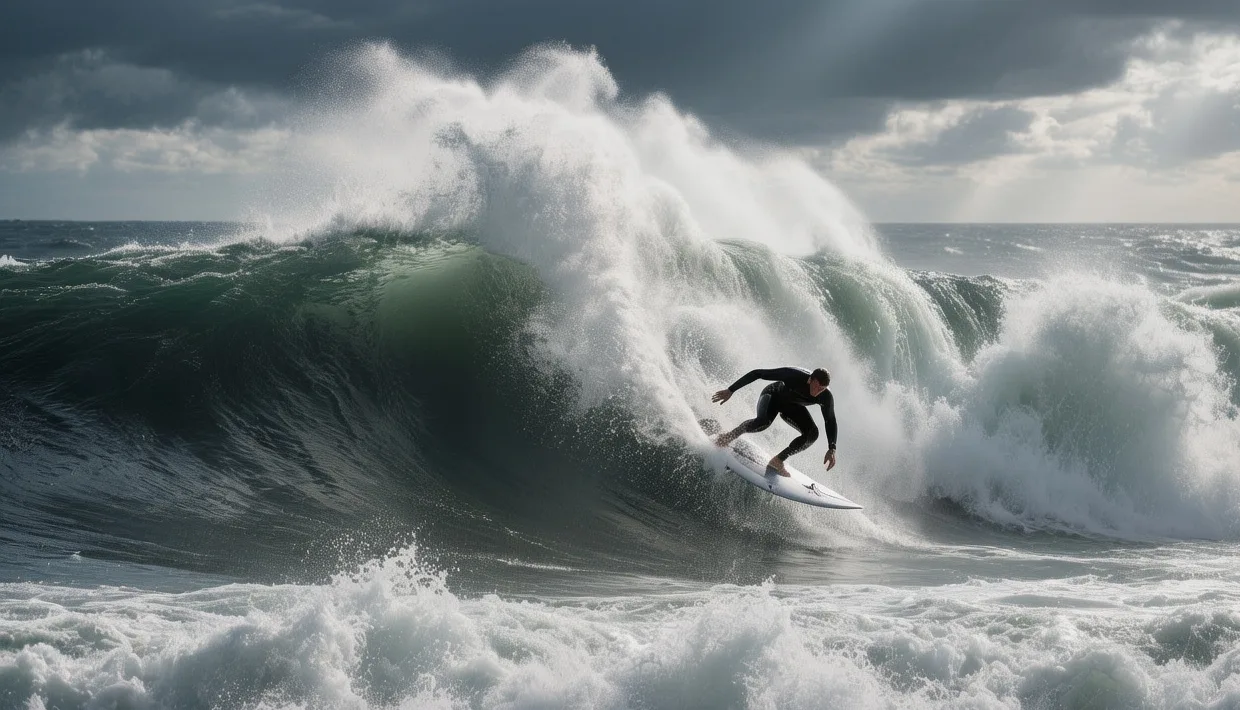
A deep, subsonic rumble shakes the wooden deck beneath your boots—an acoustic warning that arrives seconds before the water becomes visible. You stand on the sweeping arc of the Praia do Norte, watching a liquid mountain swell on the gray horizon, its face darkening as it triples in size over a matter of seconds. The air tastes violently of salt; fine sea spray coats your lips and eyelashes as the wind howls off the turbulent Atlantic. When the wave finally breaks, it does not merely crash—it detonates, throwing a chandelier of thick white spray 30 meters (98 feet) into the stormy sky. Below this chaotic apex, a solitary figure on a neon surfboard carves a sharp, defiant arc down the vertical face. The sheer scale of the water dwarfs the surfer to the size of an insect. Nazaré big wave surfing matters because it represents the absolute limit of human interaction with the ocean—a place where geological accident creates a gladiatorial arena, drawing elite athletes to test their survival against the heaviest, most terrifying walls of water on the planet.
Why Nazaré Big Wave Surfing Embodies Hydrodynamic Perfection
Nazaré big wave surfing embodies hydrodynamic perfection because it relies on a highly specific, unseen geological anomaly to solve the problem of wave amplification. For decades, standard coastal dynamics dictated that waves approaching shore lost energy as they dragged across the continental shelf. Nazaré entirely subverts this rule due to the Nazaré Canyon, an immense underwater trench located precisely 800 meters (2,625 feet) from the shoreline. This submarine gorge plunges to a depth of 5,000 meters (16,404 feet) and measures 230 kilometers (143 miles) in length. As powerful Atlantic swells—typically generated by fierce winter storms near Greenland—propagate toward the Portuguese coast, they encounter the steep, western edge of this canyon. Instead of losing energy, the deep water allows the swell to travel unhindered until it hits the abrupt eastern wall of the canyon. This sudden vertical rise forces the entire water column upward, compressing the wave energy and drastically shortening its wavelength. The resulting constructive interference creates a localized amplification effect capable of transforming a standard five-meter (16-foot) open-ocean swell into a colossal, 30-meter (98-foot) mutant wave. Before the canyon’s mechanics were fully understood by modern oceanographers, local fishermen simply knew this stretch of water as a sentient, ship-swallowing monster. Today, big wave surfers exploit this exact mathematical anomaly, using specialized tow-in equipment and jet ski assists to reach speeds of 80 kilometers per hour (50 miles per hour) necessary to drop into these fast-moving hydraulic anomalies.
The Best Time to Experience Nazaré Big Wave Surfing
To witness Nazaré big wave surfing at its most terrifying and spectacular, plan your pilgrimage between November 5 and March 12. During this precise window, the North Atlantic cyclone season reaches its peak, generating the long-period, groundswell energy required to trigger the canyon’s amplification effect. Air temperatures along the coast remain brisk, hovering between 12°C and 16°C (54°F–61°F)—cold enough to remind you of the mortal danger facing the surfers, yet mild enough to endure several hours outdoors. Arrive at the Praia do Norte viewpoint precisely between 7:30 and 9:00 AM. At this early hour, the predawn westerly winds often subside, creating the crucial "offshore" wind condition that grooms the wave faces into smooth, rideable cylinders rather than chaotic, wind-blown walls of foam. You should aggressively avoid June 15 through September 10; the Atlantic flatlines into a placid, swimming-friendly lake, rendering the famous surf break entirely nonexistent, while the town fills with sunbathers who crowd the cliffside pathways. For real-time swell forecasts, live cliffside cameras, and safety bulletins regarding beach closures.
Approximate Budget for a 7-Day Trip
Estimating costs for a big wave chasing expedition to Nazaré requires factoring in the stark reality that you are visiting a small fishing town during its most demanding, off-season weather window. This budget reflects an adventure-focused traveler prioritizing proximity to the wave over coastal luxury.
- Accommodation: €45–€75 per night (a compact, heated surf hostel or guesthouse in the Praia do Norte neighborhood, offering immediate walking access to the cliffside fort and drying rooms for wetsuits)
- Food: €30 per day (Breakfast €4 for a double espresso and a warm pastel de nata; Lunch €10 for a bifana—a thinly sliced pork steak sandwich heavily doused in spicy mustard—grabbed quickly at a cliffside kiosk; Dinner €16 for a hearty plate of caldeirada [fisherman’s stew] at a traditional, salt-crusted tavern away from the main promenade)
- Transportation: €15 total (€12 for a round-trip Rede Expressos bus ticket from Lisbon to Nazaré; €3 for a local municipal bus connecting the town center to the beach district)
- Attractions: €25 total (€5 for entry to the Nazaré Canyon Interpretive Center; €20 for a seat on a rigid inflatable Zodiac spectator boat, booked through local maritime operators like Nazaré Qualidade)
- Miscellaneous: €25 total (a heavy-duty neoprene face mask to block freezing Atlantic spray, locally sourced beach wax, and craft beer at a local microbrewery)
Total: €515–€730
6 Essential Nazaré Big Wave Surfing Experiences
- Stand on the Fort of São Miguel Arcanjo: Walk to the very edge of the historic stone fort perched on the headland. Lean against the cold metal safety railings and look directly down the 40-meter (131-foot) cliff face. When a 25-meter (82-foot) wave detonates below, you will feel the shockwave vibrate through the ancient masonry. The view provides a terrifying, vertigo-inducing scale of the wave compared to the microscopic jet skis bouncing in the whitewash.
- Book a Zodiac Spectator Boat: Board a high-powered rigid inflatable boat at the local harbor. The twin diesel engines roar as the captain navigates directly into the impact zone. Feel the freezing sea spray lash your waterproof jacket as you bob in the turbulent troughs, looking up at the wave face towering above the boat's bow. This visceral, wet perspective offers the only true understanding of the wave's terrifying volume.
- Walk the Praia do Norte at Low Tide: Descend the wooden staircase to the sand exactly two hours before low tide. Scattered along the beach, you will find massive tree trunks, thick shipping ropes, and car-sized chunks of concrete ripped from the seawall during previous winter storms. Running your hands over the salt-weathered debris provides a sobering, tactile reminder of the ocean's destructive power.
- Study the 3D Canyon Model: Enter the Nazaré Canyon Interpretive Center located near the municipal market. Examine the glowing, three-dimensional topographic map of the ocean floor. Trace the steep underwater cliff with your finger to visually understand exactly how the water is squeezed and forced upward, transforming abstract oceanography into a comprehensible, physical mechanism.
- Watch the Jet Ski Tow Teams Launch: Stand on the sand near the north rock outcroppings at dawn. Listen to the high-pitched whine of the two-stroke engines as the tow-in teams launch their heavily modified jet skis directly through the crashing shorebreak. Smell the acrid混合 of exhaust fumes and salt air as the teams accelerate to match the speed of the approaching giants.
- Eat a Bifana at Tábuas: After hours in the freezing wind, seek refuge in a crowded, steamy local tavern. Order the quintessential Portuguese pork sandwich. The crusty bread soaked in garlic-infused pork fat and sharp mustard provides an aggressive, comforting blast of calories that sharply contrasts with the harsh, elemental reality of the beach outside.
3 Hidden Gems Most Travelers Miss
- The Lighthouse Keeper’s Private Museum: Located inside the Sitio lighthouse adjacent to the main fort, this hidden gem is overlooked because most tourists stop at the exterior balcony to take photographs. To find it, walk through the heavy wooden door at the base of the lighthouse tower. Inside, the former keeper has curated a small, unassuming room displaying waterlogged surfboard fragments, shattered leashes, and dramatic photographs of near-death rescues. It costs €2 to enter, and the keeper usually hands you a shot of local ginjinha cherry liquor upon entry.
- Pedralva Beach: Situated two kilometers (1.2 miles) south of the main town, this secluded cove is completely ignored by wave chasers fixated on Praia do Norte. To access it, follow the rugged coastal dirt trail south from the Sitio neighborhood. It features dramatic, layered red-clay cliffs and a pristine, completely empty beach. It is best visited at sunset when the fading light turns the clay facades a brilliant, fiery orange.
- O Pescador Bar: A tiny, windowless drinking establishment located on a back alley in the lower town. It is overlooked because it lacks signage and looks like a private storage shed from the outside. Push open the heavy wooden door to find smoke-stained walls covered in decades of maritime photographs. This is the undisputed domain of the local jet ski drivers and tow-in rescue teams. It opens strictly at 6:00 PM; order a draft Sagres beer and drink in absolute silence alongside men who stare death in the face for a living.
Cultural & Practical Tips
- Never stand on the seawall edge during active big wave sessions; the sheer weight of the water displaces massive amounts of air, creating "sneaker waves" that can easily wash spectators off the 40-meter (131-foot) cliffs during extreme storm surges.
- Respect the local tow-in teams; these are not professional athletes performing for a crowd, but highly trained individuals executing life-or-death maneuvers. Do not block their beach launch zones or attempt to take selfies with them as they prepare their equipment.
- Learn essential Portuguese phrases to show respect: say "Bom dia" (good morning, pronounced "bom dee-ah") to the lifeguards, and use "Cuidado com as ondas" (watch out for the waves, pronounced "kwee-dah-doh kow-mahs ohn-dash") if you see a tourist getting too close to the slippery rocks.
- Protect your camera gear with extreme prejudice; the micro-droplets of salt spray in the air at Praia do Norte are highly corrosive. Use a rain cover for your camera body and wipe down your lenses with a microfiber cloth every ten minutes to prevent permanent optical damage.
- Monitor the wind direction obsessively; a shift from a southwest wind to a north wind will immediately destroy the wave face, turning a rideable mountain of water into a chaotic, unrideable mess of white water. Check the wind stations before leaving your accommodation.
- Dress in heavy, layered waterproof clothing; standing on the cliff for three hours in a 14°C (57°F) wind chill with wind speeds exceeding 40 kilometers per hour (25 miles per hour) will rapidly induce hypothermia if you are wearing only a standard autumn jacket.
Conclusion: Travel with Reverence, Not Just Spectacle
Nazaré big wave surfing demands a profound shift in how you consume extreme sports; it requires you to look past the viral internet videos and recognize the raw, terrifying indifference of the Atlantic Ocean. When you stand on the cliffs, you are not watching a sanitized sporting event—you are witnessing a high-stakes negotiation between human frailty and immense natural force. Mindful travel here means suppressing the urge to cheer wildly for the wipeouts, understanding that every brutal hold-down carries the genuine risk of drowning. It means respecting the local fishermen who navigated these waters centuries before the surfers arrived, and acknowledging that the canyon does not care about world records or social media likes. By treating the Praia do Norte with quiet awe rather than rowdy entertainment, you honor the profound, dangerous beauty of this unique geological anomaly. Let the deafening roar of the breaking swell remind you of your own smallness. In a town built on the edge of an abyss, the greatest privilege you can claim is the humility to simply stand in the freezing wind, watch the mountains rise from the deep, and hold your breath.