
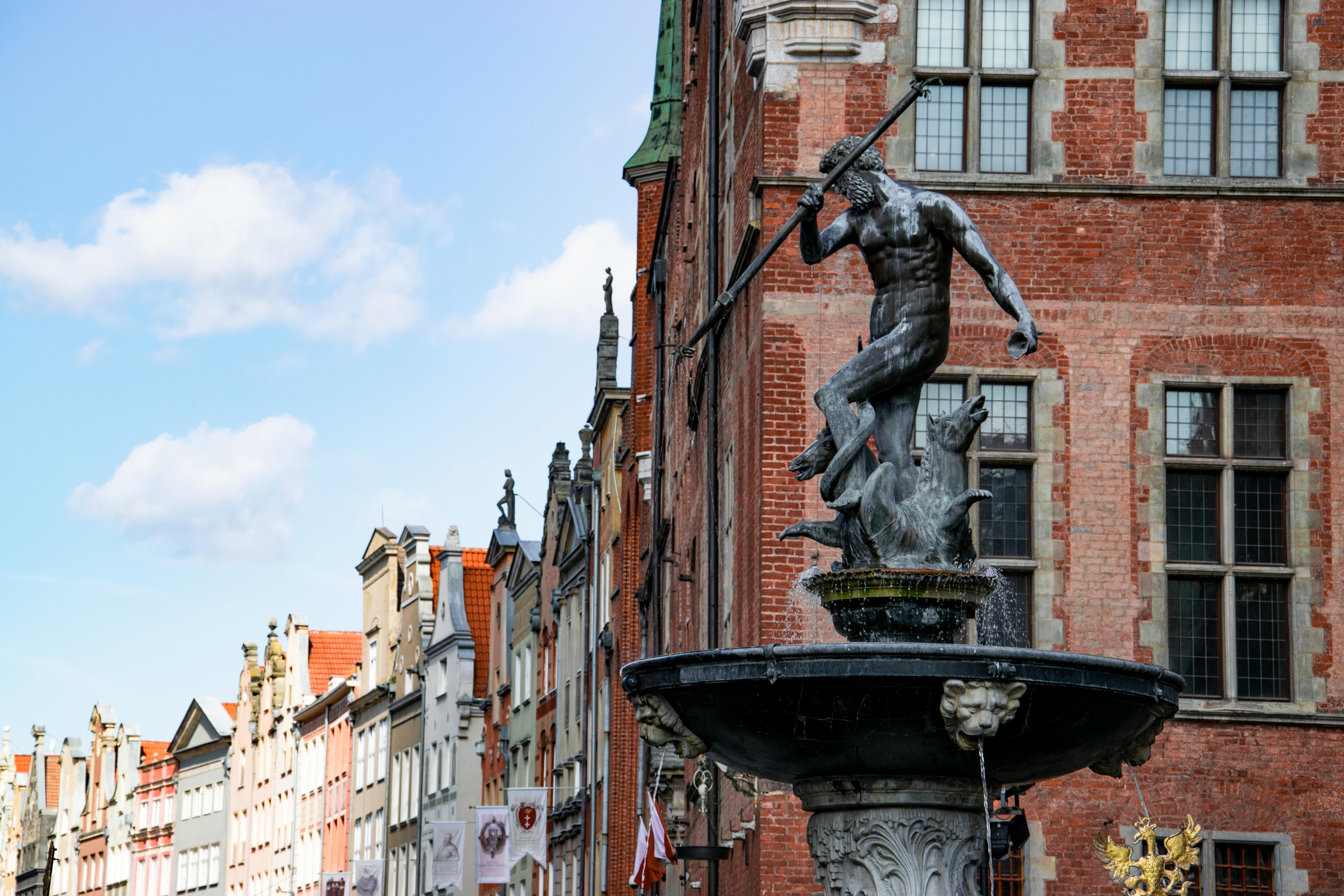
Neptune Fountain: Where Baltic Power Meets Artistic Splendor
Golden hour light spills across the cobblestones of Długi Targ (Long Market) as you approach the Neptune Fountain—Gdańsk's 17th-century masterpiece that has stood at the heart of the city since 1633. The air carries the scent of freshly baked pierniki gingerbread from nearby vendors, the faint aroma of Baltic amber, and the distant hum of the Motława River where merchant ships once docked. You hear the gentle splash of water cascading from Neptune's trident, the soft murmur of Polish conversations that have echoed through these streets for centuries, and the distant chime of St. Mary's Basilica clock tower marking the passage of time. This isn't merely a fountain—it's a living symbol of Gdańsk's maritime identity, where the Roman god of the sea stands triumphantly atop a Baroque masterpiece, surrounded by four allegorical figures representing the rivers Vistula, Oder, Warta, and Neman that connect Poland to the wider world. Standing before this bronze sculpture, you connect with the same urban fabric that witnessed the birth of the Hanseatic League's power, centuries of amber trade, and the quiet persistence of a port city that has weathered partitions, wars, and political change—a place where water, art, and history converge in a single, breathtaking monument that reminds us of humanity's enduring relationship with the sea.
Why Neptune Fountain Embodies Baltic Maritime Identity
Neptune Fountain represents far more than artistic beauty—it embodies Gdańsk's centuries-long relationship with the sea and its position as a gateway between Western and Eastern Europe. Commissioned in 1613 by Gdańsk's city council and completed in 1633 by Dutch sculptor Abraham van den Blocke, the fountain stands as one of the oldest and most significant Baroque fountains in Northern Europe, measuring 3.7 meters in height with Neptune himself reaching 2.4 meters. The fountain solved a fundamental challenge of civic identity: how to express Gdańsk's maritime power and independence through public art while navigating complex political relationships with Poland and neighboring powers. Built during the Polish-Lithuanian Commonwealth's Golden Age, the fountain features Neptune standing triumphantly on a shell-shaped chariot pulled by four hippocamps, symbolizing the city's mastery over the Baltic Sea. The four allegorical river figures surrounding the base—representing the Vistula, Oder, Warta, and Neman—create a visual narrative of Gdańsk's commercial reach across Central and Eastern Europe. What makes Neptune Fountain unique is its historical continuity: despite being removed during the Partitions of Poland and World War II, the original 17th-century design has been meticulously preserved through multiple restorations. Unlike many European fountains altered by changing tastes, Gdańsk's Neptune has maintained its essential character while adapting to modern needs—the current bronze casting, installed in 1954, faithfully reproduces van den Blocke's original vision using 18th-century documentation. The fountain's central placement in Long Market, directly in front of the Artus Court where Hanseatic merchants once gathered, creates a powerful visual statement about Gdańsk's identity as a maritime republic within the Polish Commonwealth—a delicate balance of autonomy and loyalty that defined the city's golden age.
The Best Time to Experience Neptune Fountain
To experience Neptune Fountain at its most atmospheric, plan your visit between May 20–June 15 or September 10–October 10, when daytime temperatures range from 14–22°C (57–72°F) and the surrounding Long Market blooms with spring blossoms or glows with autumn colors. During these windows, you'll enjoy comfortable conditions for photography, contemplation, and exploring the surrounding historic district without summer's humidity or winter's biting cold. For optimal photography of the fountain with Long Market's colorful Hanseatic buildings in the background, arrive at 7:00–8:30 AM when morning light strikes the eastern facades, illuminating architectural details with soft, directional illumination while the fountain's water surface remains glassy calm. Alternatively, visit at 5:30–7:00 PM during golden hour when warm light transforms limestone into amber tones and creates dramatic reflections on the water. You should firmly avoid July 15–August 25 when temperatures can exceed 28°C (82°F), the fountain becomes congested with tour groups, and harsh overhead light flattens the texture of the bronze sculpture. For event schedules, conservation information.
Approximate Budget for Visiting Neptune Fountain
Visiting Neptune Fountain requires basing yourself in Gdańsk's Old Town with easy walking access to the Long Market. The following budget assumes moderate travel style—comfortable boutique hotels, authentic Polish cuisine, and a mix of public transportation and occasional taxi rides. Prices are listed in Polish Złoty (PLN) with euro equivalents for international travelers (1 EUR ≈ 4.3 PLN in 2026).
- Accommodation: 110–260 PLN (26–60€) per night in Old Town or Główny Miasto. Budget pensions start at 55 PLN; mid-range boutique hotels run 260–500 PLN (60–116€).
- Food: 50–80 PLN (12–19€) per day total. Breakfast: 15–25 PLN for traditional śniadanie with jajecznica, local cheese, and fresh bread. Lunch: 20–35 PLN for pierogi or bigos at a milk bar like Kawiarnia Pasaż. Dinner: 40–70 PLN for sit-down meals featuring Baltic fish, oscypek cheese, and craft beer.
- Transportation: Local tram/bus: 3.40 PLN (0.80€) for 20 minutes; one-day pass: 16 PLN (3.70€); Uber/Bolt: ~15 PLN (3.50€) for short trips within city center.
- Attractions: St. Mary's Basilica entry: 20 PLN (4.70€); European Solidarity Centre: 35 PLN (8.10€); National Maritime Museum: 25 PLN (5.80€); Crane Museum: 22 PLN (5.10€).
- Miscellaneous: Baltic amber jewelry: 100–250 PLN (23–58€); traditional Polish pottery: 40–90 PLN (9–21€); folk music concert ticket: 50–120 PLN (12–28€).
Total 3-Day Visit Budget: 1,100–1,800 PLN (255–420€) per person (excluding international flights and main accommodation)
5 Essential Neptune Fountain Experiences
- Photograph the Fountain at Dawn: Arrive at 7:00 AM to capture the fountain with minimal crowds as morning light illuminates the bronze sculpture and surrounding Hanseatic architecture. The quiet atmosphere allows for reflection on centuries of history while capturing architectural details in soft morning light. Free; allow 30 minutes; tripod recommended for optimal water reflections.
- Examine the Allegorical River Figures: Study the four bronze figures representing the Vistula, Oder, Warta, and Neman rivers that surround Neptune's base. Each figure holds attributes symbolizing their river's commercial importance to Gdańsk. Visit mid-morning (10:00 AM–12:00 PM) when lighting enhances sculptural details; free; allow 20 minutes; bring a magnifying glass for intricate details.
- Attend the Midnight Water Show: Experience the fountain's special evening illumination when colored lights transform the water display into a dynamic performance. The midnight show features changing colors synchronized with classical music from nearby speakers. Shows begin at 12:00 AM; free; allow 15 minutes; best viewed from the Artus Court steps.
- Join a Historical Guided Tour: Take a specialized tour focusing on the fountain's creation, political significance, and artistic details. Knowledgeable guides reveal stories often overlooked by casual visitors, including how the fountain survived World War II. Tours typically begin at 10:00 AM and 2:00 PM; tickets 40 PLN; allow 45 minutes; book online to secure spots.
- Sketch the Fountain from Multiple Perspectives: Find different vantage points around Long Market to capture the fountain's relationship with surrounding architecture. The elevated view from Artus Court's second-floor balcony offers a unique perspective rarely captured in photographs. Free; allow 60 minutes; bring a sketchbook and comfortable seating.
3 Hidden Gems Most Travelers Miss
- The Secret Inscription on Neptune's Base: Tucked away on the fountain's western side, a Latin inscription details the fountain's creation date and commissioning city council members. Most visitors miss it because it's partially obscured by water spray. Access: Visit mid-morning (10:00 AM–12:00 PM) when lighting enhances text visibility; best examined with a magnifying glass. No additional fee; allow 15 minutes.
- The Hidden Workshop of the Fountain's Restorers: Located in a nearby building, this small studio where the fountain's bronze elements are maintained is occasionally open to the public during special heritage days. Most tourists miss it because access is limited. Access: Check gdańsk.pl for "Open Monument Days" (typically September); no advance booking required. Best visited midday; free; allow 20 minutes.
- The Moonlight Reflection Path: This lesser-known evening walking route follows the fountain's northern side where strategically placed buildings create dramatic moonlight reflections on the water surface. Most visitors leave before dusk, missing this serene experience. Access: Available during evening hours; best visited on clear nights with full moon. No additional fee; allow 30 minutes; bring a flashlight.
Cultural & Practical Tips
- Respect Historical Significance: The Neptune Fountain represents Gdańsk's maritime heritage—speak thoughtfully about its historical context. Avoid touching the bronze sculpture as oils from hands accelerate corrosion of the historic metal.
- Essential Polish Phrases: "Dzień dobry" (jen doh-brih) = Good day; "Dziękuję" (jen-koo-yeh) = Thank you; "Proszę" (proh-sheh) = Please/You're welcome; "Neptun" (neh-poon) = Neptune. Locals appreciate respectful efforts.
- Fountain Strategy: Visit early morning for photography, late evening for atmosphere. Avoid midday when the fountain is most congested with tour groups. Consider returning at different times to experience its changing character throughout the day.
- Photography Guidelines: Photography is permitted throughout the area. For professional photography requiring tripods, contact the city's tourism office for necessary permissions. Avoid using flash directly on the bronze sculpture.
- Weather Preparedness: Gdańsk experiences temperate maritime climate: summer highs reach 23°C (73°F); winter lows drop to -3°C (27°F). The fountain area can be windy year-round; carry a light layer even in summer.
- Accessibility Notes: The Long Market area features cobblestone streets that can be challenging for wheelchairs. The immediate area around the fountain has level access, but some viewing angles require navigating uneven surfaces.
- Combine with Nearby Sites: Enhance your Neptune Fountain visit with walking-distance attractions: Artus Court (adjacent), St. Mary's Basilica (2 minutes), and the Motława River boulevards (5 minutes). A regional perspective enriches understanding of Gdańsk's historical layers.
Conclusion: Travel with Reverence, Not Just Observation
Neptune Fountain invites you to do more than photograph a bronze sculpture against historic architecture. This is a place to stand where Hanseatic merchants once gathered, where maritime power was symbolically asserted against political uncertainty, where the quiet persistence of artistic vision triumphs over time's passage. When you gaze upon Neptune's commanding presence, when you trace the water's path as it has flowed for nearly four centuries, when you connect the allegorical river figures to the commercial networks that shaped European history, you participate in a legacy that transcends tourism. Travel to Neptune Fountain with reverence for the craftsmen who created this Baroque masterpiece, for the preservationists who maintained it through turbulent times, for the community that cherishes this space as their own. Respect the fragility of historical monuments—every careless touch on bronze surfaces, every piece of litter left behind, disrupts a balance measured in centuries rather than moments. Understand that the serene atmosphere you cherish depends on the mindfulness of every visitor who comes after you. Let the fountain's harmonious design humble your understanding, let its layered history deepen your compassion, and let the convergence of art, history, and maritime identity remind you that the most profound journeys are those that transform observation into meaningful connection with the enduring power of cultural symbols.