
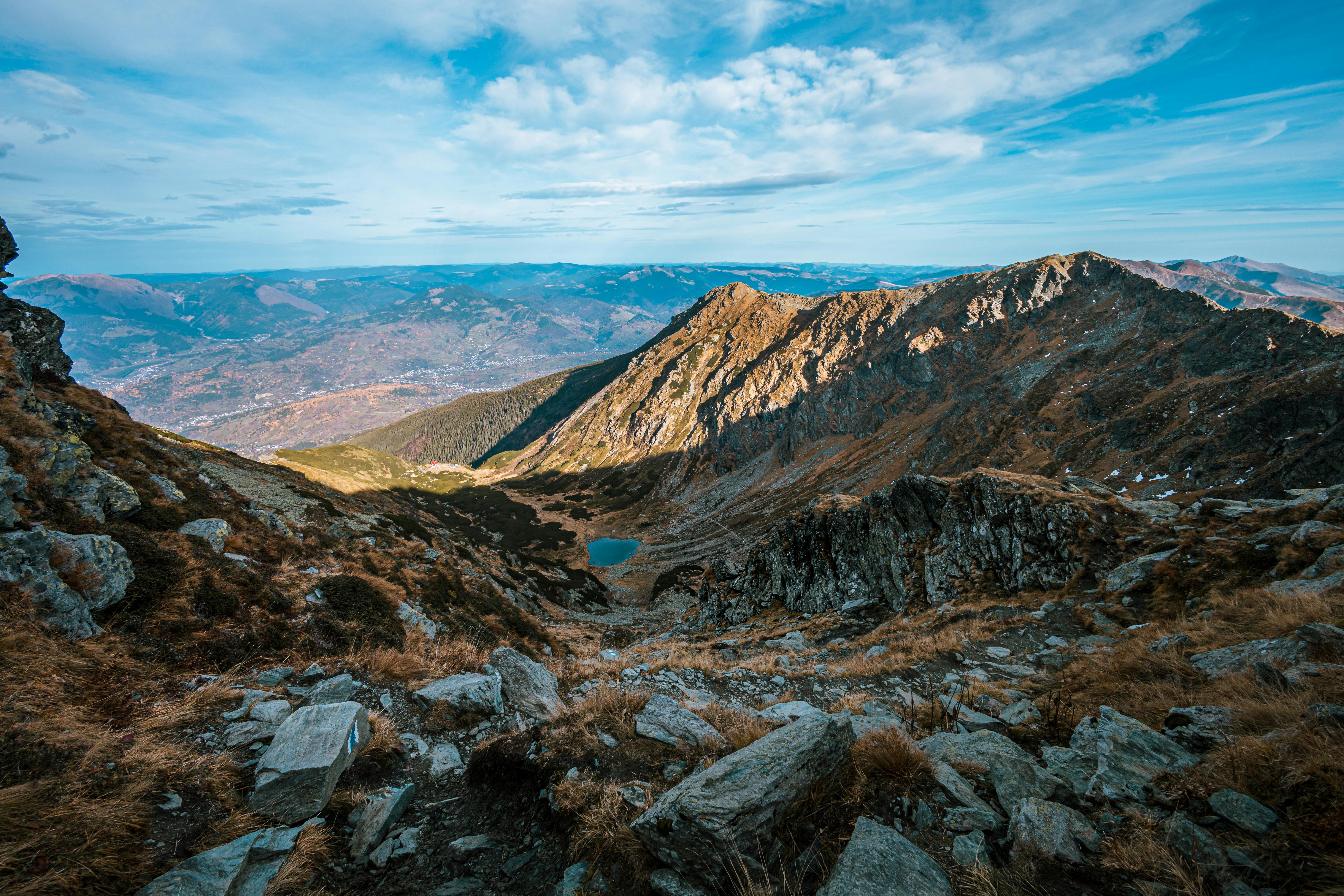
Rodna Mountains: Where Carpathian Peaks Meet Eternal Snowfields
The first light strikes Pietrosul Rodnei at 6:30 AM—and the highest summit of the Eastern Carpathians blazes gold. You are standing at 2,303 meters (7,556 feet), the wind whipping across the exposed ridge, the air so thin and cold it tastes of granite and ancient ice [citation:6]. Below you, glacial lakes glint like shards of broken mirror, and the forests of the Rodna Mountains National Park stretch for over 50 kilometers (31 miles) from west to east, a continuous spine of wilderness dividing Maramureș, Bistrița-Năsăud, and Suceava counties [citation:1][citation:6]. This is one of Romania's most formidable mountain ranges—a place where snow lingers well into June and sometimes even July, where the main ridge crossing takes three to five days, and where the only sounds are the whistle of wind and the distant bark of a shepherd's dog [citation:6]. Designated a national park in 1990 and expanded in 2000, the Rodna Mountains protect 46,599 hectares (115,150 acres) of alpine meadows, ancient spruce forests, and a UNESCO Biosphere Reserve that has remained unchanged since the last ice age [citation:1][citation:9]. Here, the Carpathians show their wildest face.
Why the Rodna Mountains Embody the Wilderness of the Eastern Carpathians
The Rodna Mountains solved a paradox: how to preserve a high-altitude ecosystem while welcoming responsible exploration. Formed during the Alpine orogeny, these young, folded mountains are among the highest in the Eastern Carpathians, with five peaks exceeding 2,000 meters (6,560 feet): Pietrosul Rodnei at 2,303 meters, Ineu Peak at 2,279 meters, Ineuț at 2,202 meters, Gârgalău at 2,158 meters, and Omu at 2,010 meters [citation:2][citation:6]. The park's centerpiece is the 3,300-hectare Pietrosul Rodnei Biosphere Reserve, which UNESCO recognized in 1979 for its exceptional glacial landforms: cirques, moraines, and more than 20 glacial lakes, including Lala Mare and Lala Mic, which sit beneath the massive north face of Ineu Peak [citation:9]. Designated a national park in 1990 and expanded in 2000, the Rodna Mountains protect 46,599 hectares (115,150 acres) of alpine meadows, ancient spruce forests, and a UNESCO Biosphere Reserve that has remained unchanged since the last ice age [citation:1][citation:9]. Three major rivers spring from these mountains—the Vișeu, the Iza, and the Bistrița—feeding the Tisza and ultimately the Danube. The park's creation in 1990, following the fall of communism, solved the problem of protecting this wilderness from uncontrolled logging and hunting, creating a sanctuary where nature—not extraction—takes priority.
The Best Time to Experience the Rodna Ridge
The Rodna Mountains offer two distinct seasons, each demanding different preparation. Summer—from July 1st through September 15th—is the prime window for ridge crossings and peak bagging. During these months, daytime temperatures at valley level range from 19°C to 26°C (66°F–79°F), while at the 2,000-meter ridge, expect 10°C to 15°C (50°F–59°F) [citation:4][citation:8]. The park is famous for snow lingering late: patches persist well into June, sometimes July, on north-facing slopes, adding a dramatic contrast to the summer alpine flowers [citation:6]. July and August see the rhododendrons in full bloom, carpeting the upper valleys in pink. For peak-bagging and photography, the early morning hours between 6:00 AM and 9:00 AM offer the most stable weather and the softest light. September brings cooler temperatures (13°C–17°C/55°F–63°F at valley level) and fewer hikers, though afternoon thunderstorms become more common [citation:2]. Winter—December through March—transforms the range into a ski-touring destination, but avalanche risk is significant; only experienced backcountry skiers with proper equipment should attempt it. Avoid the shoulder seasons of April–June and mid-September–October, when the weather is notoriously unpredictable—rain at lower elevations often becomes snow at the ridge, and the famous ridge can be socked in for days. The park's official website provides current trail conditions and weather warnings.
Approximate Budget for a 7-Day Maramureș & Rodna Itinerary
This budget assumes a mixed trip: three days of day hiking in the Rodna Mountains based in Borșa, combined with four days exploring Maramureș's cultural attractions. Prices are in Romanian Lei (RON) with Euro equivalents.
- Accommodation: 150–400 RON (€30–€80) per night. Budget: Cabana Pietrosul Rodnei (mountain hut), 50–80 RON (€10–€16) per night in dormitory. Mid-range: Pensiunea Lidia in Borșa, 180–250 RON (€36–€50) for a double room. Mountain refuges: La Cărți Shelter (12 beds), Gărgălău Shelter (12 beds)—these are free but require carrying your own sleeping bag and food [citation:2].
- Food: 100–180 RON (€20–€36) per day. Breakfast 25–35 RON (€5–€7): included in most guesthouses, featuring local cheeses, bread, and eggs. Lunch 40–60 RON (€8–€12): packed picnic from Borșa markets or a hot meal at Cabana Pietrosul Rodnei. Dinner 50–70 RON (€10–€14): traditional ciorbă de burtă (tripe soup) or grilled trout from mountain streams.
- Transportation: Car rental from Baia Mare or Cluj-Napoca airports: 150–200 RON (€30–€40) per day. Borșa is accessible via the Transrarău road (DN18) from Vatra Dornei. Local bus from Baia Mare to Borșa: 35–50 RON (€7–€10). Chairlift to Horses' Waterfall: approximately 40 RON (€8) round trip.
- Attractions: Rodna Mountains National Park entry: no fee for hiking, but parking at trailheads costs 10–20 RON (€2–€4) per day. Horses' Waterfall (Cascada Cailor): free access, approximately 80 meters (262 feet) of vertical drop—one of the highest waterfalls in Romania [citation:2]. Mocănița steam train (Viseu de Sus): 80–120 RON (€16–€24) per adult.
- Miscellaneous: Detailed hiking map of Rodna Mountains (1:50,000 scale): 25 RON (€5). Hand-carved wooden souvenir from Borșa market: 15–40 RON (€3–€8). Download the Salvamont mountain rescue app for free before your hike [citation:2].
Total estimated 7-day budget (including accommodation, meals, car rental, and basic equipment): 1,800–3,200 RON (€360–€640) per person. (Excluding international flights.)
7 Essential Rodna Mountains Experiences
- Summit Pietrosul Rodnei at Dawn: The highest peak in the Eastern Carpathians—2,303 meters (7,556 feet)—demands a predawn start from Cabana Pietrosul Rodnei or from the Borșa side via the Pietrii Pass [citation:6]. The ascent takes 4-5 hours via a well-marked but steep trail (1,300 meters/4,265 feet of elevation gain). From the summit, at 7:00 AM on a clear day, you can see across the entire range: the glacial cirques of Lala to the south, the rolling Maramureș hills to the north, and the Ukrainian border just beyond. The summit cross is a modern replacement for the original, destroyed by lightning in 2015.
- Bivouac at La Cărți Shelter: At approximately 1,750 meters (5,740 feet), this stone-and-wood refuge is the most atmospheric in the range, with stacked bunk beds sleeping 12 people, a wooden table, and a stone slab floor [citation:2]. There is no running water, no electricity, no guardian. You carry everything in; you carry everything out. The shelter sits at the intersection of several ridge routes, making it the perfect base for a two-day traverse. The name "Books" comes from the shape of the surrounding rock formations—stacked like volumes on a shelf. Sunset from the ridge above the shelter is unforgettable.
- Find the Glacial Lakes of Lala Mare and Lala Mic: Below the massive north face of Ineu Peak (2,279 meters/7,477 feet), two glacial lakes sit like mismatched sapphires [citation:3]. Lala Mare—"Big Lala"—is the larger, with a distinctive green tint from glacial silt. Lala Mic—"Little Lala"—is smaller, deeper, and colder. The trail from the Rotunda Pass to the lakes is moderate (3-4 hours round trip) and offers some of the best camping spots in the range. The surrounding meadows are covered in rhododendrons in July, and chamois are frequently seen grazing on the slopes above the lakes.
- Capture Horses' Waterfall in Golden Hour: One of the highest waterfalls in Romania, Cascada Cailor drops approximately 80 meters (262 feet) in a single, thunderous plunge [citation:2]. The easiest access is via the chairlift from Borșa, followed by a 20-minute walk on a marked path. The best photography conditions are late afternoon (4:00–6:00 PM), when the sun lights the mist and rainbows form at the base. The return walk from the waterfall to the chairlift is steep—"the difficult part of the route," as the chairlift's guides note—so budget extra time for the climb.
- Traverse the 50-Kilometer Ridge from West to East: For experienced hikers with alpine experience, the full ridge crossing—from the Prislop Pass in the west to the Rotunda Pass in the east—is one of Europe's great long-distance treks. The distance is approximately 52 kilometers (32 miles) with significant total ascent, typically completed in 3 to 5 days [citation:2]. The route is technically undemanding (class 1-2 scrambling), but the challenge is psychological: the ridge is exposed, water sources are scarce (except at refuges), and afternoon thunderstorms are common. Most hikers start at Prislop Pass and head east, finishing in the Vatra Dornei resort area—this way you are more likely to catch the wind from behind [citation:2].
- Track Wildlife on Cormaia Valley Ranger Walks: Between July and September, the park administration organizes guided excursions into Cormaia Valley specifically for wildlife tracking [citation:5]. Rangers and biologists lead groups to identify footprints, scat, and other signs of the park's large carnivores—brown bears, wolves, and lynx. These walks are not safaris; you are unlikely to see the animals themselves, but the experience of reading the forest with an expert transforms how you see the landscape. Contact the park administration at least two weeks in advance to book a spot.
- Camp at Iezer Lake Beneath Pietrosul's North Face: From the saddle below Pietrosul, descend toward Iezer Lake—one of the largest glacial lakes in the Rodna range, sitting in a dramatic cirque carved by ancient ice. The trail from Borșa to the lake takes 2-3 hours and requires sure-footedness; the final approach crosses a steep boulder field. The lake's waters are an astonishing emerald green in July, when the surrounding rhododendrons reflect off the surface. Camping is permitted but strictly LNT (leave no trace). The lake sits in the mixed reservation "Ineu – Lala," a strict protection zone where campfires are prohibited.
3 Hidden Gems Most Travelers Miss
- Gărgălău Peak's Virgin Forests: Most hikers targeting Pietrosul or Ineu overlook Gărgălău (2,158 meters/7,080 feet). This is a mistake. The trail from Gărgălău Shelter to the summit passes through a remnant of old-growth spruce forest that has never been logged—trees here are 300-400 years old, their trunks two meters in diameter. The summit view, looking west toward Pietrosul, is arguably superior to the view from the higher peak, because you see Pietrosul's north face in its full, dramatic relief. The shelter itself, a solid wood construction with 12 bunk beds, is less visited than La Cărți and often empty even in August [citation:2].
- The "Midnight Sun" of July from Refugiu sub Vârful Ineu: At approximately 2,200 meters (7,218 feet), just below the summit of Ineu Peak, a small emergency refuge sleeps four people on two double bunks. Because Ineu marks the northern edge of the range, and because the summit faces north, in late June and early July the sun barely sets before rising again. From the refuge, between 10:00 PM and 2:00 AM, there is a prolonged twilight—civil twilight merging into dawn without true darkness. It is not the Arctic midnight sun, but it is the closest you will find in the Carpathians. The phenomenon is most pronounced from June 15th through July 10th. The refuge is free and unlocked, but you must book overnight spots through the park administration; rangers check permits.
- Puzdrele Peak and the Outlaw's Pass: On the ridge between Galațului Peak and La Cărți Shelter, Puzdrele Peak offers a detour that most ridge-walkers skip in favor of the more direct path. The name comes from local folklore: in the 19th century, outlaw bands hid in the caves of this peak, preying on shepherds crossing between valleys. The "La Cărți Pass" (meaning "The Books") is named for the stack-like rock formations that outlaws used as landmarks. The detour adds 1-2 hours to your day, but the view north into the Vișeu Valley—with the Maramureș hills rolling toward the Ukrainian border—is unmatched. Look for the faint inscription carved into a boulder near the summit: "1903, Ion Pop, Viseu" [citation:7].
- Water Is Scarce on the Ridge: The defining challenge of the Rodna Mountains crossing is the absence of drinkable water on the main ridge itself [citation:6]. The few puddles that exist are typically dry by July. You must carry all the water you need—minimum 3 liters per person per day, and 4 liters if camping. Refill points exist only at Cabana Pietrosul, at the mountain huts (if open), and at the trailheads. Water from streams and lakes must be treated or boiled; giardia is present in the range. Never drink lake water unfiltered due to sheep visiting the lakes [citation:2].
- The Shepherd Dogs Are Not Pets: In summer, shepherds drive flocks into the upper meadows. The dogs—large, white, Eastern European shepherds—are bred to protect sheep from bears and wolves. They will charge at hikers who approach their flocks. Do not run (they will chase). Do not make eye contact. Back away slowly. Most attacks are bluff charges, but injuries occur every season. Keep at least 100 meters from any flock. "Better a bear than two shepherd dogs," says a local saying [citation:2].
- Cell Service Is Minimal: On the main ridge, you may have mobile network coverage in some places, but do not rely on your phone for navigation or emergencies [citation:2]. A GPS device with offline maps (such as a Garmin inReach) is recommended for multi-day treks. The refuges have no electricity, no Wi-Fi, and no phone. Download the Salvamont mountain rescue app before you leave—it can save your life in an emergency [citation:2].
- Equipment Essentials for the Ridge: The Rodna Mountains are alpine—not the rolling hills of the Apuseni or the forested slopes of the Southern Carpathians. You need: sturdy, waterproof hiking boots with ankle support; three-season sleeping bag (comfort rating to -5°C/23°F); waterproof jacket and pants (afternoon thunderstorms are daily in July); hat and gloves even in summer (nights on the ridge are cold); and a headlamp with extra batteries. Trekking poles are strongly recommended for the steep descents into the glacial cirques—the narrow path is often overgrown with grass, making it easy to slip and fall [citation:2].
- Mountain Refuge Etiquette: The refuges (La Cărți, Gărgălău, Refugiu sub Ineu) are free and unlocked, but they are not hotels. You must carry your own sleeping bag and pad. Leave the shelter cleaner than you found it. The mountain hut—Cabana Pietrosul Rodnei—charges a small fee (50–80 RON/€10–16) and serves hot meals, but it has limited beds and fills quickly on summer weekends. Lighting fires, bathing in tarns, collecting plants, and damaging nature in any way is prohibited in the campsites. As in every high mountain, everyone is obliged to carry out their own trash from the mountains [citation:2].
- Learn Two Romanian Phrases for the Trail: "Mulțumesc" (Mool-tzu-mesk) means thank you. "La revedere" (La re-veh-deh-reh) means goodbye. If you encounter a shepherd: "Noroc" (No-roke) is a friendly greeting, and "Merge treaba?" (Mer-jeh trea-ba?) asks "How's it going?" The shepherds will appreciate the effort and may invite you for brânză (cheese).
Cultural & Practical Tips
Conclusion: Travel With Resilience, Not Just a Summit
There is a temptation to treat the Rodna Mountains as a list of conquests—to bag Pietrosul, photograph Iezer Lake, and consider the range "done." But the true value of this wild range lies not in its summits but in its emptiness. Here, in the highest reaches of the Eastern Carpathians, you can walk for hours without seeing another person. The silence is not the silence of a city park; it is the silence of a landscape that has never been tamed, that still holds wolves and bears and the ghost of ancient ice. The challenge of the Rodna crossing—the scarcity of water, the afternoon storms, the shepherd dogs, the weight of your pack—is not a flaw. It is a filter. It selects for those who understand that wilderness rewards not the fastest, but the most prepared. To travel here with resilience rather than ambition is to accept that you are not the master of this place. You are a guest. Pack out what you pack in. Step carefully on the alpine meadows—they take decades to recover from a single footprint. And when you finally stand on Pietrosul, at sunrise, with the entire Carpathians spread before you, do not cheer. Breathe. That is enough.