
Sibiu Old Town Squares: Where Baroque Elegance Meets Transylvanian Soul
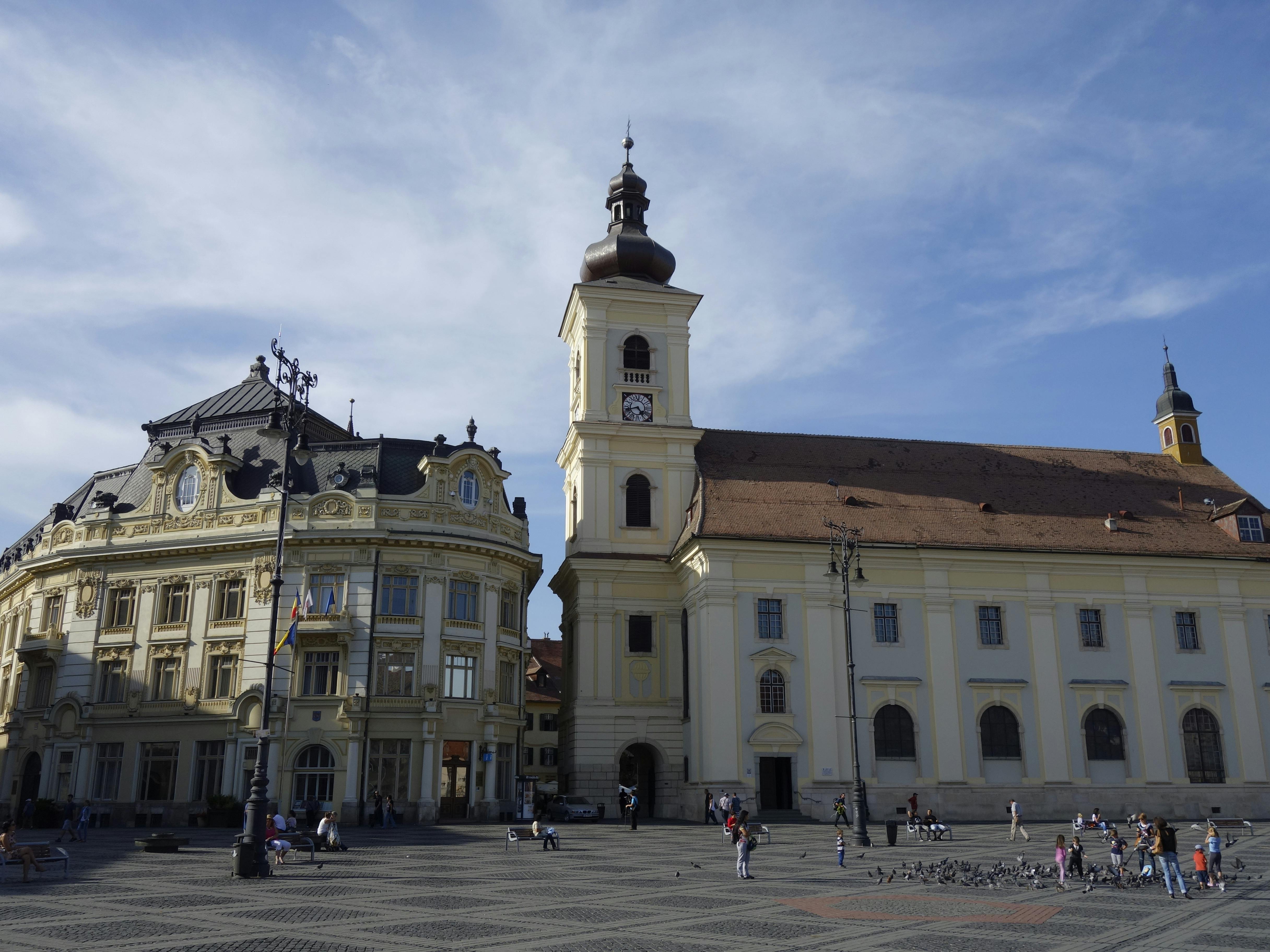
Golden light spills across the weathered cobblestones of Piața Mare as morning mist lifts from the Cibin River valley, revealing a theatrical stage of pastel-colored baroque façades, distinctive "eye" windows peering from red-tiled roofs, and the 44-meter Council Tower rising like a sentinel over eight centuries of Transylvanian history. You stand before the ochre walls of the Brukenthal Palace, where the scent of fresh plăcintă pastries mingles with espresso from sidewalk cafés and the distant chime of bells from the Evangelical Cathedral. This is Piața Mare—Sibiu's Grand Square—a 140-by-100-meter plaza first documented in 1408 and perfected by Saxon settlers who crafted one of Southeastern Europe's most harmonious urban ensembles, where merchant houses with ornate gables stand beside Gothic churches, where the "eyes of Sibiu" watch over daily life, and where every cobblestone echoes with the footsteps of traders, artists, and dreamers who shaped Romania's cultural identity. The air hums with the gentle murmur of café conversations, the rhythmic clip-clop of horse-drawn carriages on cobblestones, and the soft rustle of leaves from plane trees planted along the perimeter. Standing here, with the intimate Piața Mică connected by the narrow Staircase Passage and the forested hills of the Carpathian foothills visible beyond the red-tiled rooftops, you understand why these squares have anchored community life for over six hundred years: they remind us that some of humanity's most enduring public spaces are those that welcome both commerce and contemplation, that transform stone and timber into stages for the daily theater of human connection.
Why Sibiu Old Town Squares Embody Urban Harmony
Sibiu's old town squares represent one of Transylvania's most compelling achievements in urban design—a dual-plaza system that solved the fundamental challenge of creating distinct civic spaces for different functions while maintaining visual and functional coherence. Founded by German Saxon colonists invited by Hungarian kings in the 12th century, Sibiu reached its architectural zenith between the 15th and 18th centuries, when Piața Mare (Grand Square) served as the commercial and political heart while Piața Mică (Small Square) provided a more intimate setting for guild gatherings and residential life. The squares' distinctive layout—Piața Mare's expansive 1.4-hectare rectangle oriented east-west to maximize sunlight, Piața Mică's irregular 0.3-hectare form nestled against the medieval fortifications, and the narrow Staircase Passage connecting them—reflected the organic growth of a trading hub at the crossroads of Ottoman, Habsburg, and Romanian influences.
The technical mastery behind Sibiu's enduring appeal lies in its adaptive architecture and innovative urban features. Buildings were constructed with thick stone foundations to withstand seismic activity common in the Carpathian region, while the iconic "eyes of Sibiu"—dormer windows with eyelid-like shutters—provided ventilation for attic granaries while creating the city's distinctive anthropomorphic skyline. The Council Tower (Turnul Sfatului), completed in the 14th century and rebuilt after fires in 1542 and 1778, features a baroque spire and a mechanical clock that has marked Sibiu's hours for centuries. The squares' cobblestone surfaces, originally laid in the 15th century and restored using traditional techniques, feature subtle crowns for drainage that have prevented flooding for generations.
Today, Sibiu's old town squares fulfill multiple needs: preserving one of Europe's finest examples of Saxon urban planning, hosting cultural events that celebrate Transylvania's multicultural heritage (including the city's designation as European Capital of Culture in 2007), and providing visitors with a tangible connection to the daily rhythms of historic European life. The squares welcome approximately 350,000 visitors annually, serving as both a living museum of architectural evolution and a vibrant public space where past and present converge in the simple act of gathering.
The Best Time to Experience Sibiu Old Town Squares
The optimal window for visiting Sibiu's old town squares stretches from May 20 through September 25, when temperatures in the Transylvanian highlands range from 18–27°C (64–81°F) during daytime hours, creating ideal conditions for exploring cobblestone plazas and outdoor cafés. For the clearest light and most comfortable walking conditions, plan your visit between June 15 and September 10, when humidity levels drop and afternoon thunderstorms become less frequent. Early morning walks between 8:30–10:00 AM offer the dual advantage of softer light for photography and significantly fewer crowds, as most tour groups from Bucharest and Brașov arrive after 10:30 AM.
Late spring (May through June) brings blooming plane trees along the squares' perimeter and pleasant temperatures for outdoor exploration, though mornings can dip to 12–18°C (54–64°F). Autumn (mid-September through October) offers spectacular foliage as beech and oak forests surrounding the city turn brilliant shades of gold and crimson, with comfortable temperatures of 14–22°C (57–72°F) and dramatically fewer visitors after the summer peak.
Avoid visiting during Romanian national holidays—particularly June 1 (Great Union Day) and August 15 (Assumption Day)—when domestic tourism peaks and the squares can become congested with festival crowds. Also skip the last week of December if you prefer quiet exploration, as the Christmas market attracts up to 15,000 daily visitors despite cold weather. Winter visits (November through March) offer a different atmosphere with fewer crowds and occasional snow creating a fairy-tale ambiance, but outdoor cafés operate on reduced schedules and some exterior areas close for maintenance.
Approximate Budget for a 7-Day Trip
Exploring Sibiu's old town squares and the broader Transylvania region requires modest financial planning, as Romania remains significantly more affordable than Western European destinations while offering exceptional cultural and historical value. The following budget assumes a comfortable mid-range travel style with quality accommodations, regional Romanian cuisine, and comprehensive exploration of the squares, nearby attractions, and surrounding Carpathian experiences over seven days.
- Accommodation: €40–€75 per night for a double room in Sibiu historic center (boutique guesthouses and three-star hotels); square-view pensions €52–€88 per night; budget hostels from €23–€36 per person
- Food: €21–€33 per day (breakfast €5–€8 at accommodation with coffee, pastries, and eggs; lunch €7–€11 for traditional Romanian dishes like sarmale or mămăligă with brânză at square-side restaurants; dinner €9–€14 for grilled meats, ciorbă soup, or trout at regional restaurants)
- Transportation: Train from Bucharest to Sibiu €16 round-trip (3.5 hours scenic mountain route); local bus within Sibiu €2 per day; taxi from station to old town €6 one-way; parking near squares €3 per day if driving
- Attractions: Sibiu old town walking tour free; Council Tower entry €3 (14 RON); Brukenthal Museum entry €5 (23 RON); ASTRA Open-Air Museum day trip €12 transport + €4 entry; nearby fortified churches excursion €15; traditional craft workshop €8
- Miscellaneous: Authentic Transylvanian crafts and souvenirs €10–€27; local wine and țuică €6–€10 per evening; travel insurance €22 for the week; guidebook €9; bottled water and market snacks €11
Total estimated cost for 7 days: €460–€685 per person (depending on accommodation choices and dining preferences)
5 Essential Sibiu Old Town Squares Experiences
- Join the Morning Historical Walking Tour: Reserve the 9:00 AM guided tour of Sibiu's old town squares (free or €10 for premium), when angled morning light illuminates the baroque façades and cobblestone details. The 90-minute tour reveals the squares' evolution from medieval market to cultural heart: the "eyes of Sibiu" dormer windows providing attic ventilation, the Council Tower's baroque spire rebuilt after the 1778 fire, and the Staircase Passage connecting Piața Mare to the more intimate Piața Mică. Stand at the center of Piața Mare to appreciate the geometric precision of the rectangular layout and the harmonious color palette of ochre, cream, and terracotta that defines Sibiu's architectural identity. Photography without flash is permitted throughout; bring a wide-angle lens to capture the vertical drama of the plaza. Book at least 48 hours in advance via www.visitsibiu.ro.
- Climb the Council Tower for Panoramic Views: Dedicate 30 minutes to ascending the Council Tower's 193 stone steps (€3 / 14 RON), which offers breathtaking 360-degree views of Sibiu's red-tiled roofs, the two interconnected squares, and the forested Carpathian foothills. The climb involves narrow medieval staircases; visit between 10:00–11:30 AM when natural light filters through tower windows to illuminate historic exhibits on Sibiu's municipal history. The viewpoint reveals the geometric precision of the old town's street plan and the rolling hills stretching toward the Făgăraș Mountains. Bring a telephoto lens to capture distant peaks; wear sturdy shoes as the stone steps are uneven and can be slippery.
- Explore the Brukenthal National Museum: Dedicate 75 minutes to Romania's oldest public museum (entry €5 / 23 RON), housed in the baroque Brukenthal Palace (1778-1788) on Piața Mare's western edge. The collection features European paintings from the 15th-18th centuries, Transylvanian folk art, and historical artifacts that provide essential context for understanding Sibiu's cultural significance. Visit between 2:00–4:00 PM when natural light from the palace windows illuminates the artworks. The experience combines artistic appreciation with architectural immersion; allow extra time to explore the palace's ornate courtyard and baroque gardens.
- Walk the Staircase Passage at Golden Hour: After the afternoon tour, descend the narrow, covered Staircase Passage that connects Piața Mare to Piața Mică, where vaulted ceilings and wrought-iron lanterns create an intimate atmosphere. Visit between 5:00–6:30 PM in summer when the setting sun streams through the passage's western openings to bathe the stone steps in amber light. The perspective—looking up at the ornate balconies and "eye" windows—captures the essence of Transylvanian urban charm. Bring a telephoto lens to compress the vertical drama; a tripod is permitted on landings but not on stairs where it obstructs other visitors.
- Photograph the Squares at Blue Hour: Position yourself at Piața Mică's eastern corner at 8:00–9:00 PM in summer, when the setting sun has faded but artificial lighting creates a magical ambiance. The composition—colorful baroque buildings illuminated by warm streetlights with the Council Tower silhouetted against twilight skies—captures the essence of Sibiu's urban charm. Bring a tripod for long exposures; the squares' pedestrian zones provide stable footing for camera setup. Visit on weekdays for minimal foot traffic; the area near the Lutheran Cathedral offers a secluded vantage point for atmospheric shots.
3 Hidden Gems Most Travelers Miss
- Hidden Courtyard of the Haller House: This restored 16th-century merchant's courtyard, located behind the unassuming façade at Piața Mare number 21, features original stone arches, a working fountain, and seasonal flower displays rarely seen by international tourists. Access via the small doorway marked "Curtea Haller"; open daily 10:00 AM–6:00 PM with free entry. The courtyard is overlooked because the entrance is subtle and unmarked from the square, but the reward is a peaceful oasis where you can sit on stone benches and listen to the fountain's gentle murmur while surrounded by centuries-old architecture. Best visited between 2:00–4:00 PM when dappled sunlight filters through linden branches. No facilities; bring water if staying longer than 20 minutes.
- Traditional Black Pottery Workshop on Strada Cetății: This family-run ceramics studio, located in a restored 17th-century house on the narrow street connecting the two squares, demonstrates traditional Transylvanian black pottery techniques using clay from local deposits and wood-fired kilns. Access via the unmarked green door at number 8 on Strada Cetății; workshops are open Tuesday–Saturday 10:00 AM–4:00 PM with free observation (purchases optional). The workshop is overlooked because it lacks prominent signage from main tourist routes, but the reward is witnessing living craftsmanship and purchasing authentic handmade souvenirs directly from artisans. Best visited between 11:00 AM–2:00 PM when potters are most active. Photography permitted with permission; approach craftspeople respectfully and ask before photographing their work.
- Medieval Herb Garden Behind the Evangelical Cathedral: This small, fenced garden located behind the 14th-century Lutheran cathedral features over 40 traditional medicinal and culinary herbs once cultivated by Saxon women for healing and cooking. Access via the gate near the cathedral's eastern wall; the garden is open daily 9:00 AM–6:00 PM with free entry (donations appreciated). The site is overlooked because most visitors focus exclusively on the squares' architectural highlights, but the reward is peaceful exploration of traditional ethnobotanical knowledge and fragrant contemplation away from crowds. Best visited between 2:00–4:00 PM when herbal scents are most pronounced. Informational panels identify plants in Romanian, English, and German; no picking allowed to preserve the collection.
Cultural & Practical Tips
- Respect the Living Neighborhood: Sibiu's old town squares remain residential and commercial districts, not merely tourist attractions. Maintain respectful noise levels, dispose of waste in designated bins, and avoid obstructing pedestrian pathways with photography equipment. The squares host local events and daily commerce—trust staff guidance about temporary restrictions.
- Learn Basic Romanian Phrases: While many Sibiu businesses speak English and German, knowing a few Romanian phrases enhances your experience: "Bună ziua" (BOO-nah ZEE-wah) means "Good day"; "Mulțumesc" (mool-tsoo-MESK) means "Thank you"; "Vă rog" (vah ROHG) means "Please"; "Unde este toaleta?" (OON-deh yes-teh twah-LEH-tah) means "Where is the restroom?"
- Prepare for Cobblestone Walking: Sibiu's historic streets feature uneven cobblestones that can be challenging for wheeled luggage or mobility devices. Wear sturdy, comfortable footwear with good traction; avoid high heels or smooth-soled shoes. Many historic buildings lack elevators; confirm accessibility with accommodations in advance.
- Carry Cash (Romanian Lei): While larger restaurants and shops accept cards, market vendors, small cafés, and parking attendants often operate on cash only. The currency is Romanian leu (RON), with an approximate exchange rate of 4.9 RON to €1. ATMs are available throughout Sibiu city center but not inside historic buildings.
- Photography Guidelines: Tripods are permitted in public squares but not in narrow alleyways where they obstruct pedestrian flow. Flash photography is discouraged inside churches and museums to protect artifacts and frescoes. Drone use requires written permission from Sibiu municipal administration—contact info@visitsibiu.ro at least two weeks in advance.
- Weather Preparedness: Transylvanian highland weather changes rapidly—pack layers even in summer, including a lightweight waterproof jacket. Afternoon thunderstorms are common from June through August; if you hear thunder while exploring outdoor areas, seek shelter in a café or covered arcade. Check the forecast at the Sibiu tourist information center before starting your visit.
- Accessibility Considerations: The squares' main areas are partially wheelchair-accessible, but many historic buildings involve steps, narrow doorways, and uneven cobblestones not suitable for mobility devices. Contact the visitor center (+40 269 208 800) at least 48 hours in advance to arrange alternative routes or virtual tour access for mobility-impaired visitors.
Conclusion: Travel with Presence, Not Just Passage
Sibiu's old town squares endure not because they showcase architectural grandeur, but because they invite us to participate in the simple, profound act of urban life—a pair of plazas where six centuries of human connection have taught that historic spaces thrive when they welcome both preservation and evolution, both stranger and neighbor. When you stand on those cobblestones, tracing the footsteps of merchants, artists, and families who have shared this space across generations, you participate in a continuum of community that stretches from medieval markets to your own moment of presence. But with that privilege comes responsibility: to tread lightly on historic surfaces, to respect the delicate balance between tourism and daily life, to let the squares' authentic rhythm remind you that true travel is not about collecting sights but about connecting with place. The cobblestones will continue to echo with footsteps long after we've departed—let our presence here be measured not in photographs taken, but in the presence we carry forward, the respect we show to living heritage, and the willingness to slow down long enough to hear what community has to teach.