
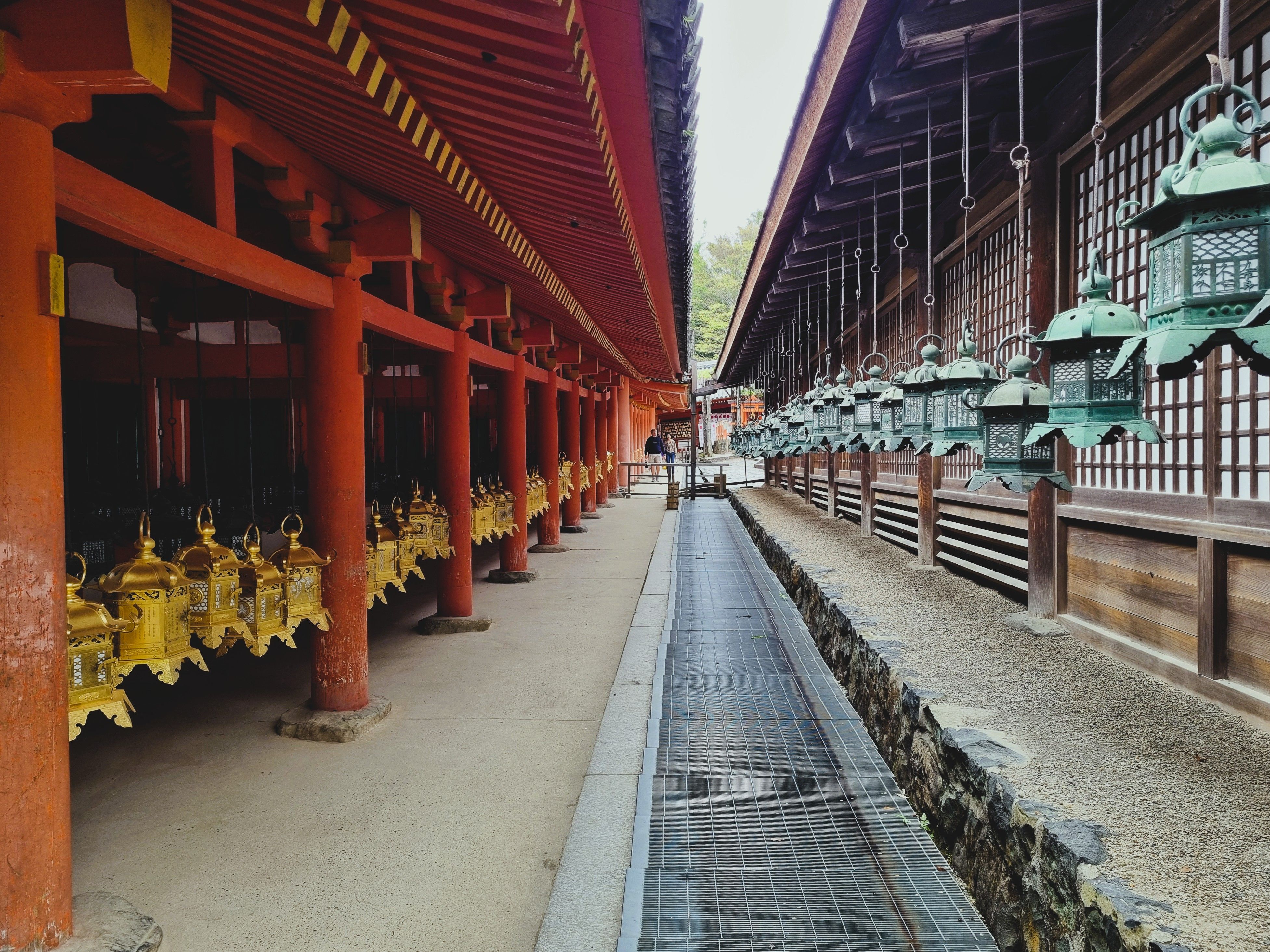
Kasuga Taisha Lanterns: Where Bronze Light Meets Ancient Cedar
The sun has just slipped behind Mount Wakakusa, and the forest of Kasuga transforms. What moments ago was a quiet path of moss-covered stones now becomes something else entirely—a sea of flickering amber lights stretching into darkness. You stand at the threshold of Kasuga Taisha, Nara's most sacred Shinto shrine, and before you unfolds a corridor lined with nearly 3,000 lanterns: some carved from stone, others cast in bronze, all of them alive with candlelight. The scent of cedar mingles with burning oil. Deer, the shrine's divine messengers, move like shadows between the glowing orbs, their hooves silent on the gravel. This is the Mantoro—the "Ten Thousand Lanterns" festival—a ritual performed only twice each year. For 800 years, these flames have been lit in prayer, each one a silent wish offered by a nameless believer. Tonight, you walk where samurai once walked, and the lanterns whisper their ancient secrets.
Why Kasuga Taisha Embodies a Millennium of Prayer
To understand these lanterns is to understand Japan's medieval soul. Kasuga Taisha was founded in 768 CE by the Fujiwara clan, Japan's most powerful aristocratic family, who chose this forested valley as the home for their guardian deity—Takemikazuchi no Mikoto, the god who legend says arrived from Kashima riding a white deer . The shrine quickly became the head of nearly 3,000 Kasuga shrines scattered across Japan . But the lanterns came later. Beginning in the late Heian period (794–1185), common people began donating lanterns as acts of faith—each one a prayer for safety, prosperity, or ancestral repose . The tradition exploded during the Muromachi (1336–1573) and Edo (1603–1868) periods, when religious associations and merchant guilds competed to offer the most elaborate lanterns. Today, roughly 2,000 stone lanterns line the approach, while approximately 1,000 bronze hanging lanterns adorn the corridors of the main shrine . Some bear the names of famous warlords from Japan's Warring States period (1467–1603)—Takeda, Uesugi, Tokugawa—their calligraphy still legible after four centuries . Together, they form one of Japan's most extraordinary collections of folk-art devotion.
The Best Time to Experience the Lanterns
For most of the year, Kasuga Taisha's lanterns stand silent, their candles unlit. But twice annually, the shrine transforms. The Setsubun Mantoro takes place on February 3 each year, marking the beginning of spring according to the old lunar calendar . Temperatures hover near 4°C to 9°C (39°F to 48°F), so dress warmly. The second illumination—Chugen Mantoro—occurs on August 14 and 15, overlapping with the Obon holiday when spirits of ancestors return to earth . August temperatures reach 28°C to 34°C (82°F to 93°F) with high humidity; bring water and a folding fan. On both occasions, the lanterns are lit from 6:30 PM to 9:00 PM, though arriving by 5:00 PM allows you to watch the lighting process. You should avoid visiting on the mornings of the 1st, 11th, and 21st of each month, when parts of the shrine close for rituals ..
Approximate Budget for a 7-Day Trip (Nara Focus)
This budget assumes you base yourself in Nara to experience both the Mantoro festivals and the quieter morning visits. Nara is significantly less expensive than Kyoto or Osaka. Prices in US dollars; ¥100 ≈ $0.67 USD.
- Accommodation: $40–$70 USD per night for guesthouses near Nara Park, $120–$200 for mid-range hotels like Nara Hotel (opened 1909) or Kanko Hotel Tamaru.
- Food: $22–$55 USD per day. Breakfast (¥400–600, $2.70–$4.00 at convenience stores), Lunch (¥1,000–1,800, $6.70–$12 for kakinoha-zushi persimmon leaf sushi or chagayu tea porridge), Dinner (¥1,800–3,500, $12–$23 for local specialties like narazuke pickles or fresh udon).
- Transportation: $8–$12 USD daily. From Kyoto (JR Nara Line: ¥720, 45 minutes; Kintetsu Line: ¥680, 35 minutes). Local transit: Nara Park is walkable, or take the Nara Kotsu Loop Bus (¥210 per ride, or ¥500 day pass).
- Attractions: Kasuga Taisha main grounds: Free. Inner sanctuary: ¥500 ($3.35). National Treasure Hall: ¥500 ($3.35). Combined ticket: ¥900 ($6.00). Mantoro illumination: Free (though donations appreciated).
- Miscellaneous: ¥1,500–3,000 ($10–$20) for omamori charms (deer or wisteria designs), Goshuin stamp book, or deer crackers (shika senbei: ¥200/$1.35 per bundle).
Total Estimated 7-Day Budget (excluding international flights): $550 – $1,100 USD
7 Essential Kasuga Taisha Lantern Experiences
- Walk the Stone Lantern Path at Dawn: Arrive at 6:30 AM (the shrine opens at this time March–October) . The approach from the main torii gate to the shrine passes hundreds of moss-covered stone lanterns, their surfaces wet with morning dew. In the half-light, the forest feels primeval—indeed, the Kasugayama Primeval Forest is a UNESCO biosphere reserve. Listen: no traffic sounds reach this valley, only birds and the rustle of deer.
- Attend Setsubun Mantoro (February 3): This is the original lantern festival, held for over 800 years . By 6:00 PM, all 3,000 lanterns blaze simultaneously. The inner corridor (requires ¥500 entry) offers the densest concentration of bronze hanging lanterns. Practical tip: Bring a small flashlight—some paths between lanterns remain dark . The festival coincides with mamemaki (bean-throwing ceremonies) elsewhere in Nara.
- Experience Chugen Mantoro (August 14–15): The summer illumination honors ancestors returning during Obon . The atmosphere differs from February—warmer, more languid, with the sound of wind chimes (furin) echoing from nearby houses. The Nandaimon Gate approach reveals lanterns donated by commoners during the Edo period, their names still carved into the stone. Unlike Setsubun, this festival lasts two nights; the second night is less crowded.
- Find the National Treasure Sword: Separate from the lanterns but unmissable, the Kasuga Taisha National Treasure Hall (國寶殿) houses the Ikakeji Katabami-mon Hyōgo-kusari no Tachi—a ceremonial 13th-century sword from the Kamakura period . At 98.2 centimeters (38.7 inches) in total length, this tachi features the revolutionary ikakeji lacquer technique: gold powder applied so densely the scabbard appears cast from solid metal. The three heart-shaped oxalis leaves on its fittings symbolize prosperity and resilience. Rotating exhibitions mean it appears several times yearly—check the website before visiting .
- View the Wisteria at Manyo Botanical Garden: Adjacent to the shrine, the Manyo Botanical Garden (万葉植物園) preserves plants mentioned in Japan's oldest poetry anthology, the Manyoshu (compiled 759 CE) . Visit in late April to early May to see the wisteria trellises in full bloom—purple cascades that inspired poets a millennium ago. The garden also contains 20 varieties of wisteria collected from across Japan. Entry: ¥500 ($3.35).
- Collect the Goshuin with Deer Design: Beside the main hall, a small wooden counter offers goshuin (shrine stamps) for ¥300–¥500 ($2–$3.35) . Unlike most shrines, Kasuga Taisha's stamp features a calligraphic deer beneath a wisteria flower—designs that change seasonally. The stamp is applied directly into your goshuincho (stamp book); purchase one at the shrine shop for ¥1,500 ($10) if you don't yet have one. Insider tip: The spring limited edition amulet features wisteria; the autumn version, maple leaves .
- Photograph the Vermilion Corridors at Magic Hour: The time between 4:00 PM and 5:00 PM (autumn) or 5:00 PM to 6:00 PM (spring) offers the ideal light for photographing the hanging lanterns. Position yourself in the eastern corridor, facing west, so the setting sun filters through the bronze lattice-work. Avoid using flash—it washes out the lanterns' patina. For the classic "lantern tunnel" shot, kneel low to align multiple lanterns into a receding diagonal line .
3 Hidden Gems Most Travelers Miss
- Wakamiya Shrine's 1,000 Lanterns: Tucked behind the main Kasuga complex, this subsidiary shrine (Wakamiya Jinja) houses an additional 1,000 stone lanterns that most tourists never see. Built in 1135 CE to appease deities during a time of plague, Wakamiya hosts its own lantern festival on December 15–18—the Wakamiya Mantoro—when all 1,000 lanterns are lit. Unlike the main festivals, December's event draws almost exclusively local worshippers. Insider tip: The path to Wakamiya passes the "Deer Watering Hole"—a stone basin where deer gather at dusk; arrive by 3:30 PM to see them drink.
- Meoto Daikokusha's Love Lanterns: Within Kasuga's grounds stands a small shrine dedicated to Meoto Daikoku (the deity of marriage and happy unions). Among its 30 bronze lanterns, one pair bears inscriptions from the Muromachi period (1336–1573)—visible only when lit during Mantoro. Couples touch the lanterns while praying for marital harmony. Insider tip: The shrine sells unique "love omamori" shaped like intertwined deer (¥800, $5.35). It's located a 5-minute walk west from the main hall, past the Kaguraden (sacred dance stage).
- The Unfinished Lantern of 1180: Hidden among the stone lanterns on the southern approach, one lantern stands incomplete—its top section missing, replaced by a flat stone. This is the "Genpei Lantern," donated in 1180 CE during the Genpei War (1180–1185), Japan's bloody civil war between the Taira and Minamoto clans. The donor, a Taira supporter, fled Kyoto after the clan's defeat at the Battle of Fujigawa (1180), leaving his lantern unfinished. Minamoto forces, upon discovering the half-completed donation, deliberately left it untouched as a trophy. The lantern remains as it was 845 years ago. Insider tip: Ask a shrine attendant (shinshoku) to point it out; most visitors walk past without noticing the historical significance.
Cultural & Practical Tips
- Etiquette at the Lanterns: Never touch the bronze lanterns—the oils from human hands accelerate corrosion. During Mantoro, do not blow out candles or relight extinguished flames; this is the priests' responsibility. When walking between lanterns, bow slightly as a sign of respect for the prayers they represent.
- Phrase: Learn "Mantoro o miseru kudasai" (Man-toh-roh oh mee-seh-roo koo-dah-sai) — "Please show me the lantern festival." For a blessing: "Nara no kami yo, mamo-tamae" (Nah-rah noh kah-mee yoh, mah-moh-tah-meh-eh) — "Gods of Nara, protect us."
- Photography Rules: During Mantoro, tripods and monopods are prohibited due to crowd density. Use a fast lens (f/1.8 or wider) and set ISO to 1600–3200. Flash is strictly forbidden inside the corridors—it disturbs worshippers and damages the lacquer on the shrine's vermilion pillars. The best handheld shot: brace yourself against a pillar and use a 1/30 second shutter speed.
- Deer Behavior During Festivals: The deer become more active at night, drawn by the warmth of the lanterns. Do not feed them shika senbei after dark—the crackers are only sold during daylight hours. If a deer approaches you near a lantern, stand still; they will not knock over the candles intentionally, but sudden movements might startle them into the displays.
- Access During Mantoro: The shrine remains open until 9:00 PM on festival nights, but buses from Nara Station stop running around 9:30 PM. The 20-minute walk back to Kintetsu Nara Station is well-lit and safe, but bring a flashlight for the park section . Alternatively, book a taxi in advance (0742-22-5188; approximately ¥1,500/$10 to the station).
- Seasonal Closure Warnings: Kasuga Taisha closes certain areas on the mornings of the 1st, 11th, and 21st of each month for tsukinami-sai (monthly rituals) . The inner sanctuary (¥500 area) reopens at 10:00 AM on those days. The main grounds remain free and accessible throughout.
- What to Wear: February Mantoro requires warm layers—temperatures drop to 0°C (32°F) by 8:00 PM. Hand warmers (kairo, sold at any convenience store for ¥200–300) are essential. August Mantoro demands light cotton or linen; the humidity combined with candle heat can exceed 80%. Wear closed-toe shoes—gravel paths and uneven stones make sandals hazardous in dim light.
Conclusion: Travel with Devotion, Not Just Photographs
It would be easy to attend the Mantoro, capture the glowing corridors on your phone, and leave, satisfied with the image. But a photograph cannot convey the weight of 800 years contained in each lantern. When you stand before a stone lantern carved with the name of a farmer who lived when Chaucer wrote The Canterbury Tales, you are not looking at an artifact—you are receiving a message. That farmer lit this flame for his children, that merchant for his ancestors, that samurai for victory in a war long forgotten. The lanterns of Kasuga Taisha are not decorations; they are the accumulated hopes of a thousand generations, still flickering in the Nara night. Walk slowly. Bow to the deer. When you light a candle—there are donation candles available at the shrine office for ¥300 ($2)—whisper your own wish into the flame. You will join a chain of prayer stretching back to the time when gods rode white deer through these very cedars. Travel here not to see lanterns, but to become, for one luminous evening, a part of their eternal story.