
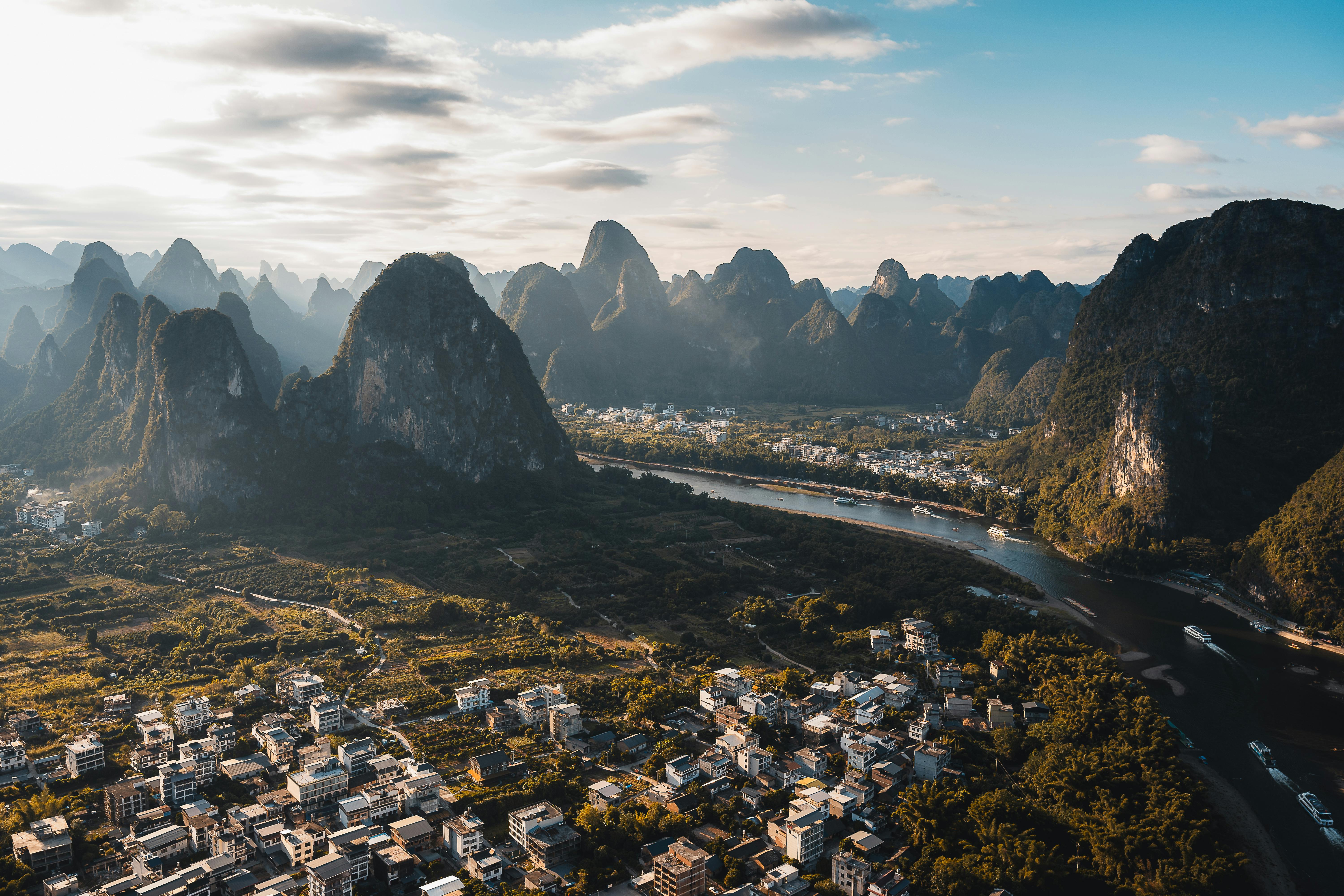
Yangshuo Karst Peaks: Where Limestone Towers Meet Rural Serenity
Golden hour bathes the landscape in liquid amber—light slanting through gaps between jagged limestone towers that rise vertically from emerald rice paddies like ancient stone sentinels. At 5:45 PM, you cycle along the Yulong River path, the air carrying the earthy scent of wet soil and blooming osmanthus, while water buffalo graze lazily in flooded fields that mirror the sky. The karst peaks—over 20,000 individual formations sculpted by 300 million years of rainfall dissolving ancient seabed limestone—create a topography so surreal it appears on China's 20-yuan banknote and inspired the floating mountains in Avatar. This is not merely scenery; it is a living shan shui (mountain-water) painting where farmers in conical straw hats tend terraced fields at the base of 300-meter cliffs, where bamboo rafts drift silently past caves that once sheltered prehistoric humans, and where every turn reveals a new composition of vertical stone and horizontal water. Yangshuo's karst landscape matters because it demonstrates nature's patient artistry and humanity's ability to live in harmonious proportion to geological grandeur—a lesson increasingly vital in our age of environmental disruption.
Why Yangshuo Karst Peaks Embodies Geological Poetry
Yangshuo's iconic karst landscape represents one of Earth's most spectacular examples of tower karst topography, formed over 300 million years when this region lay beneath the ancient Tethys Sea [[1]]. As tectonic forces uplifted the seabed during the Mesozoic era and acidic rainwater gradually dissolved the pure limestone bedrock, nature sculpted over 20,000 individual peaks across the Guilin-Yangshuo region, creating a landscape so distinctive it earned UNESCO World Heritage recognition in 2014 as part of the South China Karst designation [[4]]. The peaks—typically rising 200-300 meters above the surrounding plain with near-vertical slopes—solve a profound human need: access to landscapes that transcend ordinary tourism, offering instead a meditative immersion in China's most iconic natural cathedral.
The region's cultural significance extends beyond geology. For over 1,400 years, Yangshuo has served as a living canvas for Chinese landscape painters pursuing the shan shui aesthetic ideal, where vertical karst towers and horizontal river flows create perfect compositional balance [[7]]. Local Zhuang and Yao ethnic minorities have cultivated rice terraces at the base of these cliffs since the Tang Dynasty, developing sustainable agricultural techniques that prevent soil erosion on steep slopes while maintaining biodiversity. The peaks' engineering marvel lies in their natural formation: dissolution rates of 0.02-0.05 millimeters per year have created caves, arches, and isolated towers through processes modern science is still decoding [[9]]. Today, Yangshuo fulfills what travelers seek most: the opportunity to witness nature's patient artistry while engaging with communities that have adapted to this dramatic landscape for centuries, proving that human settlement and geological preservation can coexist when guided by wisdom rather than exploitation.
The Best Time to Experience Yangshuo Karst Peaks
To witness Yangshuo's karst peaks at their most enchanting, seasonal timing proves everything. The optimal visiting windows are April 15–June 10 for misty spring atmospheres and lush green rice paddies, and September 15–November 5 for crystal-clear autumn skies and golden harvest light. During spring, temperatures range from 18–26°C (64–79°F) with frequent morning mist creating ethereal photography conditions; autumn brings stable weather at 16–25°C (61–77°F) with 85% probability of blue skies and calm waters perfect for reflections [[12]].
For the most magical photography, position yourself at viewpoints between 6:00–7:30 AM for sunrise or 5:00–6:30 PM for golden hour—these windows offer soft, directional light that accentuates the peaks' vertical textures and creates dramatic shadows across rice terraces. The period immediately following light rain (typically 1–2 days after) offers enhanced mist effects that partially veil distant peaks, creating the layered depth characteristic of classical Chinese paintings.
Avoid: July–August peak monsoon season when heavy rains can cause flooding, humidity exceeding 90%, and occasional cruise cancellations; also avoid Chinese national holidays (October 1–7, Spring Festival in late January/February) when visitor numbers exceed 50,000 daily, overwhelming narrow cycling paths and viewpoints.
Approximate Budget for a 7-Day Trip
Yangshuo offers exceptional value for international travelers, with costs significantly lower than China's tier-one cities. This budget assumes moderate comfort with guesthouse accommodation, local dining, and comprehensive exploration of karst landscapes. All prices in Chinese Yuan (CNY/¥).
- Accommodation: ¥150–¥400 per night (mid-range guesthouses in Yangshuo countryside or near West Street; budget hostels from ¥80, riverside boutique hotels ¥500–900)
- Food: ¥90–¥160 per day
- Breakfast: ¥15–25 (rice noodles, soy milk, steamed buns, pickled vegetables)
- Lunch: ¥30–50 (Yangshuo beer fish, stir-fried river shrimp, seasonal greens)
- Dinner: ¥40–70 (taro duck, wild mushrooms, rice wine, local vegetables)
- Street snacks: ¥10–20 per item (osmanthus cakes, sticky rice, fried tofu)
- Transportation:
- High-speed train to Yangshuo Station: ¥300–500 from major cities
- Airport shuttle bus: ¥25
- Bicycle rental: ¥30/day; electric scooter: ¥80/day
- Private driver for day trips: ¥300–400
- Attractions:
- Moon Hill entrance: ¥35
- Xianggong Mountain viewpoint: ¥60
- Yulong River bamboo rafting: ¥150–240 per raft
- Impression Liu Sanjie light show: ¥198–680
- Silver Cave: ¥90
- Miscellaneous:
- Rock climbing guide (half-day): ¥200–350
- Cooking class: ¥120–180
- Souvenirs (osmanthus tea, chili sauce): ¥80–200
- Travel insurance: ¥50–100
Total for 7 days: ¥4,500–6,400 (approximately $620–880 USD)
6 Essential Yangshuo Karst Peak Experiences
- Sunrise at Xianggong Mountain: Wake at 5:00 AM and hike 20 minutes up this 300-meter peak for Yangshuo's most iconic panorama: the Li River snaking through layers of karst towers as dawn breaks. The viewpoint faces east, ensuring perfect lighting for photography between 6:00–7:15 AM. Bring a wide-angle lens to capture the sweeping vista; wear sturdy shoes as the final ascent involves steep stone steps. This 360-degree perspective reveals why this landscape inspired centuries of Chinese art—allow 45 minutes to fully absorb the scene before descending.
- Cycle the Yulong River Countryside: Rent a bicycle (¥30/day) and follow the 15-kilometer paved path that winds through rice paddies, past water buffalo, and beneath towering karst formations. Start at 7:30 AM to avoid midday heat; the route passes traditional villages, bamboo groves, and multiple photo opportunities where peaks reflect in irrigation channels. Stop at riverside cafes serving Yangshuo beer fish (¥45–65) and cold local beer. The flat terrain makes this accessible for all fitness levels; allow 3–4 hours for leisurely exploration with photography breaks.
- Climb Moon Hill's Summit Arch: Hike the 500-step stone path to this natural limestone arch spanning 50 meters wide and 30 meters tall, offering panoramic views of the surrounding karst sea. The 45-minute ascent rewards you with a 360-degree vista where dozens of peaks emerge from mist like islands in an emerald ocean. Visit 4:00–5:30 PM for golden hour light that transforms limestone to amber; bring water and sun protection as the climb is exposed. The arch's geological formation—created by water erosion dissolving weaker rock layers—demonstrates the same processes that shaped the entire region.
- Bamboo Raft the Yulong River: Experience the karst landscape from water level on a traditional bamboo raft propelled by a local poleman. The 8-kilometer journey from Jinlong Bridge to Gongnong Bridge takes 90 minutes, passing under stone bridges, past fishing villages, and through narrow channels where peaks appear to touch overhead. Best attempted 8:00–10:00 AM when morning mist often lingers on the water. Rafts accommodate 2–4 passengers (¥150–240 total); tip the poleman ¥10–20 for exceptional service or photography assistance.
- Watch Impression Liu Sanjie at Dusk: Experience Zhang Yimou's open-air theatrical production set against the karst peaks themselves, featuring 600 local performers, elaborate lighting, and traditional Zhuang minority music. The show begins at 7:30 PM (seasonal), with the natural limestone cliffs serving as a dramatic backdrop for scenes of rural life and folklore. Premium seating (¥380–680) offers unobstructed views; standard tickets (¥198–280) provide good value. Arrive 30 minutes early to secure positioning; bring a light jacket as evenings can cool to 18°C (64°F).
- Rock Climb a Karst Tower: Yangshuo is China's premier rock climbing destination, with over 300 bolted routes on limestone cliffs suitable for beginners to experts. Book a half-day introductory session (¥200–350 including gear and guide) to ascend a 30–50 meter route with panoramic views. Most climbs begin at 8:00 AM to avoid afternoon heat; routes like "The Phoenix" offer moderate difficulty with spectacular summit vistas. No prior experience required—certified guides provide instruction and ensure safety while you experience the peaks from a climber's perspective.
3 Hidden Gems Most Travelers Miss
- Old County Road Ancient Path: This 8-kilometer stone-paved trail, used by merchants since the Ming Dynasty, winds through secluded valleys where karst peaks rise dramatically on both sides. Unlike crowded cycling routes, this path sees fewer than 100 visitors daily, offering authentic encounters with farmers tending terraced fields and traditional villages unchanged for centuries. Access: Trailhead located 3 kilometers west of Yangshuo town; follow signs for "Old County Road"; free entry; allow 3–4 hours round-trip. Insider tip: Visit weekday mornings (8:00–10:00 AM) when mist often settles in valleys, creating the layered atmospheric perspective beloved by Chinese painters.
- Butterfly Spring Karst Cave: While most tourists visit the commercialized Silver Cave, this smaller limestone cavern 12 kilometers northeast of Yangshuo features stunning stalactites, underground streams, and colonies of actual butterflies in a natural grotto. The 45-minute guided tour reveals geological formations created over 2 million years, with temperatures a cool 18°C (64°F) year-round. Access: Hire a taxi from Yangshuo for ¥80–100 round-trip; entrance ¥45; open 8:30 AM–5:00 PM. Insider tip: Combine with a visit to nearby rural villages for authentic lunch at a family-run restaurant (¥30–40 per person).
- Dragon's Bridge Sunrise Viewpoint: This lesser-known stone arch bridge, built in 1782 during the Qing Dynasty, offers one of Yangshuo's most photographed yet least crowded sunrise compositions: the bridge framing karst peaks reflected in the calm Yulong River. The location requires a 15-minute walk from the nearest road, deterring casual tourists. Access: From Yulong River cycling path, follow signs for "Dragon Bridge"; free entry; arrive by 5:45 AM for sunrise. Insider tip: Bring a tripod and polarizing filter; the still water before 6:30 AM creates perfect mirror reflections impossible to capture later in the day.
Cultural & Practical Tips
- Respect Rural Communities: Yangshuo's countryside remains working agricultural land. Always ask permission before photographing farmers or entering private fields; a smile and "Nǐ hǎo" (nee how) builds rapport. Never walk through rice paddies outside designated paths—this damages crops and irrigation systems.
- Weather Preparedness: Yangshuo's subtropical climate features distinct seasons: spring (18–26°C/64–79°F) brings occasional drizzle that enhances misty atmospheres; summer (25–35°C/77–95°F) is humid with afternoon thunderstorms; autumn (16–25°C/61–77°F) offers ideal conditions; winter (8–18°C/46–64°F) can be chilly. Pack layers year-round and a compact umbrella regardless of forecast.
- Photography Guidelines: Sunrise and sunset offer the best light for karst photography; midday sun creates harsh shadows. Bring a polarizing filter to reduce glare on water surfaces and enhance sky contrast. Drones require advance permission from Guangxi Civil Aviation Authority—apply 2 weeks ahead at local tourism office.
- Transportation Safety: Cycling is the preferred way to explore, but traffic on main roads can be heavy. Use dedicated cycling paths where available; wear bright clothing for visibility. Electric scooters offer faster travel but require caution on narrow rural lanes—always wear a helmet (provided with rental).
- Local Phrases:
- "Nǐ hǎo" (nee how) = Hello
- "Xièxie" (shieh-shieh) = Thank you
- "Duōshǎo qián?" (dwo-shaou chyen) = How much?
- "Zhè lǐ hěn měi" (juh lee hen may) = This place is very beautiful
- "Qǐng wèn" (ching wun) = Excuse me / May I ask
- Crowd Strategy: Weekdays (Tuesday–Thursday) see 40% fewer visitors than weekends. Popular viewpoints like Xianggong Mountain fill by 6:30 AM—arrive earlier for unobstructed photography. Consider staying in countryside guesthouses rather than West Street to experience rural tranquility and support local economies.
- Environmental Responsibility: The karst ecosystem is fragile; never litter, even biodegradable items. Use designated waste bins in villages. Support sustainable operators who employ local guides and source food locally. Purchase crafts directly from artisans to ensure fair compensation and cultural preservation.
Conclusion: Travel with Reverence, Not Just Checklists
Yangshuo's karst peaks invite you to slow down—to cycle its rural lanes not as a tourist collecting photos but as a guest in a landscape that has shaped human consciousness for over a millennium. As you stand beneath limestone towers sculpted by 300 million years of patient erosion, as you watch farmers tend rice terraces using techniques unchanged since your great-grandparents' generation, remember that this landscape teaches harmony: between vertical ambition and horizontal patience, between human aspiration and natural limits. Travel here with reverence—respect the farmers' fields, support local communities through mindful purchases, leave no trace on paths worn by centuries of footsteps. The true gift of Yangshuo lies not in photographing every peak but in allowing the landscape to recalibrate your perspective—reminding you that humanity's greatest achievements are not the structures we build but the wisdom to live within nature's grand design. Breathe deeply. Cycle slowly. Let the karst teach you that beauty endures not through conquest but through coexistence.