
Arezzo Piazza Grande Medieval Asymmetry Meets Tuscan Light
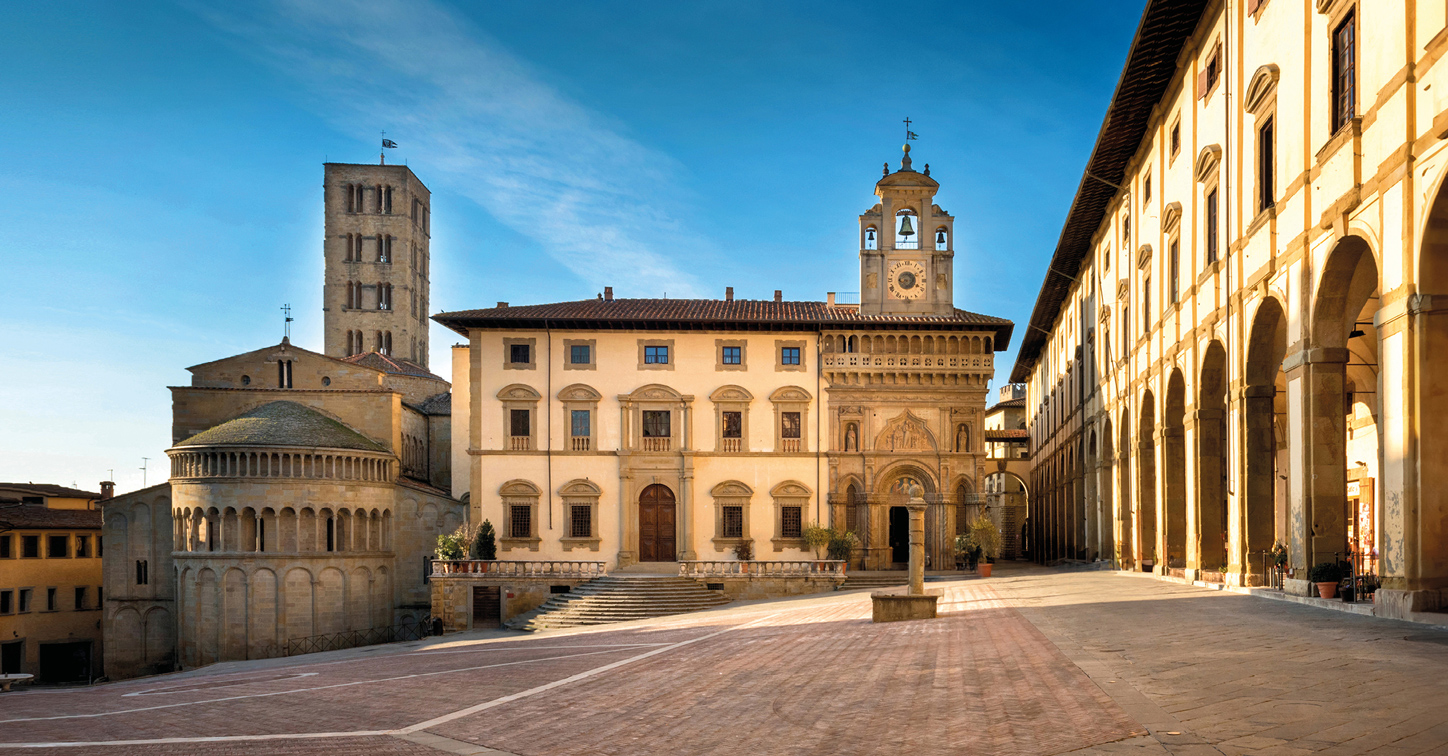
The morning sun, still low in the eastern sky, spills across the uneven cobblestones of Piazza Grande, warming the ochre and terracotta facades that lean into the space with a gentle, centuries-old intimacy. You hear the soft clatter of a waiter arranging espresso cups on a wrought-iron table, the distant chime of the cathedral bells from the hill above, and the murmur of early risers beginning their day—sounds that have echoed here since the 13th century. This is no ordinary square; its trapezoidal shape, dictated by the steep slope of the land, creates a dynamic stage where every building seems to jostle for position. At its heart stands the elegant, arched Loggia Vasari, completed in 1595, a Renaissance counterpoint to the surrounding medieval chaos. Measuring roughly 70 meters long, the piazza has witnessed everything from bustling medieval markets to the thunderous hooves of the Giostra del Saracino. In an age of homogenized travel experiences, Piazza Grande matters now more than ever—a living, breathing testament to authentic Italian urbanism that refuses to be flattened into a postcard.
Why Piazza Grande Embodies Tuscan Urban Genius
Piazza Grande isn't just Arezzo’s main square—it’s a masterclass in medieval urban planning born from necessity. Unlike the rigid, symmetrical plazas of later eras, its distinctive trapezoidal form was a direct response to the city’s challenging topography, cascading down a steep hill between the Romanesque Pieve di Santa Maria and the upper town. This asymmetry wasn’t a flaw but a brilliant solution, creating a natural amphitheater that draws the eye toward its most dramatic architectural features. The square’s current layout was largely solidified in the 13th century, but its defining element, the Loggia Vasari, was added three centuries later in 1595 under the direction of the famed architect and artist Giorgio Vasari, who was born in Arezzo. Constructed from local sandstone, the loggia’s clean, classical lines provide a serene visual anchor against the more ornate and irregular medieval palazzi that surround it, such as the Palazzo della Fraternita dei Laici with its intricate stone carvings and astronomical clock. This harmonious clash of styles—medieval pragmatism meeting Renaissance order—solved the problem of unifying a chaotic space while honoring its history. Today, it fulfills the essential need for a communal heart, a place where daily life, grand festivals, and quiet contemplation coexist seamlessly.
The Best Time to Experience Piazza Grande
To truly savor the magic of Piazza Grande without the crowds, aim for the shoulder seasons. The ideal window is May 18–June 12 or September 15–October 10, 2026. During these periods, daytime temperatures are a comfortable 22–26°C (72–79°F), perfect for lingering over a cappuccino at one of the outdoor cafes. For the most atmospheric experience, visit between 8:00–9:30 AM when the light is golden and the square is nearly empty, or in the early evening around 6:00 PM when the setting sun bathes the buildings in a warm, amber glow. Crucially, you must plan around the legendary Giostra del Saracino if you wish to witness it—or avoid it. The two 2026 jousting tournaments are confirmed for June 20 (night edition) and September 6 (day edition) [[11]]. While these events are spectacular, they mean the piazza is closed to the public for days beforehand for setup, and the city is packed with visitors. Therefore, avoid the weeks of June 15–22 and August 30–September 7 unless you are specifically attending the Giostra. For the most current event calendar, always verify dates on the official tourism site: discoverarezzo.com.
Approximate Budget for a 7-Day Trip (2026)
This budget is calculated for a solo traveler seeking a comfortable, culturally immersive experience in 2026, based on current inflation trends and average costs for Tuscany. Prices reflect mid-range options, not luxury or backpacker extremes.
- Accommodation: €80–€140 per night. Staying in the historic center near Piazza Grande commands a premium, while options in the San Giuliano neighborhood offer better value.
- Food: €45 per day. Breakfast (€5): a cornetto and espresso at a local bar. Lunch (€15): a primi dish like pappa al pomodoro at a trattoria. Dinner (€25): a secondi such as bistecca alla fiorentina with a house wine.
- Transportation: €120 total. A regional train ticket from Florence to Arezzo costs €10–€15 one-way (Trenitalia Regionale line). Within the compact city center, walking is free; occasional bus rides (Line A or B) cost €1.50.
- Attractions: Cathedral of Arezzo (€3), Medici Fortress (€5), Vasari House (€4). Many churches and the piazza itself are free to enter.
- Miscellaneous: €100. This covers a small bottle of local Chianti (€15), a hand-painted ceramic souvenir (€25), and a guided walking tour of the historic center (€60).
Total Estimated Cost: €955–€1,100
5 Essential Piazza Grande Experiences
- Climb the Vasari Loggia for a Panoramic View: Though often used for events, the loggia’s upper level offers a unique vantage point. Visit in the late afternoon when the sun illuminates the entire square, casting long shadows that accentuate the cobblestones’ texture. You’ll see the full scope of the piazza’s trapezoidal genius.
- Sip Espresso at Caffè Vasari: Take a seat at this historic cafe directly on the piazza. Order a “caffè” and watch the world go by. The ritual is simple but profound—the bitter shot of coffee, the clinking porcelain, the slow pace of Italian life unfolding before you.
- Attend the Antiques Fair (if timed right): Held on the first weekend of every month, the piazza transforms into a sprawling antiques market. Wander through stalls filled with vintage jewelry, Etruscan pottery replicas, and weathered books. Go early in the morning for the best finds.
- Trace the Giostra del Saracino Route: Even outside of tournament season, you can walk the path the knights take. Start at the top of the piazza near the Palazzo Comunale and imagine the thunderous charge down the slope toward the effigy of the Saracen king. Look for the painted crests of the four quarters (quartieri) on the buildings.
- Listen to the Fraternita Clock Chime: On the hour, the intricate 16th-century clock on the Palazzo della Fraternita dei Laici performs a short mechanical show. Stand directly below it at noon to hear the full, resonant chime echo off the surrounding stone walls.
3 Hidden Gems Most Travelers Miss
- The Whispering Corner near Via Garibaldi: On the western side of the piazza, near the archway leading to Via Garibaldi, stand in a specific spot on the cobblestones and whisper towards the wall of the Palazzo Cofani-Brizzolari. Your voice will carry clearly to someone standing at the opposite corner, a quirky acoustic phenomenon created by the building’s curved facade. It’s overlooked because it’s unmarked, but locals know it well.
- The Crypt of the Pieve di Santa Maria: While many admire the Pieve’s famous bell tower from the piazza, few venture inside to its crypt. Descend the stairs to find a cool, quiet space with ancient Roman spolia embedded in the walls. It’s open daily from 9:00 AM to 12:30 PM and 3:00 PM to 6:00 PM, but closes during Mass.
- The View from Corso Italia’s Midpoint: Walk up Corso Italia, the main street leading away from the piazza’s upper end. About halfway up, pause and look back. You’ll get a breathtaking, postcard-perfect framed view of the entire Piazza Grande nestled in the valley below, with the Tuscan hills rising in the distance. Most tourists never make it past the first few shops.
Cultural & Practical Tips
- Dress respectfully for churches: Shoulders and knees must be covered to enter any church, including the Duomo and Pieve. Carry a light scarf or jacket even in summer.
- Learn a few key phrases: “Buongiorno” (bwon-JOR-noh) for good morning, “Grazie” (GRAH-tsyeh) for thank you, and “Un caffè, per favore” (oon kah-FEH, pehr fah-VOH-reh) for ordering coffee.
- Photography etiquette: Feel free to photograph the architecture and public life, but always ask permission before taking close-up portraits of locals, especially vendors at the market.
- Embrace the passeggiata: Join the evening stroll (passeggiata) around 6:00 PM when locals dress up and socialize in the piazza. It’s a prime time for people-watching.
- Beware of uneven terrain: The piazza’s cobblestones are famously slanted and uneven. Wear sturdy, flat shoes with good grip to navigate safely, especially after rain.
- Respect the siesta: Many smaller shops and cafes close between 1:00 PM and 4:00 PM. Plan museum visits or a long lunch during this time.
Conclusion: Travel with Presence, Not Just Itineraries
In a world that often treats travel as a checklist of sights to be conquered, Piazza Grande in Arezzo offers a powerful antidote. Its enduring magic lies not in ticking off another landmark, but in the act of being present within its ancient, sloping embrace. To sit quietly on its steps as the light shifts, to listen to the layered sounds of history and modern life, is to participate in a conversation that has been ongoing for over 800 years. This mindful engagement is the true currency of travel in 2026. By choosing to linger rather than rush, to observe rather than just capture, you become part of the piazza’s living story—and in doing so, you contribute to its preservation. Your respectful presence, your genuine curiosity, is what ensures that this unique, asymmetrical heart of Tuscany continues to beat for generations to come. Slow down. Breathe in the scent of old stone and fresh espresso. Let Arezzo reveal itself to you, one quiet moment at a time.