
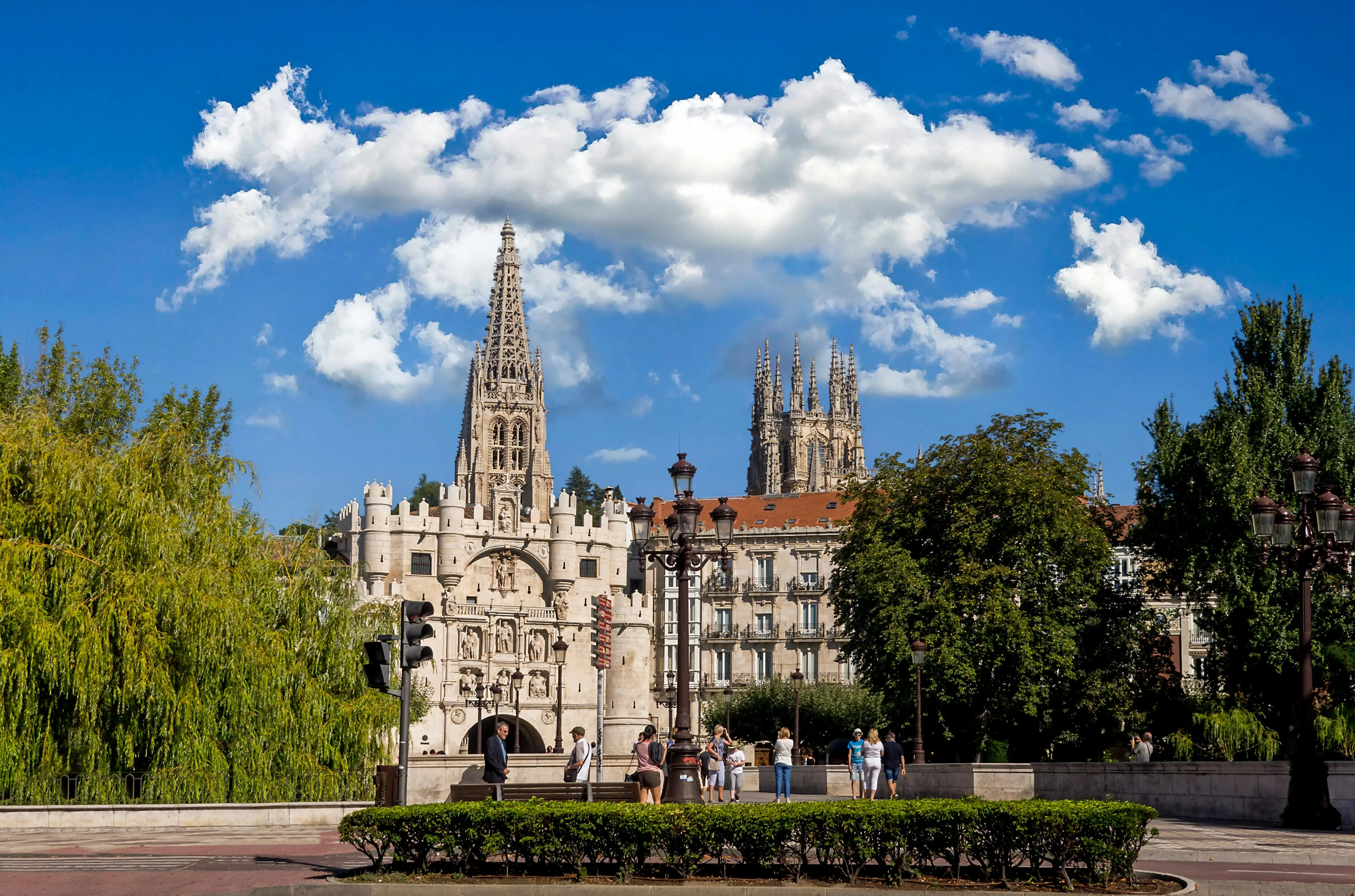
Burgos Cathedral Gothic Spires Meet Castilian Heritage
The evening bell tolls across the Plaza del Rey San Fernando as you stand before the western façade—your neck cranes upward to trace the lace-like stone tracery reaching 84 meters toward the Castilian sky. Construction began in 1221 under King Ferdinand III and Bishop Mauricio, making this Burgos Cathedral one of Spain's most significant Gothic monuments, a UNESCO World Heritage Site inscribed in 1984. You walk across cobblestones worn smooth by eight centuries of pilgrims, the air crisp with the scent of stone and distant woodsmoke from the Arlanzón River valley. The flying buttresses cast long shadows as the sun dips behind the spires; the silence is profound, broken only by the whisper of wind through the pinnacles. In 2026, as modern life accelerates beyond recognition, this place matters now more than ever: it stands as a testament to human devotion carved in limestone, demanding that you pause to witness a faith and artistry that has endured nearly 800 years without interruption.
Why Burgos Cathedral Embodies Gothic Architectural Mastery
The Burgos Cathedral represents far more than a religious monument—it stands as the crown jewel of Spanish Gothic architecture, showcasing evolution across five centuries of construction. When Bishop Mauricio laid the foundation stone in 1221, the city faced a critical need: a cathedral worthy of its status as the capital of the Kingdom of Castile. The solution was ambitious—importing French Gothic techniques while incorporating Spanish Mudéjar and Renaissance elements, creating a unique architectural dialect. This fusion solved the immediate need for a grand sanctuary while establishing Burgos as a pilgrimage destination on the Camino de Santiago.
The engineering specifics reveal the mastery of medieval builders: the twin western towers rise 84 meters (276 feet), constructed from local limestone quarried from the Sierra de Atapuerca. The star-vaulted ceiling of the crossing, designed by Juan de Colonia in the 15th century, spans 35 meters without central support—a mathematical achievement requiring precise calculation without modern tools. Inside, the Papamoscas clock mechanism from 1384 still operates, moving a figure that opens its mouth to strike the hours. The cathedral houses the tomb of El Cid Campeador and his wife Doña Jimena, warriors from the 11th century whose remains were transferred here in 1921. Today, the structure fulfills a dual need: functioning as an active archdiocesan seat while serving as a cultural museum. With 400,000 annual visitors, Burgos Cathedral remains structurally sound through continuous monitoring by the Cabildo Catedralicio, preserving a dialogue between art and faith that defines Castilian identity.
The Best Time to Experience Burgos Cathedral
While the doors of the Burgos Cathedral open daily at 10:00 AM, your experience depends heavily on the continental climate of Castilla y León and the liturgical calendar. For optimal visiting conditions, target April 20–May 30 or September 15–October 15, when daytime temperatures average 16–24°C (61–75°F) and the harsh weather softens. During these windows, you'll explore the nave comfortably without the biting winds of winter or the scorching heat of summer. The light during these months also enhances the alabaster details, creating ideal photography conditions for the interior sculptures.
For the most atmospheric experience, arrive between 10:00–11:30 AM when tour groups from Madrid haven't yet arrived, or during late afternoon (5:00–7:00 PM) when the sun angles through the stained glass. Early morning visits offer the clearest air for viewing the façade details. Winter months (December–February) bring colder temperatures of 2–10°C (36–50°F) and frequent fog, which dramatically reduces crowds but requires warm clothing for outdoor viewing. The cathedral looks dramatic against a grey sky, though access may be limited during heavy snow.
Avoid July 20–August 25 and Spanish national holidays (Semana Santa/Easter Week, August 15) when daily visitor numbers spike and temperatures soar to 30–36°C (86–97°F). Midday tours during peak season create bottlenecks near the main altar. For real-time opening hours and crowd alerts, check the official website at www.catedraldeburgos.es or call +34 947 204 712 before your visit.
Approximate Budget for a 7-Day Trip (2026)
Burgos offers exceptional value compared to Madrid or Barcelona, though prices have risen 20% since 2020 due to tourism growth and inflation. This budget assumes moderate comfort—clean, well-located accommodation; authentic meals at local restaurants; and selective paid attractions. Prices reflect 2026 rates with approximately 4% annual inflation factored into estimates. This budget covers a relaxed 7-day stay based in Burgos with day trips to the surrounding Sierra de Atapuerca.
Accommodation: €55–€100 per night for a double room in a historic hotel near the Old Town; budget hostels from €35/night
Food: €30–€50 per day
-
• Breakfast: €3–€6 (café con leche €2.20, tostada con jamón €3.50)
Transportation:
-
• AVE High-Speed Train from Madrid: €35–€55 one-way (Renfe, 2 hours)
Attractions:
-
• Burgos Cathedral entrance: €10 adults, €5 students
Miscellaneous:
-
• Local wine bottle (Ribera del Duero): €10–€18
Total for 7 days (per person, double occupancy): €750–€1,150
7 Essential Burgos Cathedral Experiences
- Climb the Tower Viewpoint: Ascend the 258 steps inside the north tower between 10:00–11:00 AM to avoid crowds. The spiral staircase is narrow and steep, so wear sturdy shoes. From the top balcony, you gain a panoramic view of the city rooftops and the Arlanzón River. The wind is often strong here—secure loose items. Your guide will point out the original Gothic foundations visible from above.
- View the El Cid Tomb: Located in the crossing near the main altar, the stone sarcophagi house Spain's most famous warriors. Spend 45 minutes examining the carved effigies and the surrounding chapels. The contrast between the martial imagery and the sacred space creates a unique dialogue across centuries. Entry is included with cathedral ticket. Listen for the acoustics during quiet moments; the stone amplifies sound beautifully.
- Explore the Golden Staircase: This Renaissance masterpiece by Diego de Siloé dates from 1519. Access: Inside the cathedral, open 10 AM–7 PM. Included in entry. Insider tip: The sculptural reliefs depict scenes from the life of Christ with extraordinary detail. Visit early morning to see the light filtering through the nearby windows.
- Walk the Cloisters at Sunset: Stroll through the 14th-century cloister near the Chapter House. Although partially restored, the viewpoint offers the best panoramic vista of the Gothic arches glowing red in the evening light. Visit at sunset when the stone glows orange. It is a popular spot for photographers, so arrive 20 minutes early to secure a position.
- Dine on Local Specialties: Reserve a table at a restaurant near the Plaza Mayor. Order the local specialty lechazo asado (roast lamb) while watching the light change on the cathedral facades. Evening dining (9:30 PM) allows you to see the cathedral illuminated against the night sky. The blood sausage (morcilla) is also exceptional, a Burgos specialty since the 13th century.
- Visit the Museum of Human Evolution: Located 1 kilometer from the cathedral, this museum showcases fossils found in the Sierra de Atapuerca. The 2-kilometer trail is flat and shaded, making it suitable for families. You will see evidence of human presence dating back 1.2 million years. Allow 3 hours for the visit. Bring water as there are limited services along the trail. The connection between ancient history and medieval history is striking here.
- Attend the Corpus Christi Procession (If Visiting in June): If visiting during the second week of June, witness the traditional festivities honoring the Eucharist. The city fills with music, dancing, and religious processions. Book accommodation 6 months in advance as hotels fill completely. The fireworks display over the Arlanzón is spectacular. This event showcases the community spirit that keeps the city alive.
3 Hidden Gems Most Travelers Miss
- Chapel of the Constables: While most visitors focus on the main altar, this funerary chapel houses some of the finest Renaissance sculpture in Spain. Access: Inside the cathedral, open during cathedral hours, included in entry. Insider tip: The alabaster tombs of the Constables of Castile are masterpieces by the Colonia family. Visit early morning to see the light filtering through the stained glass without the midday rush. The craftsmanship dates back to 1482.
- Papamoscas Clock: Located above the main entrance, this mechanical figure from 1384 still strikes the hours. Access: Visible from the nave during opening hours. Insider tip: Arrive exactly on the hour to see the figure open its mouth. Many visitors miss this automated performance. It provides context for the medieval engineering you're viewing. The mechanism has operated continuously for over 600 years.
- Arco de Santa María: A specific viewpoint located near the river, accessible via a stone gate often overlooked by tour groups. This medieval archway offers a secluded spot for reflection away from tourist crowds. Access: Follow the signs from the Plaza del Rey San Fernando, look for the marked trail. Insider tip: Bring binoculars. Golden eagles frequently soar on the thermal updrafts here. Best visited late afternoon when the heat subsides and the light hits the stone.
Cultural & Practical Tips
- Photography etiquette: Drones require permission from the local council—fines up to €500 for violations. Street photography of locals requires verbal consent; a simple "¿Puedo?" (PWEH-doh) shows respect. Flash photography is prohibited inside the cathedral to protect the artwork.
- Dress code for churches: Shoulders and knees must be covered to enter the Burgos Cathedral. Carry a lightweight scarf even in summer. Remove hats when entering religious spaces.
- Respect siesta culture: Many shops close 2–5 PM. Plan tower visits and outdoor activities for morning or evening; use midday for leisurely lunches. Quiet hours are enforced in residential areas.
- Essential phrases: "Buenos días" (BWEH-nos DEE-as) before 2 PM; "¿Dónde está el baño?" (DON-deh es-TAH el BA-nyo) = "Where is the bathroom?"; "La cuenta, por favor" (la KWEEN-ta por fa-BOR) = "The bill, please."
- Weather preparedness: The region experiences extreme temperature shifts. Nights can be 15°C cooler than days. Bring layers and a windproof jacket. Winter visits require heavy coats and sturdy shoes for potentially icy paths on the tower climbs.
- Tipping customs: Round up restaurant bills or leave 5–10% for exceptional service. Not tipping is acceptable but leaving small change shows appreciation. Taxi drivers appreciate small change rounded up to the nearest euro.
- Accessibility information: The Old Town is cobblestoned and steep, making wheelchair access challenging. The towers are not accessible due to stairs. Contact the tourism office for adapted route maps along the lower city.
Conclusion: Travel with Reverence, Not Just Checklist Tourism
The Burgos Cathedral has witnessed nearly 800 years of human history—medieval masons carving stone, pilgrims walking the Camino, warriors laid to rest beneath the vaults. When you walk these halls in 2026, you're not just capturing images for your gallery; you're stepping into a living narrative of adaptation and resilience. The limestone walls holding these spires never imagined they would support tourists from every corner of the globe; the builders who crafted these geometries never conceived their work would become a UNESCO treasure.
But here's what separates meaningful travel from tourism: this cathedral doesn't need your footprint—it needs your respect, your willingness to understand the fragility of sacred spaces, to recognize that each visitor adds wear to structures that cannot be easily replaced. In an age of overtourism, Burgos offers a masterclass in preservation—showing us that some wonders demand we subordinate our desire for access to the greater need for protection. Walk the nave, yes, but emerge with something deeper than souvenirs: carry forward a commitment to protect not just this cathedral, but all the fragile, irreplaceable treasures that connect us to our shared human history.