
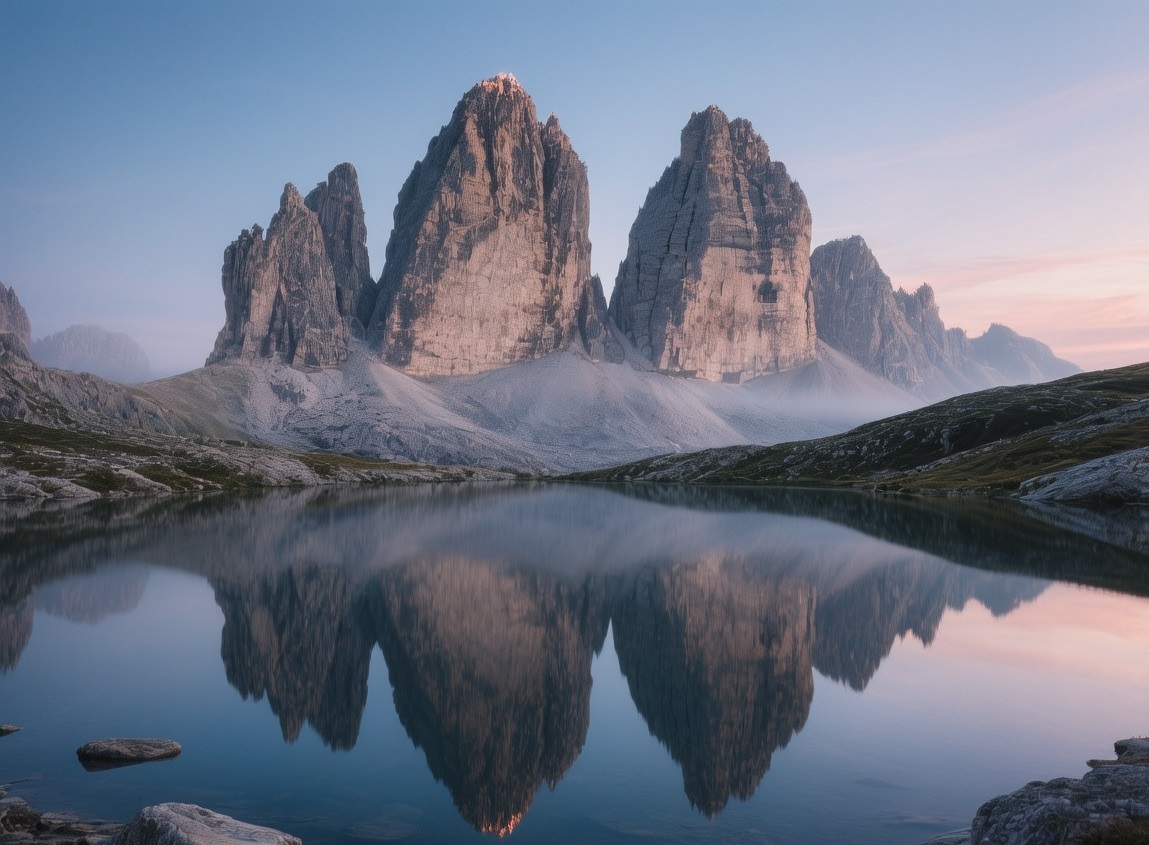
Dolomites Mountains – Tre Cime Limestone Spires Meet Alpine Silence
The first light of dawn spills over the Dolomites—turning the Tre Cime di Lavaredo into three flaming torches against a soft indigo sky. You hear the distant chime of cowbells from a high pasture, the crunch of gravel underfoot, and the whisper of wind through larch trees still dusted with last night’s frost. Rising to 2,999 meters (9,839 feet), these iconic limestone spires—part of the Sexten Dolomites range—were carved by ancient seas and glaciers over 250 million years. Designated a UNESCO World Heritage site in 2009, this landscape is not just geologically unique but culturally layered: once a WWI frontline where Italian and Austro-Hungarian soldiers tunneled into the rock, it now stands as a sanctuary for hikers, climbers, and seekers of sublime quiet. In 2026, as climate change accelerates glacial retreat and overtourism strains fragile trails, the Dolomites call for mindful presence—where every step honors the silence that has echoed here since time began.
Why Dolomites Mountains – Tre Cime Embodies Geological Poetry
The Tre Cime di Lavaredo aren’t just mountains—they’re fossilized remnants of a vanished ocean. Formed over 250 million years ago during the Triassic period, these pale limestone pinnacles were once part of a vast coral reef in the Tethys Sea. Tectonic forces later thrust them skyward, and glaciers sculpted their dramatic vertical faces. The trio—Cima Grande (2,999 m), Cima Ovest (2,973 m), and Cima Piccola (2,857 m)—are composed of dolomite rock, a magnesium-rich limestone that resists erosion and glows rose-gold at sunrise, a phenomenon locals call enrosadira. During World War I, this area became the “White War,” where soldiers lived in tunnels carved into the rock at 2,500 meters, enduring avalanches and frostbite. Today, remnants like the Strada degli Alpini trail and open-air museum at Rifugio Locatelli preserve this history. The entire Dolomites range spans 142,000 hectares across nine mountain groups, protected as a UNESCO site for its “superlative natural phenomena” and ongoing geological processes. This is a landscape where science and soul converge—a place that teaches humility through scale and silence.
The Best Time to Experience Dolomites Mountains – Tre Cime
To hike the trails and witness the enrosadira glow without snow or crowds, target the precise window of June 15–30, 2026. During these weeks, daytime temperatures range from a comfortable 12–20°C (54–68°F) at 2,000 meters—ideal for alpine trekking [[25], [28]]. Wildflowers bloom in meadows, and mountain huts (rifugi) are fully operational. Mornings between 5:30–7:30 AM offer the most intense sunrise colors and solitude on the Tre Cime loop. Alternatively, September 5–20, 2026 provides crisp air, fewer hikers, and golden larch forests. Avoid visiting during peak periods: all of July and August, when parking fills by 7:00 AM and trails become congested, and late October–May, when snow closes high-altitude routes [[30]]. For the most reliable conditions, base yourself in Misurina or Cortina d’Ampezzo and check daily trail status via the official Dolomiti UNESCO portal (dolomitiunesco.info).
Approximate Budget for a 7-Day Trip (2026)
This budget reflects mid-range 2025 pricing adjusted for Italy’s projected 2026 inflation rate of 1.5% [[37]], offering a realistic estimate for a solo traveler based in the Tre Cime area.
- Accommodation: €840–€1,120 total (€120–€160 per night) for a family-run guesthouse or mountain hut (rifugio) in Misurina, Dobbiaco, or near Lago Antorno—offering direct trail access.
- Food: €420 total (€60 per day). Breakfast at your guesthouse (included); lunch of speck, cheese, and bread from a rifugio (€15); dinner at a local gostneria (€35 for canederli dumplings, venison stew, and house red wine).
- Transportation: €95 total. Includes train from Venice (€25 round-trip); regional bus to Misurina (€10); and rental car for flexibility (€60 for 3 days, essential for remote trailheads).
- Attractions: €45 total. Dolomiti Bus Pass (€30 for 7 days); WWI Open-Air Museum entry (€8); and guided geology walk (€7 donation).
- Miscellaneous: €85 total. A high-quality topographic map (€15); locally made wool socks (€25); gelato in Cortina (€4); and a reusable water bottle with filter (€20) for alpine springs.
Total Estimated Budget: €1,485–€1,765
6 Essential Dolomites Mountains – Tre Cime Experiences
- Hike the Tre Cime Loop at Sunrise: Start from Rifugio Auronzo at 5:00 AM for the 10-kilometer circuit. As dawn breaks, the eastern face ignites in pink—a moment of pure alpine theater few witness.
- Explore the WWI Tunnels at Strada degli Alpini: Walk this historic path carved into the rock face. Interpretive signs detail how soldiers lived in sub-zero conditions, hauling supplies up sheer cliffs.
- Stay Overnight at Rifugio Locatelli: Book months ahead to sleep at 2,450 meters. Wake before dawn for unobstructed views of the Cime glowing in morning light—no crowds, just stars and silence.
- Photograph Lago di Sorapis’ Turquoise Waters: A moderate 2-hour hike from Passo Tre Croci leads to this surreal lake, its color intensified by glacial flour—a stark contrast to the gray limestone.
- Drive the Tre Cime Panoramic Road: Take the toll road (€30) from Lake Misurina to Rifugio Auronzo for those unable to hike. The final stretch offers jaw-dropping views without strenuous effort.
- Taste South Tyrolean Cuisine in Dobbiaco: At Gasthof Hubertus, try schlutzkrapfen (spinach ravioli) and apple strudel—recipes passed down through generations in this German-Italian cultural crossroads.
3 Hidden Gems Most Travelers Miss
- Lago dei Caprioli: A 45-minute hike from Val Fiscalina, this small, mirror-like lake reflects the Cime perfectly—and is often empty even in summer. Best visited at midday for calm water.
- Cascata di Rienza Waterfall: Near Monguelfo, this 30-meter cascade tumbles through a mossy gorge. Access via a short forest trail—ideal for a cool-down after a long hike.
- Malga Fonda: A working alpine dairy farm above San Candido. Visit in the morning to see cheesemaking in action and taste fresh malga cheese—call ahead (+39 0474 913 122) for permission.
Cultural & Practical Tips
- Book rifugi early: Mountain huts fill months in advance. Reserve via rifugi.com or directly with the hut keeper.
- Wear proper hiking gear: Trails are rocky and steep. Waterproof boots, layers, and trekking poles are essential—even in summer.
- Respect alpine etiquette: Stay on marked paths to protect fragile flora. Never feed wildlife, and carry out all trash—even biodegradable items.
- Learn key phrases: “Dov’è il sentiero per le Tre Cime?” (doh-VEH eel sen-TYEH-roh PEHR leh TREH CHEE-meh?) for directions; “Grazie mille” (GRAHT-see-eh MEE-leh) for thanks.
- Check weather daily: Afternoon thunderstorms are common in summer. Start hikes early and carry rain gear—conditions change rapidly above 2,000 meters.
Conclusion: Travel with Reverence, Not Just Resumes
In 2026, the Dolomites offer more than epic views—they invite humility. Your presence here carries responsibility: the €30 bus pass funds trail maintenance; choosing a family-run rifugio supports local shepherds; carrying out your waste protects the same springs that feed alpine flowers. Slow down: sit quietly at Lago di Sorapis until the water becomes glass; trace the grooves of WWI tunnels with your fingers; listen to the language of cowbells echoing through valleys older than nations. By traveling with reverence—prioritizing stillness over summit selfies—you help ensure the Dolomites remain a sanctuary of silence, not just a backdrop for achievement. Let your journey be a vow: that beauty, carefully tended, can outlast even time itself.
Image Description: Dolomites mountains - Tre Cime at sunrise, jagged limestone peaks glowing pink above alpine meadows with mist in the valley.