
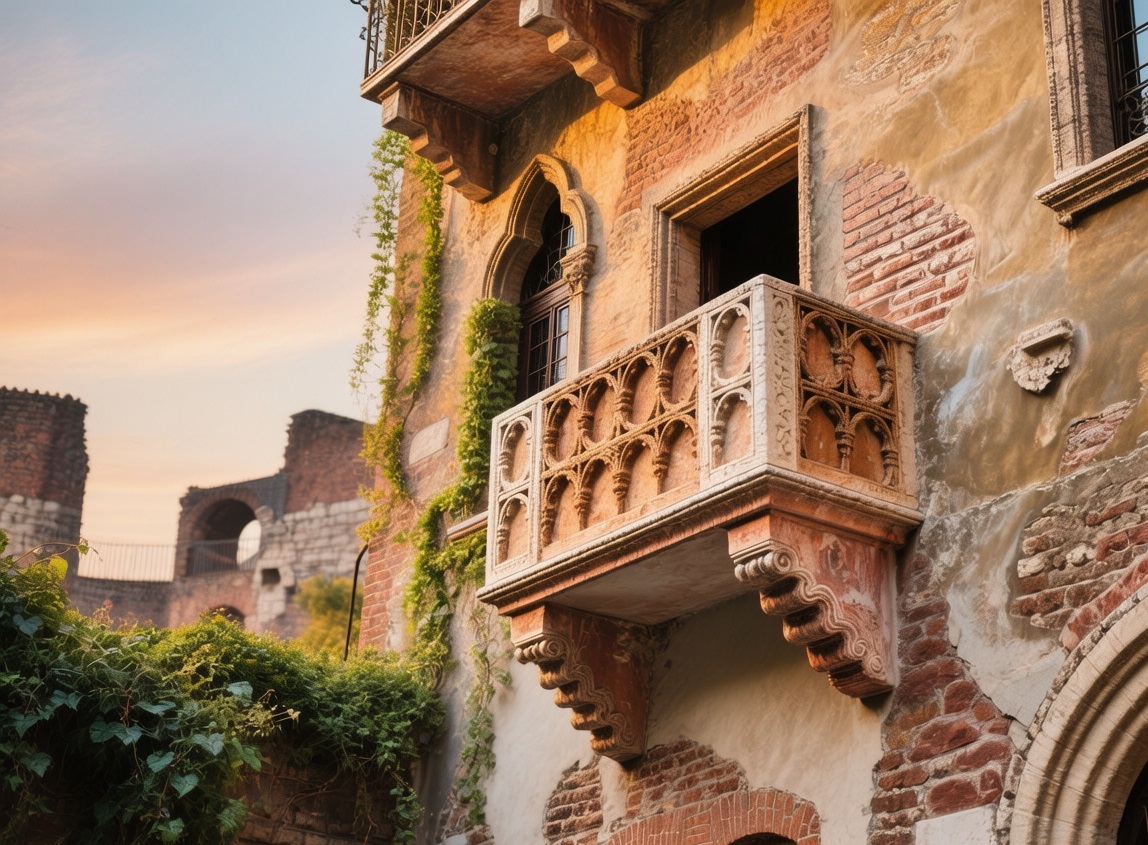
Verona – Juliet’s Balcony, Arena Roman Stone Meets Timeless Romance
The late sun gilds Verona’s terracotta rooftops—casting long shadows across Piazza delle Erbe, where the scent of fresh basil and espresso drifts from hidden courtyards. In the quiet courtyard of Casa di Giulietta, lovers leave notes on the ancient walls, their fingers brushing the bronze breast of Juliet’s statue for luck. Just beyond, the Roman Arena rises like a limestone colossus, its pink-tinged arches echoing with the ghosts of gladiators and opera singers alike. Founded by the Romans in the 1st century BCE, this city straddles the Adige River with a rare duality: it is both a UNESCO World Heritage site of imperial grandeur and the mythical stage for Shakespeare’s most enduring love story. The Arena, built around 30 CE, predates Rome’s Colosseum and remains one of the world’s best-preserved amphitheaters—hosting summer opera under the stars since 1913. In 2026, as overtourism strains historic centers across Europe, Verona offers a rare balance: monumental history and intimate romance, coexisting under one luminous sky.
Why Verona – Juliet’s Balcony, Arena Embodies Layered Legacy
Verona isn’t just a backdrop for romance—it’s a living archive of empire, art, and imagination. The Roman Arena, constructed circa 30 CE from local Valpolicella limestone, originally seated 30,000 spectators—nearly the entire population of Roman Verona. Its elliptical structure measures 139 meters long by 110 meters wide, with an outer wall standing 44 meters high, though only four of its original 72 arches remain intact after a 1117 earthquake. Remarkably, it has hosted continuous public use for nearly 2,000 years—from gladiatorial combat to medieval markets to today’s world-renowned opera festival, which draws over 500,000 attendees annually. Meanwhile, Juliet’s House (Casa di Giulietta), a 13th-century Gothic merchant’s home, was retrofitted in the 1930s with a balcony to satisfy literary pilgrims after Shakespeare immortalized the Capulet-Montague feud. Though the balcony is not original, the courtyard’s well-worn stones and the bronze statue (rubbed smooth by hopeful hands) have become symbols of universal longing. This interplay—between documented history and poetic myth—is what makes Verona uniquely resonant: a city where archaeology and emotion walk hand in hand through cobbled streets.
The Best Time to Experience Verona – Juliet’s Balcony, Arena
To enjoy Verona’s romantic ambiance and monumental sites without oppressive heat or crowds, target the precise window of May 10–24, 2026. During these weeks, daytime temperatures range from a comfortable 18–25°C (64–77°F)—ideal for exploring the Arena’s upper tiers and strolling along the Adige River [[24], [27]]. Evenings are perfect for open-air opera rehearsals or dining in Piazza Bra. Mornings between 8:00–9:30 AM offer near solitude at Juliet’s House before tour groups arrive. Alternatively, September 15–29, 2026 provides similar conditions with the added benefit of harvest season in nearby Valpolicella vineyards. Avoid visiting during peak periods: all of July and August, when temperatures exceed 32°C (90°F) and Arena opera tickets sell out months in advance, and major holidays like Italian Ferragosto (August 15) [[29]]. For the most magical experience, attend an evening opera performance—the acoustics are legendary, and the atmosphere electric. Always verify event schedules via the official Arena di Verona Foundation (arena.it).
Approximate Budget for a 7-Day Trip (2026)
This budget reflects mid-range 2025 pricing adjusted for Italy’s projected 2026 inflation rate of 1.5% [[37]], offering a realistic estimate for a solo traveler based in Verona’s historic center.
- Accommodation: €770–€1,050 total (€110–€150 per night) for a 3-star hotel or private apartment in Cittadella or near Piazza Bra—central yet quieter than the immediate Juliet’s House area.
- Food: €490 total (€70 per day). Breakfast at a café (€4 for cappuccino and cornetto); lunch of bigoli pasta with duck ragù (€15); dinner at a family-run osteria (€45 for risotto all’Amarone, grilled lake fish, and house red wine).
- Transportation: €55 total. Includes train from Milan (€20 round-trip); local bus pass (€15 for 7 days); and taxi from station to hotel (€20).
- Attractions: €95 total. Arena di Verona entry (€15); Juliet’s House (€6); Castelvecchio Museum (€12); Lamberti Tower panoramic view (€8); and an evening opera ticket (€45 for upper tier).
- Miscellaneous: €90 total. A high-quality print from Libreria Antiquaria (€25); gelato from Gelateria Ponte Pietra (€4); locally made Amarone wine bottle (€30); and a leather-bound journal (€20).
Total Estimated Budget: €1,500–€1,800
6 Essential Verona – Juliet’s Balcony, Arena Experiences
- Visit Juliet’s House at Dawn: Arrive by 8:00 AM to experience the courtyard in near silence. Read the love letters taped to the walls, touch the bronze statue’s breast for luck, and imagine the balcony scene under soft morning light.
- Explore the Arena’s Upper Tiers: Climb to the top rows for panoramic views of Verona’s red rooftops and the Adige River. The acoustics are so precise that a whisper from the stage carries clearly—a marvel of Roman engineering.
- Attend an Evening Opera Rehearsal: During summer, open rehearsals are often free or low-cost. Sit among locals as tenors and sopranos fill the ancient stone with sound—an unforgettable fusion of past and present.
- Walk the Adige River Promenade at Sunset: Follow the path from Ponte Pietra to Castel San Pietro. The Roman bridge, rebuilt after WWII bombing, offers the classic postcard view of Verona glowing in golden hour.
- Dine in Piazza delle Erbe: At Osteria Sottoriva, try local specialties like pearà (peppery bread sauce) with bollito misto. The piazza’s medieval frescoed houses and Roman columns create a dining room unlike any other.
- Climb Lamberti Tower for Panoramic Views: Take the 238-step spiral staircase (or elevator) to the top of this 84-meter tower. From here, you’ll see the Arena, Juliet’s House, and the river winding through the city—a perspective few tourists seek.
3 Hidden Gems Most Travelers Miss
- Giardino dei Giusti (Garden of the Righteous): Behind Castelvecchio, this peaceful riverside garden honors non-Jews who saved Jews during the Holocaust. Its olive trees and quiet benches offer reflection away from tourist paths.
- San Fermo Maggiore Church: Tucked near the river, this 11th-century church features stunning frescoes and a rare double-level nave—Romanesque below, Gothic above. Often empty, deeply atmospheric.
- Libreria Antiquaria Perini: Established in 1925, this historic bookstore on Via Cappello specializes in rare maps and Veronese literature. It’s a favorite among scholars—and a perfect quiet retreat after Arena crowds.
Cultural & Practical Tips
- Book Arena opera tickets early: Summer performances sell out months in advance. Reserve via arena.it; upper-tier seats offer excellent acoustics at lower prices.
- Dress modestly for churches: Shoulders and knees must be covered in religious sites like San Fermo or the Duomo.
- Respect the love letters: Do not remove or deface notes left at Juliet’s House. They are part of the site’s evolving cultural tapestry.
- Learn key phrases: “Dov’è la casa di Giulietta?” (doh-VEH lah KAH-sah dee joo-lee-EHT-tah?) for directions; “Grazie mille” (GRAHT-see-eh MEE-leh) for sincere thanks.
- Carry cash for small eateries: Many family-run osterias don’t accept cards. Tipping isn’t expected, but rounding up is appreciated.
Conclusion: Travel with Heart, Not Just Hashtags
In 2026, Verona invites more than photo ops—it calls for emotional presence. Your €15 Arena ticket funds conservation of Roman stonework; your choice to dine in a family osteria supports generational artisans; your quiet moment reading love letters at Juliet’s House honors the universal hope they represent. Slow down: listen to the echo of footsteps in Castelvecchio’s corridors, taste wine pressed from grapes grown on volcanic slopes, watch the Adige turn gold at dusk. By traveling with heart—prioritizing connection over content—you help ensure Verona remains not just a stage for romance, but a living city where history breathes and love endures. Let your visit be a sonnet, not a snapshot—and these stones will remember your sincerity long after you’ve crossed the river.