
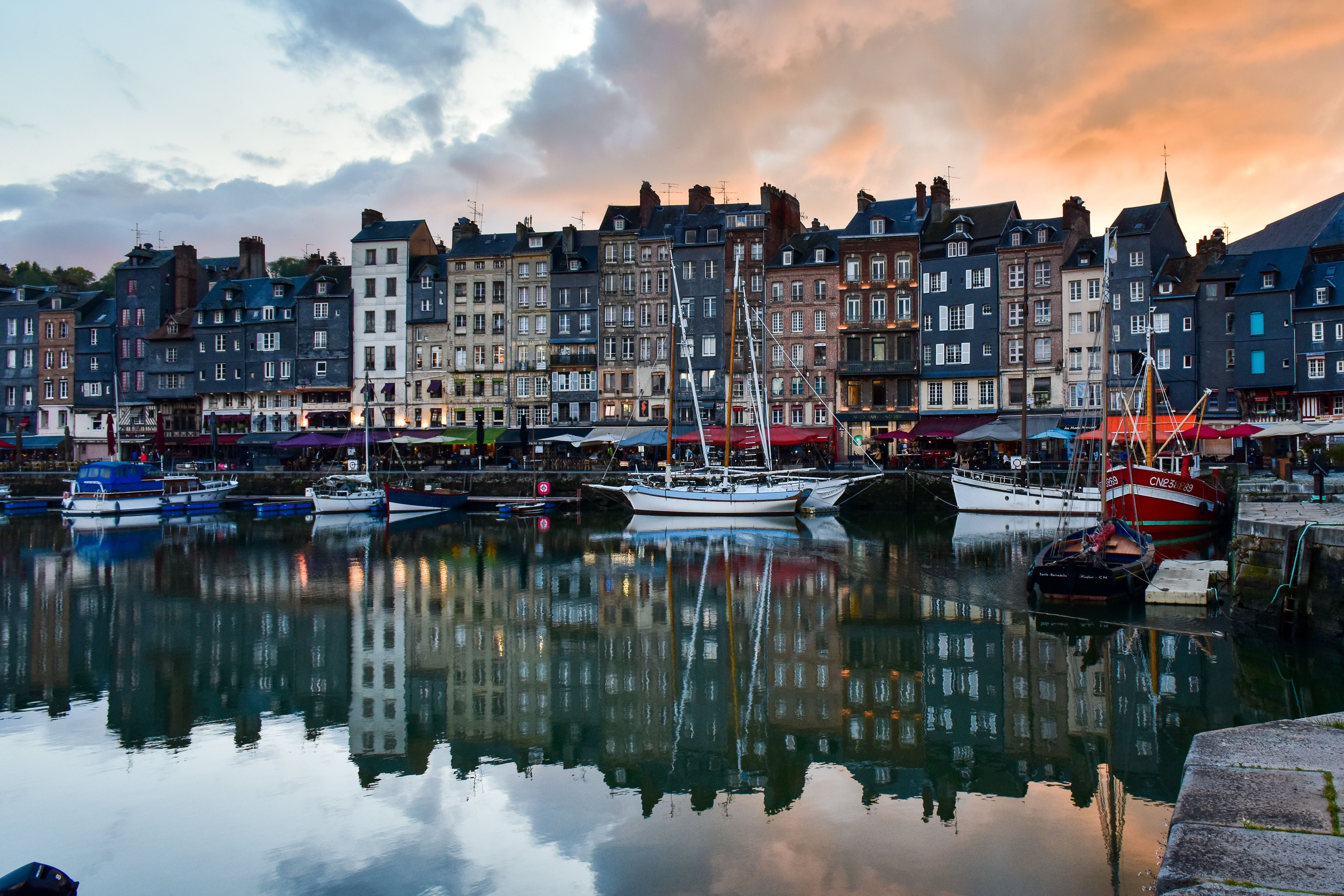
Honfleur Harbor – Colorful Buildings Where Maritime Light Paints the Vieux Bassin
Before the fishing boats return at dawn, when mist still clings to the Seine estuary, Honfleur harbor breathes with quiet authenticity. The Vieux Bassin—a rectangular harbor enclosed by 17th-century quays—mirrors rows of houses with slate-covered façades in shades of ochre, burnt sienna, and weathered gray. As morning light breaks over Normandy's hills, it doesn't merely illuminate these buildings; it transforms them. Sun strikes the slate tiles at precise angles, setting the entire waterfront ablaze with reflected gold while gulls circle above boats unloading the night's catch. This is not a stage set for tourists but a working port where fishermen mend nets beneath windows that once framed Monet's easel. In 2026, Honfleur harbor remains one of France's most emotionally resonant waterfronts—not for its perfection, but for its living continuity: where art history, maritime tradition, and daily life converge without theatricality.
Why Visit Honfleur Harbor – Colorful Buildings?
Honfleur harbor is more than a picturesque postcard—it's a masterclass in how light shapes place. The Vieux Bassin's unique character stems from its architectural adaptation to maritime necessity: after devastating fires in the 17th century, residents rebuilt using slate tiles (essentes) laid vertically to protect against salt spray and wind-driven rain. This pragmatic solution created an accidental aesthetic—buildings that absorb and reflect light differently throughout the day, shifting from cool silver at dawn to warm gold at sunset. Unlike preserved museum villages, Honfleur remains authentically functional: the same quays that hosted Samuel de Champlain's 1608 expedition to Quebec now shelter recreational sailboats and fishing smacks. Its power lies in layered history—where Impressionist painters captured transient light effects that still occur daily, and where the Sainte-Catherine church (Europe's largest wooden church) stands as testament to shipbuilders' craftsmanship. This harbor teaches us that beauty often emerges not from design, but from adaptation.
The Best Time to Visit Honfleur Harbor – Colorful Buildings
For optimal conditions—dramatic light on slate façades, manageable crowds, and authentic port activity—visit between May 12 and June 2. Daytime temperatures average 14–20°C (57–68°F), morning mist creates luminous diffusion ideal for photography, and the intense summer crowds haven't yet arrived. Arrive by 7:30 AM to witness the harbor's transformation: fishing boats returning with catch while light strikes the eastern quay buildings at angles that make slate tiles glow like embers. September 8–22 offers a second excellent window: warm days, departing tourists, and autumn light that intensifies the ochre tones in weathered façades. Avoid July 15–August 20 when temperatures exceed 25°C (77°F), quays become congested with day-trippers, and many local fishermen take vacation—diminishing the harbor's working character. Note that winter months (November–February) offer stark beauty and complete solitude, though many restaurants close Monday–Wednesday.
Approximate Budget for a 7-Day Trip (2026)
Based on 2025 benchmarks adjusted for 4% inflation (per INSEE and Normandy Tourism Board projections), here's a realistic mid-range budget for a Calvados coastal itinerary:
- Accommodation: €95–€140 per night for a family-run guesthouse in Honfleur's historic center or a boutique hotel with harbor views (book 2+ months ahead for summer).
- Food: €85–€100 per day—breakfast at a café (€6), lunch of moules-frites with local cider (€22–€28), dinner featuring fresh sole meunière and Calvados (€45–€55).
- Transportation: €35 for a 7-day Nomad'car pass (covers all regional buses). Trains reach Deauville from Paris (2 hours, €35–€55 one-way), then 15-minute bus to Honfleur.
- Attractions: Eugène Boudin Museum: €8. Sainte-Catherine church guided tour: €7. Boat tour of Seine estuary: €18. Allocate €80 total.
- Miscellaneous: €50 for Calvados apple brandy from Distillerie Groult, handmade sablés cookies, or local honey from Saturday market.
Total Estimated Cost: €1,050–€1,500 for seven days, excluding international flights.
5 Main Attractions
- Vieux Bassin: The heart of Honfleur's harbor, enclosed by 17th-century slate-covered houses where Monet, Boudin, and Jongkind painted light effects that launched Impressionism—best experienced at dawn or dusk.
- Sainte-Catherine Church: Europe's largest wooden church, built by shipwrights after the Hundred Years' War with inverted hull ceilings and separate bell tower—a masterpiece of maritime craftsmanship.
- Eugène Boudin Museum: Housed in a former chapel, this intimate museum showcases the painter who mentored Monet and captured Honfleur's ever-changing light with unprecedented sensitivity.
- Quai Saint-Étienne: The eastern quay where fishing boats still unload daily catch—observe local life as crews sort sole and scallops while gulls wheel overhead.
- Lieutenance Building: Honfleur's oldest structure (15th century), once the governor's residence, featuring timber framing and a commanding view of harbor entrance—symbol of the town's strategic importance.
3 Hidden Gems Most Travelers Miss
- Rue de la Prison Dawn Light: At 6:45 AM, walk this narrow lane between Quai Saint-Étienne and Rue Haute. The gap between buildings creates a "light tunnel" where sunrise strikes slate façades at an angle that makes them glow amber for precisely 12 minutes—a phenomenon local photographers call "l'heure dorée."
- Atelier du Vieux Port: Hidden behind No. 19 Quai aux Fourrures (look for a blue door with brass bell), this working studio of painter Marie-Josèphe Lefèvre offers intimate views of the harbor through her north-facing window—open Tuesday/Thursday mornings by appointment (+33 2 31 89 22 14).
- Cap de la Hève Viewpoint: A 15-minute drive west to this coastal headland offers the only perspective showing Honfleur harbor nestled within the vast Seine estuary—locals gather here at sunset with Calvados to watch container ships pass the historic port.
Cultural & Practical Tips
- Respect Working Port Etiquette: Never block quays during boat arrivals/departures (typically 7:00–9:00 AM and 4:00–6:00 PM). Photograph fishermen only from a distance—many consider their work sacred.
- Learn Key Phrases: "Bonjour," "Merci," and "C'est la pêche aujourd'hui?" (Is it fishing today?) show respect in this proudly maritime community.
- Photography Timing: For optimal slate façade colors, shoot eastern quays 7:30–9:00 AM and western quays 4:30–6:30 PM when low-angle light enhances texture without glare.
- Support Authentic Artisans: Purchase Calvados directly from distilleries like Groult or La Guilde du Val rather than souvenir shops. Look for "Producteur" signs indicating estate-bottled spirits.
- Market Strategy: Honfleur's Saturday market (Place Hamelin) draws crowds. For authentic local interaction, visit the smaller Wednesday market focused on regional produce with fewer tourists.
Conclusion: Travel with Artistic Patience, Not Just a Camera
Honfleur harbor endures not because it was preserved as a museum, but because its residents continue to live within its rhythms—where fishermen rise before dawn, painters chase specific light, and slate tiles weather with dignity. As a conscious traveler, your role is to engage with this continuity. Sit quietly on a quay bench and observe how light transforms façades over an hour. Support the last remaining sailmakers and rope-makers rather than mass-produced souvenirs. Understand that your presence should honor the working character that makes this harbor authentic—not diminish it through congestion or consumption. By approaching Honfleur not as a backdrop for social media, but as a living canvas where light, history, and labor intersect, you help ensure these slate-covered buildings continue to reflect not just sky and sea, but the enduring human spirit that shaped them.