
Toledo Medieval City Three Cultures Meet Castilian Stone
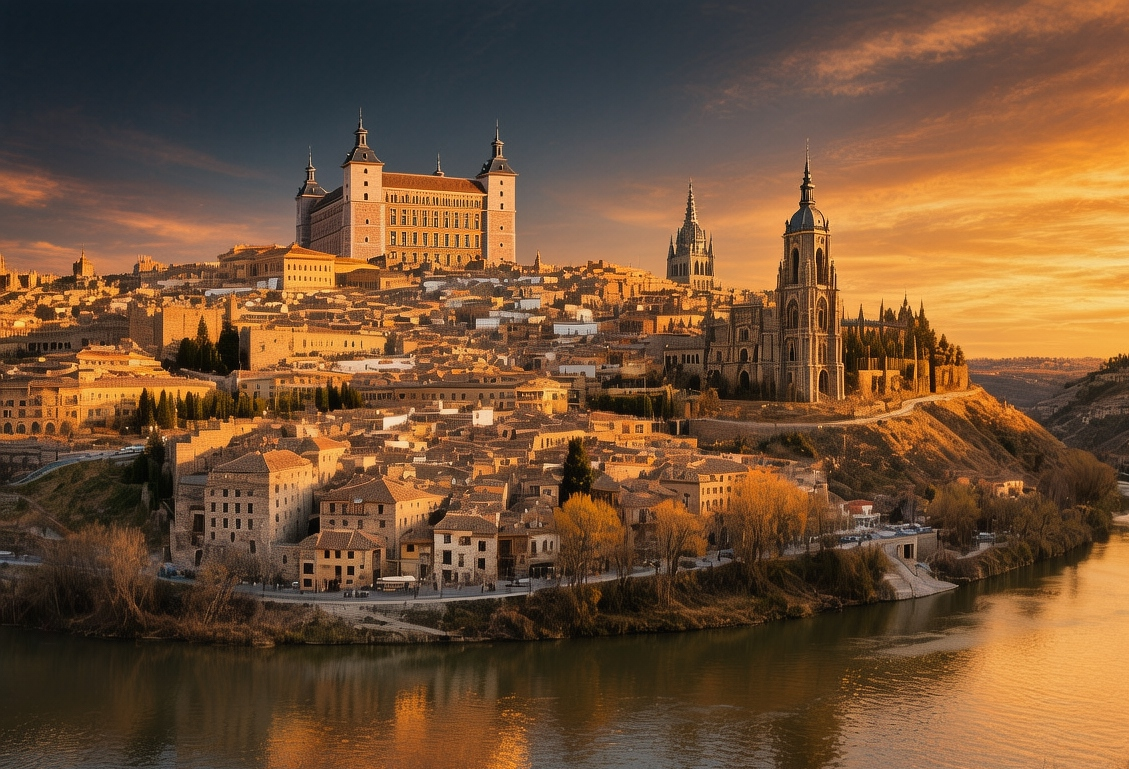
The bells of the Primate Cathedral toll across the Tagus River—a deep, resonant sound that has echoed over the Toledo medieval city since the 15th century. You stand on the Mirador del Valle, 150 meters above the riverbend, watching the sun dip behind the Sierra de Guadarrama. The air smells of thyme and heated limestone; the light turns the red brick of the Alcázar into a burning ember against the darkening sky. This is a fortress city perched on a granite hill, where 2,000 years of history are compressed into 2.3 square kilometers of winding alleys. You hear the clatter of horse-drawn carriages on cobblestones; the murmur of tourists tracing the Mudéjar arches; the silence of the ancient synagogues. In 2026, as modern cities expand outward, the Toledo medieval city remains a preserved capsule of time—a place where Visigothic foundations, Islamic walls, and Christian spires coexist in a fragile, beautiful tension that demands you slow down to truly see.
Why Toledo Medieval City Embodies Cultural Convivencia
The Toledo medieval city represents one of the world's most significant examples of cultural layering, solving the strategic need for a defensible capital while fostering an era of rare religious coexistence known as Convivencia. Founded as a Roman municipality in 192 BC, the city was fortified by the Visigoths in the 6th century and expanded by the Moors after 711 AD. The geography itself is a defensive engineering feat: the Tagus River wraps around three sides of the hill, creating a natural moat that rises 100 meters above the water level. This topography allowed a relatively small garrison to hold off sieges for centuries.
Following the Christian Reconquista in 1085 under Alfonso VI, Toledo became the primatial see of Spain, but the Islamic and Jewish populations remained, creating a unique intellectual hub. The city's architecture reflects this synthesis: the Synagogue of Santa María la Blanca, built in 1180 by Islamic architects for Jewish worship, features horseshoe arches and Mudéjar plasterwork. The Alcázar, rebuilt in the 16th century on Roman and Moorish foundations, stands 60 meters high at its keep, dominating the skyline. This integration of faiths and fortifications makes the Toledo medieval city not merely a museum but a physical document of medieval geopolitics, where every stone wall tells a story of conquest, tolerance, and expulsion.
The Best Time to Experience Toledo Medieval City
For the optimal Toledo medieval city visit, target April 15–June 10 or September 15–October 25, when temperatures range between 15–25°C (59–77°F) and the light is soft enough for photography. The city gates open 24 hours, but the ideal viewing window is 8:00–9:30 AM when the light hits the Cathedral facade directly, illuminating the Plateresque details without harsh shadows. Evening visits between 7:00–9:00 PM offer cooler temperatures and atmospheric lighting, though many shops close for siesta between 2:00–5:00 PM. Spring coincides with Corpus Christi, causing accommodation prices to increase 50–70%; book lodging four months in advance if visiting during this period.
Avoid July 15–August 25 unless you tolerate extreme heat; temperatures regularly exceed 38°C (100°F), making the stone streets radiate intense thermal energy. The lack of shade in the narrow alleys exacerbates the heat. Winter months (December–February) bring cold weather (5–12°C / 41–54°F) but fewer crowds, allowing for contemplative exploration. The Cathedral closes for religious services on Sunday mornings; verify current hours at www.toledoturismo.com or contact the tourist office at info@toledoturismo.com (+34 925 220 338). Weekday mornings typically see the lowest visitor density, allowing for clearer photography of the monuments without obstruction from day-trip buses arriving from Madrid.
Approximate Budget for a 7-Day Trip (2026)
Toledo is affordable compared to Madrid, though costs rise during Holy Week and Corpus Christi. The following budget assumes mid-range comfort with cultural immersion, based on 2026 pricing with approximately 3.5% inflation from 2025 figures. This budget covers a 7-day trip based in Toledo, exploring the city and surrounding Castilla-La Mancha region.
- Accommodation: €70–€130 per night for a double room in a parador or boutique hotel in the historic center; luxury options with views command €180–€300 per night
- Food: €40–€60 per day—breakfast €5–€8 (café con leche and torrija), lunch €15–€25 (menú del día including carcamusas, salad, and wine), dinner €20–€30 (tapas selection including perdiz estofada and marzipan)
- Transportation: Train from Madrid Atocha to Toledo: €14 high-speed AVANT (30 minutes); local bus within Toledo: €1.40 per ride or €4 daily pass; taxi from station: €10 fixed rate; regional car rental: €40 per day
- Attractions: Toledo Tourist Pass (7 monuments): €30; Cathedral entry: €10; Alcázar Army Museum: €6; Synagogue of El Tránsito: €3; Marzipan workshop tour: €15
- Miscellaneous: Damascene jewelry from €20; local wine €7–€18 per bottle; horchata drink €2.50; artisan swords €50–€150; guided history walk €20
Total estimated cost for 7 days: €950–€1,400 per person (based on double occupancy; solo travelers should add 35–45% for single supplements)
7 Essential Toledo Medieval City Experiences
- Enter the Primate Cathedral: Step into the Gothic masterpiece begun in 1227, where the main nave soars 28 meters high. The transparent transparente by Narciso Tomé allows light to flood the altar. Visit at 10:00 AM opening time to experience the space before crowds obscure the view. The choir stalls feature intricate carvings of biblical scenes. Allow 45 minutes to observe the details of the altarpiece. This is the anchor of the Toledo medieval city; do not rush past it.
- Explore the Alcázar Fortress: Ascend to the square fortress dominating the highest point of the city. The building measures 60 meters per side and houses the Army Museum. Visit between 2:00–4:00 PM when lighting accentuates the stone details. The views from the corners extend 30 kilometers across the plains. Audio guides explain the siege during the Spanish Civil War. This collection defines the military history of Spain.
- Visit the Synagogue of El Tránsito: Locate the 14th-century synagogue built by Samuel ha-Levi. The interior features intricate Mudéjar plasterwork with Hebrew inscriptions. Visit at 11:30 AM when the guide explains the Kufic influences on the decoration. The space is small, measuring only 23 meters by 9 meters, but rich in history. Audio guides available in six languages for €3. Allow 30 minutes to appreciate the details. This is a rare survivor of the pre-1492 Jewish community.
- Walk the Jewish Quarter: Stroll through the narrow streets of the Judería near the Synagogues. The walls are covered in flower pots creating a tunnel of color. Visit at 10:00 AM when the sun illuminates the blooms without casting harsh shadows. The streets are only 2 meters wide; step aside to let locals pass. It is the most photographed spot in the Toledo medieval city; arrive early to avoid crowds in your shot. The scent of jasmine is intense in spring.
- Taste Marzipan at a Convent: Eat at a traditional confectionery like Convento de las Carmelitas Descalzas. Order pan de Toledo and marzipan figures. The interiors often feature grilles where nuns sell sweets. Visit at 4:00 PM for afternoon tea. Expect to pay cash; cards are not always accepted. The atmosphere is quiet and reverent. Try Mazapán de Toledo for the protected designation of origin. This is a living culinary tradition.
- View the City from Mirador del Valle: Cross the river to the southern bank for the classic panoramic view. The viewpoint sits 150 meters above the city level. Visit at 7:00 PM when the sun sets behind the Alcázar. The bus stop is 2 kilometers from the center; take the local bus or taxi. It is the most iconic view of the Toledo medieval city; arrive early to secure a spot without people in your shot. The light reflects off the Tagus River.
- Discover El Greco's Masterpieces: Visit the Church of Santo Tomé to see The Burial of the Count of Orgaz. The painting measures 4.8 by 3.6 meters and depicts a miracle from 1312. Visit when sunlight streams through the windows to illuminate the gold leaf. The church was built in the 14th century. It demonstrates the artistic height of the Spanish Renaissance. Do not touch the protective glass; oils damage the surface.
3 Hidden Gems Most Travelers Miss
- Casa-Museo del Greco: Located in the Jewish Quarter at Paseo del Tránsito, s/n, this house recreates the painter's studio. Entry: €3; open 9:30 AM–7:00 PM (winter) or 8:00 PM (summer). It is often overlooked as visitors focus on the Cathedral. The garden features period plants and ceramics. Contact: +34 925 223 802. Visit early morning for private guided tours that access rooms closed to general public. The collection includes lesser-known works.
- Monastery of San Juan de los Reyes: A 10-minute walk west from the Cathedral, this 15th-century monastery features a stunning cloister. Entry: €4; open 10:00 AM–6:00 PM. It is often overlooked by tourists rushing to the Alcázar. The Gothic architecture is pristine. Contact: +34 925 221 437. Visit mid-morning when light illuminates the vaulted ceilings. The chains on the walls were from Christian captives freed by the Catholic Monarchs. It provides historical context often missing from the main sites.
- Cave of Hercules (Cueva de Hércules): Located near the Cathedral at Calle de la Gradas, this archaeological site reveals Roman and Visigothic structures. Entry: €2; open Tuesday–Saturday 10:00 AM–6:00 PM. It is often overlooked by tourists rushing to the viewpoints. The underground chambers date to the 1st century. Contact: +34 925 220 338. Visit mid-morning when light illuminates the mosaics. The legend says Hercules founded the city here. It provides mythological context often missing from the street walk.
Cultural & Practical Tips
- Respect residential privacy: The Toledo medieval city remains a living neighborhood. Do not peer into private patios or photograph residents without permission. Keep voices low after 10:00 PM. Many streets are only 2 meters wide—step aside to let locals pass.
- Master these phrases: "Buenos días" (BWEH-nos DEE-as) for good morning; "Por favor" (por fah-BOR) for please; "Una caña, por favor" (OO-nah KAH-nyah) to order a small beer; "¿Dónde está...?" (DON-deh es-TAH) to ask where something is located.
- Photography guidelines: Flash photography is prohibited inside the Cathedral and Synagogues. Tripods require special permission for commercial shoots. Mobile phones must be silenced in religious sites. Respect "no fotos" signs in private courtyards. Early morning offers the best light without crowds.
- Footwear selection: The cobblestones (adoquines) are uneven and slippery when wet. Wear sturdy shoes with good grip. Avoid high heels. The walk from the train station involves 20 minutes of steep uphill pavement. Comfort is prioritized over style for extensive exploration.
- Hydration strategy: Toledo's inland location means dry heat; carry a refillable bottle. Public fountains (fuentes) are available in the plazas. The water is potable. Avoid alcohol during midday heat. You'll save €2–€3 daily and reduce plastic waste. Purchase water from kiosks if fountains are unavailable.
- Security checks: While the city is safe, pickpockets operate near crowded areas like the Cathedral. Keep bags zipped and valuables secure. Do not leave phones on café tables. Allow an extra 15 minutes for security processing during peak festival seasons.
- Weather considerations: The city offers shade but temperatures can feel 3–5°C warmer due to stone thermal mass. Summer evenings remain hot; bring a fan. Winter rain occasionally makes streets slick; carry an umbrella. Wind speeds are lower in the narrow alleys compared to open plazas.
Conclusion: Travel with Reverence, Not Just Reverie
The Toledo medieval city demands more than casual observation—it asks for contemplation of the layers of history embedded in every white wall, every flower pot, every cobblestone worn by centuries of feet. When you walk these streets in 2026, you're not merely touring a monument; you're walking through a fragile ecosystem of memory where Jewish, Islamic, and Christian heritage intersect in delicate balance.
Choose to engage deeply: hire a local guide from the Judería neighborhood rather than a large tour company; purchase tickets directly to support preservation efforts; respect the residential nature of the streets. The Toledo medieval city survives not as a museum exhibit but as a living community—and its preservation depends on visitors who recognize the difference between appreciation and consumption.
Slow down. Sit in a plaza after the tour buses depart. Listen to the fountain water flowing through centuries-old channels. Taste the sweetness of marzipan from a convent shop. The city rewards those who approach it not as a checklist item but as a conversation across time—a dialogue between past and present that continues, like the river below, in perpetual evolution.