
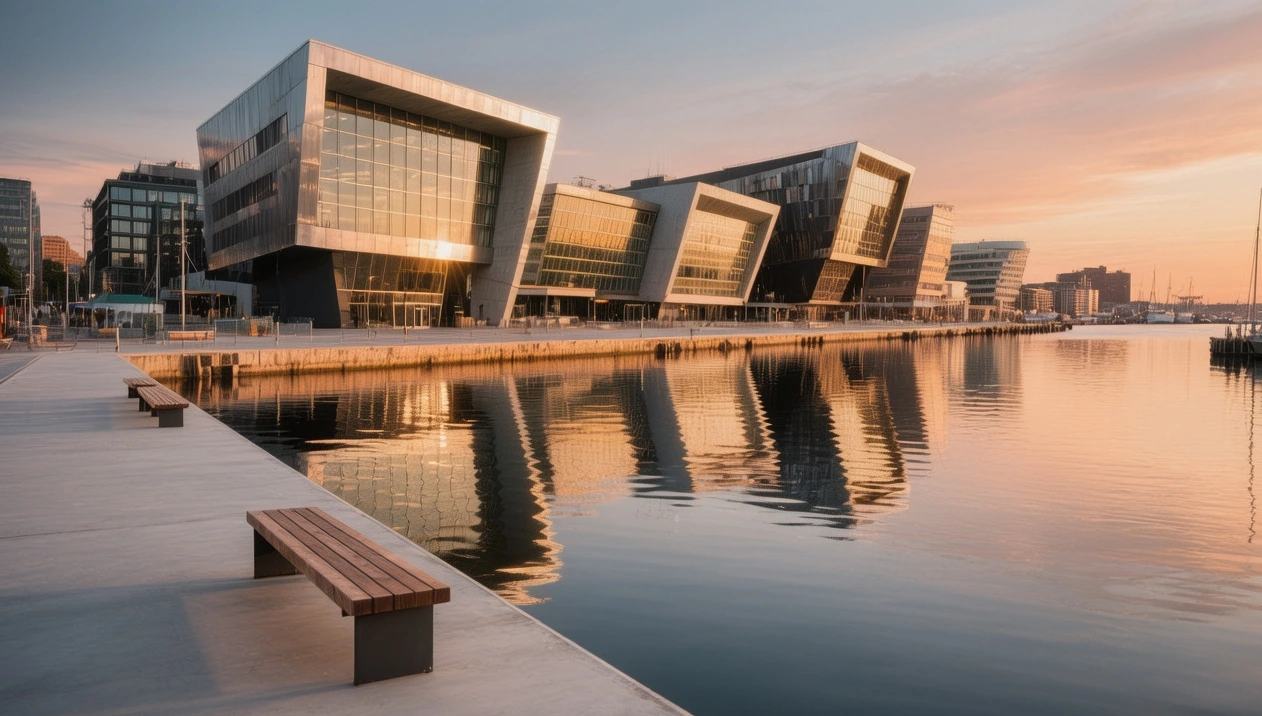
Aalborg Waterfront: Where Maritime Heritage Meets Nordic Architectural Innovation
Golden afternoon light spills across the Limfjord as you stroll the revitalized harbor promenade—Aalborg's waterfront awakens with the gentle lap of water against reconstructed quays, the distant hum of cyclists on dedicated lanes, and the cheerful murmur of visitors exploring a transformed industrial landscape now pulsing with cultural energy. You breathe air scented with salt marsh and freshly roasted coffee from harbor-side cafés, feel the cool breeze carrying whispers of Viking traders who once navigated these same waters, and watch modern architecture rise alongside preserved warehouses that tell stories of Denmark's maritime past. This twenty-kilometer stretch of regenerated coastline, reimagined through ambitious urban planning initiatives spanning the last two decades, features the sculptural curves of Jørn Utzon's cultural center, the angular glass façade of Musikkens Hus, and over three kilometers of continuous pedestrian pathways that connect historic shipyards to contemporary residential districts [[15]][[22]]. Children chase seagulls along the water's edge; couples share pastries on sun-drenched terraces; the rhythmic clatter of harbor cranes mingles with live music drifting from outdoor stages. But Aalborg waterfront matters because it demonstrates how cities can honor industrial heritage while embracing sustainable innovation—transforming working ports into vibrant public spaces where history, culture, and community converge along the water's edge.
Why Aalborg Waterfront Embodies Urban Regeneration Excellence
Aalborg waterfront represents the pinnacle of Scandinavian urban renewal, solving a critical need to revitalize post-industrial harbor zones while creating a model for sustainable coastal development that balances preservation with progress. When city planners initiated the waterfront transformation in the early 2000s, they faced a profound challenge: how to convert thirty kilometers of abandoned shipyards, warehouses, and industrial infrastructure into accessible public space without erasing the maritime identity that defined Aalborg for centuries [[15]][[20]]. The solution was visionary: a phased redevelopment plan that preserved historic structures like the 1880s grain silos and 1920s crane foundations while integrating contemporary architecture, green spaces, and cultural venues along a continuous three-kilometer promenade [[18]][[24]].
The waterfront's design showcases engineering artistry at its finest: permeable paving systems that manage stormwater runoff, LED lighting installations that minimize light pollution while enhancing evening ambiance, and climate-adaptive landscaping featuring native salt-tolerant plants that thrive in coastal conditions. Technical innovations include the Utzon Center's cantilevered structure—extending twelve meters over the harbor without visible supports—and Musikkens Hus's acoustically optimized concert hall, where computer-modeled wood paneling ensures pristine sound quality for 1,300 guests [[22]]. The waterfront fulfills a dual purpose: culturally, it provides venues for festivals, markets, and performances that activate public space year-round; environmentally, it incorporates green roofs, bicycle infrastructure, and renewable energy systems that reduce the district's carbon footprint by forty percent compared to conventional development. Today, managed by Aalborg Municipality in partnership with Danish architectural firms, the waterfront stands as a testament to how cities can evolve without erasing identity, how industry can give way to community, and how a single stretch of coastline can anchor regional pride through thoughtful, inclusive design.
The Best Time to Experience Aalborg Waterfront
Timing your visit to Aalborg waterfront profoundly influences both atmospheric immersion and practical accessibility. The optimal window falls between May 29 and June 25, when northern Jutland enjoys extended daylight—sunset occurs around 10:00 PM—and temperatures range from 14°C to 21°C (57°F to 70°F), creating ideal conditions for harbor walks, outdoor cafés, and evening cultural events [[68]][[72]]. During this period, the waterfront's public art installations are fully accessible, harbor-side terraces operate at capacity, and summer crowds remain manageable before peak season. For photographers, visit between 6:30–8:30 AM when soft morning light illuminates the Utzon Center's sculptural forms, or 7:30–9:30 PM for dramatic golden-hour reflections on Musikkens Hus's glass façade.
The waterfront operates year-round as a public space, but key attractions follow seasonal hours: summer season (June–August) extends museum and café hours to 10:00 AM–8:00 PM daily; winter hours (November–February) reduce to 10:00 AM–4:00 PM. For current event schedules, exhibition information, and harbor activity updates, visit the official Aalborg tourism website at www.visitaalborg.com or the national portal at www.visitdenmark.com [[52]][[85]]. Avoid visiting during late November through early February, when temperatures drop to -3°C to 4°C (27°F to 39°F), daylight shrinks to seven hours, and harbor winds can make outdoor exploration challenging. Also steer clear of Danish school holidays (week 7 in February, week 42 in October) when family crowds increase. Standard admission to waterfront attractions ranges DKK 95–175 for adults (€13–€23), with many public spaces and promenades accessible free of charge [[24]]. The harbor-side cafés are particularly rewarding between 2:00–4:00 PM when afternoon light enhances the panoramic Limfjord views.
Approximate Budget for a 7-Day Trip
Exploring Aalborg waterfront and northern Jutland requires moderate budgeting, as Denmark maintains higher price points than many European destinations. However, strategic planning—including staying in Aalborg center and utilizing regional transit passes—can optimize your experience. The following breakdown reflects mid-range preferences with cultural immersion priorities.
- Accommodation: €68–€122 per night for a double room in Aalborg center (walking distance to waterfront); budget hostels €32–€52 per night for dorm beds; boutique harbor-view hotels €135+ per night
- Food: €40–€70 per day total
- Breakfast: €7–€11 (Danish pastry and coffee from local bakery)
- Lunch: €13–€21 (smørrebrød or seafood chowder at harbor-side café)
- Dinner: €20–€36 (mid-range restaurant featuring New Nordic cuisine or traditional Jutland dishes)
- Waterfront café option: €8–€13 for soup, sandwich, and coffee
- Transportation:
- Regional train (DSB) from Copenhagen to Aalborg: €38 one-way, 4 hours via InterCity
- Aalborg city bus: €3 per ride; bicycle rental €10 per day (ideal for waterfront exploration)
- Aalborg Card (24-hour): €36 includes unlimited transport and discounted attraction entry
- Train to nearby towns (Hjørring, Frederikshavn): €7–€14 per trip
- Attractions:
- Utzon Center admission: €13 (DKK 95) adults; €7 students/seniors [[24]]
- Musikkens Hus concert tickets: €22–€45 depending on performance
- Historic harbor walking tour: €9
- Limfjord boat excursion: €18 per person
- Waterfront public art map: Free at tourist information
- Miscellaneous:
- Harbor-side souvenirs and design objects: €11–€48
- Audio guide rental: €4
- Photography permit for professional use: €26
Total estimated budget for 7 days: €860–€1,300 per person (excluding international flights)
7 Essential Aalborg Waterfront Experiences
- Walk the Promenade at Sunrise: Arrive between 6:00–8:00 AM when the harbor is quiet and mist softens the architectural forms. Start at the eastern end near the historic shipyard, then follow the continuous three-kilometer pathway westward, observing how preserved industrial elements—crane foundations, cobblestone quays, warehouse facades—integrate with contemporary design. Allow 45 minutes for this contemplative circuit; the morning light enhances photographic opportunities and the scent of salt air feels particularly crisp.
- Explore the Utzon Center: Enter this architectural landmark designed by Jørn Utzon, where exhibitions showcase the master's work alongside rotating contemporary design shows. Visit between 10:30 AM–12:00 PM when natural light from the building's signature skylights illuminates interior spaces. Allow 60 minutes for full appreciation; the harbor-view terrace offers a perfect pause with coffee and panoramic Limfjord vistas [[22]].
- Attend a Performance at Musikkens Hus: Experience this acoustically exceptional concert hall, where the angular glass exterior gives way to warm wood interiors optimized for sound. Check www.musikkenshus.dk for current programming; performances typically begin at 7:30 PM. Arrive 30 minutes early to explore the building's public spaces, then settle into the 1,300-seat auditorium where architecture and music intertwine.
- Enjoy Harbor-Side Dining at Golden Hour: Reserve a terrace table between 6:00–8:00 PM when the setting sun casts golden light across the Limfjord. Order fresh North Sea fish (€24) or traditional Danish favorites, then watch sailboats glide past while modern architecture frames the horizon. The café's menu emphasizes seasonal, locally sourced ingredients; the atmosphere—water views, ambient lighting—extends the waterfront experience into gastronomy.
- Photograph Architectural Details: The waterfront's blend of historic and contemporary architecture offers exceptional photographic opportunities. Focus on contrasts: weathered brick against glass façades, industrial cranes against sculptural roofs, traditional boats against modern yachts. Visit between 7:00–9:00 AM when soft light highlights textures without harsh shadows. Use a polarizing filter to manage water reflections; a wide-angle lens captures the expansive harbor vistas.
- Cycle the Waterfront Loop: Rent a bicycle and follow the dedicated harbor-side path that connects Aalborg's cultural district to residential neighborhoods and natural areas. The 8-kilometer loop takes approximately 45 minutes at a leisurely pace, offering varied perspectives of the regenerated coastline. Best attempted between 2:00–4:00 PM when afternoon light enhances the experience and harbor breezes provide natural cooling.
- Attend a Waterfront Festival or Market: Check www.visitaalborg.com for seasonal events—summer music festivals, harbor markets, outdoor film screenings—that activate public spaces along the promenade. These gatherings typically occur on weekends from June through August; arrive early for optimal positioning. The experience combines local culture, artisan crafts, and community celebration in a uniquely waterfront setting.
3 Hidden Gems Most Travelers Miss
- The Historic Crane Viewing Platform: Tucked behind the modern residential developments, a small elevated walkway offers panoramic views of preserved 1920s harbor cranes alongside contemporary architecture—a striking juxtaposition that tells Aalborg's industrial-to-innovation story. Most visitors overlook this area because it lacks prominent signage. Access: From the Utzon Center, follow the path marked "Kranudsigt" toward the western harbor; open daily daylight hours; free. Best visited between 11:00 AM–1:00 PM when the space is least crowded. The platform features interpretive panels explaining the cranes' historical role in Aalborg's maritime economy.
- The Salt Marsh Walking Trail: Beyond the developed promenade, a public footpath continues north along the Limfjord's natural shoreline for two kilometers, offering wilder coastal scenery and unexpected viewpoints of the waterfront's architecture from the water. Access: Exit the promenade at the northernmost point near the yacht harbor, follow signs for "Natursti"; open year-round daylight hours; free. Best attempted between 4:00–6:00 PM for golden-hour photography. The trail reveals how Aalborg's regeneration respects ecological boundaries—native grasses, bird habitats, and tidal zones remain undisturbed alongside urban development.
- The Waterfront Public Art Collection: Scattered along the promenade, over twenty site-specific installations by Danish and international artists transform the harbor into an open-air gallery. Many tourists walk past without noticing these subtle interventions. Access: Pick up a free public art map at the tourist information center; artworks are accessible 24/7; free. Best appreciated during a slow, unhurried walk; allow extra time to simply observe how sculpture, light, and water interact. Notable pieces include a reflective stainless-steel installation that mirrors the sky and a sound sculpture that responds to harbor winds.
Cultural & Practical Tips
- Photography Guidelines: Photography for personal use is permitted throughout Aalborg waterfront public spaces, but flash and tripods may be restricted inside cultural venues—observe signage. The harbor views and architectural details are ideal for photography; visit during golden hour for optimal light. Respect other guests' privacy when capturing candid moments.
- Language: While signage and staff are English-friendly, learning Danish phrases enhances your experience: tak (tahk = thank you), undskyld (oon-skool = excuse me), hej (hi = hello/goodbye). Danish pronunciation features soft consonants and melodic intonation.
- Dress Code: Comfortable walking shoes are essential—exploring the promenade involves significant walking on varied surfaces. Layer clothing; Limfjord breezes can drop temperatures 5°C quickly even in summer. Bring a lightweight rain jacket year-round; harbor weather can shift unexpectedly.
- Accessibility: Aalborg waterfront is largely wheelchair accessible via paved pathways connecting major attractions. Some historic areas have uneven cobblestones; alternative routes are available. Wheelchairs are available free at the tourist information center; request assistance in advance for specialized needs.
- Weather Considerations: Aalborg's coastal location means rapid weather shifts. Check the forecast before visiting; fog can obscure harbor views, while rain enhances the atmospheric quality of industrial architecture. Summer (June–August) offers the most reliable conditions; spring and fall provide fewer crowds but pack layers for variable temperatures.
- Combining with Copenhagen: Aalborg is a 4-hour train ride from Copenhagen Central Station. Purchase an Aalborg Card for unlimited transport and discounted attraction entry. Consider spending 2–3 nights in Aalborg to fully explore the waterfront alongside nearby attractions like Lindholm Høje Viking site and Rold Forest.
- Respectful Engagement: The waterfront is a living public space where residents work, relax, and commute. Speak quietly in cultural venues, respect private residential areas, and support local businesses by purchasing from harbor-side cafés and shops. The community values visitors who engage thoughtfully with Aalborg's heritage while honoring its present-day vitality.
Conclusion: Travel with Connection, Not Just Observation
Aalborg waterfront invites more than passive sightseeing—it demands engagement with the layered narratives embedded in brick, steel, and water: the ambition of planners who reimagined industrial space, the creativity of architects who honored heritage while embracing innovation, and the resilience of a community that transformed working ports into shared public treasure. When you stand on that promenade watching sunset reflect off glass façades and historic cranes, you're not merely viewing a regenerated harbor; you're connecting with a model for sustainable urban evolution, a testament to how cities can grow without erasing identity, and a reminder that the most meaningful transformations honor both past and future. This isn't a place to rush through, checklist in hand, snapping photos before racing to the next attraction. Slow down. Feel the harbor breeze carry whispers of Viking traders; listen to the rhythm of contemporary life along the water's edge; contemplate how a single stretch of coastline can anchor regional pride through thoughtful design. Travel here with curiosity about how places shape identity and how identity gives meaning to places. Support preservation by respecting the site, choosing experiences that employ local experts, and sharing not just images but understanding. The most transformative journeys leave you not just with memories of what you saw, but with deeper appreciation for how communities can evolve—and Aalborg waterfront, with its seamless fusion of maritime heritage and Nordic innovation, offers precisely that invitation to those willing to wander, to wonder, and to simply connect.