Acropolis: Where Ancient Marble Meets Eternal Athenian Sky
Acropolis: Where Sacred Rock Meets Democratic Ideal
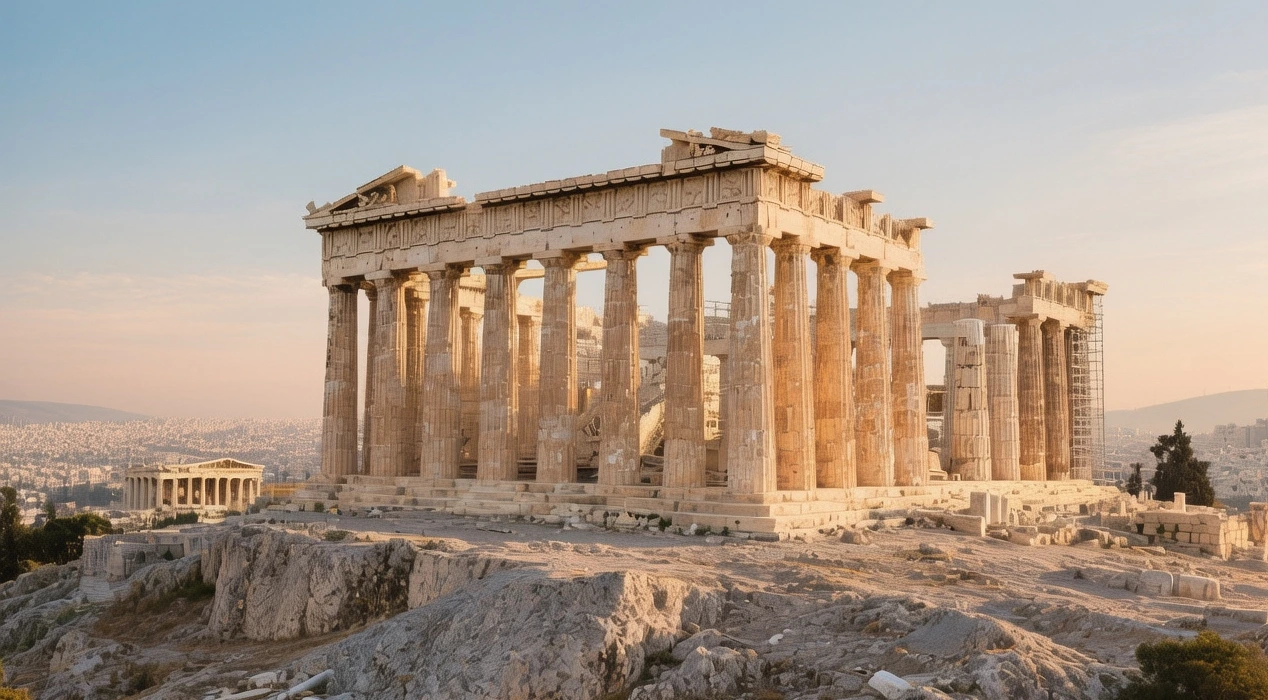
I start walking up the slope at eight in the morning. Sunlight already warms the stone path, and the marble ahead glows pale gold. The air smells of dry earth and wild thyme. I pass the lower gate and climb toward the Propylaea. Each step rises higher above the city. When I reach the top, the whole of Athens spreads out below — white rooftops stretching to the sea, and the Parthenon standing at the hill's highest point, aligned perfectly against the sky. Wind moves through the columns. Shadows shift across the marble. This is not just a ruin. It is the place where democracy took physical form.
Why Acropolis Matters
The Acropolis means "high city" in Greek. People have lived on this limestone hill for five thousand years. But what stands today began in the 5th century BC. After Persians destroyed every earlier building, the Athenians — led by Pericles — built something entirely new. They did not build a fortress. They built a sanctuary. On this rock rose four masterpieces: the Parthenon, the Propylaea, the Erechtheion, and the small Temple of Athena Nike. Together they expressed the belief that human reason, beauty, and democracy could stand above all else. That vision comes with honest disappointment. Restoration work continues everywhere. Scaffolding wraps columns. New marble blocks sit beside ancient stone, and metal pins hold sections together. The site feels like a construction site as often as it feels like an ancient landmark. Crowds overwhelm the space from mid-morning onward, and you often wait in line just to step forward a few meters.
The Best Time to Experience Acropolis
Visit from late March through May, or mid-September through October. Temperatures run 18°C to 26°C (64°F–79°F). The climb feels manageable, and light falls beautifully across the marble. June through August brings heat above 33°C (91°F). No shade exists on the summit. The rock reflects heat everywhere, and dehydration strikes fast. Winter from November through March brings cooler days around 10°C–16°C (50°F–61°F), and rain makes ancient marble dangerously slippery. Arrive exactly when gates open. You walk the summit almost alone. Late afternoon, one and a half hours before closing, also works well — crowds thin, light softens, and the view across Athens clears beautifully.
Approximate Budget for a 7-Day Trip
These figures cover one person staying in central Athens, visiting the Acropolis plus nearby sites, and eating a mix of casual and mid-range meals.
- Accommodation: €420–€665 for a double room within walking distance
- Food & Drink: €245–€420; avoid restaurants directly below the entrance
- Local Transport: €25–€50; metro stops nearby; walking costs nothing
- Attractions & Entry Fees: €75–€130; Acropolis plus combined archaeological ticket options
- Miscellaneous: €60–€110 for water, hats, and supplies
- Total: €825–€1,375 for one person
Bottled water and cold drinks sold near the entrance cost nearly three times normal price. Carry your own. The combined archaeological ticket seems convenient but expires after five days. If you cannot visit six sites within that window, buy individual tickets and save money.
Essential Acropolis Experiences
- Walk through the Propylaea — the monumental gateway that frames your first view of the Parthenon. The architects designed this approach to build awe step by step, long before cameras existed. If you struggle with steep steps, stay on the wider central path; side sections have uneven footing and no railings.
- Stand before the Parthenon and notice how every column leans inward and every curve bends upward. No line is truly straight. Every stone was shaped to look perfect to the human eye.
- Visit the Erechtheion and its Caryatids — six maidens supporting the roof. The ones you see are replicas. Five originals stand in the Acropolis Museum; one remains elsewhere. Read the labels so you understand what you are actually looking at.
- Stand beside the Temple of Athena Nike on the bastion at the southwest corner. The smallest building sits in the most powerful position, guarding the gate and offering the clearest view toward the sea.
- Walk the full perimeter path and look down across the city. From every side the Parthenon appears different, framed against different neighborhoods and different light.
- Look down at the Theatre of Dionysus carved into the south slope. This is where tragedy and comedy were first performed. Most visitors walk right above it without noticing.
Hidden Gems Most Travelers Miss
- The view from the bastion beside Temple of Athena Nike looks across the Parthenon facade rather than straight on. This angle shows the building's proportions most clearly.
- Ancient grooves and cuttings in the stone near the Propylaea show where statues and dedications once stood. Most people walk past without looking down.
- The path along the north edge stays quieter than the central route. You see the Erechtheion from its least crowded side.
- Skip the paid guided tours at the gate. Most repeat basic facts available on free information posts, and you move slower in a group.
Cultural & Practical Tips
- Wear rubber-soled walking shoes. Ancient marble stays polished and becomes slippery even when dry.
- Carry at least one liter of water per person. None is available on the summit. Heat exhaustion is common.
- Do not touch walls or columns. Oils from hands darken the marble and damage the surface over time.
- Ignore street vendors selling "priority entry" or "skip the line" passes. Lines move steadily; those offers cost extra for no real benefit.
- Stay behind barriers. Many sections are structurally unstable. Falling stone has injured visitors before.
- Buy tickets online in advance. Walk-up lines can take 45 minutes in summer heat. Third-party sites add fees; book directly.
- Do not climb on the ruins. Even low walls are fragile and illegal to mount. Guards enforce this strictly.
Essential Visitor Information
Location & Access: The Acropolis rises above central Athens, address: Athens 105 58. Two entrances exist: main west entrance through the Propylaea, and south entrance near the Theatre of Dionysus. By metro: Akropoli Station (Line 2) sits roughly 10 minutes from the south entrance. Monastiraki Station (Lines 1 and 3) is roughly 15 minutes from the west entrance. Syntagma Station (Lines 2 and 3) is roughly 20 minutes on foot. Buses stop at lower entrances but move slowly in traffic.
Tickets & Booking: Standard entry grants access to the summit and slopes. Combined ticket covers six archaeological sites over five days. Booking ahead is highly recommended April through October. Reduced rates apply for students and seniors with identification. Free entry applies on selected public holidays.
Operating Hours: Summer hours April 1–October 31: 8:00 AM–8:00 PM daily; last entry 7:30 PM. Winter hours November 1–March 31: 8:00 AM–5:00 PM daily; last entry 4:30 PM. The site closes on selected public holidays including January 1, March 25, May 1, and December 25–26. Extreme heat may trigger temporary midday closures.
Visit Duration: Minimum 90 minutes to see the four main buildings. Two to three hours lets you walk all paths and read information posts without rushing. Add time if you plan to visit the Acropolis Museum afterward.
Family Suitability: Children are welcome but must be closely supervised. Paths are steep, uneven, and lack railings on most sides. Strollers cannot reach the summit; they must be left at the lower entrance. No drinking water or restrooms exist at the top.
Timing: First hour after opening offers best light and quietest visit. Late afternoon one and a half hours before closing brings softer light and thinner crowds. Avoid 11:00 AM–3:00 PM in summer — heat and crowds peak then.
Highlights: Parthenon and its optical precision. Propylaea gateway. Erechtheion with Caryatid Porch. Temple of Athena Nike bastion. Theatre of Dionysus on the south slope.
Nearby & Day Trip: Acropolis Museum sits five minutes downhill. Ancient Agora and Thissio lie roughly 15 minutes west. Plaka district begins 10 minutes northeast. Temple of Olympian Zeus stands 15 minutes southeast. All fit comfortably into one day on foot.
Conclusion: Travel with Respect, Not Just Awe
The Acropolis is not perfect. Scaffolding wraps columns. Restoration continues. Crowds press close. Yet this rock remains powerful because it stands as an idea made visible — the belief that reason, beauty, and shared government could endure. Visit early. Walk slowly. Look closely. When you leave, ask yourself what we build today that might still stand two thousand five hundred years from now.
Post a Comment