Parthenon: Where Ancient Marble Meets Eternal Athenian Sky
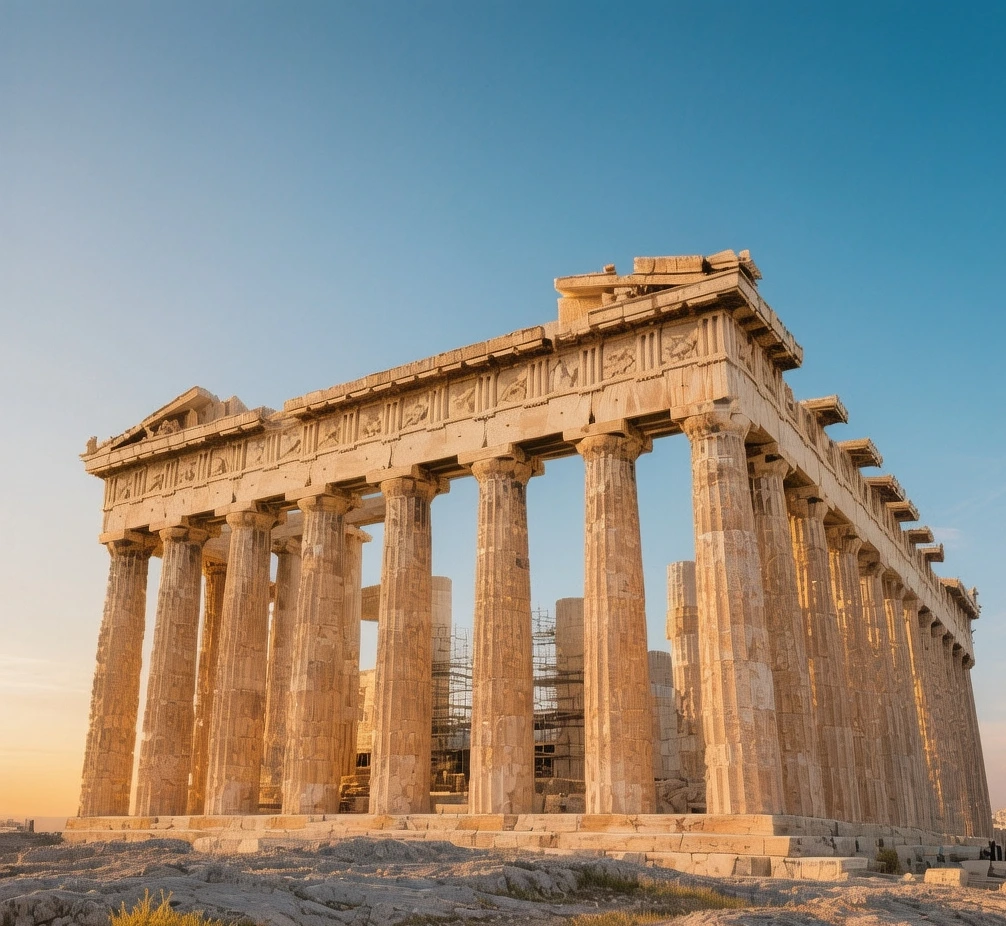
Parthenon: Where Ancient Ideal Meets Enduring Stone
I climb the final slope just after eight in the morning. Sunlight touches the marble columns before the path warms underfoot. The air feels thin and bright. I step through the Propylaea and the Parthenon stands fully into view — not perfect, not whole, but still overwhelming. Every column leans slightly inward. Every curve bends just enough to look straight to the eye. No machinery built this. Human hands shaped every block, fitting them so tightly you cannot slip a blade between stones. The ground beneath stays rough and uneven. Restoration scaffolding wraps sections of the facade. Yet the form remains complete, rising above everything around it.
Why Parthenon Matters
Built between 447 and 432 BC, the Parthenon was not just a temple. It stood as a visible statement of Athens at its peak — confident, wealthy, and determined to set a standard for the known world. Dedicated to Athena, it housed a giant statue made of gold and ivory, and served as treasury, landmark, and symbol all at once. Over centuries it became church, mosque, and gunpowder store. Explosion, war, and looting took their toll. What remains still influences architecture everywhere. The honesty comes sharp: what you see today is heavily reconstructed. New marble blocks sit beside ancient ones, held together with titanium pins. The structure has been reinforced and straightened so thoroughly that it is partly a modern building. Restoration work continues year-round, and scaffolding often covers significant sections. Many visitors feel disappointed that the view does not match the photographs they saw.
The Best Time to Experience Parthenon
Visit from late March through May, or mid-September through October. Temperatures run 18°C to 26°C (64°F–79°F), and the climb feels manageable. June through August brings heat above 33°C (91°F). The rock reflects sunlight everywhere. No shade exists on top. Dehydration happens fast. Winter from November through March brings cooler days around 10°C–16°C (50°F–61°F), and rain makes the marble dangerously slippery. Arrive exactly when gates open. The light hits columns at an angle that softens detail, and crowds have not yet climbed the slope. Late afternoon one hour before closing also works well — shadows lengthen, scaffolding recedes into shadow, and the view across Athens opens beautifully.
Approximate Budget for a 7-Day Trip
These figures assume you stay in central Athens, visit the Parthenon and several nearby sites, and eat a mix of casual and mid-range meals.
- Accommodation: €420–€665 for a double room within walking distance
- Food & Drink: €245–€420; avoid restaurants directly below the entrance
- Local Transport: €25–€50; metro stops nearby; walking costs nothing
- Attractions & Entry Fees: €70–€120; consider the combined ticket if visiting 6 sites
- Miscellaneous: €60–€110 for water, hats, and supplies
- Total: €820–€1,365 for one person
Bottled water and cold drinks sold at the hilltop kiosk cost nearly four times normal price. Carry your own. The combined ticket seems convenient but expires after five days. If you cannot visit six sites within that window, buy individual tickets and save money.
Essential Parthenon Experiences
- Walk all sides of the temple and notice how columns lean inward and curves bend upward. No line is truly straight. Every stone was cut to create an optical effect. If you have balance trouble, stay on the wider paths; edges slope unevenly and trip hazards exist everywhere.
- Stand centered on the east side and imagine the gold-and-ivory Athena statue once standing inside. The scale becomes clearer when you step back and look at the full facade.
- Notice the difference between ancient marble and new blocks used in restoration. Colors and texture do not match perfectly. Seeing what is original helps you understand what was lost.
- Look closely at the column capitals and fluting up close. Thousands of precise cuts were made by hand. The detail still feels sharp after twenty-five hundred years.
- View the Parthenon from below before climbing up. The silhouette from the Plaka district shows the temple in context, rising above the city.
- Compare what stands here with what you saw in the Acropolis Museum. Missing pieces become visible as empty spaces on the facade.
Hidden Gems Most Travelers Miss
- From the far west corner, the Parthenon aligns perfectly with the sunset on clear evenings. Few people stay long enough to see it.
- Blocks near the base still carry ancient marks and chisel cuts. Look low, away from crowds.
- The path around the outer edge stays quieter than the main central route. You see details without congestion.
- Skip the paid guided tours at the gate. Most repeat basic facts available on free information posts, and you move slower in a group.
Cultural & Practical Tips
- Wear rubber-soled walking shoes. Ancient marble stays polished and becomes slippery even when dry.
- Carry at least one liter of water per person. None is available on top. Heat exhaustion is common.
- Do not touch walls or columns. Oils from hands darken the marble and damage the surface over time.
- Ignore street vendors selling "priority entry" or "skip the line" passes. Lines move steadily; those offers cost extra for no benefit.
- Stay behind barriers. Many sections are structurally unstable. Falling stone has injured visitors before.
- Buy tickets in advance online. Walk-up lines can take 45 minutes in summer heat. Third-party sites add fees; book directly.
- Do not climb on the ruins. Even low walls are fragile and illegal to mount. Guards enforce this strictly.
Essential Visitor Information
Location & Access: The Parthenon stands on the Acropolis hill above central Athens. Main entrance is through the Propylaea on the west slope. The south slope entrance near the Acropolis Museum offers shorter lines. By metro, Acropolis Station (Line 2) sits roughly 10 minutes away by foot. Monastiraki Station (Lines 1 and 3) is roughly 15 minutes away. Syntagma Station (Lines 2 and 3) is roughly 20 minutes away. Buses stop at the lower entrances but move slowly in traffic.
Tickets & Booking: Standard entry ticket grants access to the Acropolis and Parthenon. Combined ticket covers six archaeological sites over five days. Booking ahead is highly recommended April through October. Reduced rates apply for students and seniors with identification. No ticket grants special access to restricted areas.
Operating Hours: Summer hours April 1–October 31: 8:00 AM–7:00 PM daily; last entry 6:30 PM. Winter hours November 1–March 31: 8:00 AM–5:00 PM daily; last entry 4:30 PM. The site closes on selected public holidays including January 1, March 25, May 1, and December 25–26.
Visit Duration: Minimum 45 minutes to walk around the Parthenon. Allow 90 minutes to see it thoroughly plus the Propylaea and Erechtheion. Add more time if you wish to pause and examine details without rushing.
Family Suitability: Children are welcome but must be closely supervised. Paths are steep, uneven, and lack railings on most sides. Strollers cannot reach the Parthenon; they must be left at the lower entrance. No drinking water or restrooms exist at the summit.
Timing: First hour after opening offers best light and quietest visit. Late afternoon one hour before closing brings softer light and thinner crowds. Avoid 11:00 AM–3:00 PM in summer — heat and crowds peak then.
Highlights: East facade and entrance. Optical curvature and column alignment. Erechtheion and Caryatids nearby. Propylaea gateway. Panoramic view across Athens.
Nearby & Day Trip: Acropolis Museum sits five minutes downhill. Ancient Agora and Thissio lie 15 minutes west. Plaka district begins 10 minutes northeast. Temple of Olympian Zeus stands 15 minutes southeast. All fit comfortably into the same day on foot.
Conclusion: Travel with Vision, Not Just Sightseeing
The Parthenon is not perfect. It is damaged, partly rebuilt, and often wrapped in scaffolding. Yet it still stands, after wars, explosions, earthquakes, and centuries of change. What survives is not just stone. It is the idea that humans can build something approaching perfection. When you leave, ask yourself what ideal you would build to last twenty-five hundred years.
Post a Comment