
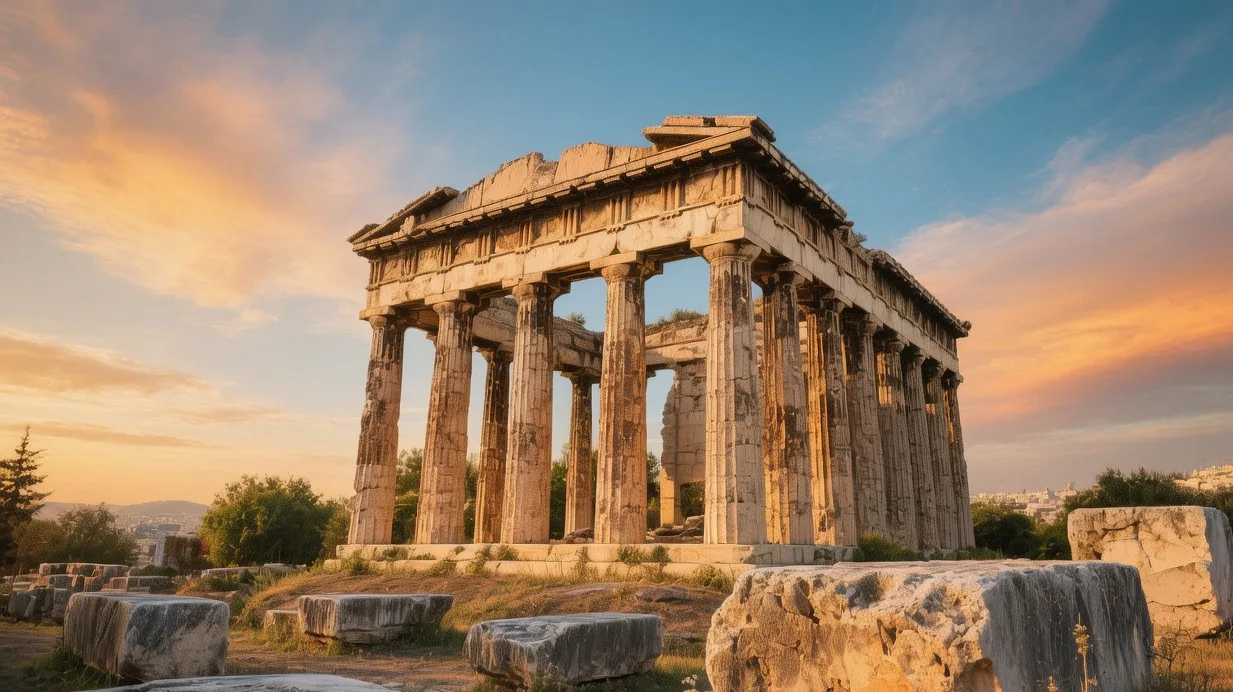
Ancient Agora: Where Democratic Debate Meets Timeless Athenian Stone
The morning sun spills over the Pnyx hill as you enter the Ancient Agora, where 12 hectares of archaeological splendor unfold beneath a canopy of olive and plane trees planted centuries ago. The air carries the scent of wild thyme, sun-warmed limestone, and the faint mineral tang of Pentelic marble from the Temple of Hephaestus standing sentinel at the site's western edge. Cicadas begin their rhythmic chorus—a sound unchanged since Socrates walked these same paths debating virtue with his students. Before you rises the Stoa of Attalos, its 45 reconstructed Doric columns stretching 115 meters in perfect symmetry, housing artifacts that tell the story of daily life in classical Athens. The ground beneath your feet holds layers of history: Bronze Age pottery shards, Classical-era foundation stones, Roman-era mosaics, all preserved in the careful stratigraphy excavated by the American School of Classical Studies since 1931. This is not merely an archaeological site; it is the birthplace of democratic discourse, where citizens gathered to vote, philosophers taught, and merchants traded goods from across the Mediterranean. Standing among these weathered stones, you understand: the Ancient Agora matters because it proves that the ideals of free speech, civic participation, and reasoned debate can take root in stone and soil—and endure for over two millennia.
Why the Ancient Agora Embodies Democratic Foundation
The Ancient Agora represents humanity's most significant experiment in self-governance—a public space that solved the fundamental need to create a physical home for democracy while fostering the intellectual exchange that defined classical Athens. Established as Athens' civic heart in the 6th century BCE, the Agora served as marketplace, political assembly, judicial center, and philosophical classroom simultaneously, accommodating up to 6,000 citizens who gathered to debate laws, elect officials, and shape the policies of the world's first democracy. The site's 12-hectare expanse was carefully organized: the Panathenaic Way—a 12-meter-wide ceremonial road—bisected the space, connecting the Dipylon Gate to the Acropolis, while the Square itself featured purpose-built structures including the Bouleuterion (council house seating 500 members), the Tholos (executive committee headquarters), and numerous stoas providing shaded walkways for commerce and conversation.
The Agora's architectural significance lies in its functional elegance: the Temple of Hephaestus, constructed between 449 and 415 BCE, stands as one of Greece's best-preserved Doric temples—measuring 31.7 meters long by 13.7 meters wide, with 6 columns on the facade and 13 on the flanks, all crafted from Pentelic marble with Parian marble for sculptural details. The Stoa of Attalos, originally built by King Attalos II of Pergamon around 150 BCE and meticulously reconstructed in the 1950s, demonstrates ancient engineering prowess: its two-story colonnade featured 45 Doric columns on the ground level and 45 Ionic columns above, creating a covered walkway 115 meters long that protected merchants and philosophers alike from sun and rain. The Agora solved Athens' need for a multifunctional civic space where commerce, politics, religion, and philosophy could intersect—a model that influenced public square design across the Western world.
Today, excavations by the American School of Classical Studies have uncovered over 100,000 artifacts ranging from voting tokens used in ostracism to merchant weights, pottery, and inscriptions that illuminate daily Athenian life. The site's ongoing preservation—using original materials and traditional techniques where possible—ensures that visitors can walk the same paths as Plato, witness the same columns that framed ancient debates, and understand how physical space shapes democratic culture. Every stone in the Ancient Agora whispers stories of citizens who believed that free people, gathered in public, could govern themselves wisely.
The Best Time to Experience the Ancient Agora
Timing transforms a visit to the Ancient Agora from routine archaeological tour to immersive journey into democratic origins. The optimal windows stretch from May 18–June 12 and September 15–October 20, when Athens temperatures hover between 18–25°C (64–77°F), olive trees bloom with fragrant white flowers, and visitor numbers remain manageable enough for unhurried exploration of the site's 12 hectares. During these shoulder seasons, you'll experience comfortable conditions for walking the Panathenaic Way while capturing photographs in the soft, directional light that reveals the marble's subtle color variations.
Arrive precisely at 8:00–9:00 AM when the gates open—this golden hour delivers cooler temperatures, minimal crowds, and the most dramatic shadows cast by the Temple of Hephaestus columns. The site operates daily from 8:00 AM year-round, closing at 8:00 PM during summer (April–October) and 5:00 PM in winter (November–March), with last entry 30 minutes before closing. Winter months (November–February) offer minimal crowds and moody, overcast skies that create atmospheric photography conditions, though temperatures drop to 10–13°C (50–55°F) with increased rainfall that can make the limestone pathways slippery.
Avoid July 15–August 31 unless absolutely necessary: temperatures regularly exceed 32°C (90°F), the exposed site offers limited shade despite its trees, and cruise ship schedules create crushing midday crowds that diminish the Agora's contemplative atmosphere. Also skip Greek Orthodox Easter week and major public holidays when domestic tourism swells visitor numbers. For the most current information on hours, ticket availability, and special events, always check the official Athens tourism portal at http://odysseus.culture.gr before your visit.
Approximate Budget for a 7-Day Trip
Athens remains one of Europe's most accessible cultural destinations, and visiting the Ancient Agora offers exceptional value as part of the city's archaeological circuit. The following breakdown reflects mid-range travel—comfortable three-star accommodations, authentic taverna dining mixed with occasional upscale meals, and comprehensive site visits—based on current pricing for a single traveler exploring Athens' historic treasures.
- Accommodation: €80–€150 per night in Plaka, Monastiraki, or Thissio neighborhoods (€560–€1,050 total). Budget hostels start at €25; luxury boutique hotels with Acropolis views run €200+.
- Food: €45–€65 per day total. Breakfast: €5–€8 (Greek coffee €3, tyropita pastry €2.50, fresh orange juice €3). Lunch: €12–€18 (gyros pita €3.50–€4.50, Greek salad €8–€10, moussaka €12). Dinner: €20–€35 (grilled octopus €16, lamb chops €18, house wine €5/glass, baklava €6).
- Transportation: €35 total. Metro from airport: €9 one-way (€18 round-trip on Line 3). 5-day unlimited transit pass: €8.20. Occasional taxi rides: €10–€15 each.
- Attractions: €85 total. Acropolis combo ticket: €36 (includes Ancient Agora, Temple of Olympian Zeus, Roman Agora, Hadrian's Library, Kerameikos, and Lyceum). Acropolis Museum: €15. National Archaeological Museum: €12. Day trip to Cape Sounion: €20 including transport.
- Miscellaneous: €100 total. Water/snacks €5/day, olive oil soap €8, handmade leather sandals €40–€80, museum guidebooks €15, tips €20.
Total: €1,300–€1,600 for 7 days (excluding international airfare)
7 Essential Ancient Agora Experiences
- Walk the Panathenaic Way at sunrise: Enter through the main gate at 8:00 AM and follow the 12-meter-wide ceremonial road that ancient Athenians used during the Great Panathenaea festival. The limestone surface still bears wheel ruts from 2,500-year-old carts. Morning light illuminates the Temple of Hephaestus from the east, revealing the precise craftsmanship of its Doric columns. Allow 20 minutes to traverse the full length, imagining the procession of citizens, priests, and athletes that once filled this sacred path.
- Explore the Stoa of Attalos museum: Enter the reconstructed two-story colonnade and ascend to the upper level for panoramic views of the Agora. The museum displays artifacts excavated since 1931: voting tokens used in ostracism, merchant weights, pottery, and inscriptions that illuminate daily Athenian life. Allow 45 minutes to appreciate the collection; the English-language audio guide (€3) provides essential context for understanding the Agora's role in democratic governance.
- Contemplate the Temple of Hephaestus: Approach the best-preserved Doric temple in Greece from the southeast corner at 9:00 AM when morning light reveals the subtle entasis (swelling) in each column. The temple, dedicated to the god of metalworking, measures 31.7 meters long and features 6 columns on the facade, 13 on the flanks. Notice the metopes depicting the Labors of Heracles and the Theseus cycle—mythological narratives that reinforced Athenian civic identity.
- Stand at the Bema of the Agora: Locate the stone platform where public speakers addressed assemblies—the same spot where Demosthenes practiced his oratory and Aeschines debated policy. The Bema, measuring approximately 3 by 4 meters, offers a tangible connection to ancient free speech. Visit at 10:00 AM when the site is quiet enough to imagine the voices that once echoed across this space.
- Photograph the columns at golden hour: Position yourself at the Stoa of Attalos' western end at 6:30–8:00 PM (summer) when the setting sun casts warm light across the reconstructed colonnade. The interplay of light and shadow on the marble creates dramatic patterns that emphasize the stoa's architectural harmony. Use a wide-angle lens to capture the full 115-meter length, or focus on details like the precisely carved column capitals.
- Trace the Boundary Stones: Near the Agora's northern edge, look for inscribed marble markers that defined the sacred precinct's limits. These horoi stones, dating to the 5th century BCE, bore warnings against unauthorized entry and demonstrate how ancient Athenians demarcated civic space. Visit between 4:00–6:00 PM when raking light accentuates the carved letters for clearer reading.
- Rest beneath the ancient plane trees: The Agora's mature plane trees—some planted over a century ago—create pockets of shade that offer respite during warmer hours. Sit on a stone bench beneath their canopy and observe how modern Athens unfolds beyond the archaeological fence: the Acropolis to the southeast, Monastiraki's bustling market to the north, and the gentle rhythm of contemporary life continuing alongside ancient stones.
3 Hidden Gems Most Travelers Miss
- The Sanctuary of the Twelve Gods: Tucked into the Agora's northwestern corner, this small altar complex dedicated to the Olympian deities served as Athens' official zero-mile marker—all distances in ancient Greece were measured from this point. The sanctuary's foundation stones and boundary markers remain visible, though few visitors venture to this quiet corner. Access: Free with Agora admission; located 50 meters northwest of the Stoa of Attalos. Visit at 11:00 AM when morning light illuminates the inscribed boundary stones. The site offers a profound reminder of how ancient civilizations conceptualized space and centrality.
- The Southeast Fountain House: Near the Agora's southeastern entrance, a small structure built around 520 BCE collected and distributed fresh water to citizens via terracotta pipes. The fountain's stone basin and drainage channels remain remarkably intact, demonstrating ancient hydraulic engineering. Access: Visible from the main path; no special access required. Most visitors focus on the Temple of Hephaestus and miss this subtle but significant infrastructure feature. Visit between 2:00–4:00 PM when sunlight through the trees creates dappled patterns on the limestone basin.
- The Agora's pottery workshop remains: On the site's western slope, excavations have revealed kilns, clay preparation areas, and discarded pottery fragments from workshops that supplied Athens' famous black- and red-figure vases. The area, active from the 6th to 4th centuries BCE, offers insight into the craft economy that supported Athenian culture. Access: Follow the western pathway from the Temple of Hephaestus; allow 10 minutes extra. Interpretive panels explain the pottery-making process. Visit at 3:00–5:00 PM when afternoon light reveals subtle color variations in the ceramic fragments still embedded in the soil.
Cultural & Practical Tips
- Photography guidelines: Personal photography without flash is permitted throughout the Ancient Agora. Tripods require advance permission from the site office (+30 210 321 0185). The best light for architectural photography occurs during the first and last hours of daylight when shadows accentuate column fluting and stone textures.
- Footwear and terrain: The site features uneven limestone pathways, grassy areas, and occasional gravel sections. Wear sturdy, closed-toe shoes with excellent grip—avoid sandals or smooth-soled footwear. During summer, stone surfaces can feel 5–7°C hotter than ambient temperature; carry water and consider visiting during cooler morning or evening hours.
- Hydration essentials: Carry at least 1.5 liters of water per person; there are no vendors within the Agora precinct. The nearest cafés are in Monastiraki or Thissio. Fill bottles at public fountains near the entrance—Athens tap water is safe and excellent quality.
- Local phrases: Kalimera (kah-lee-MEH-rah) = Good morning; Efharisto (ef-hah-REE-stoh) = Thank you; Parakalo (pah-rah-kah-LOH) = Please/You're welcome; Signomi (see-GNO-mee) = Excuse me. Using these greetings earns warm smiles from site staff and local visitors.
- Combined ticket strategy: Purchase the €36 Acropolis combo ticket to include the Ancient Agora along with six other major archaeological sites. The ticket remains valid for five days and offers significant savings versus individual admissions. Validate your ticket at the first site visited; staff will stamp it for subsequent entries.
- Accessibility considerations: The Ancient Agora features mostly level pathways suitable for wheelchairs and strollers, though some grassy areas may present challenges. Accessible restrooms are located near the entrance. Staff can provide assistance upon request; contact the site office in advance for specific accommodations (+30 210 321 0185).
- Seasonal adjustments: Summer visits require early morning or late afternoon exploration to avoid peak heat; the site offers partial shade from mature trees. Winter brings occasional rain—limestone becomes slippery, so wear appropriate footwear. Spring (March–May) offers wildflowers in the precinct and perfect temperatures for extended photography sessions.
Conclusion: Travel with Understanding, Not Just Checklists
The Ancient Agora demands more than a hurried photograph and a quick checkmark—it asks for your imagination, your reflection, your willingness to stand where democracy was practiced and philosophy was born. When you trace the wheel ruts in the Panathenaic Way or contemplate the columns that framed ancient debates, you participate in a dialogue across time: the ongoing conversation about how free people govern themselves. This is not passive tourism; it is active engagement with ideas that continue to shape our world.
Responsible travel here means understanding that every footprint on these ancient stones contributes to preservation challenges, every touch accelerates weathering on irreplaceable marble. Walk gently. Speak softly. Take only images; leave only gratitude. Support ongoing conservation by purchasing official tickets and respecting site guidelines that protect this birthplace of democracy for future generations of citizens and seekers.
This is not a ruin to be consumed but a testament to be experienced—a place where time collapses and you stand alongside philosophers, politicians, and ordinary citizens who believed that reasoned debate in public space could create a better world. Slow down. Sit on a sun-warmed stone. Watch light move across ancient columns. Let the Ancient Agora reveal its story gradually, as stone reveals its grain under patient hands. The site will still stand tomorrow, but your opportunity to encounter it with wonder and respect exists only in this moment. Choose understanding over haste, connection over completion, and carry not just photographs but a deeper appreciation for the enduring power of democratic ideals.