
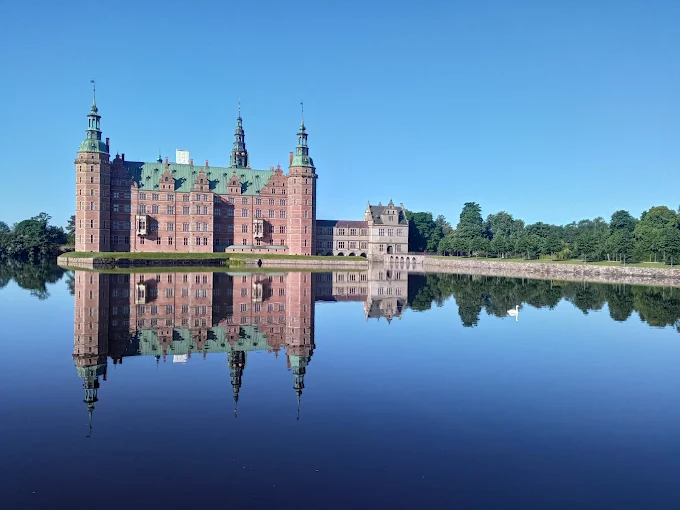
Frederiksborg Castle: Where Royal Grandeur Meets Danish Renaissance Splendor
Early morning mist drifts across the still waters of Castle Lake as the first light gilds the copper spires—Frederiksborg Castle rises from three interconnected islets like a vision of Dutch Renaissance ambition, its sandstone façade adorned with over 300 ornate gables and the distant chime of Hillerød's church bells weaving through the crisp air. You hear the gentle lap of water against the castle's foundations, the soft crunch of gravel beneath footsteps on the courtyard paths, and the hushed murmur of visitors entering a space where Danish history unfolds across four centuries. This architectural masterpiece, commissioned by King Christian IV and constructed between 1602 and 1620, spans approximately 30,000 square meters with towers reaching thirty meters skyward, its symmetrical wings enclosing courtyards that echo with the footsteps of monarchs, diplomats, and artists [[15]][[22]]. The Great Hall stretches forty meters beneath a ceiling of intricate heraldic paintings, while the Chapel—miraculously spared by the devastating fire of 1859—preserves its original 17th-century organ and gilded altarpiece. But Frederiksborg Castle matters because it embodies Denmark's golden age of royal power, artistic patronage, and architectural innovation; it is not merely a monument to the past but a living museum where national identity, cultural memory, and aesthetic beauty converge in timeless dialogue.
Why Frederiksborg Castle Embodies Danish Renaissance Mastery
Frederiksborg Castle represents the zenith of Dutch Renaissance architecture in Scandinavia, solving a profound need for royal symbolism while creating an enduring cultural institution that continues to shape Danish identity. When King Christian IV transformed his father's modest hunting lodge into a monumental residence between 1602 and 1620, he envisioned more than a palace—he crafted a 30,000-square-meter statement of Danish sovereignty, artistic ambition, and engineering prowess at the height of the kingdom's Baltic dominance [[15]][[20]]. The castle's design, attributed to Flemish-Danish architects Hans van Steenwinckel the Elder and his son, employed advanced techniques: sandstone imported from Germany, copper roofing that weathers to distinctive verdigris, and an innovative foundation system of oak pilings driven into the lakebed to support the three-islet complex [[18]][[24]].
The interior showcases Renaissance craftsmanship at its finest: the Great Hall's forty-meter length accommodates ceremonial gatherings beneath a ceiling adorned with thirty-nine painted panels depicting Christian IV's victories; the Chapel retains its original 1617 organ—one of Northern Europe's most significant historical instruments—and intricate woodcarvings that survived the 1859 fire which devastated much of the castle [[22]]. In 1878, the building found new purpose as the Museum of National History, housing over 1,200 portraits, historical paintings, and decorative arts that chronicle Denmark's story from the Middle Ages to the present. Frederiksborg Castle fulfilled a dual purpose: politically, it projected royal authority during Denmark's era as a Baltic power; culturally, it evolved into a national repository of memory and identity. Technical innovations include the castle's sophisticated drainage system that manages lake levels, climate-controlled galleries preserving sensitive artworks at 20°C (68°F) and 50% humidity, and the meticulously reconstructed Baroque Garden—restored in the 1990s using 1720 plans to recreate hedges, fountains, and pavilions with historical accuracy [[18]]. Today, managed by the Danish Palaces and Properties Agency, Frederiksborg Castle stands as a testament to how architecture can preserve narrative, how restoration can honor heritage, and how a single location can bridge monarchy, democracy, and cultural continuity.
The Best Time to Experience Frederiksborg Castle
Timing your visit to Frederiksborg Castle profoundly influences both atmospheric immersion and practical accessibility. The optimal window falls between May 20 and June 18, when Hillerød enjoys extended daylight—sunset occurs around 9:45 PM—and temperatures range from 13°C to 20°C (55°F to 68°F), creating ideal conditions for exploring the castle interiors, Baroque Garden, and lakeside pathways [[68]][[72]]. During this period, the garden's roses and ornamental hedges reach peak bloom, outdoor photography benefits from soft golden-hour light, and summer crowds have not yet peaked. For photographers, visit between 6:30–8:30 AM when morning mist creates ethereal reflections on Castle Lake, or 7:00–9:00 PM for dramatic sunset illumination on the Renaissance façade.
The castle operates year-round with seasonal hours: summer season (June–August) opens 10:00 AM–5:00 PM daily; winter hours (November–February) reduce to 10:00 AM–3:00 PM. For current exhibitions, concert schedules, and ticket reservations, visit the official Frederiksborg Castle website at www.frederiksborgslot.dk or the national tourism portal at www.visitdenmark.com [[52]][[85]]. Avoid visiting during late November through early February, when temperatures drop to -3°C to 4°C (27°F to 39°F), daylight shrinks to seven hours, and the Baroque Garden's formal geometry loses impact in winter dormancy. Also steer clear of Danish school holidays (week 7 in February, week 42 in October) when family crowds increase. Standard admission costs DKK 120 for adults (€16), DKK 60 for children ages 6–17 (€8), with children under 6 admitted free [[24]]. The castle café, overlooking the lake, is particularly rewarding between 2:00–4:00 PM when afternoon light enhances the panoramic views.
Approximate Budget for a 7-Day Trip
Exploring Frederiksborg Castle and North Zealand requires moderate budgeting, as Denmark maintains higher price points than many European destinations. However, strategic planning—including staying in Hillerød rather than central Copenhagen and utilizing regional transit passes—can optimize your experience. The following breakdown reflects mid-range preferences with cultural immersion priorities.
- Accommodation: €70–€125 per night for a double room in Hillerød (walking distance to Frederiksborg Castle); budget hostels €28–€48 per night for dorm beds; boutique hotels in historic buildings €140+ per night
- Food: €40–€68 per day total
- Breakfast: €7–€11 (Danish pastry and coffee from local bakery)
- Lunch: €13–€20 (smørrebrød open-faced sandwich or seasonal soup at castle café)
- Dinner: €20–€35 (mid-range restaurant in Hillerød featuring traditional Danish cuisine like frikadeller or fresh fish)
- Castle café option: €6–€9 for soup, sandwich, and coffee
- Transportation:
- Copenhagen Card (72-hour): €95 includes unlimited public transport and free entry to Frederiksborg Castle plus 80+ attractions
- Regional train (DSB) from Copenhagen Central to Hillerød: €10 one-way, 40 minutes via Line A
- Local bus in Hillerød: €3 per ride; bicycle rental €10 per day
- Train to Helsingør for Kronborg Castle: €5 additional
- Attractions:
- Frederiksborg Castle admission: €16 (DKK 120) adults; €8 children [[24]]
- Guided tour upgrade: €7 additional
- Baroque Garden access: Included with castle admission
- Museum of National History special exhibitions: €4 supplement
- Organ concert in the Chapel: €15–€25
- Castle gift shop: Renaissance-themed souvenirs €10–€45
- Audio guide rental: €4
- Photography permit for professional use: €30
Total estimated budget for 7 days: €860–€1,290 per person (excluding international flights)
7 Essential Frederiksborg Castle Experiences
- Walk the Castle Bridge at Sunrise: Arrive at opening time (10:00 AM) and cross the ornate bridge connecting the mainland to the castle islets. The panoramic view reveals the symmetrical Dutch Renaissance façade reflected in Castle Lake, with copper spires gleaming in morning light. Allow 20 minutes for this contemplative approach; bring a light jacket—lake breezes can be brisk even in summer.
- Explore the Great Hall: Enter the forty-meter-long ceremonial chamber where royal banquets and coronations once echoed. Observe the intricate ceiling paintings depicting Christian IV's naval victories, the heraldic tapestries, and the polished oak floors worn smooth by centuries of footsteps. Visit during the hourly guided tour (included in admission) to learn about the 1859 fire and meticulous 20th-century restoration [[22]].
- Experience the Chapel's Historic Organ: The castle Chapel, consecrated in 1617, houses one of Northern Europe's most significant historical organs, built by master craftsman Esajas Compenius. The instrument's ornate façade features carved biblical scenes and gilded details. Photography is permitted without flash; visit between 2:00–3:30 PM when natural light through the stained-glass windows illuminates the interior. Occasional organ recitals (check schedule) offer the rare chance to hear 400-year-old music in its original acoustic space.
- Stroll the Baroque Garden: Exit the castle's western gate and explore the meticulously reconstructed formal garden, designed in the 1990s based on 1720 plans. The geometric hedges, ornamental fountains, and classical pavilions create a living canvas of Renaissance landscape architecture. Visit between 11:00 AM–1:00 PM when garden volunteers provide informal explanations; allow 45 minutes for the full circuit [[18]].
- Visit the Museum of National History: Explore the castle's 150+ rooms housing over 1,200 portraits, historical paintings, and decorative arts chronicling Denmark's story. The Portrait Gallery features monarchs from Viking Age to present; the History Rooms display artifacts from pivotal national moments. Allow 90 minutes; audio guides (€4) provide rich contextual narration in eight languages.
- Photograph the Lake Reflections: The castle's lakeside setting provides iconic photographic opportunities. Visit between 7:00–9:00 AM when morning mist creates ethereal reflections, or 6:30–8:30 PM for golden-hour illumination. Use a polarizing filter to manage glare; focus on how architecture and water interact across seasons.
- Attend a Concert in the Chapel: Check www.frederiksborgslot.dk for the castle's acclaimed concert series, featuring classical, choral, and organ music in a space designed for exceptional acoustics. Book tickets at least two weeks in advance; performances typically begin at 7:00 PM. Arrive 30 minutes early to explore the exhibition spaces with fewer crowds, then settle into the intimate Chapel where architecture and sound intertwine.
3 Hidden Gems Most Travelers Miss
- The Castle's Hidden Courtyard Garden: Tucked behind the eastern wing, this intimate walled garden features period-appropriate herbs, roses, and ornamental plants used in Renaissance court life. Most visitors overlook this tranquil space because it lacks prominent signage. Access: From the main courtyard, follow the arched passage marked "Have" behind the Chapel; open daily 10:00 AM–4:00 PM (summer), 10:00 AM–2:00 PM (winter); free with castle admission. Best visited between 11:00 AM–1:00 PM when garden volunteers provide informal explanations. The garden's secluded atmosphere and rotating seasonal plantings reward contemplative visits.
- The Tower Viewpoint: The castle's central tower offers panoramic views of Hillerød, Castle Lake, and the surrounding North Zealand landscape—but access is limited and rarely advertised. Inquire at the information desk about occasional guided tower tours; typically available Wednesday and Saturday at 2:00 PM for small groups (maximum 8 people). The climb involves 85 narrow stone steps; not suitable for mobility limitations. The viewpoint reveals the castle's strategic positioning and the Baroque Garden's geometric design from above. Photography is permitted; bring binoculars to observe distant landmarks.
- The Lakeside Walking Path: Most visitors turn back at the Baroque Garden's formal boundary, but a public footpath continues north along Castle Lake for 1.5 kilometers, offering wilder shoreline scenery and unexpected viewpoints of the castle's architecture from the water. Access: Exit the garden's northern gate, follow the marked lakeside trail; open year-round daylight hours; free. Best attempted between 4:00–6:00 PM for golden-hour photography. The path reveals how Frederiksborg's design responds to its watery setting—towers appear and disappear through trees, copper roofs catch the light like beacons, and reflections transform the castle into a living painting.
Cultural & Practical Tips
- Photography Guidelines: Photography for personal use is permitted throughout Frederiksborg Castle and grounds, but flash and tripods are prohibited indoors to protect historic furnishings. Some special exhibitions restrict photography—observe signage. The lakeside views and Baroque Garden are ideal for photography; visit during golden hour for optimal light.
- Language: While exhibition labels and staff are English-friendly, learning Danish phrases enhances your experience: tak (tahk = thank you), undskyld (oon-skool = excuse me), velbekomme (vel-buh-kom-muh = you're welcome). Danish pronunciation features soft consonants and melodic intonation.
- Dress Code: Comfortable walking shoes are essential—cobblestones, uneven garden paths, and 85 tower steps demand sturdy footwear. Layer clothing; lake breezes can drop temperatures 5°C quickly even in summer. Bring a waterproof jacket year-round.
- Accessibility: Frederiksborg Castle is partially wheelchair accessible via ramps to the main courtyard and ground-floor galleries. The Chapel and Great Hall require climbing steps; the Baroque Garden includes paved paths, though some sections have gentle slopes. Wheelchairs are available free at the entrance; request assistance in advance for specialized needs.
- Weather Considerations: Hillerød's lakeside location means rapid weather shifts. Check the forecast before visiting; fog can obscure lake reflections, while rain enhances the atmospheric quality of the Renaissance architecture. Summer (June–August) offers the most reliable conditions; spring and fall provide fewer crowds but pack layers for variable temperatures.
- Combining with Copenhagen: Frederiksborg Castle is a 40-minute train ride from Copenhagen Central Station (Line A toward Hillerød). Purchase a Copenhagen Card for unlimited transport and free castle entry. Consider a day trip: depart Copenhagen at 9:00 AM, explore Frederiksborg until 3:00 PM, then visit nearby attractions or return for an evening in the capital.
- Museum Etiquette: Frederiksborg Castle encourages contemplative engagement. Speak quietly in galleries, maintain respectful distance from artworks, and allow others space to experience installations. The museum's philosophy values slow looking—resist the urge to rush; linger with works that resonate.
Conclusion: Travel with Reverence, Not Just Sightseeing
Frederiksborg Castle invites more than passive observation—it demands engagement with the layered narratives embedded in its sandstone walls: the strategic vision of Christian IV, the artistry of Renaissance craftsmen, the resilience of a monument that has witnessed fire, restoration, and transformation across four centuries. When you stand on that bridge watching Castle Lake mirror the copper spires, you're not merely viewing a scenic panorama; you're connecting with the royal history that shaped Denmark, the architectural innovation that defined an era, and the ongoing dialogue between preservation and interpretation that keeps heritage alive. This isn't a place to rush through, checklist in hand, snapping photos before racing to the next attraction. Slow down. Listen to the echo of your footsteps in the Great Hall; feel the weight of centuries in the Chapel's timbers; contemplate how a hunting lodge became a national symbol. Travel here with curiosity about how places shape identity and how identity gives meaning to places. Support preservation by respecting the site, choosing guided tours that employ local experts, and sharing not just images but understanding. The most transformative journeys leave you not just with memories of what you saw, but with deeper questions about who we are—and Frederiksborg Castle, with its blend of power, artistry, and enduring beauty, offers precisely that invitation to those willing to look beyond the surface.