
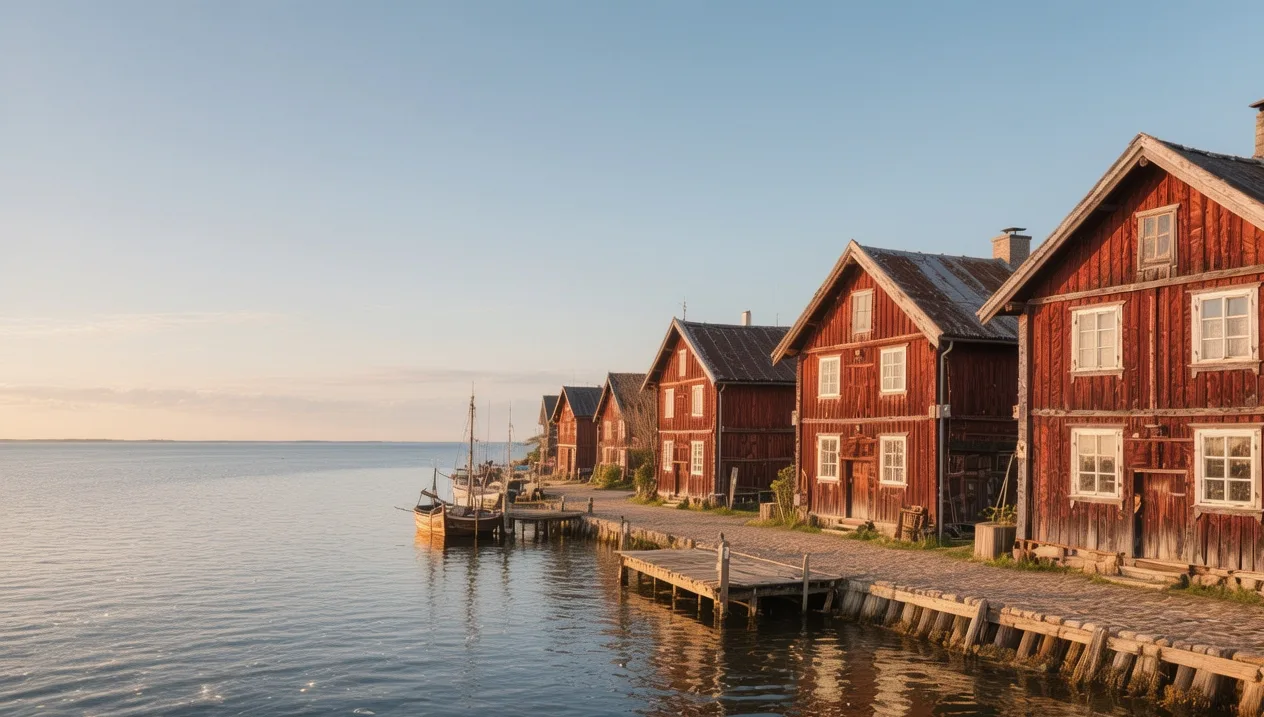
Hudiksvall Wood Town: Where Timber Heritage Meets Bothnian Bay
The morning light filters through the narrow streets at 8:00 AM in mid-July, casting long shadows across cobblestones that have borne witness to four centuries of history. You stand at Fisktorget—the Fisherman's Square—and listen: the gentle lapping of water against wooden pilings, the distant cry of gulls over the Gulf of Bothnia, the creak of a sign swinging in the breeze. Before you lies Möljen, the iconic canal lined with red wooden boathouses that have become the symbol of this resilient town. Hudiksvall—known affectionately as "Glada Hudik" or "Happy Hudik" since the 1800s—rises from the shores of Hudiksvallsfjärden, its wood-paneled architecture a testament to survival and reinvention. Founded in 1582 by King Johan III, this settlement has burned ten times—most devastatingly in 1721 when Russian forces swept down the Bothnian coast leaving only the stone church standing—yet each time, the townspeople rebuilt with timber, creating a streetscape that survives today as one of Sweden's best-preserved wooden towns . Here, wood serves as both memory and material—each painted façade, each carved doorframe, each narrow lane tells a story of maritime prosperity, flax-fueled wealth, and the indomitable spirit of Hälsingland.
Why Hudiksvall Wood Town Embodies Resilient Craftsmanship
Hudiksvall solves the architectural problem of building for eternity in a region of fire and ice. The town's current form emerged from catastrophe—the 1792 blaze that destroyed the Fiskarstan neighborhood led to a complete redesign of the street plan, creating the narrow lanes and closely packed wooden houses that characterize the district today . The solution prioritized community over grandeur: buildings constructed shoulder-to-shoulder, streets too narrow for fire to spread rapidly, and construction materials sourced from the vast forests of Hälsingland.
The timber tradition extends beyond mere survival into artistic expression. During the 19th century, flax production made Hälsingland farmers wealthy, and they expressed that prosperity through elaborate wooden manor houses—Hälsingegårdar—featuring hand-painted interiors that fused folk art with Rococo, Baroque, and Gustavian styles . Seven of these decorated farmhouses now grace UNESCO's World Heritage List. In Hudiksvall proper, the wooden architecture reflects maritime necessity: the red boathouses of Möljen—rebuilt after fires in the mid-1800s—once stored fishing gear and dried herring; the narrow fishermen's cottages of Fiskarstan housed families who wintered in town and summered on Hornslandet peninsula; and the grander merchant houses along Storgatan displayed their owners' success through ornate doorways and painted shutters . The wood itself—primarily pine and spruce harvested from local forests—was seasoned, planed, and assembled using traditional joinery techniques that allowed the structures to breathe and flex through harsh Nordic winters.
The Best Time to Experience Hudiksvall Wood Town
For optimal weather and cultural immersion, visit between June 20 and July 10, when temperatures range from 15°C to 25°C (59°F–77°F) and the town celebrates its identity through the Musik vid Dellen festival—a ten-day cultural event featuring folk music, traditional dance, and performances in historic churches and farmhouses throughout the surrounding countryside . During this window, daylight extends nearly 20 hours, allowing evening strolls through Fiskarstan's wooden lanes long past 10:00 PM.
Summer visitors (June 15–August 15) enjoy the mildest conditions for exploring the wood town on foot, though July brings peak domestic tourism and accommodation prices rise accordingly . Spring (May 15–June 15) offers fewer crowds and blooming lilacs throughout the historic district, with temperatures between 10°C and 18°C (50°F–64°F).
Avoid November through March unless you seek winter solitude; temperatures drop to -10°C to -20°C (14°F to -4°F), daylight shrinks to 6 hours, and many wooden buildings close to visitors . Late March through April brings muddy streets and unpredictable weather that makes walking tours uncomfortable.
For festival schedules, heritage site information, and guided walking tour bookings, visit the official tourism website: visitsweden.com
Approximate Budget for a 7-Day Trip
Hudiksvall offers excellent value for travelers seeking authentic Swedish heritage without Stockholm prices. The town's compact size allows exploration on foot, and accommodation ranges from budget-friendly to boutique comfort.
- Accommodation: €55–€95 per night for mid-range hotels (Quality Hotel Statt, Best Western Hotell Hudik) in the town center; €35–€55 for guesthouses and B&Bs in the historic district; €25–€40 for vacation rentals and cabins in surrounding areas . February offers lowest rates (€75 average), while June peaks at €115 .
- Food: €50 per day—breakfast €10 (hotel buffet or café pastry with coffee), lunch €15 (smörgåsbord at a local café or herring plate with potatoes), dinner €25 (moose stew or fresh whitefish at a waterfront restaurant). The fika culture means afternoon coffee and cake (€8) is practically mandatory.
- Transportation: Train from Stockholm to Hudiksvall: €45–€65 (SJ or Norrtåg, approximately 3 hours). Local buses within town: €3 per ride. Walking tours of the wood town: free (self-guided) or €15 (guided).
- Attractions: Hälsinglands Museum: €8; guided tours of decorated farmhouses: €12–€20; Delsbo Historical Center: €10; Långvinds Bruk ironworks: €8; St. Jacob's Church: free.
- Miscellaneous: Hand-painted wooden Dala horses: €25–€45; locally woven textiles: €30–€60; Hälsingland honey: €12; traditional wooden clogs: €55.
Total for 7 days: €700–€1,100 per person (mid-range), excluding international flights.
6 Essential Hudiksvall Wood Town Experiences
- Walk the Möljen Canal at Dawn: Arrive at the red boathouses by 5:30 AM during summer months to watch the sunrise paint the wooden façades in shades of gold and amber. The canal—once the lifeline connecting the inner harbor Lillfjärden to the Bothnian Bay—reflects the buildings perfectly in still water. This is Hudiksvall's most photographed scene, and early morning offers solitude before the day-trippers arrive .
- Explore Fiskarstan's Narrow Lanes: Wander the district around Lilla Kyrkogatan where fishermen's families lived in the 1800s. The wooden houses—rebuilt after the 1792 fire—stand shoulder-to-shoulder with barely enough space for a cart to pass. Notice the carved doorframes, painted shutters, and small gardens tucked between buildings. The area retains its working-class character despite gentrification, with locals still living in these historic structures.
- Visit the Hälsinglands Museum: Located in a grand wooden building near the harbor, this museum documents the region's flax wealth, fishing heritage, and decorative farmhouse tradition. Don't miss the paintings by John Sten (1879–1922)—the "Hälsingland Gauguin"—whose Post-Impressionist works on the first floor reveal the artistic sophistication of this provincial town .
- Tour a Decorated Farmhouse: Travel 15 kilometers to Delsbo to visit Västeräng or Ol-Ers farm—two of the seven UNESCO-listed Hälsingland farmhouses. These "timber palaces" feature two or three stories with up to eleven windows in a row, carved multicolored porches, and interiors painted with Baroque and Rococo motifs. The herrstuga—a separate room used only for special festivities—demonstrates the wealth that flax production brought to the region .
- Attend a Performance at the Wooden Theater: Built in 1881, this pink and gold-trimmed wooden theater in Lillfjärden Park retains most of its original interior. The auditorium features plush seating, hand-painted ceiling panels, and excellent acoustics. Check the schedule for summer performances; even if no show is scheduled, the building offers guided tours that reveal 19th-century theatrical craftsmanship .
- Climb to the Sångartempel: Walk up Köpmanberget to this wooden singing pavilion built in 1910 by architect Frej Berglund. The dome-shaped structure offers panoramic views over the wood town, the harbor, and the Gulf of Bothnia. Originally built for the Sångarförbund (singers' association), the pavilion now serves as a contemplative space where "singing voices from the past still resound" .
3 Hidden Gems Most Travelers Miss
- The Original Harbor Site at Lillfjärden: Most visitors admire Möljen's boathouses without realizing that Lillfjärden—a lake connected to the sea by a small canal—was once the town's original harbor. Before land uplift and silting forced relocation in the 1640s, this was where King Johan III founded Hudiksvall. Walk the Kärleksstigen (Love Trail) to find the 1935 Statue of Modern Youth and the Rosarium—at 61°N latitude, one of the world's northernmost rose gardens .
- The Flax Mill Ruins at Sörforsa: Located 10 kilometers north of town, the remains of Sweden's largest flax spinning mill—founded in 1897—stand as testament to the industry that built Hälsingland's wealth. While tourists flock to the decorated farmhouses, few visit this industrial heritage site where the raw material for those fortunes was processed. The brick ruins and remaining wooden structures offer a different perspective on the region's economic history. Access via local bus #50 or rental car.
- The Russian Fire Markers: Scattered throughout the wood town are small brass plaques marking buildings that survived the 1721 Russian devastation—the only structures left standing when the invaders withdrew. Most visitors walk past these unobtrusive markers, but they represent the true foundation of Hudiksvall's resilience. Look for them at knee-level on wooden walls in Fiskarstan and near St. Jacob's Church—silent witnesses to the town's darkest hour and subsequent rebirth.
Cultural & Practical Tips
- Respect the living heritage: Unlike museum towns, Hudiksvall's wooden buildings remain inhabited. Do not peer into windows or enter private courtyards without invitation. The residents take pride in their historic homes and appreciate considerate visitors.
- Learn essential Swedish: Hej (hey) for hello, Tack (tahk) for thank you, Glada Hudik (glah-dah hoo-dik) for "Happy Hudik"—the local nickname that brings smiles when used appropriately.
- Dress for variable weather: Even summer days can turn cool and rainy. Pack layers and waterproof footwear for walking the cobblestones and wooden boardwalks. The Gulf of Bothnia creates unpredictable microclimates.
- Photography guidelines: The red boathouses of Möljen photograph best in morning light (7:00–9:00 AM) when the sun illuminates their façades. For atmospheric shots of Fiskarstan's narrow lanes, visit during the golden hour before sunset when long shadows create depth.
- Experience fika properly: The Swedish coffee break is sacrosanct. Pause at a local café for coffee and cinnamon buns (kanelbullar)—rushing past this ritual misses an essential aspect of local culture. Cafés along Storgatan offer outdoor seating perfect for people-watching.
- Plan around Musik vid Dellen: If visiting in early July, book accommodation months in advance. The festival fills every room in town, and last-minute travelers may find themselves commuting from Sundsvall or Gävle .
Conclusion: Travel with Curiosity, Not Just Cameras
Hudiksvall Wood Town endures because its people chose to rebuild rather than relocate—to honor their history through timber and paint rather than abandon it for modern materials. When you walk these narrow lanes, you tread paths shaped by fire and resilience, by flax wealth and fishing poverty, by Russian devastation and Swedish determination. The wooden buildings are not museum pieces frozen in time; they are living structures that creak and settle, breathe and age, just as they have for two centuries.
Approach this town with patience and attention. Notice how the afternoon light shifts across a painted doorway. Listen to the silence of Fiskarstan at midnight when the wooden houses seem to whisper their stories. Consider the hands that carved these doorframes, that painted these shutters, that rebuilt this community ten times over. Travel here not to collect photographs of red boathouses—though you will—but to understand how a town can burn to the ground and rise again, phoenix-like, from the ashes, choosing wood as its medium of resurrection.