
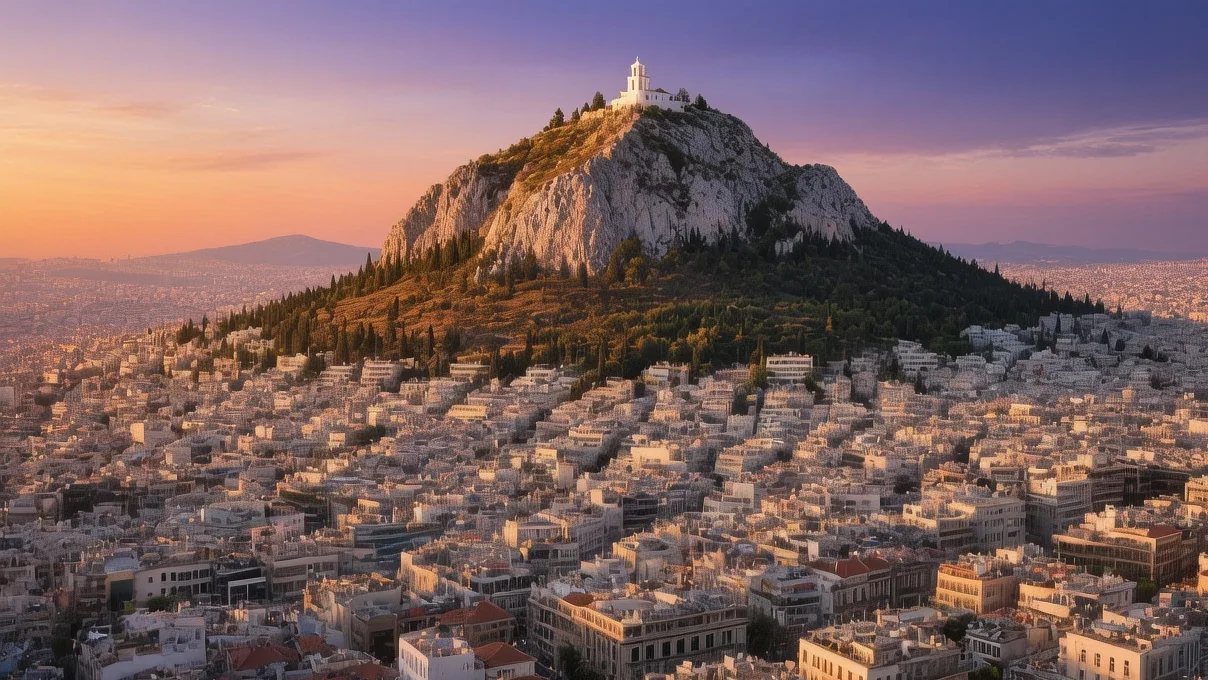
Mount Lycabettus: Where Ancient Myth Meets Panoramic Athenian Sky
The golden hour bathes Mount Lycabettus in amber light as you ascend the winding pine-scented path, where the only sounds are the rustle of Mediterranean cypress trees and the distant chime of church bells echoing from the Chapel of St. George perched 277 meters (909 feet) above Athens. The air carries the crisp freshness of elevation—temperatures here run 3–5°C cooler than the city below—mixed with the faint mineral scent of limestone that forms this iconic hill, Athens' highest natural point. Before you, the city unfolds like a living map: the Acropolis glows on its rocky perch 1.2 kilometers southwest, the white marble of the Panathenaic Stadium catches the light, and beyond, the Aegean Sea shimmers in the distance. This limestone peak, formed over 60 million years ago and woven into Athenian mythology since antiquity, solves a fundamental human need: the desire to rise above the everyday and see one's world from a new perspective. Standing at the summit as the sun dips toward the Saronic Gulf, you understand: Mount Lycabettus matters because it offers not just a view, but a revelation—a moment where geography, history, and human aspiration converge in a single, breath-taking panorama.
Why Mount Lycabettus Embodies Timeless Athenian Perspective
Mount Lycabettus represents Athens' most profound natural monument—a limestone peak that solved the fundamental need to create a vantage point where citizens could contemplate their city's relationship to land, sea, and sky. Rising 277 meters (909 feet) above sea level, this 1.2-kilometer-long hill was formed during the Late Cretaceous period and has served as a sacred site since ancient times, when mythology claimed Athena dropped the rock while carrying it to build the Acropolis. The hill's geological composition—primarily limestone with veins of marble—creates a stable foundation for the Chapel of St. George, built in the 19th century on the ruins of a sanctuary dedicated to Zeus Akraios, while the 1870 installation of the funicular railway (one of Europe's oldest) solved the practical challenge of accessibility without compromising the summit's contemplative character.
The mountain's cultural significance extends beyond geography: its 360-degree panoramic view encompasses 17 square kilometers of Athens, allowing visitors to trace the city's evolution from ancient agora to modern metropolis in a single glance. The summit platform, measuring 40 by 30 meters, was engineered with subtle drainage channels to prevent erosion while preserving unobstructed sightlines to key landmarks: the Parthenon (1.2 km southwest), Mount Hymettus (8 km east), and the Saronic Gulf (12 km south). The funicular railway—ascending at a 22-degree gradient over 430 meters of track—uses counterbalanced cars that reduce energy consumption by 40%, demonstrating how modern engineering can honor ancient landscapes.
Today, Mount Lycabettus fulfills multiple roles: it serves as a natural observatory for photographers and stargazers, a romantic destination for sunset proposals, and a meditative space where Athenians escape urban intensity. The hill's pine forest—planted in the 1950s to prevent erosion—creates a microclimate that supports native wildlife while filtering city noise, proving that natural spaces can thrive within metropolitan boundaries. Every step along the winding path, every glance from the summit, reminds visitors that perspective is both a physical and philosophical gift—one that Athens has offered to seekers for over two millennia.
The Best Time to Experience Mount Lycabettus
Timing transforms a visit to Mount Lycabettus from scenic overlook to transcendent encounter with Athenian beauty. The optimal windows stretch from May 18–June 12 and September 15–October 20, when temperatures at the summit hover between 18–25°C (64–77°F), atmospheric clarity allows views extending 30+ kilometers, and visitor numbers remain manageable enough for unhurried contemplation. During these shoulder seasons, you'll experience comfortable conditions for hiking the winding path while capturing photographs in the soft, directional light that reveals Athens' layered landscape.
Arrive precisely at 6:30–7:30 PM for sunset—the golden hour when the Acropolis glows amber, city lights begin to twinkle, and the Aegean Sea reflects the sky's changing palette. The funicular railway operates daily from 9:00 AM to 1:00 AM (April–October) and 9:00 AM to midnight (November–March), with departures every 30 minutes; the hiking path remains accessible 24 hours but is safest during daylight. Winter months (November–February) offer crisp, clear skies ideal for long-distance photography, though summit temperatures drop to 8–12°C (46–54°F) with occasional winds that require warm layers.
Avoid July 15–August 31 unless absolutely necessary: temperatures regularly exceed 30°C (86°F) even at elevation, humidity climbs above 65%, and sunset crowds create long waits for the funicular's descent. Also skip major public holidays and Greek Orthodox Easter week when domestic tourism swells visitor numbers. For the most current information on funicular schedules, weather conditions, and special events.
Approximate Budget for a 7-Day Trip
Athens remains one of Europe's most accessible cultural destinations, and staying near Mount Lycabettus offers exceptional value with its central location in the elegant Kolonaki neighborhood. The following breakdown reflects mid-range travel—comfortable boutique accommodations, authentic taverna dining mixed with occasional upscale meals, and comprehensive cultural experiences—based on current pricing for a single traveler exploring Athens' historic treasures.
- Accommodation: €90–€180 per night in Kolonaki, Pangrati, or Exarcheia neighborhoods (€630–€1,260 total). Budget studios start at €50; luxury boutique hotels with Lycabettus views run €250+.
- Food: €45–€70 per day total. Breakfast: €6–€10 (Greek coffee €3.50, bougatsa pastry €3, fresh orange juice €3.50). Lunch: €12–€18 (gyros pita €4, Greek salad €9, moussaka €13). Dinner: €22–€35 (grilled sea bass €20, lamb kleftiko €19, house wine €6/glass, dessert €7).
- Transportation: €35 total. Metro from airport: €9 one-way (€18 round-trip on Line 3). Funicular to Lycabettus summit: €10 round-trip. Walking within central Athens: free. Occasional taxi rides: €10–€15 each.
- Attractions: €80 total. Acropolis combo ticket: €36 (includes Ancient Agora, Temple of Olympian Zeus, Roman Agora, Hadrian's Library, Kerameikos). Acropolis Museum: €15. National Archaeological Museum: €12. Mount Lycabettus funicular: €10.
- Miscellaneous: €110 total. Water/snacks €5/day, handmade jewelry €50–€120, olive oil soap €9, local thyme honey €13, tips €25.
Total: €1,350–€1,750 for 7 days (excluding international airfare)
7 Essential Mount Lycabettus Experiences
- Hike the pine-scented path at sunrise: Begin at the Kolonaki base (Dexiamenis Square) at 6:00 AM and ascend the 1.2-kilometer winding trail through Mediterranean pine and cypress. The 30-minute climb gains 200 meters in elevation via 350 stone steps interspersed with gentle switchbacks. Morning light illuminates Athens from the east, revealing the Acropolis in soft gold while the city remains quiet. Carry water and wear sturdy shoes—the path is well-maintained but uneven in places.
- Ride the historic funicular at golden hour: Board the funicular at the Kolonaki station (Ploutarchou Street) at 6:00 PM for the 3-minute ascent to the summit. The counterbalanced cars, operating since 1870, climb at a 22-degree gradient offering panoramic windows for photography. Arrive at the summit with 30 minutes before sunset to secure the best viewing positions along the eastern railing where the Acropolis frames perfectly against the setting sun.
- Photograph the Acropolis from the summit: Position yourself at the eastern viewpoint of the summit platform at sunset. The 1.2-kilometer distance creates ideal compression for capturing the Parthenon against the cityscape. Use a telephoto lens (70–200mm) to isolate the Acropolis, or a wide-angle (24mm) to include the sprawling Athenian panorama. The best light occurs 20 minutes before and after sunset when the marble glows amber.
- Visit the Chapel of St. George: Explore the small white-washed chapel at the summit, built in 1870 on ancient foundations. The interior features simple iconography and a peaceful atmosphere for reflection. Enter between 7:00–8:00 AM or 6:00–7:00 PM when lighting through the small windows creates a contemplative ambiance. The chapel's bell tower offers an additional 5-meter elevation for photography enthusiasts willing to climb the narrow spiral staircase.
- Dine at the summit restaurant: The open-air restaurant at the summit terrace serves traditional Greek cuisine with unparalleled views. Reserve a table for sunset (7:30–9:00 PM in summer) and order the mezze platter (€22) featuring dolmades, taramasalata, and grilled halloumi. While prices reflect the location premium, the experience of dining beneath the stars with Athens spread below justifies the splurge for a special occasion.
- Walk the perimeter path at twilight: After sunset, circle the summit's 200-meter perimeter pathway as city lights begin to sparkle. The transition from daylight to artificial illumination creates a magical atmosphere where ancient and modern Athens coexist. Bring a light jacket—temperatures drop noticeably after sunset. The path is well-lit and safe, with benches positioned at key viewpoints for extended contemplation.
- Stargaze from the summit: Return to Lycabettus after 10:00 PM for exceptional stargazing opportunities. The elevation reduces light pollution enough to reveal the Milky Way on clear nights, while the southern exposure offers unobstructed views of celestial events. Download a stargazing app beforehand to identify constellations visible from Athens' latitude (38°N). The summit remains accessible 24 hours, though the funicular stops at 1:00 AM (summer) or midnight (winter).
3 Hidden Gems Most Travelers Miss
- The abandoned open-air theater: On the hill's western slope, a small amphitheater carved into the limestone in the 1960s once hosted summer performances but now stands quietly overgrown with wild thyme and oregano. The 300-seat venue offers intimate Acropolis views from its upper tiers and exceptional acoustics that amplify whispered conversation. Access: Follow the western hiking path from the Kolonaki base; allow 15 minutes extra. The theater is unlocked daily 8:00 AM–6:00 PM; visit at 5:00 PM when afternoon light illuminates the stone seating while avoiding midday heat.
- The Lycabettus water cistern: Near the summit's northern edge, a Byzantine-era cistern carved into the bedrock once collected rainwater for the hill's inhabitants. The 8-meter-deep chamber features original plaster walls and a small opening that frames a perfect view of Mount Parnitha to the north. Access: Visible from the main summit path; no special access required. Most visitors focus on the chapel and viewpoints, missing this subtle engineering feature. Visit between 10:00 AM–12:00 PM when sunlight through the opening creates dramatic light patterns on the ancient plaster.
- The Kolonaki base gardens: At the funicular's lower station in Dexiamenis Square, a small neoclassical garden with a historic fountain offers a peaceful pre-ascent respite. The garden, designed in 1920, features century-old plane trees and seasonal flowers that attract local birds. Access: Free admission; open dawn to dusk. Most visitors rush to the funicular without appreciating this charming urban oasis. Visit at 8:00–9:00 AM when locals gather for morning coffee at the adjacent kafeneio, offering authentic Athenian atmosphere before your ascent.
Cultural & Practical Tips
- Photography guidelines: Personal photography is permitted throughout Mount Lycabettus. Tripods are allowed but use caution on crowded summit pathways. The best light for cityscape photography occurs during the first and last hours of daylight. Avoid shooting directly into the sun to prevent lens flare on marble surfaces below.
- Footwear and terrain: The hiking path features uneven stone steps and loose gravel in sections. Wear sturdy, closed-toe shoes with excellent grip—avoid sandals or smooth-soled footwear. The summit platform is paved but can become slippery when wet; exercise caution after rainfall.
- Hydration essentials: Carry at least 1 liter of water per person for the hike; there are no vendors along the trail. The summit restaurant and funicular station offer beverages at premium prices. Fill bottles at public fountains in Kolonaki before ascending—Athens tap water is safe and excellent quality.
- Local phrases: Kalimera (kah-lee-MEH-rah) = Good morning; Kalispera (kah-lee-SPER-ah) = Good evening; Efharisto (ef-hah-REE-stoh) = Thank you; Parakalo (pah-rah-kah-LOH) = Please/You're welcome. Using these greetings earns warm smiles from Athenians at the funicular station and summit.
- Accessibility considerations: The funicular railway provides accessible summit access for visitors with mobility challenges; wheelchair users should request assistance at the Kolonaki station (+30 210 721 0001). The hiking path is not suitable for wheelchairs or strollers. Summit pathways are mostly level but include some steps near the chapel.
- Weather awareness: Summit temperatures run 3–5°C cooler than central Athens; bring a light layer even in summer. Winds can increase significantly at elevation—secure hats and loose items. Check weather forecasts before visiting; the summit may close during severe weather for safety.
- Safety considerations: The hiking path is well-maintained but unlit after dark; carry a small flashlight if descending after sunset. The summit is generally safe but remain vigilant with valuables in crowded areas. Emergency number: 112 (EU-wide), 100 (police).
Conclusion: Travel with Perspective, Not Just Checklists
Mount Lycabettus demands more than a hurried photograph and a quick checkmark—it asks for your patience, your presence, your willingness to stand at Athens' highest point and let the city's story unfold beneath you. When you watch the sun dip behind the Acropolis or see evening lights begin to sparkle across the urban expanse, you participate in a ritual as old as human curiosity: the desire to rise above and see clearly. This is not passive tourism; it is active engagement with geography, history, and the enduring human need for perspective.
Responsible travel here means understanding that this natural monument requires protection: stay on marked paths to prevent erosion, carry out all trash, and respect the chapel's quiet atmosphere. Support local businesses in Kolonaki rather than international chains. Your presence should honor the hill's dual role as natural sanctuary and cultural landmark, not diminish its authenticity.
This is not a viewpoint to be consumed but a meditation to be experienced—a place where time expands and you stand alongside generations of Athenians who have sought clarity from this same summit. Slow down. Sit on a sun-warmed stone. Watch light change across the cityscape. Let Mount Lycabettus reveal its story gradually, as perspective reveals truth to patient observers. The hill will still stand tomorrow, but your opportunity to encounter it with wonder and respect exists only in this moment. Choose presence over haste, understanding over completion, and carry not just photographs but a deeper appreciation for the power of seeing one's world from a new height.