
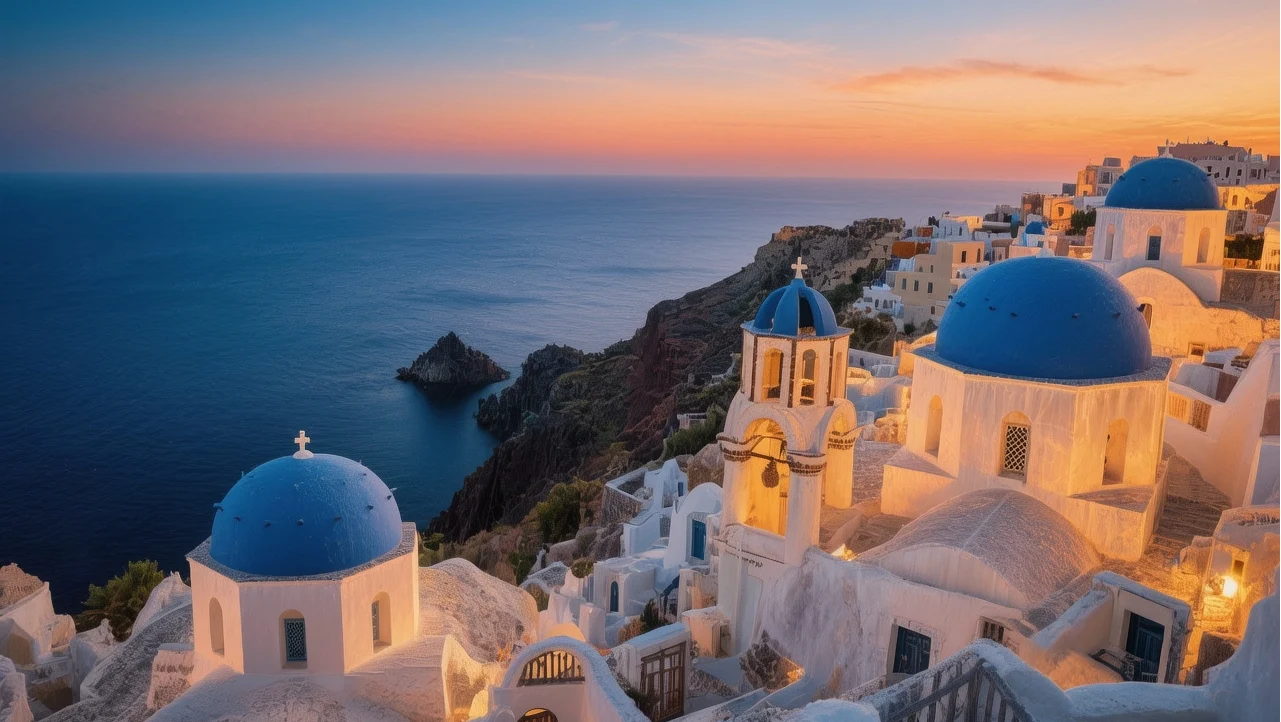
Oia Sunset: Where Aegean Twilight Meets Cycladic Stone
The final hour of daylight bathes Oia in liquid gold as you climb the winding marble path toward the castle ruins, where the air carries the crisp scent of sea salt mingled with wild thyme and the faint mineral tang of volcanic stone. Before you, the caldera unfolds in breathtaking scale: a submerged volcanic crater measuring 12 kilometers long by 7 kilometers wide, its sheer cliffs rising 300 to 400 meters from the deep azure waters of the Aegean. Whitewashed Cycladic houses cascade down the slope like sugar cubes scattered by a gentle hand, their blue-domed churches catching the fading light. The only sounds are the soft lap of waves against volcanic rock far below, the distant chime of chapel bells, and the whispered anticipation of travelers gathering for a ritual as old as human wonder. As the sun begins its descent, the sky transforms through a spectrum no artist could replicate: amber melts into rose, rose deepens to lavender, and for one suspended moment, the entire caldera glows as if lit from within. This is not merely a photograph opportunity; the Oia sunset matters because it offers a rare convergence of geological drama, architectural harmony, and atmospheric beauty—a place where earth, sea, and sky collaborate to create something that transcends description and touches the soul.
Why Oia Sunset Embodies Timeless Mediterranean Magic
The Oia sunset represents one of the world's most celebrated natural spectacles—a daily performance that solves the fundamental human need to witness beauty that requires nothing but presence. Perched on Santorini's northern tip at an elevation of 200 to 300 meters, Oia's west-facing position creates an unobstructed 180-degree panorama across the caldera basin, where the setting sun illuminates the volcanic cliffs in ever-changing hues. The village's iconic architecture—whitewashed buildings painted with lime-based plaster that reflects 80% of solar radiation—creates a luminous foreground that enhances rather than competes with the natural drama unfolding over the sea.
The sunset's visual impact stems from precise geographical alignment: Oia's cliffside location at latitude 36.46°N ensures that the sun sets directly over the caldera's western rim between May and September, creating optimal viewing conditions for approximately 120 days annually. The volcanic rock layers—alternating bands of reddish tuff, black obsidian, and pale pumice—catch the low-angle light in ways that reveal geological history written in stone. This intentional aesthetic, developed over centuries of Cycladic building tradition, solves the practical need for heat reflection while creating an architectural language that has become synonymous with Greek island beauty.
Today, the Oia sunset fulfills multiple roles: it serves as a cultural touchstone that draws travelers from around the world, a muse for photographers and artists, and a contemplative space where visitors confront the sublime power of nature. The ongoing preservation of Oia's traditional architecture—protected by Greek heritage laws since 1978—ensures that the village maintains the visual harmony that makes each sunset unique. Every glance across the caldera connects you to a landscape shaped by fire and water, where human habitation has learned to coexist with geological forces—a lesson in humility and harmony that resonates far beyond this Greek island.
The Best Time to Experience Oia Sunset
Timing transforms the Oia sunset from beautiful to transcendent. The optimal windows stretch from May 18–June 12 and September 15–October 20, when temperatures hover between 18–25°C (64–77°F), atmospheric clarity allows visibility extending 40+ kilometers across the Aegean, and visitor numbers remain manageable enough for unhurried contemplation at popular viewpoints. During these shoulder seasons, you'll experience comfortable conditions for walking the cliffside paths while capturing photographs in the soft, directional light that reveals the caldera's layered volcanic strata.
Arrive precisely at 6:30–7:00 PM to secure optimal positioning—the iconic sunset occurs between 7:30–8:30 PM depending on the season, but the most dramatic color transitions begin 30–45 minutes before the sun dips below the horizon. The Oia viewpoints operate 24 hours as public spaces, but the castle ruins and main terrace become crowded by 6:00 PM during peak season; arriving 60–90 minutes early secures the best vantage points. Winter months (November–February) offer minimal crowds and dramatic storm-washed skies, though sunset occurs earlier (5:00–5:30 PM) and temperatures drop to 10–14°C (50–57°F) with increased rainfall.
Avoid July 15–August 31 unless absolutely necessary: temperatures regularly exceed 28°C (82°F), humidity climbs above 70%, and cruise ship schedules create crushing crowds at sunset viewpoints, making leisurely photography nearly impossible. Also skip Greek Orthodox Easter week and major public holidays when domestic tourism swells visitor numbers. For the most current information on ferry schedules, weather conditions, and special events, always check the official Greek tourism portal at www.santorini-view.com before your visit.
Approximate Budget for a 7-Day Trip
Santorini offers exceptional value for travelers seeking iconic Mediterranean beauty, though costs vary significantly between caldera-view accommodations and inland options. The following breakdown reflects mid-range travel—comfortable boutique accommodations with partial caldera views, authentic taverna dining mixed with occasional upscale meals, and comprehensive island exploration—based on current pricing for a single traveler experiencing the Oia sunset.
- Accommodation: €120–€300 per night in Oia, Imerovigli, or Fira with caldera views (€840–€2,100 total). Budget studios inland start at €60; luxury cave suites with private plunge pools run €500+.
- Food: €50–€80 per day total. Breakfast: €8–€12 (Greek coffee €4, bougatsa pastry €3.50, fresh fruit €4.50). Lunch: €15–€25 (Greek salad €10, grilled octopus €18, moussaka €14). Dinner: €25–€45 (seafood platter €35, lamb kleftiko €22, Assyrtiko wine €8/glass, dessert €8).
- Transportation: €120 total. Ferry from Athens: €45–€75 one-way (€90–€150 round-trip). Local bus day pass: €9. ATV rental: €25/day. Occasional taxi rides: €15–€30 each.
- Attractions: €95 total. Caldera boat tour with hot springs: €35. Wine tasting tour: €45. Ancient Akrotiri entry: €12. Sunset catamaran cruise: €85 (optional splurge).
- Miscellaneous: €130 total. Water/snacks €6/day, handmade jewelry €60–€150, local saffron €15, volcanic stone souvenirs €20, tips €30.
Total: €1,700–€2,600 for 7 days (excluding international airfare and Athens-Santorini ferry)
7 Essential Oia Sunset Experiences
- Secure your spot at Oia Castle ruins: Arrive at the Byzantine castle ruins by 6:00 PM to claim a front-row position for the iconic sunset. The western exposure offers unobstructed views across the 12-kilometer caldera basin. As the sun dips below the horizon, the volcanic cliffs glow in shades of gold and rose before the famous "green flash" sometimes appears. Stay 15 minutes after sunset to photograph the blue hour when village lights begin to sparkle against the darkening sea.
- Photograph the Three Blue Domes at golden hour: Position yourself at the viewpoint above Oia's famous trio of blue-domed churches at 6:30–7:30 PM. The iconic composition—white architecture, cobalt domes, and caldera backdrop—requires careful timing to avoid crowds. Use a telephoto lens (70–200mm) to compress the scene, or a wide-angle (24mm) to include the cascading village. Visit on weekdays for fewer tourists.
- Walk the caldera path from Amoudi Bay: Begin at the small port of Amoudi Bay at 5:30 PM and ascend the 300 stone steps toward Oia as the light softens. This reverse approach offers unique perspectives of the village silhouetted against the brightening sky. The climb takes 15–20 minutes and rewards you with progressively expanding caldera views. Carry water and wear sturdy shoes—the steps are uneven and can be slippery.
- Experience sunset from a private terrace: Reserve a caldera-view table at a cliffside café in Oia for sunset cocktails. Order an Assyrtiko wine (€8–€12) or traditional mastiha liqueur (€7) while watching the colors unfold from a comfortable seat. While prices reflect the premium location, the experience of enjoying the sunset without jostling crowds justifies the splurge for a special evening.
- Capture the post-sunset blue hour: Remain at your viewpoint for 20–30 minutes after the sun disappears—the sky often produces its most ethereal colors during this transition. The village lights begin to glow, creating a magical contrast with the deepening blue sea. Use a tripod for long exposures that capture both the illuminated architecture and the fading sky.
- Watch from the windmill viewpoint: Position yourself near Oia's iconic windmills at the village's northern edge for a less crowded alternative to the castle ruins. The windmills—built in the 18th century to grind grain—create a charming foreground for sunset photography. Arrive by 6:15 PM to secure positioning; the view encompasses both the caldera and the village's cascading architecture.
- Sail the caldera for a water-level sunset: Book an evening catamaran cruise departing Amoudi Bay at 4:00 PM for a unique perspective of the Oia sunset from the sea. The 5-hour journey circles the caldera, offering views of the village illuminated against the darkening cliffs. Most tours include swimming stops at hot springs and a traditional Greek dinner onboard as the sun sets behind you.
3 Hidden Gems Most Travelers Miss
- The Sunset Viewpoint at Armeni: On Oia's eastern edge, a small, unmarked terrace near the Armeni neighborhood offers equally stunning caldera views without the castle ruins crowds. This quiet spot, favored by locals, provides an intimate setting for sunset contemplation with the added bonus of hearing chapel bells echo across the valley. Access: From Oia's main square, follow the path east toward Armeni for 5 minutes; look for the stone terrace with a single bench. Best visited at 6:00–7:30 PM; bring your own refreshments as there are no vendors nearby.
- The Abandoned Cave Houses of Oia: Behind the main tourist pathways, a network of restored and abandoned cave houses offers unexpected sunset viewpoints through arched windows and terraces. These traditional dwellings—carved into the volcanic rock centuries ago—frame the caldera in ways that create unique photographic compositions. Access: Wander the narrow alleys north of the main sunset route; many cave houses are now boutique accommodations with public terraces. Visit at 5:30–6:30 PM when the light filters through the archways most dramatically. Respect private property—look for signs indicating public access.
- The Orthodox Chapel of Panagia Platsani: Tucked into Oia's hillside, this small 17th-century chapel offers a serene sunset viewpoint with the added dimension of spiritual atmosphere. The chapel's bell tower provides an elevated perspective, and the interior's simple iconography creates a contemplative counterpoint to the external spectacle. Access: Located 200 meters south of the main sunset route; open for prayer 7:00–8:00 AM and 6:00–7:00 PM. Visit at 6:30 PM when the evening light illuminates the frescoes through the small windows. Dress modestly (shoulders and knees covered) and speak softly to honor the sacred space.
Cultural & Practical Tips
- Photography etiquette: Personal photography is permitted throughout public Oia viewpoints. Respect private property—many terraces and pathways belong to hotels or restaurants. The best light for caldera photography occurs during the last hour before sunset; avoid shooting directly into the sun to prevent lens flare on the sea. Use a polarizing filter to enhance sky colors and reduce water glare.
- Footwear and terrain: Oia's pathways feature uneven marble, loose gravel, and steep steps. Wear sturdy, closed-toe shoes with excellent grip—avoid sandals or smooth-soled footwear. Many viewpoints lack railings; maintain a safe distance from cliff edges, especially in windy conditions.
- Hydration essentials: Carry at least 1.5 liters of water per person for sunset viewing; there are limited vendors along cliff paths during peak hours. Fill bottles at public fountains in the village—Santorini tap water is safe for brushing teeth but bottled water is recommended for drinking due to mineral content.
- Local phrases: Kalimera (kah-lee-MEH-rah) = Good morning; Kalispera (kah-lee-SPER-ah) = Good evening; Efharisto (ef-hah-REE-stoh) = Thank you; Parakalo (pah-rah-kah-LOH) = Please/You're welcome; Yassou (YAH-soo) = Hello. Using these greetings earns warm smiles from Santorini's hospitality-focused residents.
- Crowd management strategy: Popular viewpoints become crowded 90 minutes before sunset. Arrive early to secure positioning, or choose alternative locations like Armeni terrace or the windmill viewpoint for equally stunning views with fewer people. Bring a light layer—winds increase significantly at cliff edges after sunset.
- Weather awareness: Oia's cliffside location is exposed to strong meltemi winds, especially July–August. Secure hats, loose clothing, and camera equipment. Check wind forecasts before planning sunset viewing; gusts can exceed 40 km/h. Winter visits may experience sudden rain—volcanic stone becomes extremely slippery when wet.
- Respectful tourism: Oia's beauty depends on preservation. Stay on marked paths to prevent erosion of fragile volcanic soil. Carry out all trash. Support local businesses rather than international chains. Your presence should honor the village's delicate balance between tourism and sustainability.
Conclusion: Travel with Presence, Not Just Checklists
The Oia sunset demands more than a hurried photograph and a quick checkmark—it asks for your patience, your presence, your willingness to stand at the edge of a volcanic world and let its beauty unfold gradually. When you watch the sky transform through colors no pigment can replicate, or feel the sea breeze carry the scent of wild thyme across the caldera, you participate in a moment as old as human wonder. This is not passive tourism; it is active communion with a landscape shaped by fire, water, and time.
Responsible travel here means understanding that Oia's beauty is fragile: every footprint on unmarked paths accelerates erosion, every discarded item mars the pristine vistas, every disrespectful action diminishes the experience for those who follow. Walk gently. Speak softly. Take only images; leave only gratitude. Support conservation efforts by choosing eco-conscious accommodations and respecting local guidelines that protect this volcanic treasure.
This is not a backdrop to be consumed but a meditation to be experienced—a place where geological drama and human artistry converge to create something transcendent. Slow down. Sit on a sun-warmed stone. Watch light change across the caldera. Let the Oia sunset reveal its story gradually, as volcanic layers reveal their history to patient observers. The view will still be here tomorrow, but your opportunity to encounter it with wonder and respect exists only in this moment. Choose presence over haste, connection over completion, and carry not just photographs but a deeper appreciation for the enduring power of natural beauty.