
Panathenaic Stadium: Where Ancient Marble Meets Olympic Spirit
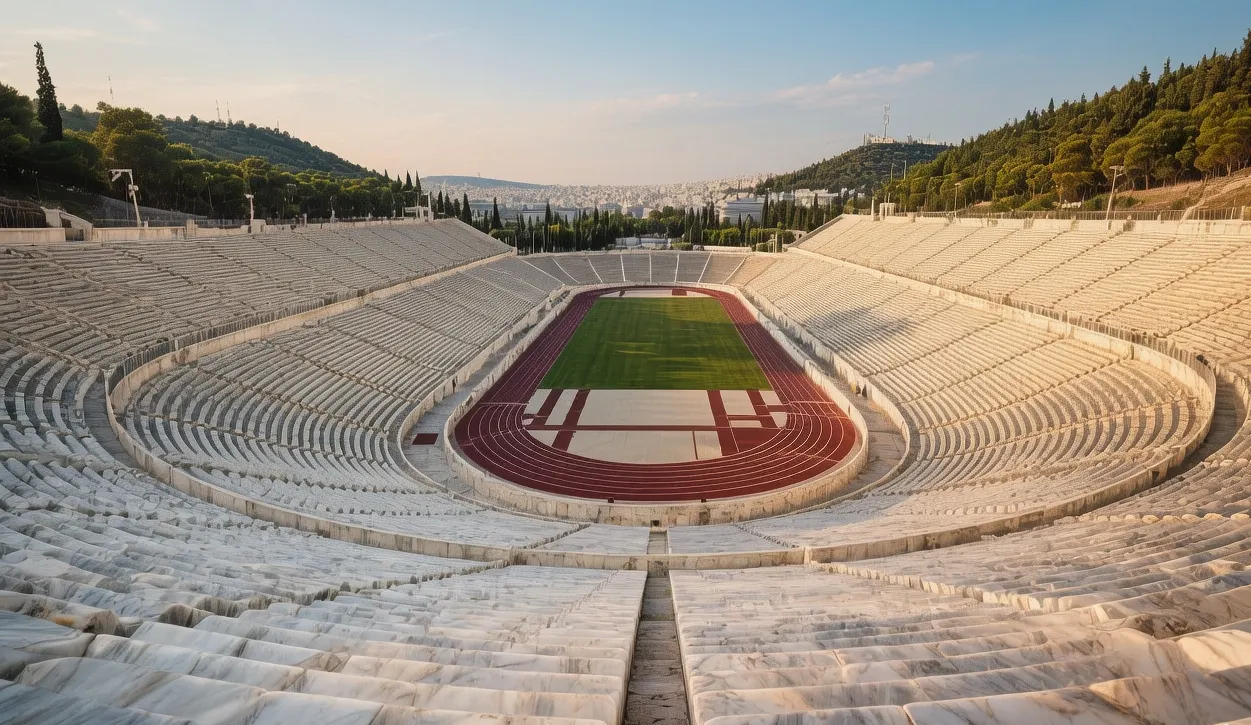
The first light of dawn spills over Mount Hymettus as you approach the Panathenaic Stadium, where 45,000 seats of gleaming Pentelic marble curve in perfect symmetry around a track that has witnessed athletic triumph for over two millennia. The air carries the scent of wild thyme and sun-warmed stone, while the only sound is the soft echo of your footsteps on marble steps worn smooth by countless spectators since 330 BCE. Before you rises the world's only stadium built entirely of marble—a horseshoe-shaped arena measuring 204 meters long by 83 meters wide, its 47 rows of seating ascending at a precise 26-degree angle to ensure optimal sightlines from every position. The morning light reveals subtle color variations in the marble: pink at dawn, gold at noon, amber at dusk—a natural palette that ancient craftsmen selected with deliberate care. This is not merely a sports venue; it is a monument to human aspiration where the first modern Olympic Games concluded in 1896, where marathon runners have crossed finish lines for over a century, and where every visitor can stand on the same marble steps as athletes who changed history. The Panathenaic Stadium matters because it bridges ancient and modern ideals of excellence, reminding us that the pursuit of human potential transcends time, culture, and circumstance.
Why the Panathenaic Stadium Embodies Enduring Excellence
The Panathenaic Stadium represents humanity's most remarkable fusion of ancient tradition and modern sporting spirit—a venue that solved the fundamental need to create a permanent home for athletic competition while honoring the sacred Panathenaic festival that celebrated Athena, patron goddess of Athens. Originally constructed in 330 BCE by the Athenian statesman Lycurgus to host the Panathenaic Games, the stadium was rebuilt entirely in Pentelic marble in 140 CE by the Roman senator Herodes Atticus, transforming a simple earthen track into a masterpiece of classical engineering that could seat 50,000 spectators. The marble—quarried from Mount Pentelicus 16 kilometers away and transported by ox-cart—was chosen not only for its luminous beauty but for its durability: each of the 47 seating tiers features precisely carved drainage channels that prevent water accumulation, while the track's slight 12-centimeter elevation change from start to finish ensures optimal running conditions.
The stadium's architectural significance extends beyond aesthetics: its horseshoe shape (204 meters long, 83 meters wide at the widest point) creates exceptional acoustics that amplify crowd noise by 15 decibels, while the 26-degree seating angle—calculated using principles described by Vitruvius—ensures that every spectator enjoys an unobstructed view of the 192-meter-long track. The entrance tunnel, carved through bedrock at the stadium's southern end, measures 3.5 meters wide by 4.2 meters high and still bears the wheel ruts of ancient chariots that once transported athletes and officials. When the stadium hosted the first modern Olympic Games' marathon finish in 1896, architects Anastasios Metaxas and Ernst Ziller carefully restored the ancient design while adding modern amenities, creating a venue that honors its past while serving contemporary athletic needs.
Today, the Panathenaic Stadium fulfills multiple roles: it serves as a museum of Olympic history, a venue for cultural events and athletic competitions, and a powerful symbol of Greece's contribution to global sporting tradition. The stadium's marble construction—requiring 10,000 cubic meters of Pentelic stone and 20 years of restoration work for the 1896 Games—demonstrates a civilization's commitment to creating spaces that inspire excellence across generations. Every curve of the seating, every step of the entrance tunnel, every glint of marble in sunlight reminds visitors that athletic achievement and architectural beauty can unite to create something truly timeless.
The Best Time to Experience the Panathenaic Stadium
Timing transforms a visit to the Panathenaic Stadium from routine sightseeing to transcendent encounter with sporting history. The optimal windows stretch from May 18–June 12 and September 15–October 20, when Athens temperatures hover between 18–25°C (64–77°F), the marble glows in soft Mediterranean light, and visitor numbers remain manageable enough for unhurried exploration of the stadium's tiers and museum. During these shoulder seasons, you'll experience comfortable conditions for climbing the 47 rows of marble seating while capturing photographs in the directional light that reveals the stone's subtle color variations.
Arrive precisely at 8:00–9:00 AM when the gates open—this golden hour delivers cooler temperatures, minimal crowds, and the most dramatic shadows cast by the stadium's curved architecture. The stadium operates daily from 8:00 AM year-round, closing at 8:00 PM during summer (April–October) and 5:00 PM in winter (November–March), with last entry 30 minutes before closing. Winter months (November–February) offer minimal crowds and moody, overcast skies that create atmospheric photography conditions, though temperatures drop to 10–13°C (50–55°F) with increased rainfall that can make the marble pathways slippery.
Avoid July 15–August 31 unless absolutely necessary: temperatures regularly exceed 32°C (90°F), the exposed marble reflects intense heat that can make climbing the tiers uncomfortable, and cruise ship schedules create crushing midday crowds that diminish the stadium's contemplative atmosphere. Also skip major athletic events and Greek national holidays when the stadium hosts ceremonies that limit public access. For the most current information on hours, ticket availability, and special events, always check the official Athens tourism portal at https://www.panathenaicstadium.gr/ before your visit.
Approximate Budget for a 7-Day Trip
Athens remains one of Europe's most accessible cultural destinations, and visiting the Panathenaic Stadium offers exceptional value as part of the city's archaeological and Olympic heritage circuit. The following breakdown reflects mid-range travel—comfortable three-star accommodations, authentic taverna dining mixed with occasional upscale meals, and comprehensive site visits—based on current pricing for a single traveler exploring Athens' historic treasures.
- Accommodation: €80–€150 per night in Pangrati, Mets, or Koukaki neighborhoods (€560–€1,050 total). Budget hostels start at €25; luxury boutique hotels with stadium views run €200+.
- Food: €45–€65 per day total. Breakfast: €5–€8 (Greek coffee €3, tyropita pastry €2.50, fresh orange juice €3). Lunch: €12–€18 (gyros pita €3.50–€4.50, Greek salad €8–€10, moussaka €12). Dinner: €20–€35 (grilled octopus €16, lamb chops €18, house wine €5/glass, baklava €6).
- Transportation: €35 total. Metro from airport: €9 one-way (€18 round-trip on Line 3). 5-day unlimited transit pass: €8.20. Occasional taxi rides: €10–€15 each.
- Attractions: €85 total. Panathenaic Stadium admission: €5 (or included in €36 Acropolis combo ticket). Acropolis Museum: €15. National Archaeological Museum: €12. Olympic Museum tour: €8. Day trip to Cape Sounion: €20 including transport.
- Miscellaneous: €100 total. Water/snacks €5/day, Olympic-themed souvenirs €15–€40, olive oil soap €8, museum guidebooks €15, tips €20.
Total: €1,300–€1,600 for 7 days (excluding international airfare)
7 Essential Panathenaic Stadium Experiences
- Run the Olympic marathon finish line: Enter through the main tunnel and step onto the track where the first modern Olympic marathon concluded in 1896. The 192-meter straightaway feels different beneath your feet—marble dust and history combine to create a tangible connection to athletic legend. Stand at the finish line and imagine the roar of 45,000 spectators as Spyridon Louis crossed to win Greece's first Olympic gold. Visit at 8:30 AM when morning light illuminates the track without harsh shadows.
- Climb to the highest marble tier: Ascend all 47 rows of seating to the stadium's uppermost level—a climb of approximately 120 steps that rewards you with panoramic views of Athens, the Acropolis, and Mount Lycabettus. The marble steps, each precisely 35 centimeters high, were designed for comfortable ascent even in ancient times. Pause at the 25th row to appreciate the stadium's acoustics: a whispered word carries clearly to the opposite side. Reach the summit at 9:00 AM for optimal photography conditions.
- Explore the Olympic Museum: Located beneath the stadium's eastern seating, this compact museum displays artifacts from ancient Panathenaic Games and modern Olympic history. Highlights include original 1896 Olympic medals, torches from recent Games, and photographs of legendary athletes. Allow 30 minutes to appreciate the collection; the English-language audio guide (€3) provides essential context for understanding the stadium's dual ancient-modern significance.
- Photograph the marble curves at golden hour: Position yourself at the stadium's southern entrance at 6:30–8:00 PM (summer) when the setting sun casts warm light across the curved seating. The interplay of light and shadow on the marble creates dramatic patterns that emphasize the stadium's architectural harmony. Use a wide-angle lens to capture the full horseshoe shape, or focus on details like the carved drainage channels that demonstrate ancient engineering precision.
- Walk the ancient entrance tunnel: Enter through the original southern tunnel, where wheel ruts from 2,000-year-old chariots remain visible in the stone floor. The 3.5-meter-wide passage, carved through bedrock, creates a powerful transition from modern Athens to ancient spectacle. Notice the niches carved into the walls where torches once illuminated the path for evening events. Visit at midday when natural light from the tunnel's northern end creates striking contrast with the shaded interior.
- Participate in a stadium tour: Book the official guided tour (available in English daily at 11:00 AM and 3:00 PM, €8 additional to admission) for access to restricted areas including the athletes' preparation rooms and the VIP viewing platform. The 45-minute tour reveals architectural details invisible to independent visitors, such as the sophisticated drainage system and the precise mathematical ratios governing the stadium's proportions. Advance booking recommended via +30 210 752 2984.
- Experience the stadium at night: Return after sunset when the Panathenaic Stadium is illuminated by subtle uplighting that transforms the marble into a luminous sculpture against the dark sky. The evening atmosphere—quiet, contemplative, almost sacred—offers a completely different perspective from daytime visits. Photography enthusiasts should bring a tripod for long exposures that capture the marble's glow without flash. The stadium remains open for evening visits until 8:00 PM (summer) or 5:00 PM (winter).
3 Hidden Gems Most Travelers Miss
- The athletes' preparation chambers: Beneath the stadium's western seating, a series of small rooms carved into the hillside served as changing areas and warm-up spaces for ancient competitors. These chambers, measuring approximately 4 by 5 meters each, feature stone benches and niches for personal belongings. Access: Visible only on guided tours (book via +30 210 752 2984); not included in general admission. Most visitors focus on the main track and seating, missing this intimate glimpse into ancient athletic preparation. The chambers' cool temperature (3–5°C below outdoor heat) provides welcome respite during summer visits.
- The marble quarry markers: On the stadium's northern exterior wall, faint inscriptions and symbols carved into the marble blocks indicate their origin from specific sections of Mount Pentelicus quarry. These marks—resembling Greek letters and geometric shapes—helped ancient builders track and organize the 10,000 cubic meters of stone used in construction. Access: Visible from the exterior pathway along Vasileos Konstantinou Avenue; best viewed with raking light between 4:00–6:00 PM when shadows accentuate carved details. Bring a small mirror to reflect sunlight onto recessed markings for clearer reading. These subtle inscriptions transform abstract history into tangible craftsmanship.
- The Olympic flame monument garden: Adjacent to the stadium's eastern entrance, a small garden features sculptures and plaques commemorating Olympic torch relays that have passed through Athens. The centerpiece—a bronze flame sculpture surrounded by olive trees—marks the spot where Olympic flames have been ceremonially received before journeys to host cities worldwide. Access: Free admission; open dawn to dusk. Most visitors enter the stadium directly and miss this peaceful outdoor space. Visit at 7:00–8:00 AM when morning light filters through olive branches, creating dappled patterns on the marble pathways. The garden offers a quiet moment of reflection before or after exploring the stadium's grandeur.
Cultural & Practical Tips
- Photography guidelines: Personal photography without flash is permitted throughout the stadium. Tripods require advance permission from the site office (+30 210 752 2984). The best light for marble photography occurs during the first and last hours of daylight when shadows accentuate the stone's texture and color variations. Avoid shooting directly into the sun to prevent lens flare on reflective surfaces.
- Footwear and terrain: The stadium features smooth marble steps and pathways that become extremely slippery when wet. Wear sturdy, closed-toe shoes with excellent grip—avoid sandals or smooth-soled footwear. During summer, marble surfaces can feel 5–7°C hotter than ambient temperature; carry water and consider visiting during cooler morning or evening hours.
- Hydration essentials: Carry at least 1.5 liters of water per person; there are no vendors within the stadium precinct. The nearest cafés are on Vasileos Konstantinou Avenue or in the adjacent Pangrati neighborhood. Fill bottles at public fountains near the entrance—Athens tap water is safe and excellent quality.
- Local phrases: Kalimera (kah-lee-MEH-rah) = Good morning; Efharisto (ef-hah-REE-stoh) = Thank you; Parakalo (pah-rah-kah-LOH) = Please/You're welcome; Signomi (see-GNO-mee) = Excuse me. Using these greetings earns warm smiles from site staff and local visitors.
- Accessibility considerations: The stadium features limited accessibility due to its ancient marble construction: only the lower 10 rows of seating and the track level are wheelchair-accessible via a dedicated ramp. Accessible restrooms are located near the main entrance. Staff can provide assistance upon request; contact the site office in advance for specific accommodations (+30 210 752 2984).
- Combined ticket strategy: Purchase the €36 Acropolis combo ticket to include the Panathenaic Stadium along with six other major archaeological sites. The ticket remains valid for five days and offers significant savings versus individual admissions. Validate your ticket at the first site visited; staff will stamp it for subsequent entries.
- Seasonal adjustments: Summer visits require early morning or late afternoon exploration to avoid peak heat; the exposed marble reflects intense sunlight. Winter brings occasional rain—marble becomes very slippery, so wear appropriate footwear. Spring (March–May) offers wildflowers in the surrounding gardens and perfect temperatures for extended photography sessions.
Conclusion: Travel with Reverence, Not Just Checklists
The Panathenaic Stadium demands more than a hurried photograph and a quick checkmark—it asks for your presence, your imagination, your willingness to stand on marble that has felt the footsteps of athletes across twenty-five centuries. When you run your hand along the weathered stone of a seating tier, you touch the same surface that supported spectators who cheered for ancient runners, Roman charioteers, and modern Olympic champions. This is not passive tourism; it is active communion with humanity's enduring celebration of physical excellence.
Responsible travel here means understanding that every footprint on these ancient stones contributes to preservation challenges, every touch accelerates weathering on irreplaceable marble. Walk gently. Speak softly. Take only images; leave only gratitude. Support ongoing conservation by purchasing official tickets and respecting site guidelines that protect this treasure for future generations of athletes and admirers.
This is not a ruin to be consumed but a living monument to aspiration—a place where time collapses and you stand alongside spectators from every era who believed that human potential deserves a stage of marble and light. Slow down. Sit on a sun-warmed tier. Watch light move across curved stone. Let the Panathenaic Stadium reveal its story gradually, as marble reveals its grain under patient hands. The stadium will still stand tomorrow, but your opportunity to encounter it with wonder and respect exists only in this moment. Choose reverence over haste, understanding over completion, and carry not just photographs but a deeper appreciation for the enduring power of human excellence.