
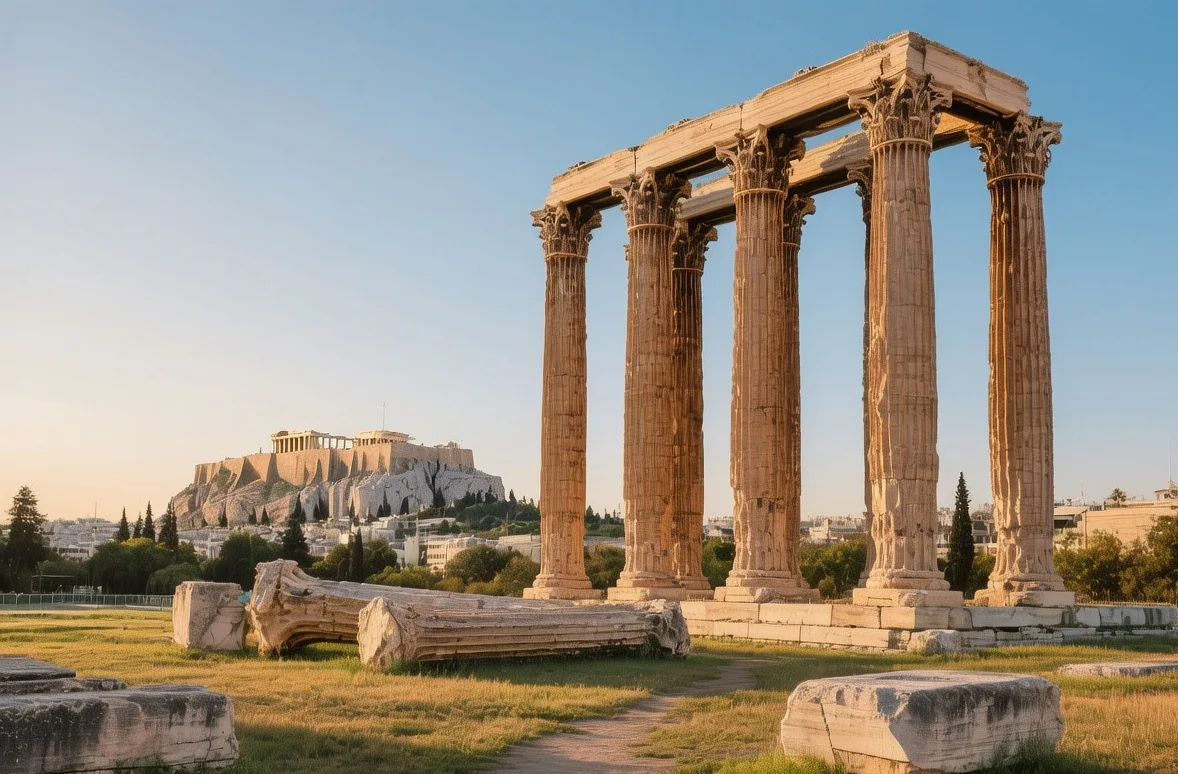
Temple of Olympian Zeus: Where Colossal Columns Meet Athenian Sky
The late afternoon sun bathes the remaining Corinthian columns of the Temple of Olympian Zeus in honeyed light as you walk across the 14,000-square-meter sacred precinct, where the scent of wild thyme mingles with the mineral warmth of Pentelic marble. Fifteen colossal pillars—each rising 17 meters (56 feet) high with a diameter of 2 meters (6.5 feet)—stand sentinel against the amber sky, their fluted surfaces catching the light in rhythmic patterns that echo the temple's original grandeur. The air carries the distant hum of Athens traffic softened by ancient stone, while beneath your feet, the foundations of 89 additional columns lie buried, waiting silently beneath layers of earth and time. This sanctuary, dedicated to Zeus, king of the Olympian gods, represents one of antiquity's most ambitious architectural undertakings: construction began in the 6th century BCE under the tyrant Peisistratus but remained unfinished for over six centuries until Emperor Hadrian finally consecrated the completed temple in 131 CE. Standing in the shadow of these weathered giants, you understand: the Temple of Olympian Zeus matters not because it stands complete, but because its very incompleteness tells a profound story about human ambition, perseverance, and the passage of time itself.
Why the Temple of Olympian Zeus Embodies Monumental Ambition
The Temple of Olympian Zeus represents ancient Greece's most audacious architectural statement—a sanctuary that solved the fundamental need to create a temple worthy of the king of gods while demonstrating Athens' cultural supremacy across centuries of political change. Originally conceived in the 6th century BCE by the Peisistratid tyrants, the temple's construction spanned an extraordinary 650 years, interrupted by regime changes, wars, and shifting priorities, finally reaching completion under Roman Emperor Hadrian in 131 CE. The finished structure measured 96 meters long by 40 meters wide—larger than the Parthenon—and featured 104 colossal Corinthian columns arranged in a double row of 20 on the long sides and triple rows of eight on the facades, creating a forest of stone that inspired awe in every visitor.
Built from locally quarried Pentelic marble and limestone, each column required precisely carved drums weighing up to 15 tons, fitted without mortar using iron clamps sealed with lead. The temple's Corinthian capitals—among the earliest and most elaborate examples of the order—feature acanthus leaves carved with botanical precision, each measuring 1.2 meters tall and requiring master craftsmen months to complete. Inside the cella, Hadrian placed a chryselephantine statue of Zeus seated on a throne, modeled after Phidias's masterpiece at Olympia but crafted in gold and ivory over a wooden core, standing approximately 12 meters tall. The sculptural program included bronze statues of Hadrian and other benefactors positioned before the temple, while the precinct housed sacred olive trees and altars for ritual sacrifice.
The temple fulfilled multiple needs simultaneously: it honored Zeus as protector of Athens, demonstrated imperial patronage under Roman rule, and created a pilgrimage destination that rivaled Olympia itself. Its Corinthian order—more ornate than the Doric Parthenon—signaled a shift toward Hellenistic and Roman aesthetic preferences, influencing temple design across the empire. Today, the 15 standing columns (one felled by storm in 1852) and scattered foundations allow visitors to grasp the temple's original scale while contemplating the centuries of effort required to bring such a vision to life. This is architecture as testament: every column whispers stories of tyrants, emperors, craftsmen, and pilgrims who believed that stone could touch the divine.
The Best Time to Experience the Temple of Olympian Zeus
Timing transforms a visit to the Temple of Olympian Zeus from routine sightseeing to contemplative encounter with antiquity. The optimal windows stretch from May 18–June 12 and September 15–October 20, when Athens temperatures hover between 18–25°C (64–77°F), the site's olive trees bloom with fragrant white flowers, and visitor numbers remain manageable enough for unhurried exploration. During these shoulder seasons, you'll experience comfortable conditions for walking the open precinct while capturing photographs in the soft, directional light that reveals the marble's subtle color variations.
Arrive precisely at 8:00–9:00 AM when the gates open—this golden hour delivers cooler temperatures, minimal crowds, and the most dramatic shadows cast by the towering columns. The site operates daily from 8:00 AM year-round, closing at 8:00 PM during summer (April–October) and 5:00 PM in winter (November–March), with last entry 30 minutes before closing. Winter months (November–February) offer minimal crowds and moody, overcast skies that create atmospheric photography conditions, though temperatures drop to 10–13°C (50–55°F) with increased rainfall that can make the marble pathways slippery.
Avoid July 15–August 31 unless absolutely necessary: temperatures regularly exceed 32°C (90°F), the exposed marble precinct offers little shade, and cruise ship schedules create crushing midday crowds that diminish the site's contemplative atmosphere. Also skip Greek Orthodox Easter week and major public holidays when domestic tourism swells visitor numbers. For the most current information on hours, ticket availability, and special events, always check the official Greek Ministry of Culture website at www.thisisathens.org before your visit.
Approximate Budget for a 7-Day Trip
Athens remains one of Europe's most accessible cultural destinations, and visiting the Temple of Olympian Zeus offers exceptional value as part of the city's archaeological circuit. The following breakdown reflects mid-range travel—comfortable three-star accommodations, authentic taverna dining mixed with occasional upscale meals, and comprehensive site visits—based on current pricing for a single traveler exploring Athens' ancient treasures.
- Accommodation: €80–€150 per night in Plaka, Koukaki, or Makrygianni neighborhoods (€560–€1,050 total). Budget hostels start at €25; luxury boutique hotels with Acropolis views run €200+.
- Food: €45–€65 per day total. Breakfast: €5–€8 (Greek coffee €3, tyropita pastry €2.50, fresh orange juice €3). Lunch: €12–€18 (gyros pita €3.50–€4.50, Greek salad €8–€10, moussaka €12). Dinner: €20–€35 (grilled octopus €16, lamb chops €18, house wine €5/glass, baklava €6).
- Transportation: €35 total. Metro from airport: €9 one-way (€18 round-trip on Line 3). 5-day unlimited transit pass: €8.20. Occasional taxi rides: €10–€15 each.
- Attractions: €85 total. Acropolis combo ticket: €36 (includes Temple of Olympian Zeus, Ancient Agora, Roman Agora, Hadrian's Library, Kerameikos, and Lyceum). Acropolis Museum: €15. National Archaeological Museum: €12. Day trip to Cape Sounion: €20 including transport.
- Miscellaneous: €100 total. Water/snacks €5/day, olive oil soap €8, handmade leather sandals €40–€80, museum guidebooks €15, tips €20.
Total: €1,300–€1,600 for 7 days (excluding international airfare)
7 Essential Temple of Olympian Zeus Experiences
- Walk the perimeter at sunrise: Arrive at 8:00 AM when gates open and circle the temple's foundations clockwise. The morning light illuminates the fluted columns from the east, revealing the precise craftsmanship of the Corinthian capitals. Position yourself at the southeast corner to photograph the columns against the Acropolis hill in the distance—a composition that connects two of Athens' greatest sanctuaries across 500 meters of urban landscape.
- Study the Corinthian capitals up close: Approach the standing columns on the southeast side and examine the acanthus-leaf carvings at eye level. Each capital features two rows of stylized leaves with volutes at the corners, designed to support the massive entablature above. Notice how weathering has softened some details while preserving others—a tangible lesson in marble's endurance. Bring a small flashlight to highlight recessed carvings in shadowed areas.
- Trace the temple's original footprint: Walk the grassy precinct following the visible foundation stones that outline the 96-by-40-meter structure. Count the positions where 89 columns once stood; imagine the forest of stone that greeted ancient pilgrims. The scale becomes comprehensible only when you traverse the full length—approximately 30 seconds of walking at a normal pace reveals the temple's monumental proportions.
- Photograph through the columns at golden hour: Position yourself between two standing columns at 6:30–8:00 PM (summer) when the setting sun casts long shadows across the precinct. Frame the Acropolis or Mount Lycabettus through the column gap, creating a layered composition that connects ancient sanctuaries. Use a narrow aperture (f/8–f/11) to keep both foreground columns and distant landmarks sharp.
- Visit the sacred olive grove: On the temple's western side, a small grove of olive trees—descendants of those planted in antiquity—provides shade and context for the sanctuary's ritual landscape. The olive, sacred to Athena and associated with peace and prosperity, reminds visitors that Greek religion intertwined nature and architecture. Sit on a stone bench beneath the trees at midday for respite from summer heat.
- Explore the Hadrianic Arch viewpoint: Exit the temple precinct and walk 100 meters north to the Arch of Hadrian, built in 131 CE to mark the boundary between ancient Athens and the Roman city extension. From the arch's eastern side, photograph the Temple of Olympian Zeus framed by the marble gateway—a powerful visual statement of imperial patronage. The inscription on the arch's western face reads: "This is Athens, the ancient city of Theseus"; the eastern face declares: "This is the city of Hadrian, not of Theseus."
- Combine with the National Garden: Adjacent to the temple's eastern boundary, the 15.5-hectare National Garden offers a peaceful extension to your visit. Enter through the gate near the temple (open 7:00 AM–sunset, free admission) and follow pathways lined with plane trees planted in 1840. The garden's microclimate feels 3–5°C cooler than the exposed temple precinct—ideal for afternoon contemplation after exploring the columns.
3 Hidden Gems Most Travelers Miss
- The Byzantine church of Agios Nikolaos Ragkavas: Tucked into the temple precinct's northeastern corner, this small 11th-century church incorporates marble spolia from the Temple of Olympian Zeus in its walls and foundation. The church features original Byzantine frescoes and a bell tower constructed from ancient column drums. Access: Visible from the main temple path; open for prayer 7:00–8:00 AM daily. Most visitors focus on the colossal columns and miss this intimate example of how sacred spaces evolve across centuries. Allow 10 minutes to appreciate the fusion of pagan and Christian heritage.
- The foundation inscription stones: Near the temple's southwest corner, several marble blocks bear partially legible Greek inscriptions documenting construction phases and dedications. One stone records Hadrian's consecration ceremony in 131 CE; another lists contributions from benefactors across the Roman Empire. Access: Located along the western perimeter path; best viewed with raking light between 4:00–6:00 PM when shadows accentuate carved letters. Bring a small mirror to reflect sunlight onto recessed inscriptions for clearer reading. These stones transform abstract history into tangible text.
- The temple's drainage system: Beneath the precinct's surface, ancient engineers carved a sophisticated network of channels and cisterns to manage rainwater and protect the marble foundations from erosion. During heavy rain, water flows visibly through stone conduits toward the Ilissos River bed. Access: Observe the drainage outlets along the southern perimeter wall after rainfall; no special access required. This often-overlooked engineering feature demonstrates how Greek architects solved practical challenges while pursuing aesthetic perfection—a reminder that beauty and function were inseparable in classical design.
Cultural & Practical Tips
- Photography guidelines: Personal photography without flash is permitted throughout the site. Tripods require advance permission from the site office (+30 210 922 6330). The best light for column photography occurs during the first and last hours of daylight when shadows accentuate fluting and capital details. Avoid shooting directly into the sun to prevent lens flare on marble surfaces.
- Footwear and terrain: The precinct features uneven marble pathways and grassy areas that become slippery when wet. Wear sturdy, closed-toe shoes with good grip. During summer, marble surfaces can feel 5–7°C hotter than ambient temperature—avoid touching columns during midday heat to prevent discomfort.
- Hydration essentials: Carry at least 1.5 liters of water per person; there are no vendors within the temple precinct. The nearest cafés are on Amalias Avenue or in the adjacent National Garden. Fill bottles at public fountains near the entrance—Athens tap water is safe and excellent quality.
- Local phrases: Kalimera (kah-lee-MEH-rah) = Good morning; Efharisto (ef-hah-REE-stoh) = Thank you; Parakalo (pah-rah-kah-LOH) = Please/You're welcome; Signomi (see-GNO-mee) = Excuse me. Using these greetings earns warm smiles from site staff and local visitors.
- Combined ticket strategy: Purchase the €36 Acropolis combo ticket to include the Temple of Olympian Zeus along with six other major archaeological sites. The ticket remains valid for five days and offers significant savings versus individual admissions. Validate your ticket at the first site visited; staff will stamp it for subsequent entries.
- Accessibility considerations: The temple precinct features mostly level pathways suitable for wheelchairs and strollers, though some grassy areas may present challenges. Accessible restrooms are located near the entrance. Staff can provide assistance upon request; contact the site office in advance for specific accommodations (+30 210 922 6330).
- Seasonal adjustments: Summer visits require early morning or late afternoon exploration to avoid peak heat; the exposed precinct offers minimal shade. Winter brings occasional rain—marble becomes very slippery, so wear appropriate footwear. Spring (March–May) offers wildflowers in the precinct and perfect temperatures for extended photography sessions.
Conclusion: Travel with Contemplation, Not Just Checklists
The Temple of Olympian Zeus demands more than a hurried photograph and a quick checkmark—it asks for your patience, your imagination, your willingness to stand among these weathered giants and contemplate the centuries of human effort they represent. When you trace the fluting on a Corinthian column with your eyes, you follow the same lines that ancient craftsmen carved with chisel and mallet, believing they were building for eternity. They were right: though the temple stands incomplete, its ambition endures.
Responsible travel here means understanding that every footprint on these ancient stones contributes to preservation challenges, every touch accelerates weathering on irreplaceable marble. Walk gently. Speak softly. Take only images; leave only gratitude. Support ongoing conservation by purchasing official tickets and respecting site guidelines that protect these treasures for future generations.
This is not a ruin to be consumed but a meditation to be experienced—a place where time collapses and you stand alongside pilgrims from six centuries of construction, from Peisistratus to Hadrian to today. Slow down. Sit on a sun-warmed foundation stone. Watch light move across column flutes. Let the Temple of Olympian Zeus reveal its story gradually, as stone reveals its grain under patient hands. The columns will still stand tomorrow, but your opportunity to encounter them with wonder and respect exists only in this moment. Choose contemplation over haste, understanding over completion, and carry not just photographs but a deeper appreciation for the enduring power of human aspiration.