
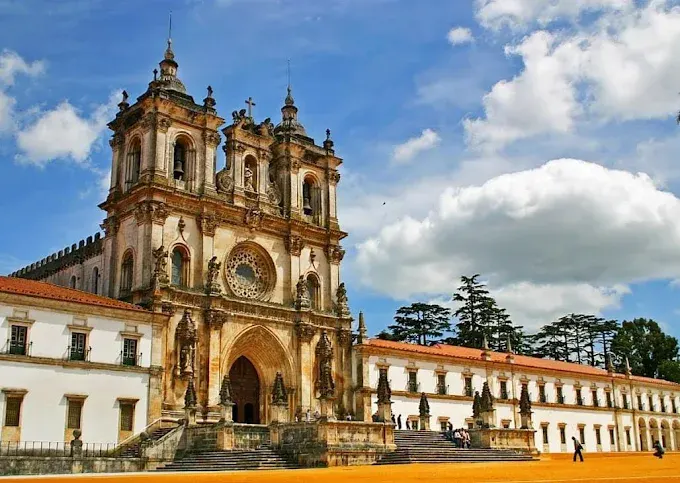
Alcobaça Monastery: Where Cistercian Asceticism Meets Portuguese Royal Drama
Late afternoon light slants through the massive western façade of the Alcobaça Monastery, casting long, cool shadows across the vast, flagstone floor of the nave. You stand at the exact center of the church, engulfed by a silence so profound it rings softly in your ears. The air smells faintly of cold limestone, ancient beeswax, and the damp earth carried on the breeze from the nearby Alcoa and Baça rivers—the two waterways that give this sacred site its name. Stretching an astonishing 106 meters (348 feet) in length, the sheer unadorned walls soar upward, drawing your eye relentlessly toward the complex, intersecting ribbed vaulting overhead. No gilded altars distract the gaze; no painted ceilings compete for attention. Founded by the first Portuguese king following a pivotal military victory, this sprawling complex was designed to strip away worldly excess. The Alcobaça Monastery matters because it stands as the ultimate architectural manifestation of spiritual purity in the Iberian Peninsula, while simultaneously serving as the immortal, stone-carved stage for Portugal’s most tragic and enduring love story.
Why Alcobaça Monastery Embodies Cistercian Asceticism
The Alcobaça Monastery embodies Cistercian asceticism because it was engineered to solve a profound spiritual crisis: the perceived corruption and visual excess of the Cluniac order. When King Afonso Henriques established the monastery in the late twelfth century, he imported monks from Clairvaux in France, demanding they build a headquarters that strictly adhered to the ascetic mandates of Saint Bernard. This ideological requirement presented a massive architectural challenge—how to construct a building of monumental scale using absolutely no decorative ornamentation. The master masons solved this by relying entirely on the pure, mathematical proportionality of early Gothic structural engineering. They utilized locally quarried limestone, laying it in perfectly flush ashlar blocks that emphasize the sheer mass of the walls rather than any surface decoration. To support the staggering height of the central nave—which measures 23 meters (75 feet) to the vault springing—builders implemented a revolutionary system of pointed arches and flying buttresses hidden within the upper walls, effectively distributing the immense downward thrust of the heavy stone roof. This structural honesty extended to the daily lives of the monks, most visibly in the monastic kitchen. Built in the eighteenth century beneath a staggering 18-meter (59-foot) conical chimney, the kitchen features an ingenious hydraulic engineering system: a diverted branch of the Alcoa River flows directly through the center of the room via a carved stone channel. This rushing water turned a massive horizontal water wheel used to roast meat on an automated spit, perfectly blending the Cistercian ethos of self-sufficiency with silent, mechanical efficiency.
The Best Time to Experience Alcobaça Monastery
To experience the Alcobaça Monastery in its most contemplative state, plan your visit between April 10 and May 25. During this specific window, the surrounding agricultural fields erupt in vivid green, and the interior stone retains a pleasant, stabilizing chill. Temperatures remain a comfortable 16°C–22°C (61°F–72°F), allowing you to explore the unheated cloisters without shivering. Arrive precisely between 9:00 and 10:30 AM. At this early hour, the morning sun penetrates the upper clerestory windows, casting sharp, geometric patterns across the bare nave floor, and the acoustic silence remains entirely undisturbed by large tour groups. You should firmly avoid July 20 through August 25. During these weeks, summer heat pushes temperatures to a sweltering 33°C (91°F), the massive stone walls trap and radiate this heat for hours, and the narrow corridors become suffocatingly congested with visitors. For current restoration updates, precise Mass schedules, and advanced ticket purchases, consult the official monument website at www.mosteiroalcobaca.gov.pt. Checking this resource ensures you avoid unexpected closures of the royal tombs and secure the profoundly silent encounter with medieval architecture that this sacred space fundamentally demands.
Approximate Budget for a 7-Day Trip
Estimating costs for a deep cultural immersion into the Alcobaça Monastery requires factoring in the highly favorable pricing of this small, agricultural town in the Estremadura region. This budget reflects a mid-range traveler prioritizing historical engagement and regional gastronomy over modern luxury.
- Accommodation: €55–€80 per night (a restored nineteenth-century guesthouse in the historic center, featuring traditional blue-and-white azulejo facades and a courtyard breakfast)
- Food: €35 per day (Breakfast €4 for a strong bica espresso and a local pastel de nata; Lunch €11 for a hearty prato do dia featuring grilled bacalhau with boiled potatoes; Dinner €20 for a tender portion of leitão da Bairrada [roast suckling pig] paired with sparkling Espumante)
- Transportation: €20 total (€12 for a round-trip Rede Expressos bus ticket from Lisbon to Alcobaça; €8 for local taxis to and from the monastery gates)
- Attractions: €6 total (€6 for the standard combined ticket granting access to the church, cloisters, and the royal tombs)
- Miscellaneous: €25 total (a bottle of locally produced fruit liqueur, a hand-painted ceramic plate depicting the monastery façade, and an illustrated historical guidebook from the museum shop)
Total: €446–€621
6 Essential Alcobaça Monastery Experiences
- Stand in the Immense Nave: Walk to the exact center of the church, directly beneath the crossing tower. Look up to trace the clean, uninterrupted lines of the Gothic vaulting converging in perfect mathematical symmetry. Close your eyes and speak softly; the total absence of resonant echo in this acoustically deadened space is a deliberate architectural trick designed to enforce absolute silence.
- Behold the Tombs of Pedro and Inês: Descend into the transepts to find the matching, exquisitely carved marble sarcophagi of King Pedro I and his murdered lover, Inês de Castro. Notice their macabre placement—they lie feet-to-feet so that, on the Day of Judgment, they will rise to immediately look at one another. Trace the intricate, heartbreaking reliefs depicting their tragic love story and her violent assassination.
- Explore the Monastic Kitchen: Step into the vast, domed kitchen and walk directly over the covered stone channel where river water still rushes audibly beneath your boots. Look up into the massive, soot-stained conical chimney. Visualize the medieval monks silently processing hundreds of fish pulled directly from the flowing indoor stream.
- Walk the Cloister of Silence: Enter the Gothic cloister of King Dinis. Run your fingers along the pale, weathered limestone capitals; notice the transition from the austere, vegetal carvings of the early period to the slightly more relaxed, naturalistic forms that signaled the slow relaxation of Cistercian rules.
- Admire the Hall of Kings: Locate the expansive, rectangular chamber adjacent to the church. Look up at the magnificent eighteenth-century blue-and-white tiled panels depicting the foundational myth of the monastery, alongside a spectacular collection of baroque statues representing the kings and queens of Portugal who supported the abbey.
- Visit the Dormitory Corridor: Climb the austere stone staircase to the upper floor of the east wing. Walk the length of the vast, barrel-vaulted dormitory where the monks once slept in communal silence. The sheer length of the room—spanning the entire eastern range of the monastery—emphasizes the monastic obsession with uniformity and communal discipline.
3 Hidden Gems Most Travelers Miss
- The Refectory Washing Basin: Located in a small, shadowed alcove just before the entrance to the main refectory. It is routinely overlooked because tourists rush toward the larger kitchen. To find it, pause at the heavy stone doorframe and look left. This deeply carved, circular limestone basin was used by monks for ritual hand-washing before meals; the centuries of friction have worn the stone edges into a smooth, almost liquid curve.
- The Paradise Garden (Jardim do Paraíso): A walled, rectangular green space situated between the church façade and the main entrance gate. Visitors miss it because it serves as a transitional walkway rather than an interior room. Stop in the center of this geometric lawn; historically, this garden represented the transition from the profane outside world into the sacred purity of the monastery, acting as a visual and spiritual decompression chamber.
- The Sacred Art Museum in the Dormitory: Situated at the far northern end of the upper dormitory corridor. It is ignored because many visitors are fatigued by the time they reach the upper floors. Enter the low-lit room to find an exquisite collection of medieval illuminated manuscripts, intricate silver reliquaries, and stunning Flemish triptychs that represent the shocking accumulation of wealth the Cistercians originally vowed to reject.
Cultural & Practical Tips
- Maintain absolute silence inside the church and cloisters; the Alcobaça Monastery remains an active place of worship, and the Cistercian tradition of silence is aggressively enforced by staff. Loud conversations will result in stern reprimands.
- Learn basic Portuguese courtesies: say "Bom dia" (good morning, pronounced "bom dee-ah") when purchasing your ticket, and use "Obrigado" (thank you, pronounced "oh-bree-gah-doo") when interacting with local vendors outside the gates.
- Photography is strictly forbidden inside the Royal Tombs area; the flash from cameras causes irreversible degradation to the delicate, polychrome marble details of Pedro and Inês. Security guards will intervene if you raise your phone.
- Wear shoes with thick rubber soles and bring a light sweater; the original stone floors are extremely cold and hard, dropping the perceived temperature by several degrees even during warmer months.
- Check the weather forecast before departing; the Estremadura region experiences sudden, heavy downpours in spring, and the open-air courtyards lack sufficient covered shelter to wait out a storm.
- Purchase the combined ticket that includes the upper floors; many budget travelers opt for the cheaper church-only entry, missing the spectacular kitchen, the dormitory, and the invaluable museum artifacts entirely.
Conclusion: Travel with Reverence, Not Just Sightseeing
The Alcobaça Monastery demands far more from its visitors than a passive, camera-ready stroll through ancient hallways; it requires a profound, active submission to stillness. When you choose to lower your voice and match the deliberate, measured pace of the silent stone corridors, you honor the radical, centuries-old discipline that built this monument. Mindful travel here means resisting the urge to rush from the famous royal tombs to the parking lot. It means pausing in the vast, empty nave to appreciate the sheer, intimidating audacity of building a 106-meter (348-foot) church with absolutely no ornamentation—a structural act of faith in pure mathematics and light. By respecting the strict rules of silence, you actively protect the fragile, contemplative atmosphere that makes this space so radically different from the chaotic modern world. Let the cold limestone walls and the rushing sound of the kitchen river remind you that true architectural greatness does not need to shout. In a culture addicted to constant visual stimulation, the greatest privilege the Alcobaça Monastery offers is the rare, uncompromising space to simply stop, breathe, and exist in absolute silence.