
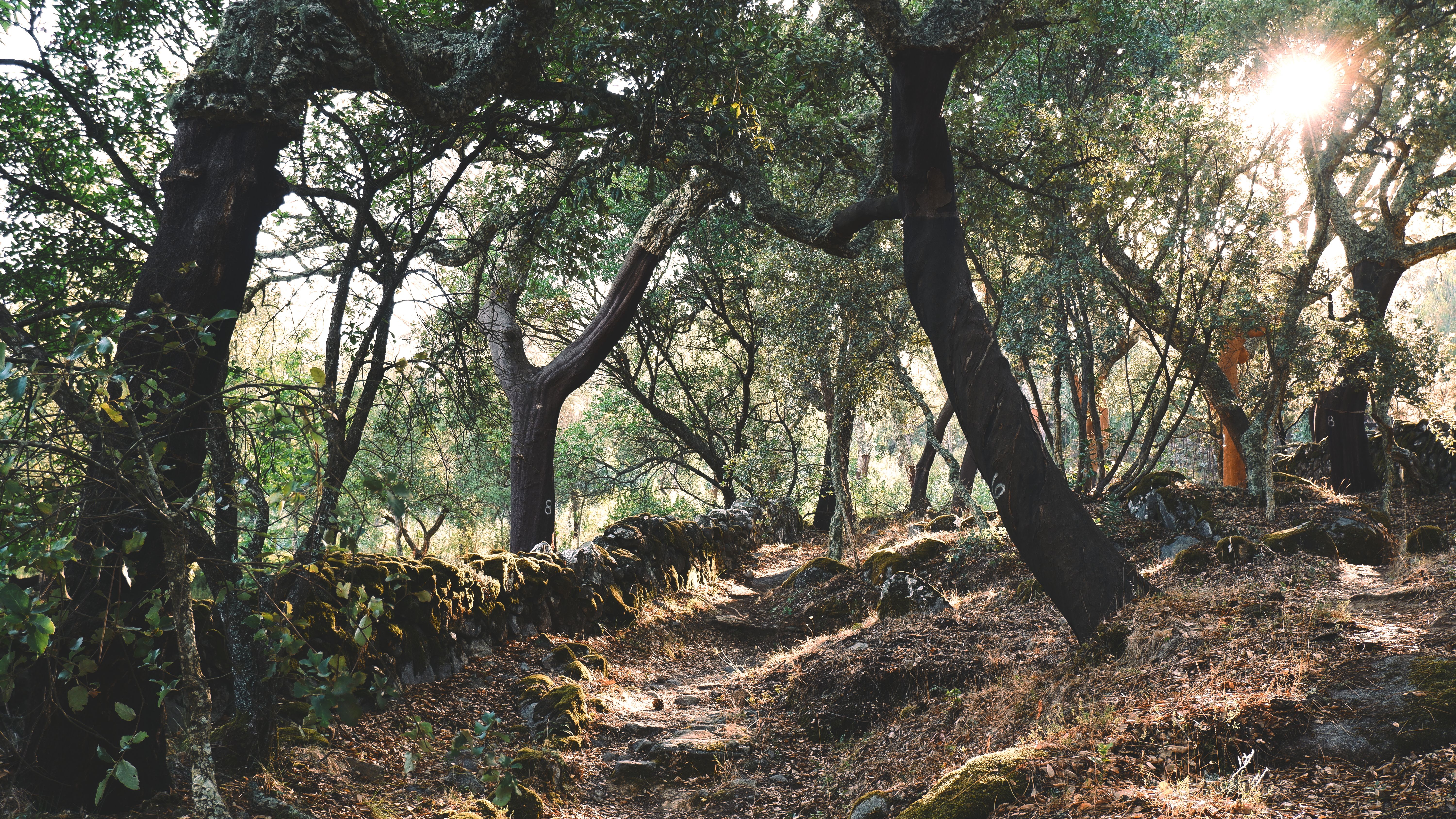
Alentejo Cork Forests: Where Ancient Bark Meets Mediterranean Biodiversity
Dawn breaks over the Alentejo plains, painting the undulating hills in shades of ochre and burnt sienna. You stand on a dusty dirt track, enveloped by the profound silence of the montado—a vast, savanna-like landscape punctuated by the gnarled silhouettes of centuries-old cork oaks. The air smells intensely of dry earth, wild lavender, and the faintly sweet, spongy scent of recently stripped bark. A sudden, sharp crack echoes through the canopy as a descortiçador (cork stripper) expertly wedges his axe, peeling a massive, 30-kilogram (66-pound) slab of raw cork away from the trunk in a single, fluid motion. Covering roughly 730,000 hectares (1.8 million acres), these woodlands form the world’s largest concentration of Quercus suber, supplying more than half of the world’s commercial cork. The Alentejo cork forests matter because they represent a miraculous, symbiotic alliance between human industry and ecological preservation—a rare agricultural system where the very act of harvesting drives the survival of an endangered Mediterranean ecosystem.
Why Alentejo Cork Forests Embody Sustainable Synergy
The Alentejo cork forests embody sustainable synergy because they ingeniously solved the complex problem of economic survival in a marginalized, arid climate without destroying the environment. While cork harvesting has existed since antiquity, it was during the eighteenth and nineteenth centuries—accelerated by Dom Pérignon’s revolutionary use of cork to seal champagne bottles—that the Alentejo recognized the immense economic potential of its native trees. The core challenge was how to monetize a slow-growing forest without clear-cutting it. The solution lies in the biological miracle of the cork oak itself. The tree yields a thick, insulating outer bark composed of millions of microscopic, honeycomb-like cells filled with a waxy substance called suberin, making the bark waterproof, fire-retardant, and incredibly lightweight. This specialized bark can be stripped entirely without killing the tree—a process that actually stimulates subsequent regrowth. A cork oak must be at least 25 years old before its first harvest, producing rough "virgin" cork. Subsequent harvests occur precisely every nine years, with the tree growing increasingly high-quality, smooth bark. By meticulously measuring the trunk circumference and using specialized axes to slice only the outer layer—leaving the delicate inner living cambium completely untouched—harvesters extract an entirely renewable, carbon-negative building material. This technical precision sustains roughly 100,000 jobs in Portugal, proving that a centuries-old manual labor process can still be the most effective ecological engineering solution for land conservation.
The Best Time to Experience Alentejo Cork Forests
To witness the Alentejo cork forests at their most vibrant and active, plan your visit between May 18 and June 12. During this narrow window, the spring wildflowers are still blooming beneath the canopy, the landscape is a brilliant, verdant green, and temperatures remain a comfortable 20°C–26°C (68°F–79°F)—perfect for hiking under the dappled shade. Most importantly, this is peak harvest season. Arrive precisely between 8:00 and 9:30 AM. At this hour, the golden morning light pierces the twisted branches, and the harvesters are already deep at work, their axes ringing rhythmically through the cool, damp air before the midday heat forces them to rest. You should strictly avoid July 15 through August 30. During these weeks, the Alentejo experiences punishing heatwaves with temperatures routinely exceeding 40°C (104°F), making outdoor exploration physically dangerous, while the risk of devastating forest fires closes many rural access roads. For seasonal harvest schedules, eco-tourism trail maps,.
Approximate Budget for a 7-Day Trip
Estimating costs for an eco-immersion into the Alentejo cork forests requires factoring in the region’s status as one of Western Europe’s most affordable rural destinations. This budget reflects a sustainable traveler prioritizing rural guesthouses, farm-to-table dining, and nature-based activities over luxury resorts.
- Accommodation: €60–€90 per night (a restored monte, or traditional Alentejo farmhouse, surrounded by private cork oak groves near the town of Redondo)
- Food: €35 per day (Breakfast €4 for local sheep cheese and freshly baked bread; Lunch €10 for a hearty ensopado de borrego [lamb stew] at a village tavern; Dinner €21 for grilled black pork with chestnuts at an agritourism estate)
- Transportation: €40 total (€30 for a round-trip Rede Expressos bus ticket from Lisbon to Évora; €10 for a local rental mountain bike to explore the forest trails near Portel)
- Attractions: €15 total (€0 for hiking the public forest trails; €15 for a guided, hands-on cork harvesting demonstration with a local descortiçador)
- Miscellaneous: €25 total (a bottle of cold-pressed local olive oil, handcrafted cork coasters from a village cooperative, and premium Alentejo wine)
Total: €560–€785
6 Essential Alentejo Cork Forests Experiences
- Watch the Cork Harvesters at Work: Stand at a respectful distance from a working descortiçador. Listen to the sharp, rhythmic thud of the axe blade striking the precise score marks. Watch as the harvester braces his boots against the trunk and peels back a 1.5-meter (5-foot) sheet of bark like opening a giant book. The physical strength and intuitive precision required to avoid wounding the inner tree is mesmerizing to witness.
- Touch the Stripped Trunk: Immediately after a harvest, approach the tree and place your palm flat against the exposed inner bark. It feels astonishingly smooth, warm, and almost mahogany-like in color. Smell the trunk; it releases a subtle, honeyed resin that contrasts sharply with the dry, earthy scent of the discarded outer bark lying on the forest floor.
- Hike the Perímetro Florestal near Redondo: Walk the 8-kilometer (5-mile) circular trail starting at the village outskirts. The path winds through a dense canopy where dappled sunlight creates shifting geometric patterns on the white schist rocks. Stop at the high ridgeline to take in a 360-degree view of the rolling Alentejo plains, completely uninterrupted by power lines or modern infrastructure.
- Visit a Cork Processing Factory: Tour a small-batch factory in the town of Coruche. Feel the immense, spongy texture of the raw cork planks stacked floor to ceiling. Listen to the deafening roar of the industrial boilers that steam the raw bark to expand and flatten it, and watch the laser-guided precision machines punch out thousands of natural wine stoppers in a matter of minutes.
- Spot the Imperial Eagle: Bring binoculars and scan the highest, dead branches of the cork oaks at dusk. The Alentejo cork forests provide critical nesting habitat for the endangered Iberian imperial eagle. You might also spot black storks or vibrant bee-eaters darting through the underbrush, drawn to the unparalleled biodiversity the montado supports.
- Taste Acorn-Fed Pork: Sit down for a meal at a rural estate and order the local porco preto (black Iberian pig). These pigs roam freely through the cork forests, gorging exclusively on fallen cork acorns. The resulting meat possesses a uniquely rich, nutty, melt-in-the-mouth texture that literally tastes like the forest itself.
3 Hidden Gems Most Travelers Miss
- Herdade dos Coelheiros Eco-trail: Located 20 kilometers (12 miles) northwest of Évora, this private estate offers a hidden gem of a walking trail that tourists miss because it requires calling ahead for access. To visit, contact the estate manager to schedule a morning appointment (+351 266 748 510). The trail features a pristine, century-old cork oak grove intersected by ancient Roman irrigation channels, offering absolute solitude away from the more popular public routes.
- Cork Oak Museum in Salvaterra do Extremo: Situated in a tiny border village, this hidden gem is overlooked because it sits far from the main tourist hubs of Évora or Monsaraz. To access it, drive 45 minutes east from Redondo. The museum is housed in a restored traditional home and features highly tactile exhibits showing the exact tools, axes, and hand-woven baskets used by harvesters before modern mechanization. It is open only on weekdays from 10:00 AM to 1:00 PM.
- The Megalithic Complex of Almendres: Located just 15 kilometers (9 miles) west of Évora, this site is often missed by nature tourists focused solely on the living trees. Walk through the dense, fragrant scrubland to find a circular clearing containing 95 massive granite stones arranged in a solar calendar. The stones are surrounded by a pristine cork oak canopy, creating a stunning visual contrast between ancient human monuments and natural forest architecture.
Cultural & Practical Tips
- Never approach a cork oak during the off-season and attempt to peel the bark; unauthorized stripping is illegal in Portugal. The bark can only be legally and safely removed by licensed professionals during the strict summer window when the sap is rising.
- Learn basic Portuguese courtesies to show respect to the rural workers: say "Bom dia" (good morning, pronounced "bom dee-ah") when passing harvesters on the trails, and use "Obrigado" (thank you, pronounced "oh-bree-gah-doo") when purchasing goods from village cooperatives.
- Wear long pants and sturdy hiking boots; the forest floor is densely covered in sharp, ankle-high scrub brush, wild thistles, and abrasive schist rocks that easily scratch exposed skin or pierce thin sneakers.
- Use a polarizing filter for photography; the high contrast between the bright white bark of the freshly stripped trees and the dark, shadowed canopy can easily fool your camera’s light meter, resulting in washed-out images.
- Pack at least two liters of water per person; despite the canopy cover, the Alentejo sun is relentless, and the rural trails lack any commercial facilities, water fountains, or shaded rest stops.
- Be acutely aware of wildfire warnings; if you smell smoke or see a red flag posted at the trailheads, evacuate the forest immediately via the designated emergency escape routes. The cork bark is highly flammable, and fires spread devastatingly fast in the montado.
Conclusion: Travel with Ecological Reverence, Not Just Consumerism
The Alentejo cork forests demand a profound shift in how you interact with the natural world; they require you to look beyond the finished product—the wine stopper or the designer handbag—and acknowledge the living, breathing ecosystem that produces it. When you choose to walk these dusty trails, listening to the axe strikes and observing the delicate balance between human labor and botanical regeneration, you honor a sustainable agricultural model that the modern world desperately needs to emulate. Mindful travel here means resisting the urge to simply take a photograph of a twisted tree for social media. It means pausing to feel the warm, exposed trunk, understanding that this tree will continue to absorb carbon dioxide and shelter endangered birds for centuries to come, provided we continue to harvest it with such meticulous care. By spending your euros in the local villages, respecting the off-limits boundaries, and supporting the montado economy, you actively participate in the preservation of this Mediterranean biome. Let the silence of the plains remind you that true sustainability requires immense patience. In a forest built on nine-year cycles, the greatest privilege you can claim is the grace to simply slow down and watch it grow.