
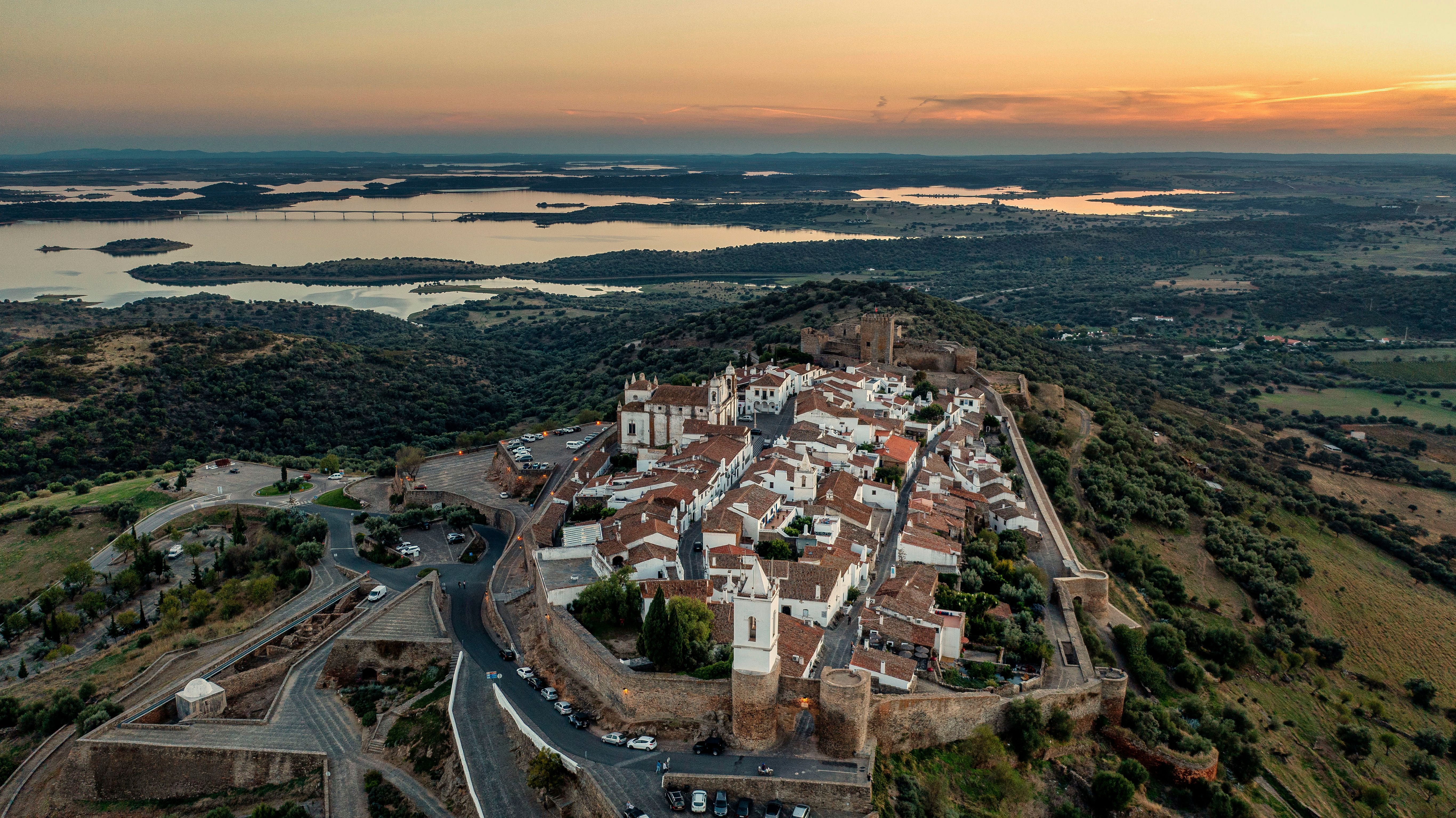
Monsaraz Walled Village: Where Medieval Stonework Meets Alentejo Golden Plains
Late afternoon light spills across the Alentejo, igniting the schist and granite facades of the Monsaraz walled village. You stand atop the 100-meter (328-foot) limestone plateau, listening to the crunch of your boots on the uneven cobblestones and the distant, hollow clanging of goat bells echoing from the valley below. The air smells intensely of wild rosemary, baking bread, and the dry, dusty heat radiating from the ancient stone. Flanking the main street, stark white houses with narrow iron-grilled windows stand sentinel, their terracotta roofs forming a jagged crown against the vast, empty sky. Stretching for nearly 750 meters (2,460 feet) around the perimeter, the formidable defensive walls drop away into a sheer cliff face on one side, overlooking the expansive, mirror-like surface of the Alqueva lake. Monsaraz matters because it is a rare, living time capsule—a fortified hilltop settlement that has physically and culturally resisted the march of modernity, remaining frozen in a state of austere, breathtaking medieval perfection.
Why Monsaraz Walled Village Embodies Architectural Continuity
The Monsaraz walled village embodies architectural continuity because it ingeniously solved the dual problem of frontier defense and harsh climatic survival through integrated stonework. Granted to the Knights Templar in the twelfth century and later consolidated under King Dinis, the village had to function as an impenetrable military buffer against invading Castilian forces while simultaneously sheltering a civilian population. Master masons solved this by constructing a massive defensive perimeter using locally quarried greywacke and schist, with walls measuring a staggering 2 meters (6.5 feet) thick at the base. This dense, monolithic construction absorbs the brutal kinetic energy of medieval siege weapons. To solve the secondary problem of the relentless Alentejo sun, the builders developed an ingenious urban microclimate: the houses were packed tightly together along steep, winding alleys, and their facades were uniformly coated in thick lime whitewash. This brilliant white surface acts as a passive solar reflector, bouncing harsh ultraviolet light deep into the narrow streets and preventing the dark schist from absorbing and radiating heat into the living spaces. The steep incline of the main thoroughfare was not an accident of geography but a deliberate engineering solution, designed as a colossal drainage channel to funnel torrential winter rains away from the building foundations. Every cobblestone and shaded doorway represents a highly specific, functional response to the extremes of the Iberian frontier.
The Best Time to Experience Monsaraz Walled Village
To experience the Monsaraz walled village in its most evocative state, plan your visit between April 15 and May 30. During this precise window, the surrounding Alentejo plains are carpeted in vivid green wildflowers, and daytime temperatures remain a comfortable 17°C–23°C (63°F–73°F)—ideal for climbing the steep, shadeless cobblestone lanes without physical exhaustion. Arrive precisely between 7:30 and 9:00 AM. At this early hour, the angled morning light creates sharp, dramatic shadows against the whitewashed walls, and the village is completely silent, save for the morning chores of local residents sweeping their doorsteps. You should firmly avoid July 20 through August 25. During these weeks, daytime temperatures routinely exceed 40°C (104°F), the reflective white walls offer no relief from the blinding glare, and the narrow pedestrian corridors become suffocatingly congested with day-trippers. For real-time updates on village parking restrictions, museum hours, and local artisan schedules, consult the official municipal tourism website at www.cm-reguengos-monsaraz.pt. Checking this resource ensures you secure access to the highly limited parking area inside the gates and experience the site with the profound tranquility it fundamentally demands.
Approximate Budget for a 7-Day Trip
Estimating costs for a cultural immersion into the Monsaraz walled village requires factoring in the highly favorable, agrarian economics of the Alentejo region. This budget reflects a mid-range traveler prioritizing historic atmosphere and hyper-local gastronomy over modern luxury.
- Accommodation: €70–€100 per night (a restored schist-stone guesthouse located directly inside the village walls, featuring exposed wooden beams and panoramic views of the Guadiana valley)
- Food: €35 per day (Breakfast €3 for a strong bica espresso and a local pastel de nata; Lunch €12 for a hearty migas—fried bread crumbs with garlic and pork—at a rustic taverna; Dinner €20 for slow-roasted porco preto [black pork] paired with a robust local red wine)
- Transportation: €30 total (€22 for a round-trip Rede Expressos bus ticket from Lisbon to Reguengos de Monsaraz; €8 for a pre-booked local taxi from the bus station to the hilltop village gates)
- Attractions: €8 total (€0 for walking the castle walls and village streets; €4 for the Museu do Fresco housing the seventeenth-century religious paintings; €4 for the Clock Tower observation deck)
- Miscellaneous: €20 total (a bottle of cold-pressed Alentejo olive oil, a hand-woven cork trivet from a local cooperative, and premium local wool blankets)
Total: €603–€858
6 Essential Monsaraz Walled Village Experiences
- Walk the Complete Perimeter at Dawn: Begin at the Porta da Vila and trace the entire 750-meter (2,460-foot) circuit of the battlements. Feel the coarse, weathered granite under your palms as you pass through the medieval guard towers. Looking out over the sheer eastern cliff face, you will see the Alqueva lake stretching toward Spain—a visual reminder of the village’s historic role as a military watchtower.
- Enter the Igreja de Santa Maria da Lagoa: Push open the heavy wooden door of this thirteenth-century church. The air inside is instantly cooler, smelling faintly of aged incense and damp stone. Examine the rare, perfectly preserved seventeenth-century frescoes depicting the miracles of the Virgin Mary; the vibrant blue and red pigments stand out starkly against the austere, whitewashed nave.
- Stand in the Castle Keep: Climb the worn stone steps of the Torre de Menagem. The wind howls fiercely at this elevated vantage point. Look down through the narrow arrow slits to see the village's spiderweb of narrow streets far below—a tactical architectural layout designed to trap and confuse invading forces.
- Photograph the Blue-and-White Street Patterns: Walk down the Rua Direita at 8:00 AM. The morning light perfectly illuminates the traditional blue-painted baseboards and decorative ceramic tiles adorning the whitewashed facades. The geometric contrast of the deep cobalt blue against the blinding white limestone offers some of the most photogenic street scenes in Portugal.
- Dine on the Ramparts at Sunset: Secure a table on the outdoor terrace of a castle-wall restaurant just before 7:00 PM. Order a glass of crisp Alentejo wine. As the sun dips below the horizon, the vast plain explodes into shades of burnt orange and deep violet, while the village streetlights flicker on, casting a warm, golden glow over the ancient cobblestones.
- Feel the Texture of the Cobblestones: Pause in the Largo do Pelourinho and look down. The street is paved with irregularly shaped, smoothly worn calçada stones laid in intricate, nautical patterns. Run your shoe across the uneven surface to feel the physical history embedded in the ground beneath your feet.
3 Hidden Gems Most Travelers Miss
- The Subterranean Cistern (Cisterna da Vila): Located near the main gate, this massive underground water reservoir is routinely missed because its entrance is an unassuming wooden door easily mistaken for a private cellar. To access it, ask at the nearby tourism kiosk for the key. Inside, you will find a cavernous, cruciform chamber supported by robust stone pillars, where a foot of perfectly still, crystal-clear water reflects the arched ceiling like a dark mirror.
- The Inquisition Jail Cells: Situated beneath the old Town Hall building in the main square, this hidden gem is overlooked because tourists rarely think to look below street level. Walk down the steep stone steps into the dimly lit vaults. The thick schist walls still feature heavy iron rings bolted into the stone, serving as a sobering, chilling reminder of the village’s darker, less romanticized history during the Portuguese Inquisition.
- The Ermita de São Bento: A tiny, isolated stone chapel located 300 meters (984 feet) outside the village walls. It is missed because visitors rarely leave the immediate perimeter of the castle. Follow the dirt path leading south from the main gate through the olive groves. The chapel features a singular, stunning Manueline doorway carved with intricate rope motifs, framed entirely by the silent, uncultivated Alentejo scrubland.
Cultural & Practical Tips
- Maintain absolute quiet after 9:00 PM; the Monsaraz walled village is a living residential community where sound travels aggressively between the tightly packed stone houses, and loud voices are considered deeply intrusive.
- Wear shoes with thick rubber soles and excellent ankle support; the schist cobblestones are severely eroded, highly irregular, and become incredibly slippery when exposed to morning dew or rare rainfall.
- Learn basic Portuguese courtesies to show respect: say "Bom dia" (good morning, pronounced "bom dee-ah") to the elderly residents sitting on their doorsteps, and use "Com licença" (excuse me, pronounced "com lee-sen-sa") when navigating the narrow, one-person-wide alleyways.
- Use a wide-angle lens for architectural photography; the streets are so narrow that a standard 50mm lens cannot capture the full height of the facades without severe distortion or stepping into private property.
- Bring a high-quality windbreaker; the hilltop elevation offers absolutely no windbreaks, and the gusts sweeping off the plains can drop the perceived temperature by 5 degrees Celsius in minutes, even during summer evenings.
- Be acutely aware of your parking spot; the village has a strict quota of roughly 20 vehicles allowed inside the main gate. Arrive before 10:00 AM or you will be forced to park 500 meters (1,640 feet) down the hill and walk up a steep, exposed access road.
Conclusion: Travel with Historical Reverence, Not Just Spectatorship
The Monsaraz walled village demands far more from its visitors than a passive, camera-ready stroll through a scenic fortress; it requires a conscious, physical engagement with a way of life that predates modern convenience. When you choose to walk the perimeter at dawn, feeling the coarse schist beneath your boots and acknowledging the harsh climatic realities the whitewashed walls were designed to deflect, you honor the immense resilience of the people who built this sanctuary. Mindful travel here means resisting the urge to treat the village as a sterile, open-air museum. It means respecting the absolute silence of the residential alleys, understanding that the elderly woman sweeping her step is not a performer, but a guardian of an ancient legacy. By spending your euros in the local tavernas, adhering to the parking restrictions, and moving through the fortified lanes with deep respect, you actively participate in the preservation of this extraordinary frontier community. Let the sheer drop of the castle walls remind you of the vulnerability of human existence. In a village defined by its boundaries, the greatest privilege you can claim is the patience to simply stand still and listen to the wind.