
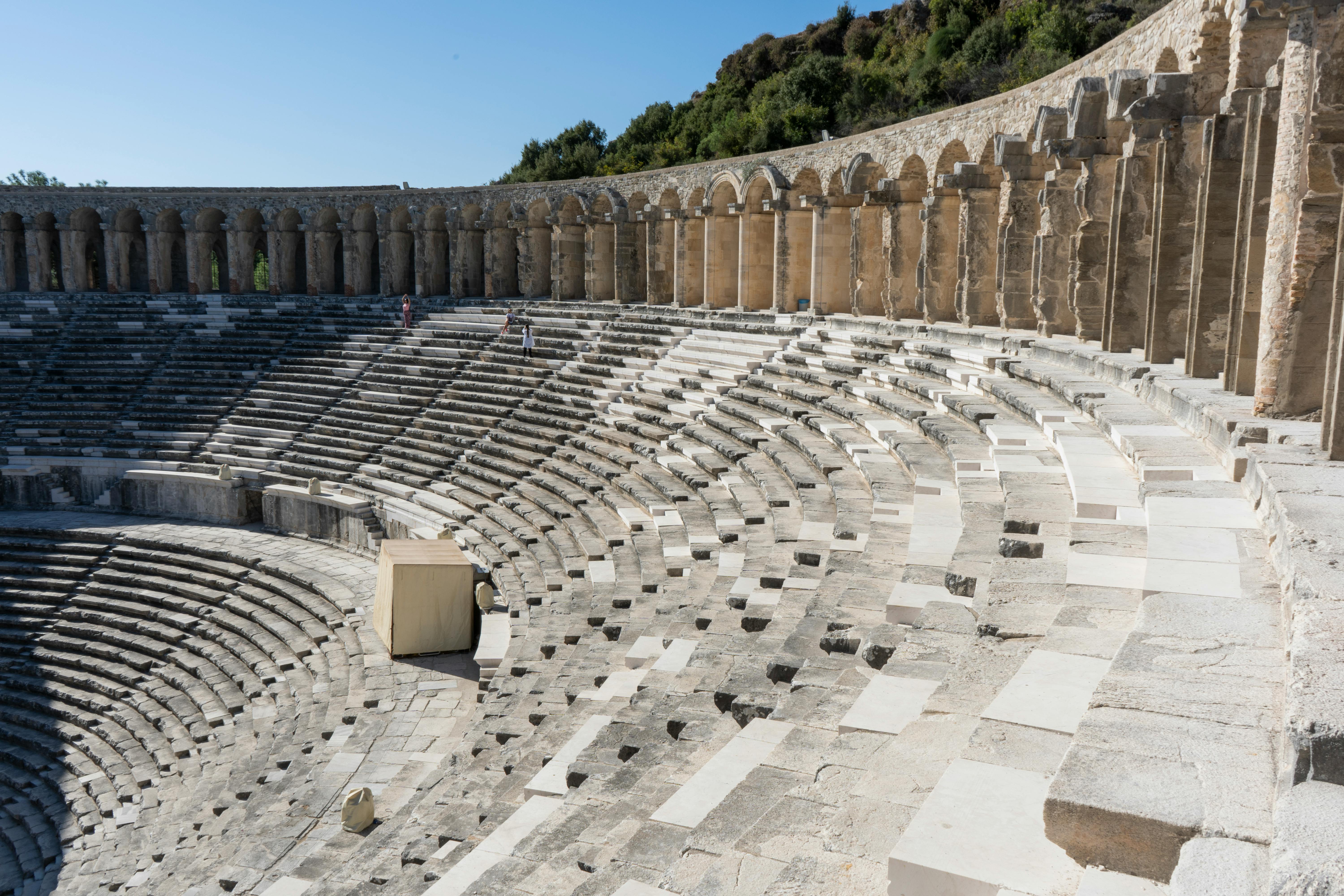
Aspendos Theater: Where Ancient Acoustics Meet Mediterranean Sky
Golden afternoon light spills across weathered limestone as you step onto the stage of Aspendos Theater—a masterpiece of Roman engineering where a whisper carries clearly to the highest row, nearly fifty meters above. The air carries the scent of wild thyme and sun-baked stone, while cicadas sing their ancient song in olive trees rooted in the hillside beyond the cavea. You stand on a stage measuring sixty-three meters wide, flanked by a two-story scaenae frons adorned with Corinthian columns and niches that once held statues of emperors and gods. This semicircular auditorium, with fifty rows of seats accommodating twelve thousand to fifteen thousand spectators, represents one of antiquity's most perfectly preserved theaters—a structure so acoustically refined that a coin dropped on the stage can be heard from the top tier. This place matters because it preserves the living soul of Roman theatrical tradition—a sanctuary where you can experience the same acoustic miracle that enchanted audiences nearly two millennia ago, where stone still echoes with the voices of actors, musicians, and emperors, and where the Mediterranean sky frames a monument that proves human artistry can transcend time itself.
Why Aspendos Theater Embodies Architectural Perfection
Aspendos Theater represents one of the Roman world's most extraordinary achievements in architectural engineering, solving the ancient challenge of creating a venue where every spectator—regardless of seating position—could hear performances with crystal clarity. Built in 155 CE during the reign of Emperor Marcus Aurelius, the theater was designed by the Greek architect Zeno, who dedicated the structure to the imperial family and the city's patron deities. The theater's semicircular cavea spans approximately ninety-six meters in diameter, with fifty rows of limestone seats divided by a horizontal walkway (diazoma) that separates the lower and upper tiers—a design that optimizes both sightlines and sound distribution.
The engineering behind Aspendos reveals sophisticated understanding of acoustics and structural integrity: the stage building (scaenae frons) rises two stories high with sixty-three meters of ornate facade featuring Corinthian columns, arched niches, and intricate floral reliefs carved from local marble. The cavea's precise curvature—calculated to reflect sound waves toward the audience—creates the theater's legendary acoustics, while the vomitoria (entry passages) allow efficient crowd movement without disrupting performances. Engineers constructed the seating using wedge-shaped limestone blocks fitted without mortar, a technique that has allowed the structure to withstand earthquakes for nearly two thousand years.
Beyond its aesthetic grandeur, the theater fulfilled critical cultural functions: it hosted dramatic performances, musical competitions, and civic gatherings that reinforced Roman identity in this prosperous Anatolian city. The Turkish Ministry of Culture designated Aspendos as a protected archaeological site in 1965, implementing conservation measures that preserve the stonework while allowing continued use for performances. Today, the theater hosts the annual Aspendos International Opera and Ballet Festival, proving that ancient engineering can still serve modern artistry. Scientific studies by Istanbul Technical University have documented the theater's acoustic properties, revealing how subtle architectural details—column spacing, niche depth, and stone texture—combine to create sound clarity unmatched by most modern venues. The Aspendos Theater thus serves as both a monument to Roman ingenuity and a living performance space where past and present converge beneath the Mediterranean sky.
The Best Time to Experience Aspendos Theater
Timing your visit to Aspendos Theater dramatically affects lighting, comfort, and the opportunity to experience performances. The optimal window stretches from April 15–May 30 and September 10–October 20, when air temperatures range between 19–27°C (66–81°F) and the Mediterranean breeze keeps humidity comfortable. During these shoulder seasons, wildflowers bloom among the ruins, golden-hour photography conditions are spectacular, and visitor numbers stay manageable at approximately four hundred to seven hundred daily rather than the fifteen hundred to two thousand seen in peak summer. Arrive at the theater between 8:30–10:00 AM when morning light illuminates the stage facade beautifully and before tour buses arrive from Antalya resorts.
Avoid July 15 through August 25 absolutely: temperatures soar to 34–41°C (93–106°F), exposed limestone reflects heat intensely, and minimal shade exists within the cavea, making extended exploration uncomfortable and potentially hazardous. Midday visits between 11:00 AM and 3:00 PM during peak season prove particularly punishing—the white stone creates blinding glare, and finding respite from the sun becomes difficult. Winter months (November through March) bring cooler air temperatures of 9–15°C (48–59°F) and occasional rain that makes ancient stone steps treacherously slippery, though the theater remains stunningly beautiful for photography with dramatic cloud formations.
The theater operates daily with seasonal hour adjustments. For current opening times, performance schedules, and conservation updates, consult the official resource: https://muze.gov.tr—Turkey's Ministry of Culture and Tourism portal provides verified information about Aspendos accessibility, ticket prices, and the annual International Opera and Ballet Festival. Note that admission typically costs €8–€10, and evening performances during festival season (June–July) require separate ticketing booked well in advance through the Ministry's cultural events portal.
Approximate Budget for a 7-Day Trip
Exploring Aspendos Theater and the surrounding Antalya region offers exceptional value for history enthusiasts and cultural travelers. This budget assumes moderate comfort—mid-range accommodation with sea or mountain views, fresh Turkish and Mediterranean cuisine, local transportation, site entrance fees, and selective guided experiences. Prices reflect 2026 rates for travelers seeking authentic archaeological experiences without luxury resort pricing.
- Accommodation: €42–€78 per night in Serik or nearby Antalya (boutique hotels with pool and traditional breakfast; budget pensions from €24, upscale heritage hotels from €125)
- Food: €24–€38 per day (breakfast €4—Turkish kahvaltı spread with cheeses, olives, tomatoes, honey, börek; lunch €7–€11—gözleme, grilled chicken dürüm, or meze platter at local cafes; dinner €13–€23—fresh sea bass, lamb tandır, or vegetarian options with local wine)
- Transportation: €60 total (Antalya Airport to Serik via shuttle: €8 each way; local dolmuş to Aspendos: €2.50 per ride; taxi from Serik: €12; bicycle rental: €7/day; optional car rental for exploring: €32/day)
- Attractions: €86 total (Aspendos Theater entrance: €10; Perge ancient city: €8; Side archaeological site: €7; guided theater tour: €18; opera festival ticket: €35; Antalya Museum: €6)
- Miscellaneous: €44 (guidebook €9, Turkish evil eye charm €6, local olive oil products €12, reef-safe sunscreen €7, travel insurance prorated €10)
Total: €450–€630 for 7 days (excluding international flights to Antalya)
7 Essential Aspendos Theater Experiences
- Test the legendary acoustics on stage: Stand at the center of the stage and speak softly or clap your hands. Walk to the highest row—fifty meters above—and listen as your voice carries with remarkable clarity. This acoustic miracle, achieved through precise geometric calculations and stone texture, remains one of antiquity's most impressive engineering feats. Visit between 9:00–11:00 AM when ambient noise is minimal and you can fully appreciate the sound propagation. Allow fifteen minutes for this interactive experience that connects you directly to Roman theatrical tradition.
- Examine the scaenae frons facade: Walk along the front of the two-story stage building to admire the ornate Corinthian columns, arched niches, and floral reliefs carved from local marble. The facade measures sixty-three meters wide and rises approximately seventeen meters high—a monumental backdrop designed to impress audiences and honor imperial patronage. Look for the dedicatory inscription above the central arch, which records the architect Zeno's dedication to Emperor Marcus Aurelius. Visit at midday when overhead light minimizes shadows on carved details, revealing intricate craftsmanship.
- Climb to the upper cavea viewpoint: Ascend the stone steps to the highest tier of seating for panoramic views of the theater's full semicircular form and the surrounding Anatolian landscape. The climb involves approximately two hundred steps but rewards with photographs showing the cavea's precise curvature and the stage building framed by distant hills. Visit during golden hour (5:00–7:00 PM in summer) when warm light bathes the limestone in amber tones. Bring water and wear sturdy shoes—the ancient steps are worn smooth by millennia of footsteps.
- Walk the vomitoria passages: Explore the vaulted entry corridors (vomitoria) that allowed ancient spectators to enter and exit efficiently without disrupting performances. These tunnels, carved into the hillside behind the cavea, demonstrate Roman crowd-management engineering. The cool, shadowed interiors provide welcome respite from midday heat and offer photographic opportunities with dramatic light filtering through stone arches. Allow twenty minutes to walk the full circuit and imagine the flow of twelve thousand spectators moving through these spaces.
- Attend a performance during festival season: If visiting in June or July, book tickets for the Aspendos International Opera and Ballet Festival (€35–€65 depending on seating). Experiencing a live performance in this ancient venue—where voices and instruments resonate through stone unchanged for nearly two millennia—creates an unforgettable connection between past and present. Arrive one hour early to explore the theater in twilight light and secure your seat before the performance begins.
- Photograph the theater at sunrise: Return to the site at opening time (8:00 AM) when morning light illuminates the eastern facade and the cavea remains empty of crowds. Position yourself on the stage for compositions that capture the semicircular seating rising toward the Mediterranean sky. Bring a polarizing filter to enhance the contrast between golden limestone and blue sky. This quiet hour rewards with photographs free of tourist crowds and a profound sense of solitude in a space designed for communal experience.
- Explore the adjacent ancient city ruins: Beyond the theater, the remains of Aspendos's agora, basilica, and nymphaeum offer context for the theater's role in civic life. Follow the marked path uphill for fifteen minutes to reach these lesser-visited ruins, where stone foundations and scattered columns reveal the layout of a prosperous Roman city. Visit between 4:00–6:00 PM when cooler temperatures and golden light enhance the experience. Allow one hour to appreciate how the theater anchored the city's cultural and social landscape.
3 Hidden Gems Most Travelers Miss
- The underground service tunnels: Beneath the stage floor, a network of narrow passages allowed stagehands to operate scenery mechanisms and actors to make dramatic entrances. Most visitors never access these tunnels because they require special permission from site management. Ask at the ticket office for "yer altı tünelleri" (underground tunnels) and request authorization at least twenty-four hours in advance. Guided access (€15 supplement) reveals Roman theatrical technology including trapdoors, pulley systems, and storage chambers. Bring a flashlight—lighting is minimal—and wear clothing you don't mind getting dusty.
- The architect's inscription stone: Near the theater's eastern entrance, a partially buried limestone block bears the original dedicatory inscription naming architect Zeno and recording the theater's completion in 155 CE. Most tourists overlook this artifact because it lacks prominent signage. Ask site staff for "Zeno yazıtı" (Zeno inscription) directions. Visit at mid-morning when angled light reveals the carved Latin and Greek letters. This stone offers a tangible connection to the individual whose genius created one of antiquity's most enduring monuments.
- The hillside viewpoint beyond the cavea: A short path behind the upper seating tier leads to a rocky outcrop offering panoramic views of the theater nestled in its natural amphitheater setting. This spot remains overlooked because it lacks formal signage and requires a five-minute scramble over limestone. Ask guards for "manzara tepesi" (viewpoint hill) directions. Visit at sunset when warm light bathes the entire structure and you can photograph the theater with the Anatolian landscape stretching to the horizon. This secluded perch rewards with photography opportunities free of crowds and a profound sense of the theater's harmony with its environment.
Cultural & Practical Tips
- Respect archaeological preservation: Aspendos Theater is a protected UNESCO World Heritage candidate site. Never climb on fragile stonework, touch carved reliefs, or remove fragments—oils from skin accelerate deterioration and violations carry fines up to ₺2,000 (approximately €60). Stay behind barriers and respect roped-off conservation areas.
- Wear appropriate footwear: The theater's ancient stone steps are worn smooth by millennia of footsteps and can become slippery when dry or damp. Sturdy walking shoes or hiking sandals with grip are essential; avoid flip-flops or smooth-soled shoes. The climb to upper tiers involves approximately two hundred steps with uneven surfaces.
- Carry sun protection: Minimal shade exists within the cavea, and white limestone reflects UV rays intensely. Bring a wide-brimmed hat, sunscreen (SPF 30+), and at least one liter of water per person. A small kiosk sells beverages near the entrance, but prices are inflated (€3 for water).
- Learn essential Turkish phrases: "Merhaba" (mehr-hah-bah—hello), "Teşekkür ederim" (teh-shek-kür eh-deh-rim—thank you), "Tiyatro nerede?" (tee-yah-troh neh-reh-deh—where is the theater?), "Su nerede?" (soo neh-reh-deh—where is the water?), and "İyi günler" (iy-ee gün-ler—good day). Even basic efforts earn warm responses from site staff and local vendors.
- Photography guidelines: General photography is permitted throughout the theater. Tripods require permission from site staff—usually granted for non-commercial use. When photographing other visitors, especially Turkish families, always ask "Fotoğraf çekebilir miyim?" (foh-toh-raf cheh-keh-bee-leer mee-yim—may I take a photo?). Avoid using flash inside the stage building where it can disturb other visitors.
- Plan for performance schedules: If hoping to attend a festival performance, book tickets at least two months in advance through the Ministry of Culture's events portal. Evening performances begin at 8:30 PM in summer; arrive by 7:30 PM to explore the theater in twilight light. Note that photography during performances is prohibited to respect artists and fellow audience members.
- Combine with nearby attractions: Aspendos sits within easy reach of Perge ancient city (20 minutes), Side archaeological site (30 minutes), and Antalya's old harbor (40 minutes). Purchase a combined museum card (€25) for discounted entry to multiple sites. This allows you to visit each location during optimal lighting conditions rather than rushing through in one session.
Conclusion: Travel with Wonder, Not Just Checklists
Aspendos Theater doesn't surrender its deepest magic to hurried visitors ticking boxes on an itinerary. It rewards those who pause to test the acoustics with a whispered word, who trace the chisel marks on marble columns carved by hands long stilled, who understand that this stone amphitheater represents a dialogue between human creativity and timeless craft. When you stand on a stage where actors performed for Roman emperors and hear your voice echo clearly to seats filled by spectators two millennia ago, you're participating in an experience that transcends ordinary tourism.
Responsible travel here means honoring the theater's fragility—these stones have survived earthquakes, conquests, and centuries of neglect only to face modern threats from weathering and human impact. Support preservation by hiring local guides certified through Turkey's Ministry of Culture, purchasing crafts from Anatolian artisans rather than mass-produced imports, and respecting every barrier erected to protect archaeological deposits still waiting beneath the soil. Leave only footprints on steps worn smooth by millennia of theatergoers. Take only photographs and the profound understanding that history isn't confined to textbooks—it lives in stone that still carries voices, in acoustics that still astonish, in the patient work of conservators preserving tomorrow's heritage today.