
Perge Ruins: Where Roman Grandeur Meets Anatolian Earth
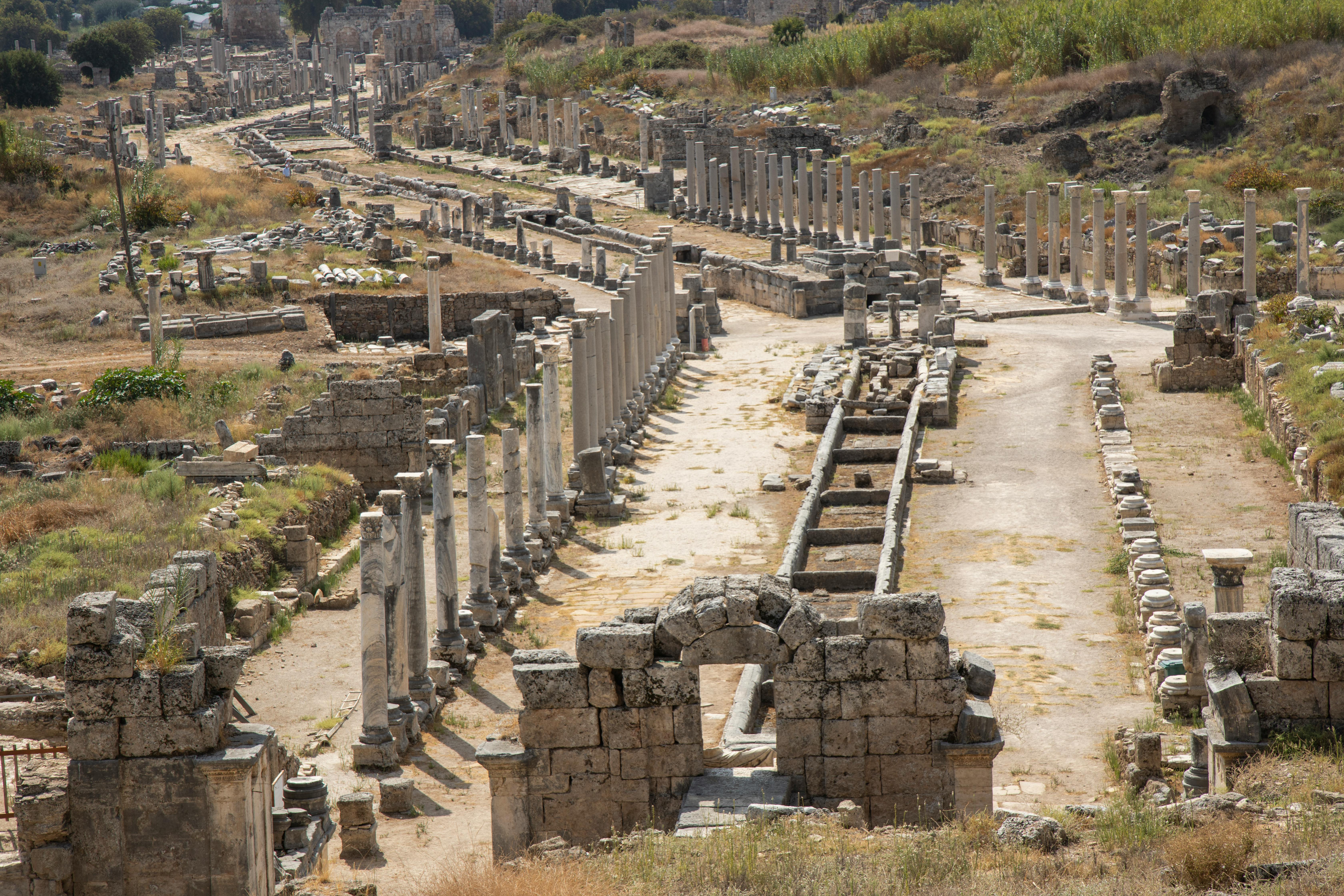
Golden afternoon light spills across weathered marble as you walk the colonnaded street of Perge ruins—an ancient Pamphylian city where Roman engineering and Greek artistry converge beneath the Anatolian sky. The air carries the scent of wild thyme and sun-baked limestone, while cicadas sing their eternal song in olive trees rooted between fallen columns. You stand on a thoroughfare measuring twenty-five meters wide, flanked by two-story porticoes that once sheltered merchants, philosophers, and emperors. This archaeological landscape spans approximately one hundred hectares, with a theater seating twelve thousand spectators, a stadium holding thirty thousand, and bath complexes adorned with mosaics that still shimmer with original tesserae. This place matters because it preserves the living soul of Roman urban life—a city where you can trace the footsteps of Saint Paul, who preached here in the first century CE, and where every stone tells a story of a civilization that understood beauty, commerce, and community as interconnected pillars of human flourishing.
Why Perge Ruins Embody Roman Urban Mastery
Perge ruins represent one of Anatolia's most complete examples of Roman city planning, solving the ancient challenge of creating a prosperous urban center that balanced civic function, commercial vitality, and aesthetic grandeur. Founded as a Hellenistic settlement in the third century BCE and flourishing under Roman rule from the first century CE onward, Perge served as the capital of Pamphylia—a region prized for its fertile plains and strategic position along Mediterranean trade routes. The city's layout reflects sophisticated urban engineering: a grid-pattern street system oriented to prevailing winds, an advanced water management network with nymphaea and aqueducts, and public buildings positioned to maximize both utility and visual impact.
The architectural splendor of Perge reveals Roman mastery of materials and scale: the colonnaded street features marble columns rising eight meters high, supporting entablatures carved with floral motifs and mythological scenes; the theater's cavea spans ninety-six meters in diameter with fifty rows of limestone seats; and the bath complexes cover over two thousand square meters with hypocaust heating systems that circulated warm air beneath marble floors. Engineers constructed foundations using local limestone blocks fitted without mortar—a technique that has allowed structures to withstand earthquakes for nearly two thousand years. The famous statues of Perge—now displayed in the Antalya Museum—demonstrate the city's artistic sophistication, blending Greek classical ideals with Roman imperial iconography.
Beyond its aesthetic grandeur, Perge fulfilled critical historical functions: it housed administrative offices for the Pamphylian province, facilitated trade in grain, olive oil, and textiles between Anatolia and the Levant, and served as a cultural center where philosophy, theater, and athletics flourished. The Turkish Ministry of Culture designated Perge as a protected archaeological site in 1965, implementing conservation measures that preserve fragile mosaics and structural elements while allowing public access. Scientific excavations by Turkish and international teams since 1946 have uncovered over sixty percent of the ancient city, revealing insights about daily life, religious practices, and urban development in Roman Anatolia. Today, Perge ruins serve as both an open-air museum and a testament to human ingenuity—a place where visitors can walk through history and imagine the bustling metropolis that once thrived on this sun-drenched plain.
The Best Time to Experience Perge Ruins
Timing your visit to Perge ruins dramatically affects lighting, comfort, and photographic opportunities. The optimal window stretches from April 18–May 30 and September 10–October 22, when air temperatures range between 19–27°C (66–81°F) and the Mediterranean breeze keeps humidity comfortable. During these shoulder seasons, wildflowers bloom among the ruins, golden-hour photography conditions are spectacular, and visitor numbers stay manageable at approximately five hundred to eight hundred daily rather than the two thousand to three thousand seen in peak summer. Arrive at the site between 8:30–10:00 AM when morning light illuminates the colonnaded street beautifully and before tour buses arrive from Antalya resorts.
Avoid July 15 through August 25 absolutely: temperatures soar to 34–41°C (93–106°F), exposed limestone reflects heat intensely, and minimal shade exists within the archaeological park, making extended exploration uncomfortable and potentially hazardous. Midday visits between 11:00 AM and 3:00 PM during peak season prove particularly punishing—the white stone creates blinding glare, and finding respite from the sun becomes difficult. Winter months (November through March) bring cooler air temperatures of 9–15°C (48–59°F) and occasional rain that makes ancient stone pathways treacherously slippery, though the site remains stunningly beautiful for photography with dramatic cloud formations.
The site operates daily with seasonal hour adjustments. For current opening times, admission fees, and conservation updates, consult the official resource: https://whc.unesco.org—Turkey's Ministry of Culture and Tourism portal provides verified information about Perge accessibility, ticket prices, and ongoing excavation projects. Note that admission typically costs €8–€10, and combined tickets with nearby Aspendos Theater offer discounted entry to multiple archaeological sites.
Approximate Budget for a 7-Day Trip
Exploring Perge ruins and the surrounding Antalya region offers exceptional value for history enthusiasts and cultural travelers. This budget assumes moderate comfort—mid-range accommodation with sea or mountain views, fresh Turkish and Mediterranean cuisine, local transportation, site entrance fees, and selective guided experiences. Prices reflect 2026 rates for travelers seeking authentic archaeological experiences without luxury resort pricing.
- Accommodation: €42–€78 per night in Aksu or nearby Antalya (boutique hotels with pool and traditional breakfast; budget pensions from €24, upscale heritage hotels from €125)
- Food: €24–€38 per day (breakfast €4—Turkish kahvaltı spread with cheeses, olives, tomatoes, honey, börek; lunch €7–€11—gözleme, grilled chicken dürüm, or meze platter at local cafes; dinner €13–€23—fresh sea bass, lamb tandır, or vegetarian options with local wine)
- Transportation: €60 total (Antalya Airport to Perge via shuttle: €8 each way; local dolmuş to site: €2.50 per ride; taxi from Aksu: €12; bicycle rental: €7/day; optional car rental for exploring: €32/day)
- Attractions: €86 total (Perge ruins entrance: €10; Aspendos Theater: €10; Side archaeological site: €7; guided walking tour: €18; Antalya Museum: €6; Kurşunlu Waterfall tour: €15)
- Miscellaneous: €44 (guidebook €9, Turkish evil eye charm €6, local olive oil products €12, reef-safe sunscreen €7, travel insurance prorated €10)
Total: €450–€630 for 7 days (excluding international flights to Antalya)
7 Essential Perge Ruins Experiences
- Walk the colonnaded street at golden hour: Enter through the Hellenistic gate and proceed down the marble-paved thoroughfare flanked by two-story porticoes. The street measures twenty-five meters wide and extends approximately two hundred meters, creating a grand processional way that once connected the city gate to the agora. Visit between 4:00–6:00 PM when warm light bathes the columns in amber tones and long shadows accentuate carved details. Allow thirty minutes to stroll the full length, imagining merchants, philosophers, and citizens moving through this bustling artery of Roman life.
- Explore the theater's acoustic marvel: Climb to the upper tiers of the Roman theater, which seats approximately twelve thousand spectators. Stand on the stage and speak softly—notice how your voice carries clearly to the highest rows, a testament to precise geometric calculations and stone texture. The cavea spans ninety-six meters in diameter with fifty rows of limestone seats. Visit between 9:00–11:00 AM when ambient noise is minimal and you can fully appreciate the acoustic engineering that made Roman performances possible.
- Examine the bath complex mosaics: Enter the southern bath complex to view floor mosaics that still shimmer with original tesserae depicting mythological scenes, geometric patterns, and marine life. The hypocaust heating system—visible through floor openings—demonstrates Roman engineering sophistication. Look for the frigidarium (cold room), tepidarium (warm room), and caldarium (hot room) arranged along a central axis. Visit at midday when natural light penetrates the roofless chambers, illuminating mosaic colors without harsh shadows.
- Climb to the acropolis viewpoint: Follow the path uphill from the main ruins to the ancient acropolis, where Hellenistic fortifications offer panoramic views of the entire archaeological site and the surrounding Pamphylian plain. The climb involves approximately one hundred fifty steps but rewards with photographs showing the theater, stadium, and colonnaded street in contextual relationship. Visit at sunset when warm light bathes the landscape and you can appreciate how Perge's planners harmonized urban design with natural topography.
- Visit the stadium's starting gates: Walk to the eastern edge of the site to explore the stadium, which held approximately thirty thousand spectators for athletic competitions and public spectacles. The starting gates (sphendone) remain remarkably intact, with stone barriers that once separated runners from spectators. The track measures two hundred meters long—a standard Roman stadium dimension. Allow twenty minutes to walk the perimeter and imagine the roar of crowds cheering chariot races or foot races beneath the Anatolian sun.
- Photograph the nymphaeum fountain: Near the colonnaded street's midpoint, the monumental nymphaeum features a two-story facade with niches that once held statues of nymphs and deities. Water cascaded from marble spouts into a basin below, creating a cooling microclimate for passersby. Visit between 10:00 AM–12:00 PM when sunlight illuminates carved details and the fountain's architectural symmetry creates striking photographic compositions. Bring a polarizing filter to enhance the contrast between white marble and blue sky.
- Reflect at the Hellenistic gate: Begin or end your visit at the monumental city gate erected in the third century BCE, featuring twin towers and arched passageways that welcomed travelers for over two millennia. Stand beneath the central arch—four meters wide and six meters high—and imagine the procession of merchants, pilgrims, and conquerors who passed through this threshold. Visit at sunrise when morning light creates dramatic shadows that emphasize the gate's imposing scale and historical weight.
3 Hidden Gems Most Travelers Miss
- The underground water channels: Beneath the colonnaded street, a network of stone-lined channels carried freshwater from mountain springs to the city's fountains and baths. Most visitors never access these tunnels because they require special permission from site management. Ask at the ticket office for "yer altı su kanalları" (underground water channels) and request authorization at least twenty-four hours in advance. Guided access (€12 supplement) reveals Roman hydraulic engineering including sedimentation tanks, distribution valves, and maintenance passages. Bring a flashlight—lighting is minimal—and wear clothing you don't mind getting dusty.
- The sculptor's workshop ruins: Behind the bath complex, partially excavated foundations mark a workshop where artisans carved the statues and reliefs that adorned Perge's public spaces. This site remains overlooked because signage is minimal and access requires asking staff for "heykel atölyesi" (sculptor's workshop) directions. Scattered marble chips, unfinished column drums, and tool marks on stone blocks reveal the industrial scale of artistic production. Visit during mid-morning when angled light reveals chisel details on working surfaces. This hidden corner offers tangible connections to the craftsmen whose hands shaped Perge's beauty.
- The eastern necropolis pathway: Beyond the stadium, a quiet trail leads to a cluster of rock-cut tombs and sarcophagi that served Perge's elite families. This area remains overlooked because it lacks formal signage and requires a ten-minute walk from the main ruins. Ask guards for "doğu mezarlık" (eastern cemetery) directions. The tombs feature relief carvings depicting banquets and mythological scenes, offering insights into Lycian-Roman funerary traditions. Visit between 3:00–5:00 PM when fewer visitors are present and afternoon light illuminates carved details. Bring water and wear sturdy shoes; paths include loose gravel sections.
Cultural & Practical Tips
- Respect archaeological preservation: Perge ruins are protected under Turkish cultural heritage law. Never climb on fragile stonework, touch carved reliefs, or remove fragments—oils from skin accelerate deterioration and violations carry fines up to ₺2,000 (approximately €60). Stay behind barriers and respect roped-off conservation areas.
- Wear appropriate footwear: The site features uneven limestone surfaces, ancient stone steps worn smooth over millennia, and loose gravel paths. Sturdy walking shoes or hiking sandals with grip are essential; avoid flip-flops or smooth-soled shoes. Many paths include elevation changes as you navigate between the theater, baths, and acropolis.
- Carry sun protection: Minimal shade exists within the archaeological park, and white limestone reflects UV rays intensely. Bring a wide-brimmed hat, sunscreen (SPF 30+), and at least one liter of water per person. A small kiosk sells beverages near the entrance, but prices are inflated (€3 for water).
- Learn essential Turkish phrases: "Merhaba" (mehr-hah-bah—hello), "Teşekkür ederim" (teh-shek-kür eh-deh-rim—thank you), "Perge harabeleri nerede?" (per-geh hah-reh-beh-leh-ree neh-reh-deh—where are the Perge ruins?), "Su nerede?" (soo neh-reh-deh—where is the water?), and "İyi günler" (iy-ee gün-ler—good day). Even basic efforts earn warm responses from site staff and local vendors.
- Photography guidelines: General photography is permitted throughout Perge ruins. Tripods require permission from site staff—usually granted for non-commercial use. When photographing other visitors, especially Turkish families, always ask "Fotoğraf çekebilir miyim?" (foh-toh-raf cheh-keh-bee-leer mee-yim—may I take a photo?). Avoid using flash inside covered chambers where it can disturb other visitors.
- Plan for seasonal considerations: Spring (April–May) offers wildflower blooms, comfortable temperatures, and excellent photographic light but occasional rain showers. Autumn (September–October) provides stable weather, fewer crowds, and golden-hour lighting ideal for photography. Summer visits require early morning arrival (before 9:00 AM) to avoid heat exhaustion. Winter months see reduced hours but offer solitary exploration opportunities with dramatic skies.
- Combine with nearby attractions: Perge sits within easy reach of Aspendos Theater (20 minutes), Side archaeological site (30 minutes), and Antalya's old harbor (40 minutes). Purchase a combined museum card (€25) for discounted entry to multiple sites. This allows you to visit each location during optimal lighting conditions rather than rushing through in one session.
Conclusion: Travel with Curiosity, Not Just Checklists
Perge ruins don't surrender their deepest secrets to hurried visitors ticking boxes on an itinerary. They reward those who pause to examine how Roman masons fitted limestone blocks without mortar, who linger in the theater to imagine twelve thousand spectators cheering ancient performances, who understand that every mosaic tessera tells a story of artisans who transformed stone into beauty. When you walk the colonnaded street where Saint Paul once preached, you're participating in a dialogue spanning two millennia—a reminder that human curiosity and cultural exchange transcend eras.
Responsible travel here means honoring these monuments' fragility—these stones have survived earthquakes, conquests, and centuries of neglect only to face modern threats from weathering and human impact. Support preservation by hiring local guides certified through Turkey's Ministry of Culture, purchasing crafts from Anatolian artisans rather than mass-produced imports, and respecting every barrier erected to protect archaeological deposits still waiting beneath the soil. Leave only footprints on paths worn smooth by millennia of travelers. Take only photographs and the profound understanding that history isn't confined to textbooks—it lives in weathered columns, in mosaics that still shimmer, in the patient work of conservators preserving tomorrow's heritage today.