
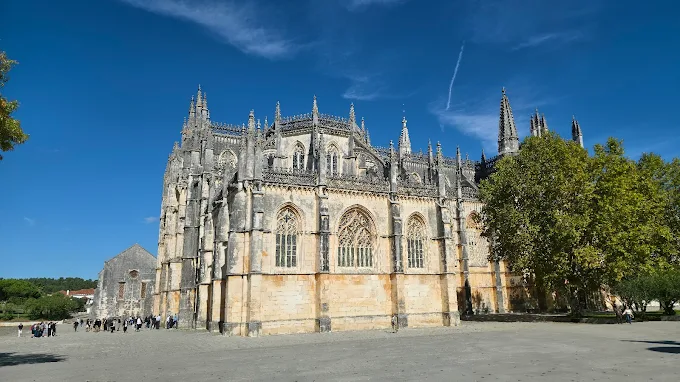
Batalha Monastery: Where Flamboyant Gothic Meets Portuguese Royal Legacy
Morning light spills across the pale limestone façade of the Batalha Monastery, illuminating the intricate, weathered carvings that pierce the clear central Portuguese sky. You walk through the heavy arched doorway, your footsteps echoing against the vast, flagstone floor of the nave. The air smells of cold stone, ancient dust, and damp earth—a sharp contrast to the warm sunshine outside. Towering above you, the sheer scale of the Gothic architecture dominates the senses; the ribbed vaulting soars 32 meters (105 feet) overhead, creating a cavernous space that swallows sound. Sunbeams angle through the massive clerestory windows, casting sharp, geometric shadows across the elaborate tombs of kings. Founded as a monumental vow following a desperate military victory against Castilian forces in the late fourteenth century, this sprawling complex stretches over 300 meters (984 feet) in length. The surrounding town hums quietly with the low rumble of distant traffic, but inside these walls, time feels entirely suspended. The Batalha Monastery matters because it is not merely a church, but the foundational stone of Portuguese national identity—a spectacular, sprawling testament to a nation’s fight for sovereignty, rendered in the most exuberant stone architecture of the late Middle Ages.
Why Batalha Monastery Embodies Architectural Triumph
The Batalha Monastery embodies architectural triumph because it was engineered to solve a profound political and spiritual problem: the need to legitimize a newly established, independent Portuguese dynasty. Following a pivotal battlefield victory, King João I vowed to construct a magnificent monastery, effectively transforming a military triumph into a permanent, stone-encased national myth. To fulfill this mandate, master architects Afonso Domingues and Huguet were brought in to execute a building campaign that would ultimately span well over a century of continuous construction. The primary technical challenge was constructing a structure that felt overwhelmingly weightless despite its massive scale. The solution was the revolutionary use of the complex ribbed vault. In the Founder’s Chapel, Huguet engineered an immense, unsupported octagonal vault spanning 19 meters (62 feet) across. This intricate network of intersecting stone ribs—built from local limestone hauled by oxcart from nearby quarries—distributes the immense downward thrust of the roof into a handful of slender pillars, creating a breathtaking illusion of a floating ceiling. Later, under the direction of master builder Mateus Fernandes, the site became the testing ground for the Manueline style. In the Unfinished Chapels, stonemasons carved delicate, organic motifs directly into the rock—ropes, corals, and armillary spheres—creating a hyper-decorated lacework that pushes traditional Gothic structural limits to their absolute breaking point. Every stone here serves a dual purpose: structural necessity and bold dynastic propaganda.
The Best Time to Experience Batalha Monastery
To experience the Batalha Monastery in its most evocative light, plan your visit between April 12 and May 25. During this narrow window, the surrounding agricultural fields are vividly green, and daytime temperatures remain a comfortable 16°C–22°C (61°F–72°F)—ideal for walking the expansive, shadeless courtyards without physical discomfort. Arrive precisely between 9:00 and 10:30 AM. At this early hour, the sunlight strikes the western façade directly, perfectly highlighting the deep undercut shadows of the Gothic tracery, and the acoustic silence of the empty cloisters allows you to hear the distant, melodic chirping of swallows nesting in the upper vaults. You should firmly avoid July 25 through August 20. During these weeks, summer heat pushes temperatures to a sweltering 33°C (91°F), the blinding white limestone reflects the sun aggressively, and massive tour bus convoys turn the intimate royal tombs into congested corridors. For current restoration updates, precise Mass schedules
Approximate Budget for a 7-Day Trip
Estimating costs for a cultural immersion into the Batalha Monastery requires factoring in the highly affordable pricing of this small, historic Portuguese town. The following budget reflects a mid-range traveler prioritizing deep historical engagement and regional gastronomy over luxury amenities.
- Accommodation: €60–€85 per night (a restored guesthouse in the historic center featuring antique tilework and breakfast included)
- Food: €35 per day (Breakfast €4 for a strong bica espresso and a pastel de nata; Lunch €10 for a bitoque—a steak served with a crispy fried egg, rice, and fries; Dinner €21 for roasted leitão da Bairrada [suckling pig] paired with sparkling Espumante at a local tavern)
- Transportation: €18 total (€14 for a round-trip Rede Expressos bus ticket from Lisbon to Batalha; €4 for a local taxi from the bus station to the monastery gates)
- Attractions: €12 total (€6 for the standard Batalha Monastery entrance ticket; €6 for the adjacent Museum of the Combatants detailing the military history of the region)
- Miscellaneous: €20 total (a hand-painted ceramic tile depicting the monastery façade, a bottle of local Dão region wine, and an illustrated architectural guidebook)
Total: €445–€615
6 Essential Batalha Monastery Experiences
- Stand beneath the Unfinished Chapels: Walk through the open-air portal into the Capelas Imperfeitas. Feel the cool morning breeze against your face as you look up through the massive, open hole in the roof to the sky. Trace the intricate Manueline carvings of twisted ropes and scallop shells with your eyes, feeling the raw, unfinished energy of the stonemasons who suddenly abandoned their tools.
- Gaze up in the Founder’s Chapel: Enter the octagonal chamber and stand directly beneath the central vault. Look down to see the beautifully carved effigies of King João I and his English queen, Philippa of Lancaster, resting their heads on intricately detailed stone elephants. The cool, damp air here carries the distinct scent of ancient limestone.
- Trace the Cloister of King João I: Walk along the covered arcades of this massive square courtyard. Press your fingers against the highly textured, asymmetrical Gothic tracery; notice the organic, flowing lines that resemble tangled tree branches rather than rigid mathematical forms. Listen to the acoustic echo of your footsteps bouncing off the blank walls opposite the intricate stone screens.
- Study the Chapter House vault: Step into this austere, square room and tilt your head back to observe one of the earliest unsupported star vaults in Portugal. The sheer weight of the stone canopy pressing down is visually intimidating, yet the engineering holds flawlessly, creating a profound sense of hushed reverence perfect for quiet contemplation.
- Admire the Royal Cloister transition: Walk the two levels of this vast courtyard. Compare the lower level, built by Afonso Domingues in a strict, symmetrical Gothic style, with the upper level, added later by Mateus Fernandes. Run your hand along the upper balustrade to feel the sudden, dramatic shift into the highly decorative, nautical-inspired Manueline aesthetic.
- Walk the Affonso Domingues Cloister: Step away from the crowds into this smaller, deeply restful courtyard located near the entrance. Notice the perfectly proportional arches and the thick, lichen-covered stone pillars. The serene, unadorned geometry offers a striking mental palate cleanser after the overwhelming visual density of the royal tombs.
3 Hidden Gems Most Travelers Miss
- The Stall of the Founder (O Coreto): Located in the exact center of the Royal Cloister, this delicate, octagonal stone pulpit is a hidden gem routinely overlooked because visitors focus on the surrounding walls. To find it, walk to the central garden intersection and look down. The structure features breathtakingly detailed Manueline carvings of coral and seaweed at its base, designed for the monks to read sermons aloud to the community in the garden below.
- The Tomb of the Unknown Soldier: Situated in a quiet recess of the Founder’s Chapel, this modest tomb is missed because tourists are looking up at the royal effigies. It holds the remains of two unidentified Portuguese soldiers killed during the Great War, flanked by eternal flames. It is a profoundly moving, sobering contrast to the opulent royal monuments surrounding it.
- Largo do Combatentes Viewpoint: A small stone terrace located just outside the eastern wall of the monastery. It is ignored because it requires walking away from the main entrance, past the modern visitor center. The terrace offers a sweeping, elevated view of the surrounding valley, providing the only vantage point from which you can fully comprehend the massive, fortress-like scale of the monastery's eastern flying buttresses.
Cultural & Practical Tips
- Maintain respectful silence inside the church and cloisters; the Batalha Monastery remains an active religious site, and loud conversations or disruptive behavior are met with immediate, stern reprimands from the attendants.
- Learn basic Portuguese courtesies: say "Bom dia" (good morning, pronounced "bom dee-ah") when purchasing your ticket, and use "Obrigado" (thank you, pronounced "oh-bree-gah-doo") when leaving the museum.
- Photography is permitted in the cloisters, but the use of flash and tripods is strictly prohibited inside the chapels to protect the delicate pigments of the medieval stonework and prevent trip hazards in crowded areas.
- Wear shoes with excellent rubber grip; the original limestone flagstones in the nave and cloisters have been worn smooth by centuries of foot traffic and become incredibly slippery when exposed to rain or morning dew.
- Be prepared for sudden drops in temperature; the thick stone walls trap a persistent subterranean chill, making the interior feel significantly colder than the exterior, even during the peak of summer.
- Allocate a minimum of two hours for your visit; rushing through the sprawling complex means missing the subtle transitional details between the Gothic and Manueline architectural styles that make this site historically invaluable.
Conclusion: Travel with Historical Empathy, Not Just Sightseeing
The Batalha Monastery demands far more from its visitors than a passive, camera-ready stroll through ancient corridors; it requires a profound, active engagement with the physical remnants of a nation’s defining struggle. When you choose to pause beside the tomb of an unknown soldier, or trace the organic, unfinished carvings of the Manueline stonecutters, you honor the intense human labor that built this monumental vow. Mindful travel here means resisting the urge to simply photograph the grand façade and move on. It means touching the cold limestone pillars, acknowledging the sheer audacity of the medieval engineers, and recognizing that this sprawling complex was built not as a museum, but as a desperate, joyful declaration of survival. By treating the worn flagstones with deep respect and spending your euros in the surrounding local town, you actively participate in the preservation of Portugal’s cultural heritage. Let the silent, soaring vaults remind you that true architectural majesty cannot be rushed. In a landscape defined by stone and memory, the greatest privilege you can claim is the patience to simply stand still, look up, and listen to the echoes of history.