
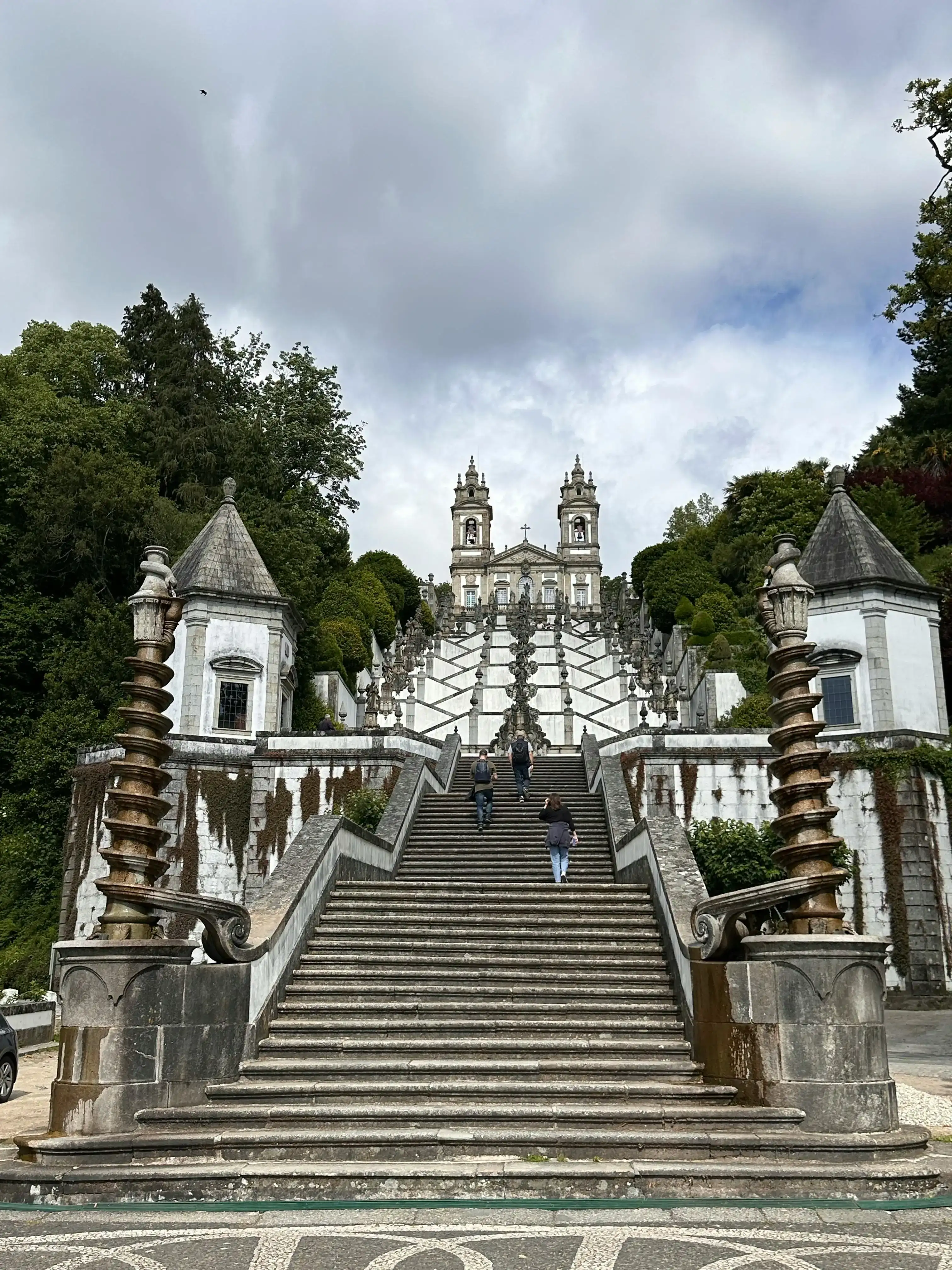
Braga Bom Jesus Stairs: Where Baroque Grandeur Meets Devotional Ascent
Mist clings to the granite steps of the Braga Bom Jesus stairs as dawn breaks over the Minho valley—a hush broken only by the rhythmic crunch of gravel beneath early pilgrims. The air smells of damp earth, fragrant eucalyptus, and aging limestone. Before you unfolds a monumental zigzag of pale stone, climbing 116 meters (381 feet) through a dense tunnel of centuries-old arborvitae. Sunlight fractures through the canopy, illuminating the delicate blue-and-white azulejo panels depicting the Passion of Christ that line the initial landings. Each of the 573 steps demands a deliberate pause, forcing you to slow your pace to match the methodical rhythm of the 18th-century craftsmen who carved this pathway. With every landing, the sounds of the modern city fade, replaced entirely by birdsong and the distant murmur of flowing water from the hillside fountains. The Braga Bom Jesus stairs are not merely an architectural structure; they are a physical liturgy mapped onto a hillside. This sanctuary matters because it transforms the abstract concept of faith into an exhausting, visceral, undeniably beautiful journey—one that ultimately rewards the aching body with breathtaking panoramic views of Portugal's oldest city.
Why Braga Bom Jesus Stairs Embodies Baroque Devotion
Conceived in 1722 by Archbishop Rodrigo de Moura Teles, the Braga Bom Jesus stairs represent the pinnacle of Portuguese Baroque landscape engineering—a direct response to the Counter-Reformation's demand for immersive, participatory religious theater. The architects faced a formidable topographical challenge: how to translate the deeply emotional Stations of the Cross into a climbable, processional topography. The solution was a structural masterclass spanning 115 years of phased construction, ultimately completed under the supervision of architect Carlos Amarante in 1837. Rather than a punishingly steep straight incline, they designed a scallop-shaped zigzag (an escadório) spanning 17 meters (56 feet) in width at its broadest points. The stairs ingeniously solve a theological problem through civil engineering by physically separating the Via Crucis (the sorrowful path of Christ) from the Via Lucis (the glorious resurrection path). The lower staircases feature intimate chapels housing striking, life-sized polychrome terracotta sculptures—primarily crafted by sculptors like Paulo Mota—capturing agonizing moments of biblical suffering. Ascending further, the architecture transitions dramatically into ornate fountains dedicated to the Five Senses and the Three Theological Virtues. Water crashes over carved allegorical figures to symbolize the baptismal cleansing of worldly perception before reaching the summit. Constructed from robust local granite and finer limestone, the structure functions as a massive allegorical machine, using sheer elevation to physically manifest spiritual ascension.
The Best Time to Experience Braga Bom Jesus Stairs
To experience the Braga Bom Jesus stairs without the jostle of tourist crowds, plan your visit between September 14 and October 5. During this specific window, the surrounding forests ignite with amber and ochre foliage, providing a striking visual contrast to the pale granite. Temperatures are exceptionally mild, hovering between 18°C and 22°C (64°F–72°F)—perfect conditions for the physical exertion of the climb. Arrive precisely between 7:30 and 9:00 AM. At this early hour, the angled sunlight casts deep, dramatic shadows across the azulejo alcoves, and the stone steps remain pleasantly cool to the touch. You should actively avoid August 1 through August 20, when summer holidays push temperatures to a sweltering 30°C (86°F) and pack the narrow staircases with dense foot traffic, entirely destroying the sanctuary's contemplative atmosphere. For comprehensive festival schedules, real-time weather alerts, and sanctuary access updates, consult the official municipal tourism portal at https://bomjesus.pt. Checking this resource ensures you avoid unexpected closures of the upper basilica or disruptions caused by local religious processions, allowing you to secure the solitary, reverent ascent this sacred space fundamentally demands.
Approximate Budget for a 7-Day Trip
Estimating costs for a cultural immersion near the Braga Bom Jesus stairs requires factoring in the city's highly favorable position as one of Western Europe's most affordable historic destinations. The following budget reflects a mid-range traveler prioritizing authentic, locally sourced experiences over luxury amenities.
- Accommodation: €65–€95 per night (a restored 19th-century guesthouse in the historic center, specifically within walking distance of the Arco da Porta Nova, featuring traditional tiled facades and courtyard gardens)
- Food: €45 per day (Breakfast €5 featuring fresh pastéis de nata and a milky galão at a corner bakery; Lunch €12 for a hearty, sauce-drenched francesinha in a bustling local tavern; Dinner €28 for oven-roasted bacalhau à Braga paired with a crisp Vinho Verde at a sit-down restaurant)
- Transportation: €22 total (€3.50 for a one-way ride on the historic Bom Jesus water-balanced funicular; €1.60 per ride on the TUB municipal bus connecting the city center directly to the sanctuary base)
- Attractions: €16 total (€0 for the Bom Jesus church and stairs, which remain publicly accessible; €8 for the Museu dos Biscainhos; €8 for the Palácio do Raio)
- Miscellaneous: €35 (Hand-painted Barcelos rooster ceramics from a local artisan shop, premium coffee at the historic Café A Brasileira, and small votive candles left in the hillside chapels)
Total: €548–€703
6 Essential Braga Bom Jesus Stairs Experiences
- Count the Chapels of the Via Crucis: Begin your journey at the base and deliberately seek out the 14 small chapels embedded into the hillside. Touch the cool, slightly rough granite doorframes and peer through the intricate wrought-iron grilles to examine the expressive, life-sized polychrome terracotta figures. Notice the meticulous details in the sculpted drapery and the anguished expressions depicting Christ's condemnation, falls, and crucifixion—each scene designed to evoke visceral empathy in the passing pilgrim.
- Drink from the Fountain of the Five Senses: Located precisely at the mid-point transition between the sorrowful and glorious paths, pause at the octagonal basin. Listen to the water crashing over the carved stone faces representing Sight, Hearing, Smell, Taste, and Touch. While the water is safe and historically symbolic—meant to purify worldly perception before spiritual enlightenment—it carries a distinct metallic mineral taste from the local bedrock.
- Ride the Elevador do Bom Jesus: Skip the climb exactly once to experience the 1882 water-balanced funicular, a marvel of Victorian-era sustainable engineering. Stand on the lower wooden platform as the descending car fills with 1,300 liters of spring water from the summit fountain; this shifting weight uses gravity to silently pull your upward carriage along the steep 274-meter (899-foot) inclined rail.
- Photograph the Staircase from the Lower Portico: Walk 40 meters (131 feet) past the initial triumphal archway, turn around, and shoot upward with a wide-angle lens. The geometric zigzag of the stairs, framed tightly by the dark green canopy of arborvitae, creates a striking optical illusion of infinite ascent. Capture this at 8:15 AM when the morning mist lingers in the V-shaped gaps of the staircases.
- Enter the Basilica at High Noon: Time your arrival at the summit to coincide precisely with 12:00 PM. The natural light streams directly through the clerestory windows, illuminating the excessively gilded rococo altarpiece and the dark, rosewood choir stalls in a warm, dramatic glow that emphasizes the immense depth of the interior architecture.
- Explore the Terreiro dos Reis: Step out behind the basilica onto this massive, symmetrical polygonal terrace. Feel the sharp, cool Minho breeze against your skin as you take in the sweeping, unobstructed vista of the Braga skyline, the silver thread of the Cavado River valley, and the jagged, purple-hued silhouette of the distant Serra de Gerês mountain range.
3 Hidden Gems Most Travelers Miss
- Parque do Bom Jesus Arboretum: Located 300 meters southeast of the basilica, this sprawling 19th-century botanical garden is overwhelmingly overlooked because visitors rarely venture past the main staircases. Access is free through a rusted, overgrown wrought-iron gate located near the funicular summit station. The grounds contain towering North American sequoias, rare camelia species, and a tranquil, moss-draped artificial lake, offering absolute silence compared to the echoing sanctuary. Visit between 9:00 AM and 5:00 PM, and wear closed-toe shoes, as the peripheral trails are unpaved and can be muddy after rain.
- Igreja de Santa Cruz: Situated 1.2 kilometers (0.7 miles) down the hill from the sanctuary, this petite 18th-century church is missed because it entirely lacks the grand, theatrical stairway of its famous neighbor. To find it, take the uneven cobblestone pedestrian path branching left at the sanctuary's lower gate. Inside, you will discover remarkably preserved blue-and-white coffered ceilings and an entirely original, fully functional 1765 pipe organ. No appointment is needed, but entry is strictly limited to Tuesday through Saturday, 10:00 AM to 1:00 PM.
- Miradouro da Velha: An unmarked, natural stone outcropping situated exactly 50 meters off the main descent path on the northern slope. It is overlooked simply because there is no physical signpost to mark its location. Walk past the 3rd Station of the Cross chapel, take the narrow dirt trail veering right, and scramble up three large rock steps. It provides a rare, elevated side-profile view of the lower staircases perfectly framed by ancient oak branches. This vantage point is best photographed at 5:30 PM in autumn, when the setting sun dramatically backlights the pale stone facades.
Cultural & Practical Tips
- Maintain respectful silence on the Braga Bom Jesus stairs; they remain a highly active pilgrimage route, and loud conversations or playing music without headphones is considered deeply disrespectful by local devotees performing their devotions.
- Dress modestly when entering the upper basilica—cover your shoulders and knees with scarves or longer garments, or the sanctuary wardens will politely but firmly deny your entry to the sacred space.
- Wear shoes with substantial rubber grip; the Braga Bom Jesus stairs feature polished granite that becomes exceedingly slippery and hazardous during morning dew or light rain showers.
- Learn a few essential local phrases: say "Bom dia" (good morning, pronounced "bom dee-ah") to the sanctuary attendants, and use "Com licença" (excuse me, pronounced "com lee-sen-sa") when passing slower climbers on the narrow landings.
- Tripod photography is strictly prohibited on the staircases without prior written authorization from the sanctuary board; contact them at +351 253 679 200 to apply for a permit at least 14 days in advance.
- Bring a lightweight, refillable water bottle; while there are flowing fountains, the 116-meter (381-foot) elevation gain in direct sunlight rapidly accelerates dehydration even in seemingly mild autumn temperatures.
- Be highly mindful of pickpockets during the crowded summer weekends; keep your phone zipped in an interior pocket when pausing to take photographs on the congested mid-level landings near the fountains.
Conclusion: Travel with Reverence, Not Just Restlessness
The Braga Bom Jesus stairs stand as a profound counterargument to the modern culture of rushed tourism—a space where the journey is intrinsically more valuable than the destination. When you choose to walk these steps deliberately, you are participating in a nearly 300-year-old choreography of faith, art, and nature that demands nothing less than your complete presence. Mindful travel here means resisting the urge to simply sprint to the summit for a photograph; it means touching the weathered stone, pausing in the shadowed chapels, and allowing the physical exertion to heighten your sensory awareness. By moving slowly, you actively contribute to the preservation of this site's sacred atmosphere, ensuring it remains a sanctuary rather than a spectacle. Let the stairs teach you the art of the deliberate ascent. In a world obsessed with immediate gratification, the true luxury of the Braga Bom Jesus stairs lies in the quiet, exhausting, beautiful act of taking your time.